The software landscape has shifted fundamentally in 2026. For years, businesses accepted high subscription costs, steep learning curves, and bloated features as the standard price of doing business. Today, the SaaS era is evolving rapidly into the AI era. Generative AI tools are no longer just neat add-ons or chatbots; they are actively replacing traditional software across almost every industry.
Business owners, freelancers, and enterprise IT leaders are cutting subscription bloat and replacing expensive, rigid legacy platforms with smart, intent-driven AI. If you want to know how to optimize your workflow and reduce software costs this year, you need to understand which AI alternatives actually work. This guide breaks down the top AI software of 2026, detailing exactly what these platforms do, which expensive tools they replace, and how you can implement them immediately.
What Is Generative AI?
Generative AI is a type of artificial intelligence that creates brand-new content from scratch. Give it a text prompt, and it can write a story, answer a technical question, draw an image, compose music, or produce working code.
Think of it this way: traditional software follows fixed rules. Generative AI learns patterns from massive datasets and uses those patterns to produce something new every time. That is why tools like ChatGPT can hold a conversation that sounds almost human, while DALL-E 3 can turn a sentence like “a golden retriever in a spacesuit on Mars” into a detailed image in seconds.
These models power the wave of AI-driven solutions now replacing older software across industries. They connect with platforms like WordPress, VS Code, and HubSpot right out of the box, which means digital transformation no longer requires a huge IT team or a long implementation timeline.
By 2026, agentic AI workflows are becoming the new normal, with tools that do not just assist but actively complete tasks end to end, from research to content publishing to code deployment, with minimal human input needed.
The Shift: Why Generative AI is Overtaking Legacy SaaS
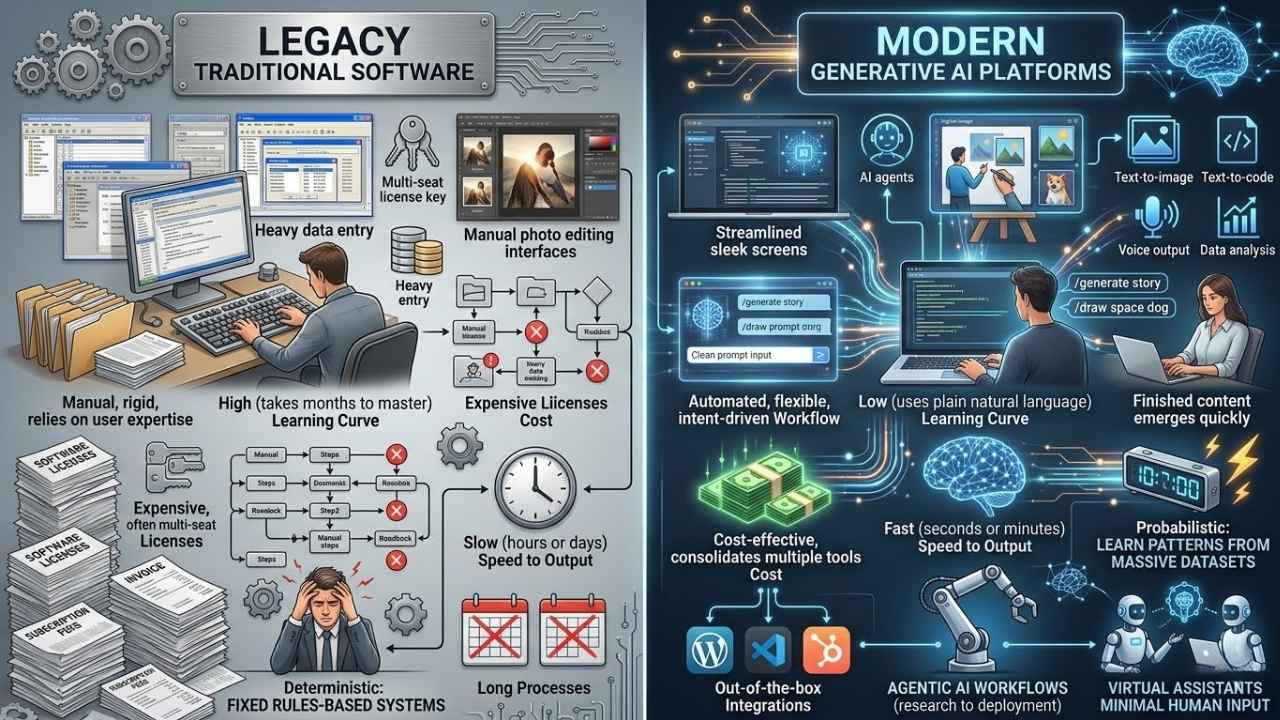
The transition from legacy software to AI platforms is the shift from deterministic software to probabilistic software. Traditional software is deterministic, meaning it requires you to click specific buttons in a specific order to get a specific result. It relies entirely on your manual input and knowledge of the interface. Generative AI is probabilistic. It understands your intent through natural language and does the heavy lifting for you, generating the final output based on your commands.
This shift is overtaking legacy SaaS for three main reasons. First, cost savings are massive. Consolidating five specialized legacy tools into one or two generative AI platforms can save businesses thousands of dollars annually. Second, speed is unmatched. Tasks that used to take days—like rendering video, writing code, or drafting marketing copy—now take minutes. Finally, AI democratizes skills. You no longer need a decade of experience in complex traditional software to produce professional-grade videos, code, or data visualizations.
Here is a quick breakdown of how legacy software compares to modern AI platforms:
| Feature | Legacy Traditional Software | Modern Generative AI Platforms |
| Workflow | Manual, rigid, relies on user expertise | Automated, flexible, intent-driven |
| Learning Curve | High (takes months to master) | Low (uses plain natural language) |
| Cost | Expensive, often multi-seat licenses | Cost-effective, consolidates multiple tools |
| Speed to Output | Slow (hours or days) | Fast (seconds or minutes) |
Top 10 Generative AI Tools Revolutionizing the Workplace
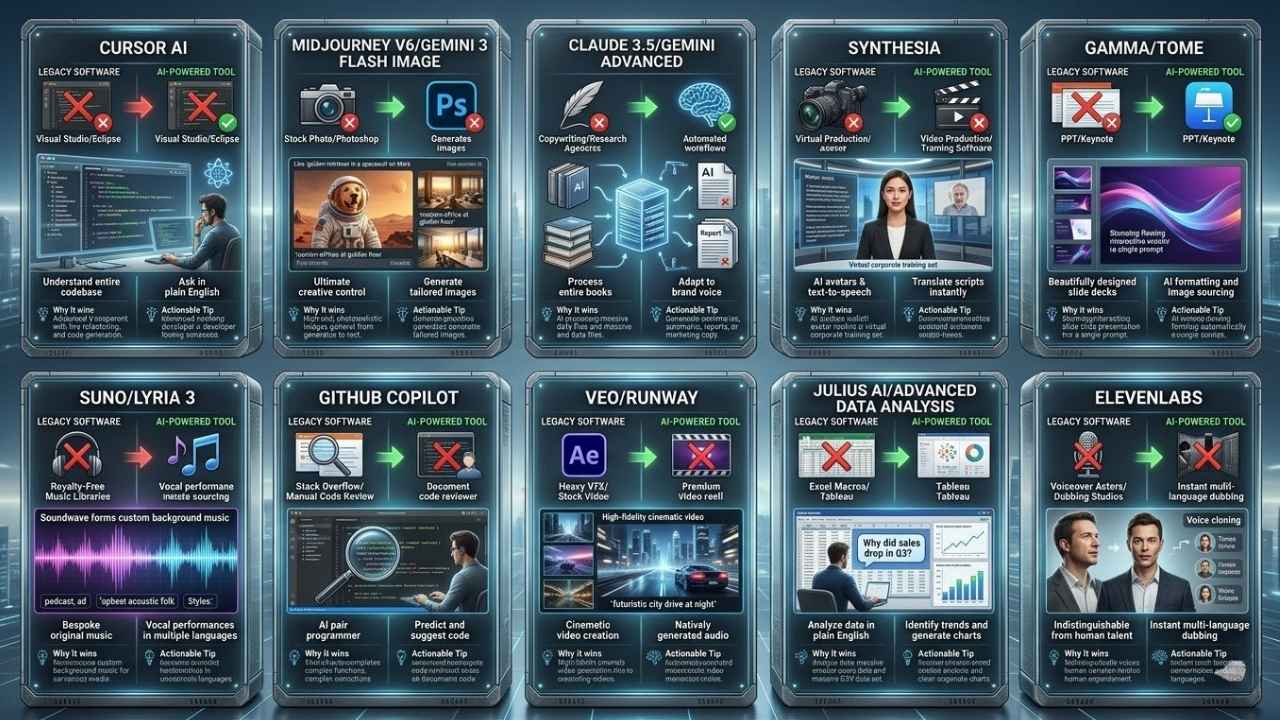
If you are looking for the best generative AI for business workflows, these ten platforms are currently leading the charge. They are proving to be reliable, powerful AI alternatives to some of the most entrenched legacy software on the market.
1. Cursor AI
Replaces: Traditional IDEs like Visual Studio and Eclipse
Cursor AI has fundamentally changed how developers write software. Instead of simply highlighting syntax or offering basic autocomplete, Cursor is an AI-first code editor that understands your entire codebase. You can ask it to refactor large chunks of code, find hidden bugs, or write complex new functions just by typing what you want in plain English.
Why it wins: It bridges the gap between human logic and machine execution. Rather than spending hours hunting through documentation or Stack Overflow, developers can use Cursor to generate workable code instantly. This AI automation tool for the workplace drastically reduces development time and allows engineers to focus on high-level architecture rather than repetitive typing.
- Actionable Tip: If your team is migrating to Cursor, start by using its codebase-indexing feature to allow the AI to learn your specific coding standards and formatting rules before generating new code.
2. Midjourney V6 / Gemini 3 Flash Image
Replaces: Stock Photo Subscriptions and Basic Adobe Photoshop
Sourcing images used to mean paying for expensive stock photo subscriptions or spending hours manipulating layers in Photoshop. Today, AI alternatives to Photoshop and stock libraries dominate the visual space. Midjourney V6 provides highly artistic, photorealistic images from text prompts. Similarly, Google’s Gemini 3 Flash Image (powered by the state-of-the-art Nano Banana 2 model) excels at text-to-image generation, editing, and complex style transfers.
Why it wins: These tools offer ultimate creative control. Instead of searching for the “perfect” stock photo that loosely fits your brand, you can generate an exact image tailored to your exact specifications. Furthermore, tools like Gemini 3 Flash Image allow for multi-image composition, meaning you can easily edit and combine elements without knowing how to use masking or lasso tools.
- Actionable Tip: Stop using generic prompts. For the best results, structure your image prompts by defining the subject, the environment, the lighting, and the camera angle (e.g., “A modern office desk at golden hour, shallow depth of field, cinematic lighting”).
3. Claude 3.5 / Gemini Advanced
Replaces: Basic Copywriting, Research Agencies, and Entry-Level Assistants
Large Language Models (LLMs) have matured into essential business partners. Claude 3.5 and Gemini Advanced are fully capable of handling deep research, drafting comprehensive reports, summarizing massive documents, and writing persuasive marketing copy. Many businesses are realizing they no longer need to outsource basic research or initial draft creation to expensive third-party agencies.
Why it wins: Context window size and reasoning capabilities. These models can process entire books, massive code repositories, or years of financial data in seconds. They understand nuance, can adapt to your specific brand voice, and provide logical, well-structured outputs. They act as tireless, always-on research assistants that cost a fraction of traditional outsourcing.
- Actionable Tip: Build a “Brand Voice” prompt library. Instead of asking the AI to “write a blog post,” feed it three of your best past articles and instruct it to mimic the tone, sentence structure, and vocabulary exactly.
4. Synthesia
Replaces: Corporate Video Production and Training Software
Producing corporate training videos, onboarding materials, or internal communications used to require cameras, lighting, actors, and expensive editing software. Synthesia replaces this entire workflow by allowing you to generate high-quality video using AI avatars and text-to-speech technology. You simply type your script, choose an avatar, and the software generates a polished video.
Why it wins: It eliminates the logistical nightmare of traditional video production. If a company policy changes, you do not need to reshoot a video; you simply update the text script in Synthesia and generate a new version in minutes. This makes it an incredibly powerful tool for scaling global communications, as it can also translate your script into dozens of languages instantly.
- Actionable Tip: Use Synthesia to create a personalized onboarding video for new hires. Simply swap out the new employee’s name and role in the text script to generate a custom welcome video that makes a great first impression.
5. Gamma / Tome
Replaces: Microsoft PowerPoint and Apple Keynote
Creating slide decks is universally recognized as a tedious, time-consuming task. Gamma and Tome are AI platforms that replace legacy presentation software by automatically generating beautifully designed, highly engaging slide decks from a single text prompt or an outline. They handle the formatting, the image sourcing, and the layout alignment for you.
Why it wins: They remove the design bottleneck. Most professionals are not graphic designers, yet they waste hours trying to align text boxes in PowerPoint. Gamma and Tome use AI to instantly apply modern design principles to your content. You focus entirely on the message, and the AI ensures the presentation looks like it was built by a professional design agency.
- Actionable Tip: Write your core arguments in a standard text document first. Paste that raw text into Gamma, and let the AI break it down into digestible, visually appealing slides. You can then tweak the generated slides much faster than starting from a blank page.
6. Suno / Lyria 3
Replaces: Royalty-Free Music Libraries and Basic Audio Production
Finding the right background music for a podcast, ad campaign, or YouTube video usually involves endlessly scrolling through royalty-free music libraries. AI music generators like Suno and Google’s Lyria 3 model are changing this. Lyria 3, for example, is a multimodal model capable of generating highly realistic, professional-grade 30-second tracks. It offers automated lyric writing and realistic vocal performances across multiple languages.
Why it wins: You get bespoke, original music tailored exactly to the mood, tempo, and genre of your project. Instead of settling for a generic track that hundreds of other creators are using, you can generate a custom soundtrack that perfectly matches the emotional beats of your content. (Note: Tracks generated by Lyria 3 include SynthID watermarking for AI identification, ensuring transparency).
- Actionable Tip: Be specific with your emotional descriptors. Instead of prompting for “happy music,” prompt for “upbeat acoustic indie folk with a driving bassline, building to an energetic, triumphant chorus.”
7. GitHub Copilot
Replaces: Endless Stack Overflow Searching and Manual Code Review
While Cursor AI replaces the entire IDE, GitHub Copilot integrates into your existing setup to act as an AI pair programmer. It replaces the traditional developer workflow of writing a few lines of code, hitting a roadblock, and spending 20 minutes searching forums for a solution. Copilot suggests whole lines or blocks of code as you type, directly within your editor.
Why it wins: It keeps developers in the flow state. By predicting what you are trying to write and offering immediate, context-aware suggestions, it drastically reduces mental fatigue. It is also exceptional at writing boilerplate code, unit tests, and documentation, freeing up human developers to focus on complex problem-solving.
- Actionable Tip: Use Copilot to write your unit tests. After writing a complex function, simply write a comment that says // Write unit tests for the above function and let the AI generate the test cases automatically.
8. Veo / Runway
Replaces: Heavy VFX Software and Premium Stock Video Sites
High-end video generation has officially arrived. Google’s Veo and platforms like Runway are replacing the need for expensive stock video footage and complex visual effects software like Adobe After Effects. Veo is a state-of-the-art model that generates high-fidelity videos with natively generated audio. It can extend existing videos, generate content between specific frames, or use reference images to guide the video output.
Why it wins: These tools make cinematic video creation accessible to everyone. If a marketing team needs a five-second clip of a car driving through a futuristic city at night, they no longer need to hire a 3D animator or buy a $200 stock clip. They can generate exactly what they need, with matching audio cues, in a matter of minutes.
- Actionable Tip: When using Veo or Runway, use reference images alongside your text prompts. Providing a strong visual anchor helps the AI understand the exact color grading, style, and composition you want in the final video.
9. Julius AI / Advanced Data Analysis
Replaces: Complex Excel Macros, Tableau, and Basic Data Analysts
Data analysis used to require a deep knowledge of spreadsheet formulas, SQL, or visualization software like Tableau. Julius AI and the Advanced Data Analysis features in leading LLMs allow you to simply upload a massive CSV file and ask questions about your data in plain English. The AI will clean the data, run complex analyses, and generate beautiful charts.
Why it wins: It bridges the gap between raw data and actionable insights for non-technical users. You can ask the AI, “Why did our sales drop in Q3?” and it will cross-reference variables, identify trends, and provide a clear, visual answer. It completely eliminates the need to manually write complex pivot tables or Excel macros.
- Actionable Tip: Always ask the AI to “explain the steps taken to reach this conclusion.” This ensures the AI isn’t hallucinating data and allows you to verify the logic behind its mathematical analysis.
10. ElevenLabs
Replaces: Expensive Voiceover Actors and Dubbing Studios
Recording professional voiceovers used to require renting a quiet studio, buying expensive microphones, and hiring voice actors. ElevenLabs has revolutionized text-to-speech technology, providing voices that breathe, pause, and emote exactly like real humans. It is now the go-to AI alternative for audiobooks, video narration, and podcasting.
Why it wins: The realism is indistinguishable from human talent. Furthermore, ElevenLabs allows for voice cloning and instant dubbing into multiple languages while retaining the original speaker’s tone and emotion. This allows creators and businesses to localize their content for global audiences instantly, without hiring translation and dubbing studios.
- Actionable Tip: To get the most natural read, use punctuation heavily in your text script. Adding em dashes, ellipses, and line breaks forces the AI to naturally pause and change its inflection, resulting in a highly authentic voiceover.
How to Safely Transition from Traditional Software to AI
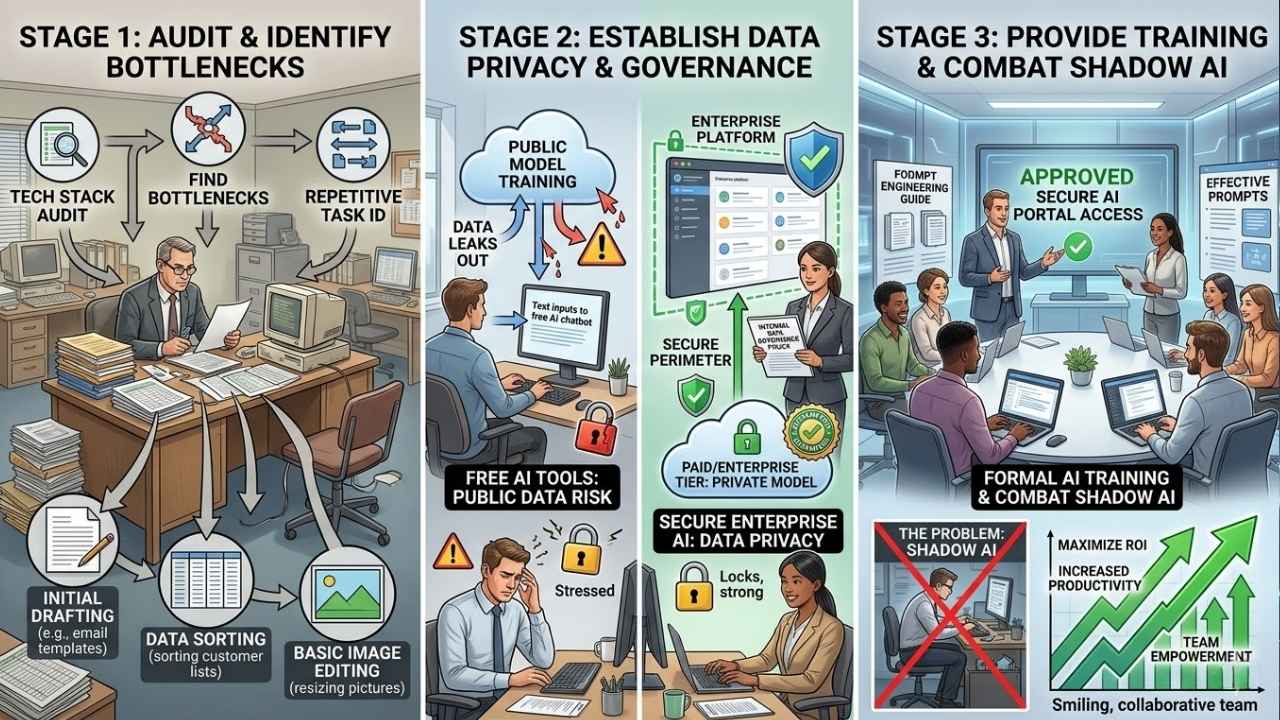
Adopting enterprise AI and moving away from traditional software requires strategy. You cannot simply cancel your legacy subscriptions overnight. Here is how to manage the transition safely:
First, audit your current tech stack to identify bottlenecks. Look for areas where your team spends too much time on repetitive tasks, such as initial drafting, data sorting, or basic image editing. These are your prime targets for AI replacement.
Second, address data privacy immediately. Free AI tools often train their models on user inputs, which is a major security risk for proprietary business data. Always invest in the enterprise or paid tiers of generative AI tools, as these typically guarantee that your data remains private and will not be used to train public models. Establish strict internal data governance policies regarding what information can and cannot be fed into an AI prompt.
Finally, combat “shadow AI”—where employees use unapproved AI tools secretly—by providing formal training. Embrace the technology openly, give your team access to secure, approved platforms, and train them on how to write effective prompts to maximize ROI.
Final Thoughts
The transition to generative AI is the most significant shift in business technology since the move to cloud computing. As we navigate 2026, the businesses that thrive will be those that strategically replace slow, expensive legacy software with agile, intent-driven AI tools.
However, building your AI tech stack does not mean ripping out all your traditional software today. Start small. Choose one area of friction in your business—whether that is code generation with Cursor, visual content creation with Gemini 3 Flash Image, or data analysis with Julius AI—and run a pilot program. Test the output, measure the time saved, and scale up from there. The AI revolution is already here; it is time to let it do the heavy lifting for you.