Are you tired of pouring hours into your website, only to see it stuck on page two or three? It’s incredibly frustrating to watch competitors zoom past you while you wait months for a single keyword to rank. You might be wondering if the old “Parasite SEO” shortcuts still work as we head deeper into 2026.
Here is the reality: This strategy used to be the wild west of ranking. People would lease pages on massive sites and shoot to the top of Google overnight. But things have changed. A few years ago, managing SEO campaigns involved many tactics; rise and fall. But few have been hit as hard as this one. Is it dead? Not exactly, but the rules are completely different now.
I’m going to walk you through exactly what’s working today and what will get your site penalized. Let’s look at the smart way to handle this.
What is Parasite SEO?
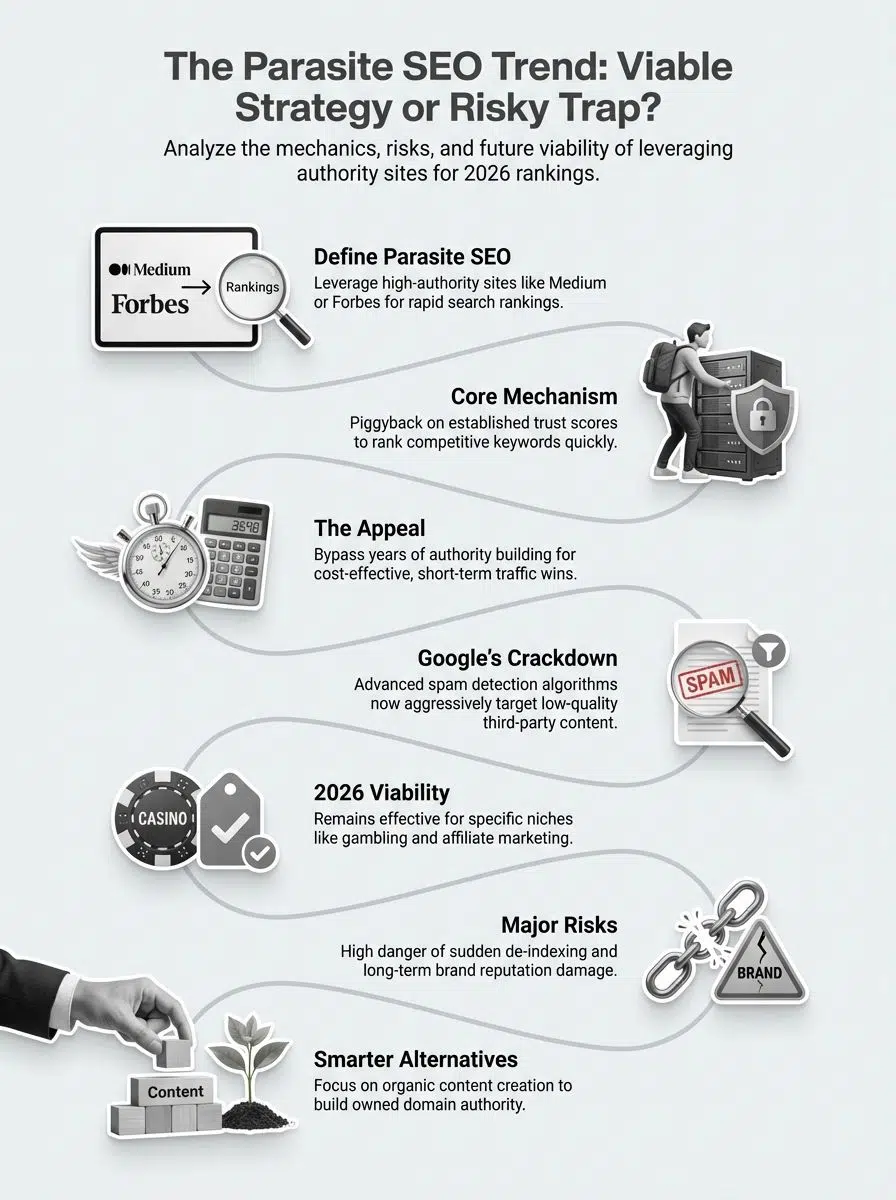
Parasite SEO is the practice of publishing your content on a high-authority third-party website to “borrow” its trust and rank higher than you could on your own. Instead of building your own site’s reputation from scratch, you piggyback on a domain that Google already loves.
For example, you might see a promotional article about “Best Crypto Wallets” posted on a local newspaper’s website or a major publication like Outlook India or The Times of Israel. These large sites have tremendous “Domain Authority” (DA), often scoring 80 or 90+ out of 100.
You don’t have to own the building to hang up your sign.
Because Google trusts the host site, it often indexes and ranks these pages within days. In 2026, we call this “Site Reputation Abuse” when it’s done poorly, but many marketers still use refined versions of it on platforms like LinkedIn Pulse or Medium to generate quick visibility.
How Does Parasite SEO Work?
The process is surprisingly simple, which is why it became so popular. Marketers identify a website with a high “Domain Rating” (DR), a metric you can check using tools like Ahrefs or Semrush. If a site has a DR of 70 or higher, it is a prime target.
You then pay for a “sponsored post” or create a free account to publish your article. Because the host site has millions of backlinks and a strong history, Google’s crawlers assume your new article is trustworthy by association.
The Technical Shortcut
When you publish on a site like LinkedIn, your content sits on a URL structure that looks like linkedin.com/pulse/your-article. Search engines see the root domain “linkedin.com” and assign it high priority.
Common platforms used in 2026 include:
- LinkedIn Articles: Extremely effective for B2B keywords and “best of” lists.
- Reddit: Threads often rank #1 for “review” keywords due to the “Hidden Gems” algorithm update.
- YouTube: Video descriptions and titles rank independently of your website’s authority.
- Sponsored News Sections: Paying for placement on regional news sites (though this is riskier now).
This tactic bypasses the “sandbox” period, the 6 to 12 months a new website usually waits before Google takes it seriously.
Why Has Parasite SEO Gained Popularity?
The appeal is speed. I’ve seen clients wait a year to rank for a term like “best CRM software,” while a Parasite SEO article could hit the top 3 spots in less than a week.
Platforms like Forbes or Business Insider have spent decades building trust. When you post there, you skip the hard work. It is the difference between building a reputation for a new restaurant and just getting a menu item listed at McDonald’s.
In 2025, data showed that user-generated content on sites like Quora and Reddit saw a massive visibility boost. Marketers realized they didn’t need to be technically perfect; they just needed to be on the right platform.
Parasite vs. Traditional SEO Comparison
To give you a clear picture of why businesses choose this path, look at the difference in resources and results:
| Feature | Traditional Organic SEO | Parasite SEO Strategy |
|---|---|---|
| Time to Rank | 4-12 Months | 3-10 Days |
| Primary Cost | Content & Technical Retainers ($2k+/mo) | Single Sponsored Post Fee ($500-$3k) |
| Asset Ownership | You own 100% of the asset | You rent space (High Risk) |
| Longevity | Years of steady traffic | Weeks/Months (until updates hit) |
Cost-effective strategy for short-term results
For a startup with a limited budget, paying $1,500 for a sponsored article on a high-traffic news site is often cheaper than hiring an SEO agency for six months. You get immediate eyeballs on your offer.
However, this is a short-term play. If you stop paying or the platform changes its rules, your traffic disappears instantly.
The Evolution of Parasite SEO
This isn’t a new trick. It started back in 2014 when people realized they could rank YouTube videos on the first page of Google. But the methods have shifted dramatically.
Early adoption and growth
In the early days, it was about quantity. Marketers would spam thousands of posts on free forums. By 2018, it evolved into “leasing subfolders.” This was where a site like a local newspaper would literally rent out a section of their website (e.g., news-site.com/coupons/) to a third-party marketing company.
Key milestones in its development
Understanding the history helps you see where we are going next. Here are the major turning points:

- 2015: Marketers begin mass-posting on Medium and LinkedIn to capture “long-tail” keywords.
- 2019: The rise of “Subfolder Leasing,” where major publishers sold URL space to affiliate marketers.
- March 2024 (The Big Shift): Google announces the “Site reputation abuse” policy. This was the shot across the bow.
- May 2024: Google begins manual enforcement, de-indexing huge sections of famous websites that hosted spammy third-party content.
- 2025: The “Hidden Gems” update prioritizes forum content, making Reddit the new king of Parasite SEO.
Google’s Crackdown on Parasite SEO
If you take one thing away from this guide, let it be this: Google is no longer ignoring this practice. The March 2024 Core Update specifically targeted “Site Reputation Abuse.”
Algorithm updates targeting abuse
Google defined this abuse clearly: it is when third-party pages are published with little or no first-party oversight, and the purpose is to manipulate search rankings. For example, if an educational website suddenly starts publishing reviews about “payday loans,” Google now flags that as spam.
The consequences are severe:
- Manual Actions: A human reviewer at Google can remove your specific pages from search results entirely.
- Algorithmic Demotion: Your content simply stops ranking, regardless of the host site’s power.
- Host Penalties: The host site (like the newspaper) risks its own reputation, so many are now banning these types of sponsored posts.
Impact on ranking strategies
The “lease a subfolder” model is effectively dead for shady niches. You can no longer just buy your way onto a trusted site with low-quality content. Publishers are scared. They are auditing their content and removing anything that looks like “reputation abuse” to protect their own business.
Is Parasite SEO Still Effective in 2026?
Yes, but you have to be smarter. The “churn and burn” spam tactics are gone. The new era is about “Authority Piggybacking” on legitimate social platforms.
Benefits and limitations in today’s environment
The strategy now relies on platforms that are meant for user content. LinkedIn and Reddit are the two biggest winners in 2026. Because these sites are designed for user contributions, posting there doesn’t violate the “Site Reputation Abuse” policy, as long as your content is actually helpful.
Why it works now:
- LinkedIn: Google treats LinkedIn like a verified news source. An article there establishes you as an expert.
- Reddit: Google has a partnership with Reddit (as of 2024) to surface forum discussions. A well-optimized thread can rank #1 for “best [product] reviews”.
Industries where it remains viable
Certain sectors still rely heavily on this because they cannot rank easily on their own sites due to strict regulations (YMYL – Your Money Your Life).
- Crypto & Finance: New projects use Medium and press releases to get visibility.
- SaaS & Software: Companies use “listicle” articles on platforms like G2 or Capterra (and their blogs) to rank for “Best X Software.”
- Supplements & Health: Brands often use sponsored content on lifestyle magazines to bypass the strict E-E-A-T requirements for health websites.
Ethical Considerations of Parasite SEO
Just because you can do it, doesn’t mean you should. There is a reputational cost that comes with shortcuts.

Risks of black hat tactics
If you use automated tools to spam Reddit or buy links on “link farms,” you are playing with fire. I’ve seen brands get blacklisted. Once your brand name is associated with spam, cleaning up that mess takes years.
Long-term impacts on brand reputation
Imagine a potential customer searching for your company and finding a low-quality, spammy article on a random news site. It looks desperate. In 2026, trust is your most valuable currency. Relying on “grey hat” tactics signals that you aren’t confident enough to build your own authority.
Alternatives to Parasite SEO
If you want the benefits of high-authority rankings without the risk of penalties, there are better ways to do it. These methods are sustainable and build your asset, not someone else’s.
Organic SEO strategies
The best investment is always your own domain. By focusing on long-tail keywords that your competitors miss, you can rank even a new site. Tools like AnswerThePublic or AlsoAsked can help you find specific questions real people are asking.
Digital PR and “Connectively”
Instead of paying for a sponsored post, earn a real feature. Use platforms like Connectively (formerly HARO) or Qwoted to connect with journalists. When a reporter from a major site quotes you as an expert, you get the high-authority backlink and the trust, but it’s 100% white-hat and safe.
This builds true “Domain Authority” for your site, meaning eventually, you won’t need to rely on anyone else to rank.
Wrapping Up: Effective or Too Risky?
Parasite SEO isn’t dead in 2026, but it has grown up. The days of spamming cheap articles on news sites are over. Today, it’s about strategically using platforms like LinkedIn and Reddit to build genuine visibility. If you need quick traffic, test these platforms with high-quality content. But don’t build your entire business on rented land.
The smartest play is to use these third-party sites for short-term wins while you invest the real money into your own website. That way, no matter what algorithm update Google rolls out next, your business remains safe.