Do you ever feel like the world is telling you exactly what you can’t do? Maybe you feel boxed in by old rules or expectations. If you have ever felt that way, you need to meet Begum Rokeya. She is not just a name in a history book. She is the friend who stood up when everyone else sat down.
Born into a strict world where girls were often kept invisible, she didn’t just break the rules. She rewrote them.
In this chat, we are going to walk through the incredible life of Begum Rokeya Sakhawat Hossain. From learning to read by candlelight to predicting solar power long before it was real, her story is the spark you might need today.
So grab a cup of tea, and let me introduce you to the woman who changed everything for millions of us.
Key Takeaways
- A Secret Scholar: Born in the village of Pairaband, she taught herself to read English and Bengali late at night with help from her brother, defying her father’s strict ban.
- A Supportive Partnership: She married Khan Bahadur Syed Sakhawat Hossain at 16. He didn’t just support her; he encouraged her to write and set aside money for her school before he passed away in 1909.
- From 5 Students to a Legacy: In 1911, she moved her school to Kolkata with just 8 students. She literally went door-to-door to beg parents to educate their daughters.
- A Sci-Fi Pioneer: Her 1905 story, “Sultana’s Dream,” imagined a world run by women using solar energy and flying cars—decades before these were reality.
- An Enduring Icon: Today, we celebrate Rokeya Day on December 9th, honoring the woman who founded the Anjuman-i-Khawatin-i-Islam to help women in need.

Early Life and Education
Imagine growing up in a home where knowledge was considered dangerous for girls. That was reality for Rokeya Khatun in the late 1800s. While her father, a wealthy landlord in the Rangpur district (now in Bangladesh), was happy to educate his sons, he drew a hard line for his daughters.
He believed girls only needed to know enough Arabic or Persian to read religious texts. Anything else, especially English or Bengali, was off-limits.
What challenges did Begum Rokeya face growing up in a conservative Muslim family?
Life in her family estate was governed by the strictest form of purdah. This wasn’t just about wearing a veil; it meant being physically separated from the outside world. Women were often confined to the inner quarters of the house, unseen by any men outside the immediate family.
The message society sent was clear and harsh.
“The opponents of female education say that women will become unruly… Fie! They call themselves Muslims and yet go against the basic tenet of Islam which gives equal right to education.” — Begum Rokeya
Patriarchy didn’t just set limits; it built walls. Speaking English was seen as a betrayal of culture, and learning Bengali was considered unnecessary for a woman who “should” only manage a household. Yet, Rokeya had a hunger for words that no wall could contain.
How did her siblings help her receive a secret education?
This is where the story gets really heartwarming. Her older brother, Ibrahim Saber, became her co-conspirator. He saw the spark in his little sister and decided to feed it.
They developed a system that feels like something out of a movie:
- The Midnight Lessons: After the household went to sleep, Ibrahim would sneak into her room with a candle.
- The Dual Curriculum: He taught her English prose and poetry, while her sister Karimunnesa helped her master Bengali.
- The Silent Pact: They kept this going for years, terrified of being caught by their father, who would have put a stop to it immediately.
These secret sessions did more than teach her grammar. They gave her a voice. Years later, she dedicated her book Padmarag to her brother, calling him the one who “molded” her mind. That bond proves that even in the toughest times, having just one ally can change your entire path.
Marriage and Support for Her Mission
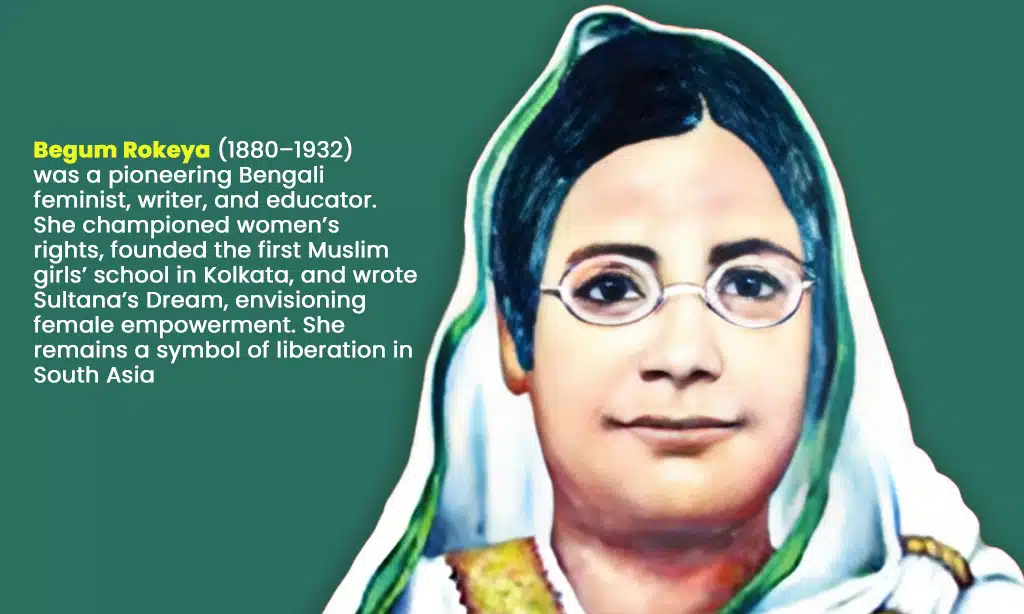
When Rokeya was 16, she married Khan Bahadur Syed Sakhawat Hossain. Now, you might expect this to be the part where her dreams get crushed by a traditional marriage. But life surprised her.
Sakhawat was a Deputy Magistrate in Bhagalpur, Bihar. He was educated in England and had a totally different view of the world.
Who was Sakhawat Hossain and how did he support Begum Rokeya’s mission?
Sakhawat Hossain was her biggest cheerleader. He didn’t just “allow” her to write; he actively pushed her to do it. He saw her writing in a notebook one day and asked what she was doing. When he realized her talent, he urged her to publish her work in Bengali magazines.
He knew the language of the common people in Bengal was Bengali, not the Urdu that the elite preferred. He told her that if she wanted to reach the hearts of women, she had to write in their mother tongue.
Their partnership was cut short tragically. He died in 1909 from diabetes complications. But even in death, he gave her a final gift: 10,000 rupees. He left this specific sum with a clear instruction to start a school for Muslim girls. That money wasn’t just cash; it was a vote of confidence that lasted forever.
Begum Rokeya’s Pioneering Feminist Writings
If you think sci-fi and feminist manifestos are modern inventions, Begum Rokeya is here to prove you wrong. She used her pen like a sword, slicing through superstition and inequality with wit and sharp logic.
Sultana’s Dream: A vision of female empowerment
In 1905, she published a story called Sultana’s Dream. It is mind-blowing to read even today. The story flips the script entirely.
It takes place in “Ladyland,” a utopia where women run the government and men are the ones kept indoors in the “mardana.” But she didn’t stop at social changes; she predicted technology that didn’t exist yet.

| Feature in 1905 Story | Why It Was Ahead of Its Time |
|---|---|
| Solar Heat Cooking | She described using trapped solar rays to cook decades before solar energy was a mainstream concept. |
| Cloud Condensers | The women in the story use balloon-like machines to draw water from clouds for irrigation, preventing drought. |
| Flying Cars | She imagined “air-cars” for efficient transport, a staple of sci-fi that came much later. |
This wasn’t just a fantasy. It was her way of showing that if women were given access to science and education, they wouldn’t just manage; they would innovate and solve the world’s biggest problems.
Padmarag: Advocating for women’s independence
In her novel Padmarag, she created a place called “Tarini Bhavan.” Think of it as a shelter, a school, and a workshop all rolled into one.
The women here weren’t waiting for a savior. They were widows, rejected wives, and victims of poverty who worked together to earn their own living. Rokeya was making a massive point: a woman’s worth isn’t tied to her husband or father. It is tied to her own ability to stand on her own two feet.
Matichur: Essays on women’s rights and education
Matichur is a collection of her essays, and the title translates roughly to “sweetcrumbs.” But don’t let the name fool you; the content is spicy. In essays like “Niriho Bangali” (The Gentle Bengali), she criticizes the passive nature of her society.
She asks uncomfortable questions. She challenges religious leaders who misinterpret texts to keep women down. She argues that a nation can’t rise if half of its population is locked inside. It is raw, honest, and incredibly brave for the early 20th century.
Establishing the Sakhawat Memorial School
Starting a school today is hard. Starting a school for Muslim girls in 1911 was nearly impossible. After her husband died, Rokeya first tried to start the school in Bhagalpur, but family disputes forced her to leave.
She moved to Kolkata (then Calcutta) and started over at 13, Waliullah Lane. She had just 8 students.
How did Begum Rokeya overcome societal opposition to educate Muslim girls?
She faced a mountain of criticism. People spread rumors that she was corrupting girls. Landlords refused to rent to her. But Rokeya was relentless.
She knew she had to compromise to win the bigger war. To convince conservative parents, she promised total privacy. She hired a horse-drawn carriage and covered it with thick curtains so the girls could travel without being seen. She called it the “Purdah Bus.”
This practical move worked. Parents felt their daughters were safe from prying eyes, so they let them go to school. Once the girls were inside, Rokeya taught them everything—English, Bengali, math, and self-confidence.
Today, that tiny initiative is the Sakhawat Memorial Govt. Girls’ High School, one of the most prestigious schools in West Bengal. It stands as brick-and-mortar proof that she won.
Advocacy for Women’s Liberation
Rokeya knew that a school wasn’t enough. She needed a movement. So, in 1916, she founded the Anjuman-i-Khawatin-i-Islam (Islamic Women’s Association). This organization was the engine of her activism.
What campaigns did she lead for education as empowerment?
Through the Anjuman, she created a support system for the most vulnerable women in society. She didn’t just talk theory; she organized practical help.
- Slum Relief: The group went into the poorest areas of Kolkata to provide medical aid and basic supplies to women who had no one else.
- Widow Support: She fought for the financial rights of widows, ensuring they had training to earn a living instead of begging.
- Paying for Education: The association used its funds to pay tuition for girls whose parents couldn’t afford it.
She famously said, “We must wake up! We have slept too long.” Her campaigns were about waking up an entire society to the potential they were wasting by ignoring women.
How did she break norms and promote female self-reliance?
She attacked the root of the problem: the mindset. In her essay Stri Jatir Abanati (The Downfall of Women), she famously compared women’s jewelry to prisoner’s shackles. She asked women, “Why do you love your chains?”
She argued that economic independence was the only key to freedom. As long as women had to ask men for money to buy food or clothes, they would never be free. She pushed for women to take up jobs, become teachers, and run businesses.
This was radical. But she lived it herself, running her school and managing her own affairs, showing everyone that a “Muslim woman” and a “CEO” could be the same person.
Legacy and Lasting Impact
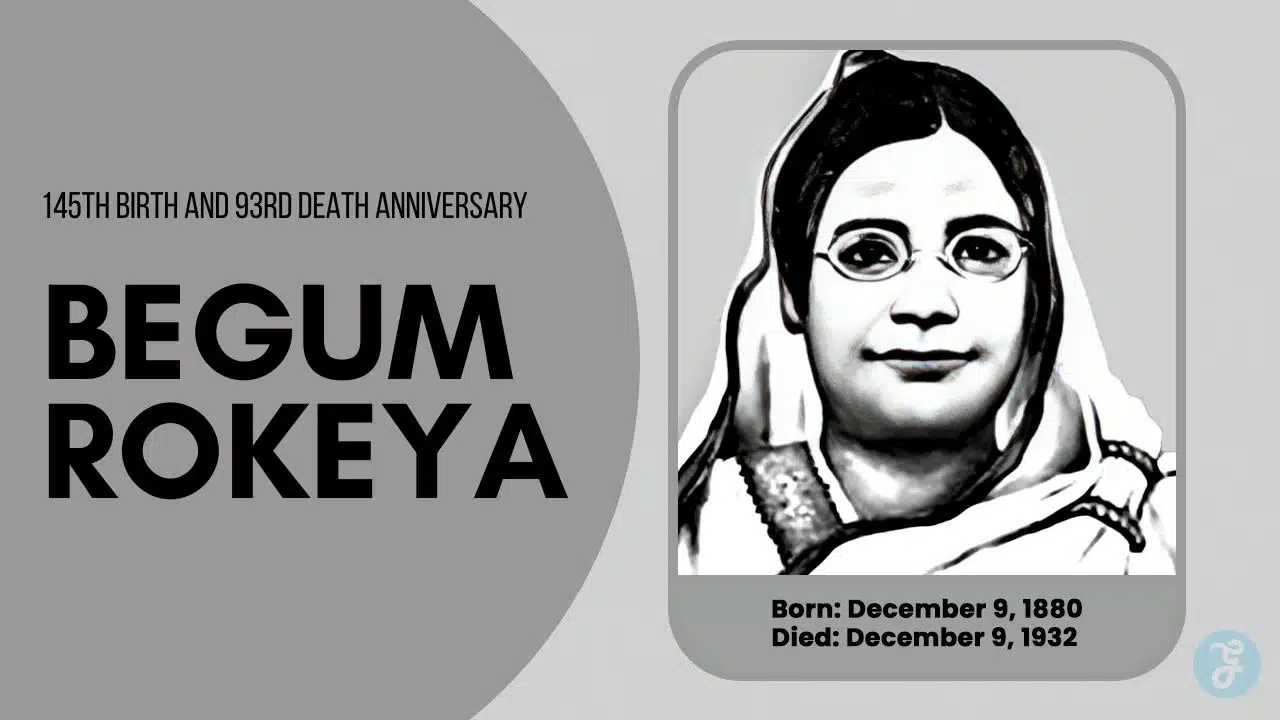
Begum Rokeya passed away on December 9, 1932. It is poetic that she died on the very same date she was born. Her life came full circle, but her impact has only grown.
How did Begum Rokeya influence future feminists and reformers?
Her fingerprints are everywhere in South Asia today. In a 2004 poll by the BBC, she was voted the 6th Greatest Bengali of All Time, ranking alongside legends like Rabindranath Tagore and Mujibur Rahman.
Her legacy is alive in stone and spirit:
- Rokeya Hall: The University of Dhaka named a major female dormitory after her, symbolizing her role as the guardian of female students.
- Rokeya University: A public university in Rangpur, Bangladesh, was established in 2008 in her honor.
- National Recognition: Both Bangladesh and West Bengal observe December 9th as Rokeya Day, celebrating her contributions to literature and rights.
Every time a girl in Bengal picks up a book, or a woman walks to work with her head held high, she is walking on a path paved by Begum Rokeya.
Takeaways
Begum Rokeya’s life wasn’t just a struggle; it was a victory.
She took the heavy stones of tradition and used them to build a foundation for the future. From a secret student in a candlelit room to a pioneer who debated philosophy and ran institutions, she showed us that courage is contagious.
Her story reminds us that no matter how high the walls are, there is always a way to open a window. And sometimes, if you are brave enough, you can even build a door for everyone else to walk through.
FAQs on Begum Rokeya
1. Who was Begum Rokeya and why is she important in history?
Begum Rokeya Sakhawat Hossain was a pioneering social reformer in British India who fought tirelessly for gender equality and the rights of Muslim women.
2. What role did Begum Rokeya play in promoting education for women?
She established the Sakhawat Memorial Girls’ School in 1909 to offer Muslim girls a rare chance at learning outside the strict purdah system. Although the school started in Bhagalpur with just five students, she eventually moved the institution to Calcutta in 1911 to reach a wider student body.
3. How did her literary works influence society?
Her famous 1905 sci-fi story Sultana’s Dream depicted a feminist utopia called Ladyland, radically challenging the patriarchal norms of the time. Writings like this and Padmarag sparked critical conversations about the need for women’s liberation during the Bengali Renaissance.
4. What challenges did she face while working toward women’s liberation?
She faced immense criticism from conservative society and her own family’s strict adherence to customs that physically and mentally isolated women. Despite these hurdles and the limitations of the zamindari lifestyle, she taught herself Bengali and English at night with help from her supportive brother and sister.
5. How do people remember Begum Rokeya today?
We honor her legacy every year on December 9, known as Rokeya Day, to mark the date of both her birth and death. Institutions like the University of Dhaka’s Rokeya Hall and the prestigious Begum Rokeya Padak award keep her memory alive across Bangladesh and West Bengal.
6. Why does Begum Rokeya’s story matter now?
Her life reminds us that the fight for gender equality requires persistent courage and practical action rather than just high hopes. Even today, her emphasis on economic independence remains the most effective tool for women seeking true freedom in society.