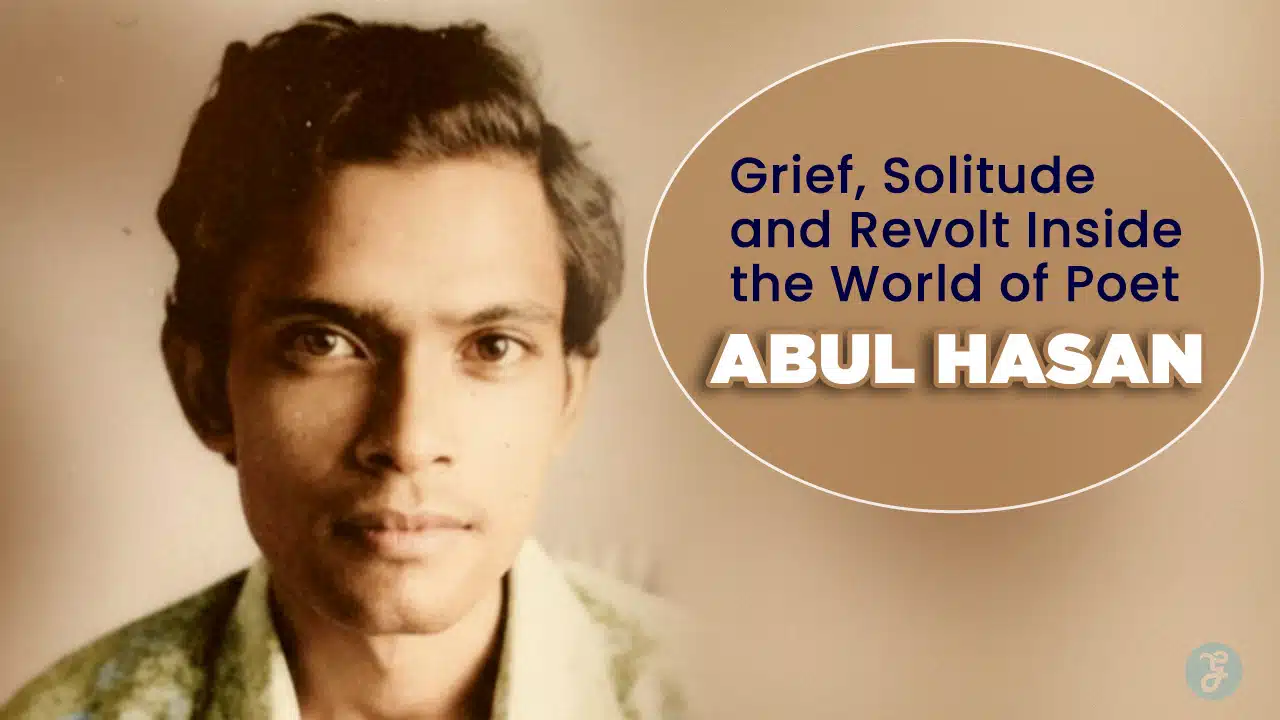
Grief, solitude and revolt sit quietly behind many doors in Dhaka. One of those doors belonged to a young man who never reached his thirtieth birthday. His name was Abul Hasan – a Bangladeshi poet and journalist whose short life left a deep mark on modern Bangla poetry. When we read his poems today, we can feel a restless heart. We see a young man walking alone in the city, smoking, thinking, watching the world fall apart and rebuild itself. His lines speak of love and failure, of hope and revolt, of a quiet but intense desire to resist injustice. They are simple, but heavy. They are emotional, but controlled.
This article takes you inside the world of poet Abul Hasan – his life, his work, his awards and recognition, and his lasting influence.
Who was Abul Hasan? A brief biography
Abul Hasan was born on 4 August 1947 at Barnigram in Tungipara, then a part of Gopalganj under Faridpur District, in what was East Bengal. Born at his maternal uncle’s house. His real name was Abul Hossain Miah; “Abul Hasan” later became his pen name. His paternal home was in Jhanjhania village in Nazirpur, in present-day Pirojpur District. This movement between two homes – one in Tungipara and one in Nazirpur – shaped his early life. It exposed him to both rural calm and the deep emotional ties of extended family. Many readers feel that his early sense of displacement later appears in his poems as separation, exile and longing.
Student life in Dhaka
Like many talented young people of his generation, Hasan moved to Dhaka for higher study. He enrolled at the University of Dhaka to study English literature with honours. But he did not complete his degree. University life was important for him in other ways. In Dhaka he met other writers, activists and journalists. He saw the political unrest of the 1960s. The growing movement for autonomy and then for independence. All of this entered his poems as anger, revolt and a sense of crisis.
From classroom to newsroom: the journalist-poet
In 1969, Abul Hasan joined the news section of the daily Ittefaq, a major Bangladeshi newspaper. After independence, he worked as assistant editor of the weekly Ganabangla (1972–73) and later of Dainik Janapad (1973–74). These jobs brought him close to everyday politics, street life and the language of ordinary people. The newsroom trained him to write quickly, clearly and sharply. This experience shaped his poetic style:
- short, strong lines,
- an urban voice,
- and a mix of lyrical feeling with plain, direct speech.
A life cut short
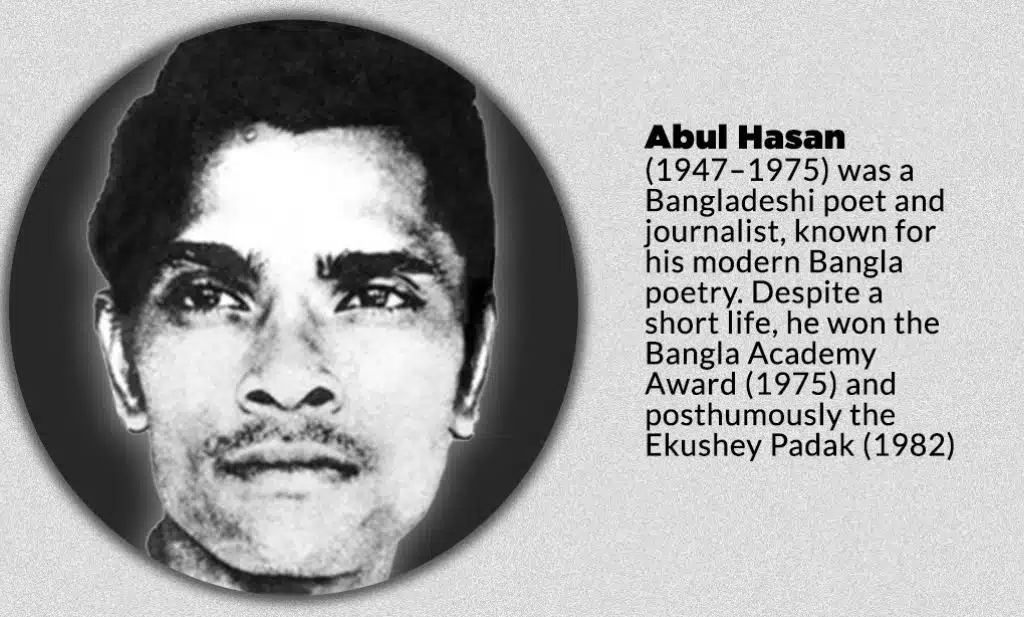
Abul Hasan suffered from serious heart problems.On 26 November 1975, he died at only 28 years old at the then PG Hospital in Dhaka (now Bangabandhu Sheikh Mujib Medical University).
His literary career was very short – roughly a decade. Yet in that time, he created a powerful body of work that changed modern Bangla poetry. This “brief, blazing” life is one reason many critics compare him to poets like Keats, who also died young but left a lasting legacy.
A decade of fire: Abul Hasan’s literary career
Despite his short career, Hasan gained recognition quickly. In 1970, he came first in the Asian Poetry Competition, which brought him wider fame in literary circles. This victory confirmed him as a major new voice in modern Bengali poetry. It also strengthened his confidence to push his own intense style of writing. His poems began to appear more often in magazines and journals.
Major poetry collections
Abul Hasan published three main volumes of poems during his lifetime.
- Raja Jaay Raja Ase (Raja Jay Raja Ase) – 1972
- This collection came out soon after the Liberation War.
- Critics see it as a turning point for him.
- The title, which means “Kings go, kings come”, hints at political change, broken promises and the cycle of power.
- Je Tumi Horon Koro (Ye Tumi Haran Karo) – published in the mid-1970s (often listed as 1974)
- This book deepens his focus on love, loss and emotional theft.
- The title can be read as “You who steal”, suggesting both a lover and a cruel world.
- Prithok Palongko (Prithak Palanka / “Separate Bed”) – 1975
- This is often viewed as a late work filled with a sense of distance, illness and approaching death.
In these books, we see a steady movement from public anger and revolt toward more private grief and solitude.
Yet the political world never disappears; it is always there, just behind the personal emotions.
Posthumous works and continued publication
After his death, more of his writing reached readers.
- The poetic play Ora Kayekjan (“Those Few People”) was published in 1988.
- A collection of short stories, Abul Hasaner Galpa Sanggraha, was published in 1990.
In recent years, Bangladeshi publishers have reissued his three main poetry collections, helping a new generation discover him.
Awards and recognition
Even though Abul Hasan lived only 28 years, he received some of the highest honours in Bangladeshi literature. These awards show how strongly critics and readers valued his work in modern Bangla poetry.
Bangla Academy Literary Award (1975)
In 1975, the same year he died, Abul Hasan received the Bangla Academy Literary Award for poetry.
The Bangla Academy Literary Award is one of the most respected literary prizes in Bangladesh. It is given by the Bangla Academy, the country’s main national institution for language and literature. The award honours writers for outstanding books and long-term contribution to Bangla literature.
By giving this award to Abul Hasan, the Academy recognised:
- the power and originality of his poetic voice,
- his role in shaping modern, urban, emotionally intense Bangla poetry,
- and the importance of his three main collections:
- Raja Jaay Raja Ase,
- Je Tumi Horon Koro,
- Prithok Palongko.
For a poet with only about a decade of active writing, this was a major recognition. It confirmed that his work stood beside much older, more established poets of his time.
Ekushey Padak (1982) – national honour
In 1982, seven years after his death, Abul Hasan received the Ekushey Padak for his contribution to literature.
The Ekushey Padak is the second highest civilian award in Bangladesh. It is given by the Government of Bangladesh to honour major contributions in fields like language, literature, culture, education and social work.
The award is named after 21 February 1952, the date of the Language Movement, which is central to Bangladeshi identity.
Receiving the Ekushey Padak means that a person’s work has become part of the national cultural memory.
For Abul Hasan, this posthumous award shows that:
- his poetry was not only loved by readers but also officially recognised by the state,
- his themes of grief, solitude and revolt were seen as important expressions of the country’s emotional history,
- his name belongs in the same line with other major figures of Bangla literature who also received this medal.
Asian Poetry Competition and wider literary respect
Before these national awards, Abul Hasan had already gained international recognition.
In 1970, he came first in the Asian Poetry Competition, which brought his name to readers and critics outside Bangladesh as well.
This achievement showed that:
- his poetry could speak to a wider Asian audience,
- his themes of loneliness, death and separation had universal appeal,
- and his craft was strong enough to stand in a competitive regional space.
Later, his poems continued to be:
- reprinted in anthologies,
- translated into English and other languages,
- discussed by scholars and featured in articles marking his birth and death anniversaries.
Online libraries and publishers in Bangladesh still reissue his books, and many websites host his poems for new readers.
Grief and solitude in Abul Hasan’s poetry
Many critics describe Abul Hasan’s work as a poetry of grief, self-sacrifice and loneliness. His poems often show a speaker who feels isolated, misunderstood and tired.
Common emotional themes include:
- deep sadness and a sense of inner damage,
- self-abnegation – the feeling of giving up oneself,
- long-term loneliness, even in crowded cities,
- visions of death and separation.
This emotional world may be linked to his poor health, his intense sensitivity and the turbulent time in which he lived.
Examples of grief and solitude
We can see these themes across many of his poems, which are collected on Bangla literary sites.
In many pieces, he writes of:
- waiting for someone who never returns,
- walking alone through a harsh city,
- feeling like a stranger in his own country.
He uses images like:
- night, rain and empty roads,
- closed rooms and separate beds,
- tired bodies and weak hearts.
These simple images carry heavy emotional weight. They show a man who feels different from the world around him, and who sees life as fragile.
The private pain behind the public voice
Abul Hasan was not an openly confessional poet in the Western sense, but many readers feel that his personal pain stands behind his poems. His illness, his short life span, and the pressure of political events could all have added to his sense of anxiety and doom. Yet his grief is never self-pitying. He often turns his private sorrow into a more universal experience.
The lonely speaker in his poems can be read as:
- a sick young man,
- a failed lover,
- or an entire generation that feels betrayed by rulers and systems.
This mix of personal and collective sadness is one reason his poetry still touches readers today.
Revolt, politics and post-liberation Bangladesh
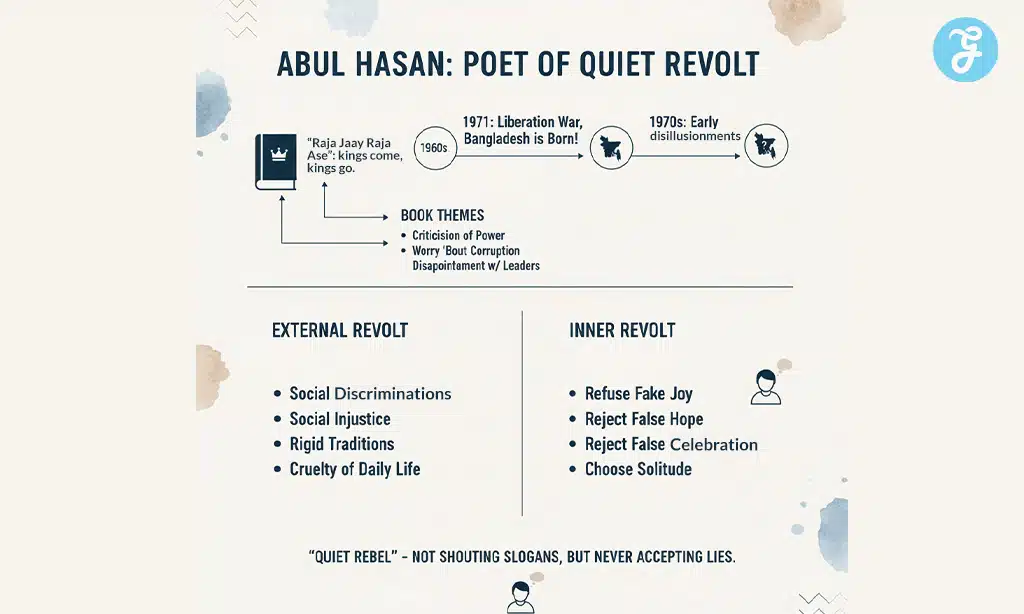
Abul Hasan wrote during one of the most intense periods in South Asian history.
He saw:
- the final years of Pakistani rule,
- the Liberation War of 1971,
- the birth of independent Bangladesh,
- and the early disillusionments that followed.
This context gave his poetry a strong sense of crisis and revolt. His anger was not always loud. Often, it was a quiet but sharp rejection of injustice, hypocrisy and empty slogans.
“Raja Jaay Raja Ase”: kings come, kings go
His first major collection, Raja Jaay Raja Ase, directly suggests political change. The idea that kings come and go reflects the cycle of rulers who promise justice but often fail.
Inside such poems, we find:
- criticism of power,
- worry about corruption and moral decline,
- disappointment with leaders after independence.
Revolt, in his work, is not only against governments. It is also against social injustice, rigid traditions and the cruelty of daily life.
Inner revolt as resistance
Many of his poems show a private, inner revolt.
The speaker may refuse to join fake celebrations.
He may reject false hope offered by rulers or by society.
He may choose solitude instead of dishonest company.
This inner refusal becomes a kind of resistance. By protecting his own honesty and sensitivity, the speaker resists a rough, cruel world. This makes Abul Hasan a “quiet rebel” in modern Bangla poetry – not always shouting slogans, but never accepting lies.
Style, language and innovation in modern Bangla poetry
Abul Hasan’s language is simple but lyrical. He often uses common words and everyday images. But he arranges them in a way that creates strong emotional impact.
His style combines:
- short, clear sentences,
- spoken rhythms, like conversation,
- and sudden moments of high lyricism.
This mix makes his poetry easy to read but hard to forget. Even readers who are not experts in literature can feel the depth of his lines.
Imagery, symbolism and the presence of death
Abul Hasan uses recurring images and symbols to express his ideas:
- Night and darkness – often linked to fear, sickness and despair.
- City streets and rooms – representing isolation in modern urban life.
- Beds, doors, windows – suggesting intimacy, separation and secrecy.
- Rain and rivers – figures of change, purification and sometimes sadness.
Death is never far in his poems.
Sometimes it appears directly, as illness, accident or war.
Sometimes it appears indirectly, as weariness, loss of hope, or the end of a relationship.
How he differs from his contemporaries
The 1960s and 70s saw many important Bangladeshi poets.
Yet Abul Hasan stands out because of:
- his extreme emotional intensity,
- his strong sense of loneliness,
- his mix of journalistic clarity and poetic sensitivity,
- and the fact that he wrote so much in such a short time.
While some poets focused more on ideology or formal experiment, Hasan’s poems feel like immediate cries from a wounded soul living through a broken age.
Where to start: reading Abul Hasan today
If you want to enter Abul Hasan’s world, these are the key works:
- Raja Jaay Raja Ase
- A strong entry point into his political and social vision.
- Shows the theme of revolt against unjust power.
- Je Tumi Horon Koro
- Focuses more on love, emotional loss and inner damage.
- Good for readers who like intimate, romantic but dark poetry.
- Prithok Palongko
- A later collection that reflects illness, isolation and death more strongly.
- The title image of a separate bed captures distance between people and also between life and death.
These books are available in print in Bangladesh and sometimes online through digital libraries and e-book sites.
Poems available online
Many of Abul Hasan’s poems can be read on:
- PoemHunter, which also offers a short biography and a PDF selection.
- Bengali sites such as Bangla Kobita and various e-libraries, which host collections of his work.
These sites are useful starting points for readers outside Bangladesh or those who cannot easily access printed books.
Tips for new readers
Because Abul Hasan writes about grief, solitude and revolt, his poems can feel heavy.
Here are some tips:
- Read slowly.
Take one or two poems at a time. Let the images sink in. - Notice the mood.
Do not rush to “explain” the poem. First, feel the atmosphere – is it sad, angry, calm, or hopeful? - Connect with history.
It helps to read a quick overview of Bangladesh in the 1960s and 70s. Then the political hints become clearer. - Reread.
Many lines reveal new layers on a second or third reading.
By following these steps, you can enjoy his poetry even if you are new to Bangla literature.
Legacy and influence: why Abul Hasan still matters
Scholars and critics agree that Abul Hasan holds an important place in modern Bengali poetry, especially within Bangladesh.
Although he wrote for only about ten years, his name appears in almost every serious discussion of post-1960s Bangla poetry.
Reference works describe him as one of the most talented and sensitive poets of his generation, who gave modern poetry a new emotional depth.
Influence on later poets
His impact can be seen in several ways:
- Emotional honesty- Later Bangladeshi poets felt freer to write about mental pain, loneliness and personal crisis because poets like Abul Hasan had already opened that door.
- Urban melancholy- He helped shape a style where the modern city is not just a backdrop, but a source of sadness and inspiration at the same time.
- Fusion of journalism and poetry-His clear, direct language influenced writers who wanted to combine social awareness with lyrical expression.
His work also continues to inspire readers, not only writers.
Many young people find comfort and recognition in his lines when they feel isolated or disillusioned.
Reading Abul Hasan in the 21st century
We now live in a world of:
- rapid urbanization,
- mental health struggles,
- political unrest,
- and constant social media noise.
In this context, Abul Hasan’s poems feel surprisingly modern.
His grief looks like our own sense of burnout.
His solitude mirrors our loneliness even when we are surrounded by people.
His revolt reflects our frustration with injustice and corruption.
For readers today, especially in Bangladesh and the Bengali-speaking world, Abul Hasan offers:
- language to describe emotional pain,
- a mirror for their own anger and sadness,
- and an example of how a fragile life can still produce powerful art.
why his world still calls us
Abul Hasan’s life was brief, but his presence in modern Bangla poetry is far from small.
He moved from quiet river villages to the noisy streets of Dhaka, from university classrooms to newspaper offices, from hopeful youth to an early death – carrying with him a heart that felt everything too intensely.
In his poems we meet:
- a young man who loved fiercely and suffered quietly,
- a citizen who believed in freedom but refused to worship new “kings”,
- an artist who turned newsroom clarity into lyrical fire,
- and a fragile body that held an extraordinary depth of feeling.
Grief, solitude and revolt – the three forces that run through his work – are not just personal moods.
They are doors that open into the wider experience of a generation, and even into our own time.
When we read Abul Hasan today, we do not just study an important “figure” in Bangla literature; we hear a voice that still speaks to our loneliness, our doubts and our desire for justice.