Ever read a technical update and forget it five minutes later? A strong tech tale fixes that by turning dry facts into a story you can actually follow.
That is the appeal of Tech Tales on Pro-Reed. The format works best when it explains modern technology through people, decisions, mistakes, and outcomes, instead of a pile of disconnected notes.
This page walks you through what makes that style useful, where it still needs work, and how readers can get more value from it.
Key Features of Tech Tales Pro Reed
As of March 2026, Pro-Reed describes itself as a site focused on crypto, tech, and gaming, and its Tech Tales archive already covers subjects like managed AWS visibility, cybersecurity risks, volunteer management software, and digital tools for travel. That range is helpful for readers because it keeps the section broad and approachable, but it also raises the bar for clarity. Every article has to get to the point fast.
What makes Tech Tales Pro Reed stand out is not a secret feature set. It is the editorial choice to use storytelling, plain language, and real-world framing so readers can understand what happened, why it mattered, and what they should do next.
Narrative-driven documentation
A good story-based technical article follows the same path a useful incident review does: what broke, what the team saw, what they tried, and what changed after the fix. In Google SRE guidance, blameless postmortems work best when they include a detailed timeline and action items with an owner and a tracking number. That structure keeps a story from drifting into opinion.
For readers, this matters because context is usually the missing piece. Code tells you what changed. A narrative tells you why the change happened, what trade-offs were made, and which mistake you should avoid repeating.
- Start with the trigger: name the bug, outage, migration, or design decision.
- Show the timeline: readers understand faster when events appear in order.
- End with action items: each lesson should point to a clear next step.
- Keep it blameless: focus on the system, not on shaming one person.
Code-integrated posts and GitHub support
This is where a tech tale becomes practical. GitHub supports fenced code blocks with triple backticks and optional language identifiers for syntax highlighting, which makes examples easier to scan. GitHub also renders Mermaid diagrams in Markdown, pull requests, discussions, wikis, and issues, so a flowchart or sequence diagram can sit right beside the story instead of in a separate file.
That combination is useful for readers because it cuts the gap between explanation and proof. You can read the story, inspect the code, and see the system flow without jumping between tools.
| Element | Why it helps readers | Simple rule |
|---|---|---|
| Syntax-highlighted code | Makes examples readable at a glance | Label each code block with the right language |
| Mermaid diagrams | Turns architecture and timelines into something visual | Use one diagram only when it answers a specific question |
| Pull request comments | Captures review notes on exact lines of code | Keep comments attached to the changed file, not buried in chat |
| CODEOWNERS | Shows who must review sensitive parts of a repo | Store the file in .github, the root, or docs |
GitHub also lets teams require code owner approval before a pull request is merged, and CODEOWNERS files must stay under 3 MB. That is a small detail, but it matters. If ownership rules are too large or too messy, the review workflow breaks down right when the archive starts to grow.
AI-powered tale summarization
AI can help readers skim long technical stories, but it should be the first pass, not the final judge. In the 2025 Stack Overflow Developer Survey, 84% of respondents said they use or plan to use AI tools in development, yet 46% said they do not trust the accuracy of the output. The same survey found that 66% were frustrated by answers that were almost right, which is exactly why human review still matters.
Use AI to shorten the first read. Then verify the code, the dates, and the security claims before you trust the summary.
- Use AI to extract the key lesson, the root problem, and the final fix.
- Have a human check every command, metric, and recommendation.
- Keep the summary short enough to guide the reader, not replace the article.
Real-World Use Cases
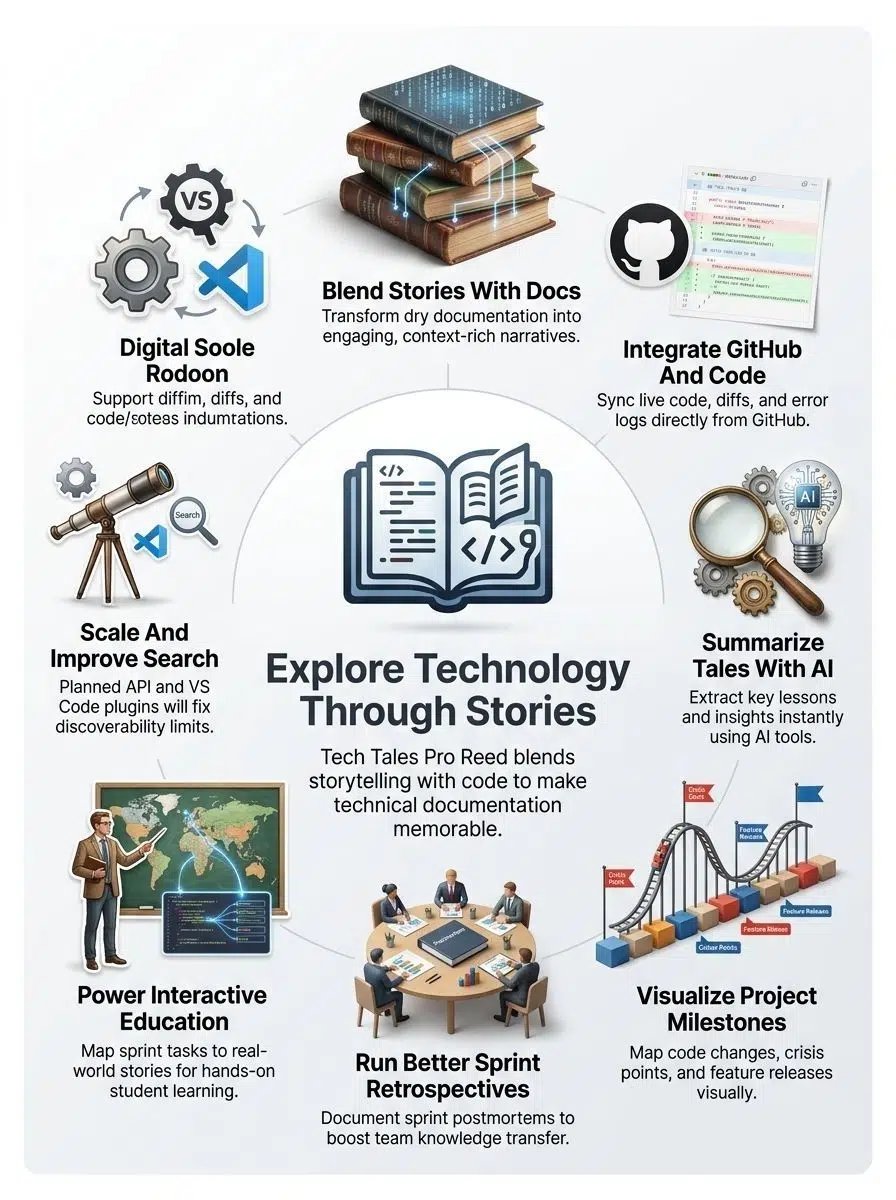
Story-based tech writing is most useful when a reader needs both accuracy and context. That makes Tech Tales a solid fit for team retrospectives, classroom projects, onboarding guides, and reader-friendly explainers on fast-moving topics like AI, cloud computing, and cybersecurity.
Sprint retrospectives for development teams
Retrospectives get better when they read like a clear timeline instead of a vague mood board. The Scrum Guide says the Sprint Retrospective is timeboxed to a maximum of three hours for a one-month sprint, which is a good reminder to keep the review focused. You do not need a long meeting. You need a usable record.
Google SRE’s postmortem guidance pushes the same idea further: action items should have ownership, priority, and a verifiable end state. That is the difference between a feel-good retro and one that actually improves software development.
- Open with the sprint goal: anchor the story before you list problems.
- Build a simple timeline: release, regression, fix, follow-up.
- Use a light prompt: Start, Stop, and Continue still work because they are easy to answer.
- End with one or two tracked actions: if nobody owns the change, it will fade.
This format also helps casual readers inside a company. A new hire can scan one retro and understand the team, the stack, and the pressure points far faster than by reading raw tickets alone.
Interactive learning for educators
Educators can get a lot out of this format because students usually learn technical ideas faster when they have to solve a real problem. A 2014 meta-analysis of 225 STEM studies found that active learning improved student performance and cut failure rates from 32% to 21%. That is a strong reason to make students build, explain, and reflect, instead of just copy notes.
The U.S. Department of Education’s OER STEM project makes the classroom case even stronger. Its guidance describes open educational resources as abundant, customizable, free, and convenient to integrate into lessons. For a teacher, that means a Tech Tales style assignment can combine a short story, a code sample, a diagram, and a reflection without forcing students into expensive tools.
- Use a real scenario: a bug fix, a cloud cost spike, or a smart city sensor failure.
- Ask for evidence: one screenshot, one code block, and one lesson learned.
- Require reflection: students should explain what changed and why.
- Keep peer feedback structured: one strength, one question, and one next step.
That approach turns storytelling into a learning tool, not just a writing exercise. Readers stay engaged because the story leads them to a decision.
Challenges and Areas for Improvement
Tech Tales is easy to like when the archive is small. The harder test comes later, when dozens or hundreds of posts pile up and readers need to find one exact answer fast.
Content discoverability and scalability issues
As of March 2026, the Tech Tales archive on Pro-Reed already spans multiple pages. That is a good sign for freshness, but it also means older pieces can sink fast if titles, tags, and summaries are loose. A story that helped one reader last month should still be easy to retrieve six months later.
GitHub offers a useful model here. Projects can be linked to repositories and teams, then filtered by qualifiers and text search. GitHub code search can search symbols, files, repositories, issues, and pull requests across huge codebases. For Tech Tales, the lesson is simple: a growing library needs better metadata, not just more writing.
| Challenge | Why readers feel it | Best fix |
|---|---|---|
| Weak titles | The story sounds interesting but hides the actual topic | Use problem-first headlines with the system or tool named clearly |
| Loose tagging | Readers cannot filter by stack, role, or difficulty | Tag every post by language, platform, topic, and use case |
| Thin summaries | People do not know if a post is worth opening | Add a two-line plain-English summary at the top |
| Growing archive | Older high-value posts disappear under new ones | Build curated collections for cloud, ai, cybersecurity, and onboarding |
Security and governance gaps
If Tech Tales ever expands from reader-friendly articles into private team knowledge, governance will matter just as much as writing quality. NIST defines least privilege as giving users only the access they need to do assigned tasks. OWASP treats the same principle as a foundation for stronger zero trust security.
That matters because story-rich technical content often contains the exact details attackers want: architecture notes, debugging steps, internal screenshots, or incident timelines. GitHub organization owners can set base permissions for repositories, and organizations using GitHub Enterprise Cloud can create custom repository roles. For a growing knowledge hub, that is the right direction: give broad read access only where it is safe, and keep sensitive reviews behind tighter roles.
- Separate public explainers from internal incident write-ups.
- Require named owners for security-sensitive sections.
- Review screenshots and logs before publishing.
- Use human approval for any AI-generated summary of confidential material.
Right now, Tech Tales on Pro-Reed feels strongest as an editorial section for readers. With sharper filters, tighter governance, and a more consistent review workflow, it could also become a stronger source of tech media for teams that need dependable knowledge, not just quick reads.
Final Words
A memorable tech tale does more than explain a feature. It shows the problem, the decision, and the result in a way readers can reuse.
That is why Tech Tales Pro Reed has real potential. When Pro-Reed pairs clear storytelling with code context, visual structure, and careful human review, readers get a faster, friendlier way to understand modern technology and stay close to the future of tech.