Let’s be honest: the phrase “virtual team building” usually triggers a collective groan. You are sitting in a Zoom call, staring at a grid of silent faces, while a well-meaning manager tries to force everyone to share a “fun fact” about themselves. The silence is deafening. The awkwardness is palpable. You can practically see people checking their emails in another tab.
This is the reality of remote work in 2026. While distributed teams are efficient, they often lack the “water cooler” moments that build genuine trust. But the solution isn’t forced fun or patronizing icebreakers.
The “No Cringe” Rule
To build a remote culture that actually works, we need to filter out the cringe. The activities in this guide were selected based on three strict criteria:
- No Forced Intimacy: No one should have to share personal secrets with colleagues they barely know.
- Low Social Risk: Activities shouldn’t require acting, singing, or high-pressure performance unless the team opts in.
- Genuine Engagement: The focus is on the activity, not on making small talk.
Whether you have 5 minutes before a Scrum meeting or an hour for a quarterly bond, here are 12 team building activities for remote teams that your team will actually thank you for.
The Best Team Building Activities for Remote Teams at a Glance
Short on time? Here are our top picks by category.
| Category | Best For… | Activity Name | Time Needed |
| Speedy | Starting meetings with energy | The Wikipedia Race | 5-10 Mins |
| Chill | Introverted teams | Virtual “Coffee Shop” | 30+ Mins |
| Fun | Competitive groups | GeoGuessr Challenge | 15-20 Mins |
| Deep | Improving workflows | “User Manual to Me” | 45-60 Mins |
Quick & Low-Pressure Activities (Under 15 Mins)
These activities are perfect for “warm-ups.” They are designed to be fast, requiring little to no preparation, and they respect your team’s productivity.
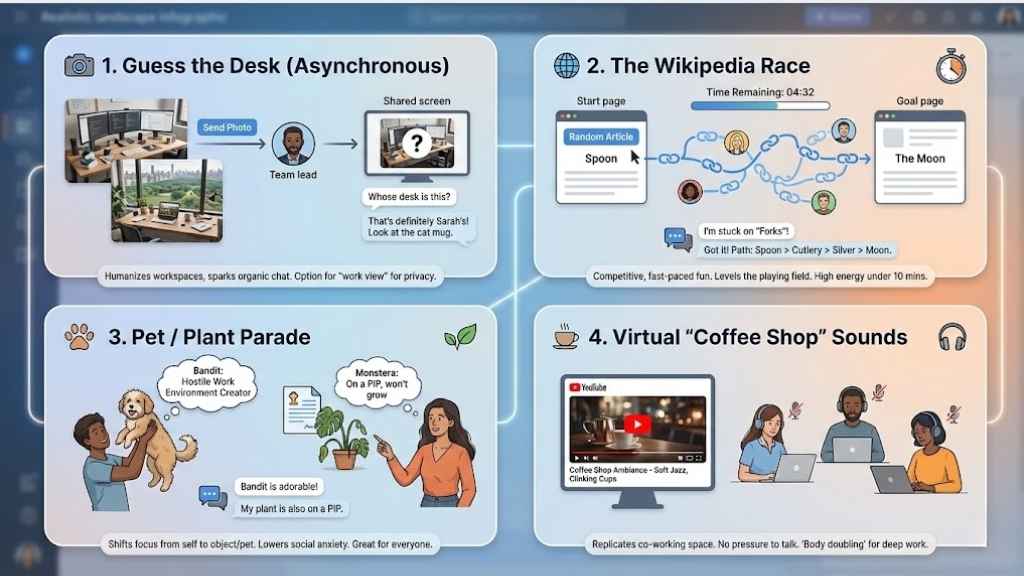
1. “Guess the Desk” (Asynchronous)
One of the biggest barriers in remote work is that we don’t see our colleagues’ environments. We see a blurred background or a virtual green screen. “Guess the Desk” humanizes the workspace without being intrusive.
How it works:
- Ask every team member to take a photo of their desk setup or their “view from the office.”
- Have them send the photos privately to the team lead.
- During your next all-hands or stand-up, share the screen and show the photos one by one.
- The team has to guess whose desk is whose.
Why it’s not cringe:
It satisfies a natural curiosity (voyeurism lite) without putting anyone on the spot to speak. It often sparks organic conversations about gadgets, messy cables, or interesting coffee mugs.
Pro Tip: If some team members are shy about their messy rooms, allow them to submit a photo of their “work view” (e.g., a window or a coffee shop table) instead.
2. The “Wikipedia Race”
This is the gold standard for nerdy, fast-paced fun. It’s competitive, intellectual, and completely removes the need for awkward small talk because everyone is frantically reading.
How it works:
- Send everyone to a random Wikipedia page (use the “Random Article” button).
- Announce a Goal Page (e.g., “The Moon” or “Kevin Bacon”).
- The objective is to get from the random start page to the Goal Page using only the blue internal links within the articles.
- The first person to reach the destination and paste their link path in the chat wins.
Why it works:
It levels the playing field. An intern can beat the CEO. It generates high energy and adrenaline in under 10 minutes.
3. “Pet / Plant Parade” (The Anti-Show & Tell)
Traditional “Show and Tell” feels like kindergarten. But people love talking about their pets or their struggling house plants.
How it works:
Instead of asking people to talk about themselves, ask them to introduce a “co-worker.”
- “This is Bandit. He creates a hostile work environment by barking at the mailman.”
- “This is my Monstera plant. It is currently on a performance improvement plan because it won’t grow new leaves.”
Why it’s not cringe:
It shifts the focus away from the human and onto an external object. This lowers social anxiety significantly. If someone doesn’t have a pet or plant, they can show off a favorite mug or gadget.
4. Virtual “Coffee Shop” Sounds
Sometimes, you don’t need a game. You just need presence. This is essentially “body doubling” for remote teams.
How it works:
- Open a Google Meet or Zoom room.
- Play a “Coffee Shop Ambiance” video from YouTube (soft jazz, clinking cups) via screen share audio.
- The Rule: No one is obligated to talk. You just work together “in silence.”
Why it works:
It replicates the feeling of a co-working space. It’s perfect for deep work sessions where people might want to occasionally unmute to say, “Ugh, this spreadsheet,” and hear a sympathetic laugh, but mostly just want to feel like they aren’t alone.
Gamified & Competitive (Medium Effort)
If you have 30 to 60 minutes, structured play is the best way to bond. A game provides a “third object” to focus on, removing the pressure to carry a conversation.
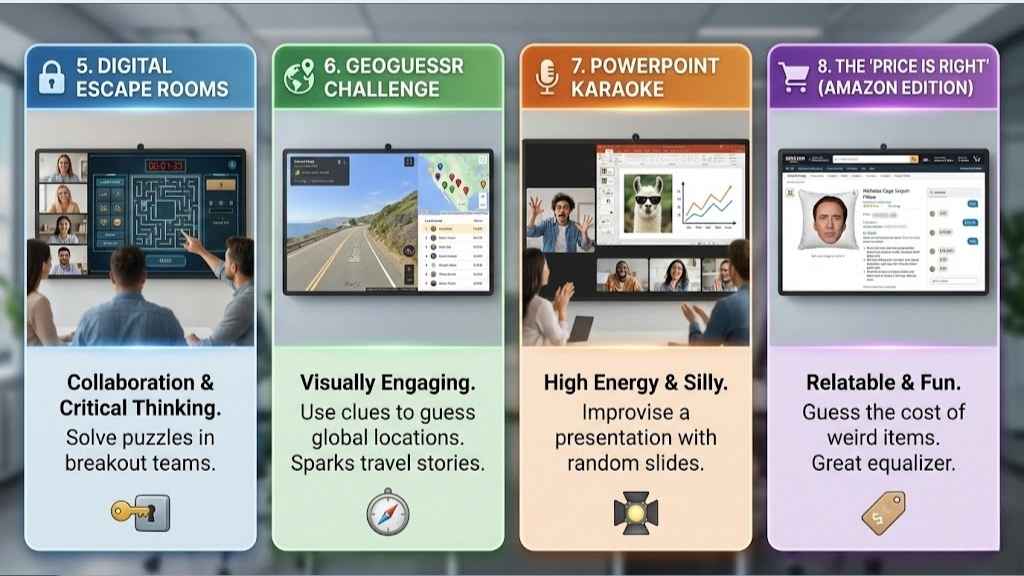
5. Digital Escape Rooms (Curated)
Solving a puzzle requires collaboration, critical thinking, and communication. It reveals team dynamics in a low-stakes environment.
How it works:
You can hire companies to run high-end virtual escape rooms, or you can use free/low-cost web-based ones. The team is split into breakout rooms (4-5 people max). They must share screens and solve riddles to “unlock” the next page.
Why it works:
It forces the team to identify strengths. You will quickly see who is the “leader,” who is the “detail-oriented observer,” and who is the “creative thinker.”
Tools to try: The Grimm Escape (Puzzle Break) or various free Google Form escape rooms.
6. GeoGuessr Challenge
This is one of the most visually engaging remote team building activities available. It drops you onto a random street in the world via Google Maps, and you have to guess where you are.
How it works:
- The host shares their screen with GeoGuessr open (or use the “Party” mode so everyone plays on their own device).
- The team looks for clues: What language is on the sign? Which side of the road are they driving on? What do the trees look like?
- Everyone drops a pin on the world map where they think the location is.
- Points are awarded based on how close the guess was.
Why it works:
It sparks travel stories naturally. “Oh, that looks like Spain, I went there in 2019!” It’s educational and highly addictive.
7. “PowerPoint Karaoke”
Warning: This is high energy. It is best for teams that already know each other a little bit or have a good sense of humor.
How it works:
- Create a slide deck with random, nonsensical images (a picture of a llama, a complex graph, a plate of spaghetti).
- Assign a “Presenter.”
- The Presenter must deliver a serious business presentation on a topic (e.g., “Our Q4 Marketing Strategy”) using those slides, which they have never seen before.
Why it works:
It is intentionally silly. It parodies the corporate world we all live in. Because the task is impossible to do “well,” nobody feels bad about messing up. The failure is the fun part.
8. The “Price is Right” (Amazon Edition)
Everyone shops. Everyone has an opinion on how much things cost. This is a great equalizer.
How it works:
- The host pulls up weird or fancy items on Amazon (e.g., a 5lb bag of gummy bears, a luxury toaster, a Nicholas Cage sequin pillow).
- The host shares the screen, showing the item but hiding the price.
- Team members type their price guess in the chat.
- Closest without going over wins.
Why it works:
It’s relatable. It often leads to hilarious debates about why a toaster should never cost $400.
Culture & Connection (High Impact)
These activities are less about “fun” and more about “understanding.” These are best for quarterly retreats or when a new team is forming.
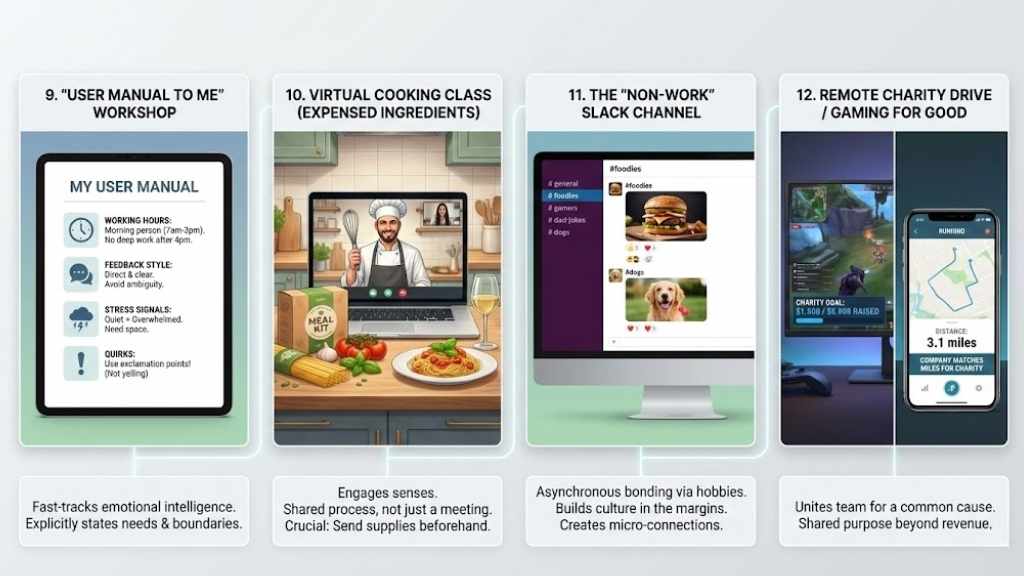
9. A “User Manual to Me” Workshop
This is arguably the most valuable professional exercise a remote team can do. It fast-tracks emotional intelligence.
How it works:
Have every team member fill out a one-page “User Manual” about themselves.
- My working hours: (e.g., “I’m a morning person, don’t expect brilliance after 4 PM.”)
- How I like to receive feedback: (e.g., “Tell me directly, I hate ambiguity.”)
- My stress signals: (e.g., “If I go quiet, I am overwhelmed.”)
- Quirks: (e.g., “I use a lot of exclamation points, I’m not yelling!”)
Why it works:
It removes the guesswork from remote communication. It prevents conflict before it happens by explicitly stating needs and boundaries.
10. Virtual Cooking Class (With Expensed Ingredients)
Eating together is the oldest form of human bonding. In a remote setting, we can’t share a table, but we can share the process.
How it works:
- Choose a simple recipe (e.g., dumplings, pasta, or fancy cocktails).
- Crucial Step: Give employees a stipend or send them a grocery delivery kit beforehand. Do not ask them to buy their own supplies.
- Get a chef (or a talented team member) to lead the class live on Zoom.
Why it works:
It engages the senses—smell, touch, and taste—which are usually absent in digital work. It feels like a “treat” rather than a meeting.
11. The “Non-Work” Slack Channel
Culture isn’t built in a meeting; it’s built in the margins. If you don’t have spaces for casual chat, your culture will die.
How it works:
Create channels specifically designated for hobbies.
- #foodies: Photos of lunch/dinner.
- #gamers: Discussing the latest release.
- #dad-jokes: Purely for bad puns.
- #dogs: Self-explanatory.
Why it works:
It allows asynchronous bonding. People can participate when they have time, removing the pressure of live calls. It creates “micro-connections” throughout the week.
12. Remote Charity Drive / Gaming for Good
Uniting against a common enemy or for a common cause is powerful psychology.
How it works:
Organize a “Gaming for Good” stream where the team plays a game, and the company donates money for every point scored or level beaten. Alternatively, do a remote 5K where everyone tracks their run/walk on Strava, and the company matches the miles with dollars for a charity.
Why it works:
It gives the team a sense of shared purpose that goes beyond revenue and KPIs.
How to Choose an Activity That Won’t Flop
Not every activity works for every team. A group of extroverted sales reps might love PowerPoint Karaoke, while a team of quiet developers might prefer the Wikipedia Race.
Use the “OPT” Framework
- O – Opt-in: Never make participation mandatory. Mandatory fun is an oxymoron. If people are busy, let them work. The people who do show up will bring better energy.
- P – Personality: Read the room. Are they introverts? stick to puzzles and asynchronous games. Are they performers? Try the karaoke or debates.
- T – Time: Don’t drag a 15-minute game into an hour. Always end the activity while people are still having fun, not when they are bored.
Final Thoughts
Building a remote team isn’t about replicating the office—it’s about creating new rituals that fit the medium. The goal of these activities isn’t to force everyone to be best friends. It is to create enough psychological safety that when a work crisis hits, your team feels comfortable reaching out to one another.