When you look at social safety nets around the world, the Sweden universal healthcare model often steals the spotlight. People universally praise the Scandinavian nation for its high standard of living and commitment to equal medical care. From the outside, the system looks almost perfect. You get sick, you go to the doctor, and the government takes care of the bill without any fuss. But the day-to-day reality of medicine in Sweden is a bit more complicated and far more fascinating.
This guide strips away the myths to give you an objective look at how Swedish medical care actually operates. You will learn how the nation balances a decentralised funding system, small out-of-pocket fees, and impressive digital health tools. We will also look at the ongoing struggles the country faces, from frustratingly long waiting lists for surgery to staffing shortages in major hospitals. Whether you plan to relocate or just want to understand how other nations manage wellness, these fifteen points cover everything you need to know.
How Does Sweden’s Universal Healthcare Model Work?
The core foundation of the Sweden universal healthcare model relies on shared responsibility and heavy local funding. Central government guidelines dictate the rules, but local authorities actually manage the clinics and hospitals on the ground. This setup ensures that care reaches every corner of the country, though it demands heavy regional taxation to keep the lights on. The ultimate goal is straightforward and noble: provide care based strictly on medical need, not the size of your bank account.
1. Decentralised Management at Regional Levels
| Feature | Description | Key Fact |
| Management Level | Regional and Municipal | No direct national control over clinics. |
| Regional Councils | 21 governing bodies | They run the hospitals and primary care centres. |
| Municipalities | 290 local bodies | They handle nursing homes and school health. |
| National Role | Broad oversight | The central government only passes foundational laws. |
When you look at how the Sweden universal healthcare model is managed, the most surprising fact is the lack of direct national control. Instead of a single massive government department dictating every hospital shift, the system relies on a highly decentralised structure. The country is split into twenty-one regional councils and two hundred and ninety local municipalities, and these local bodies hold the real operational power. The central government in Stockholm only sets the broad medical guidelines and passes the foundational health laws.
Meanwhile, the regions collect local taxes and manage the daily operations of hospitals, primary care clinics, and psychiatric units. The local municipalities take on the heavy lifting for nursing homes, disability services, and school health programmes. This division of labour allows local leaders to adapt their resources to the specific demographic needs of their own communities. However, it also means that the availability of certain specialised treatments can vary slightly depending on which county you happen to live in.
2. Tax-Funded But Not Entirely Free
| Cost Element | Details | Financial Impact |
| Primary Funding | Regional taxation | Covers roughly 85% of all medical costs. |
| Patient Co-pays | Small out-of-pocket fees | Keeps clinics from being overwhelmed. |
| GP Visit Cost | 150 to 300 SEK | Varies slightly depending on the regional council. |
| Specialist Cost | 300 to 400 SEK | Applied for hospital consultations and ER visits. |
You might assume universal coverage means you never open your wallet at the clinic, but the reality involves a balance of taxes and small fees. The system is heavily subsidised rather than completely free at the point of use. Regional and municipal taxes cover the vast majority of medical expenses, absorbing the massive costs of surgeries and hospital stays. However, patients still pay small out-of-pocket fees when they see a doctor for a routine issue.
A standard primary care visit typically costs between 150 and 300 Swedish Krona, while seeing a specialist or visiting the emergency room might cost up to 400 Krona. These fees act as a minor barrier to keep the clinics from getting swamped with people suffering from simple colds while keeping care highly affordable for the average earner. Unemployed individuals and pensioners also pay these fees, ensuring everyone contributes a small fraction to the daily running costs.
3. The High-Cost Ceiling (Högkostnadsskydd)
| Protection Rule | How It Works | Patient Benefit |
| Consultation Cap | 1400 SEK per year | Prevents ruinous debt from constant doctor visits. |
| Rolling Period | Twelve months | Starts on the day of your first medical purchase. |
| Free Period | After the cap is hit | All standard visits become free until the year ends. |
| Tracking Method | Digital registry | Automatically calculated via your personal ID number. |
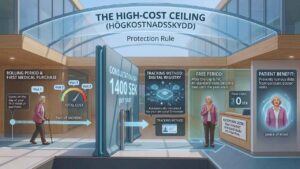
To make sure nobody goes bankrupt from an unexpected illness, the country relies on a brilliant safety net called the high-cost ceiling. In Swedish, they refer to this system as högkostnadsskydd. Once you spend around 1,400 Krona on medical appointments within a single twelve-month window, the government hands you a free pass. Every standard medical visit for the rest of that rolling year becomes completely free of charge.
This ceiling gives incredible peace of mind to people managing chronic conditions, recovering from severe injuries, or dealing with frequent check-ups. The best part is that you do not need to carry a punch card or save your receipts to prove your spending. The entire tracking process is handled digitally through your personal identity number, so the reception desk automatically knows when you have hit your limit and stops charging you.
4. Equality and Access for All Residents
| Patient Group | Entitlement Level | Access Conditions |
| Registered Residents | Full public access | Requires a Swedish personal identity number. |
| EU Citizens | Subsidised access | Requires a valid European Health Insurance Card. |
| Non-EU Tourists | Emergency only | Expected to pay full costs without travel insurance. |
| Undocumented Migrants | Necessary care | Legally entitled to care that cannot be deferred. |
The guiding philosophy driving public clinics in Sweden is strict equality of care. Medical staff prioritise treatments strictly based on urgency and medical need, without any regard for a patient’s social status, background, or income level. If you hold a Swedish personal identity number and are a registered resident, you get full, unquestioned access to the network. Furthermore, hospital emergency rooms will never turn anyone away in a severe crisis.
Even if you are a tourist or a temporary visitor lacking proper insurance paperwork, doctors will stabilise you first and figure out the billing details much later. The law also extends a basic level of human dignity to undocumented migrants, who hold the right to receive medical care that cannot be reasonably deferred. This moral baseline ensures that financial barriers never block someone from receiving life-saving emergency interventions.
Quality of Care and Patient Experience
A public health system proves its worth through the results it produces for everyday people. The medical outcomes under the Sweden universal healthcare model rank among the best globally, thanks to a heavy focus on preventative care and early intervention. Still, the patient experience is not entirely flawless. Strict guarantees about access often crash into the hard reality of overloaded clinics, leading to long waits for non-emergency treatments that test the patience of the public.
5. High Life Expectancy and Health Outcomes
| Health Metric | National Average | Global Standing |
| Life Expectancy | Over 83 years | Among the top ten nations globally. |
| Infant Mortality | Under 2 per 1000 births | Exceptionally low risk for newborns and mothers. |
| Cancer Survival | Above EU average | High success rates due to early screening programmes. |
| Preventative Care | Highly funded | Routine checks catch severe illnesses early. |
The numbers speak for themselves when you look at Swedish medical success over the last few decades. The country consistently posts a life expectancy hovering around 83 years, making it one of the healthiest populations on the planet. Infant mortality rates remain some of the lowest recorded anywhere, reflecting the incredible care given to expectant mothers and newborn babies. When dealing with serious, life-threatening conditions like cardiovascular disease or breast cancer, patient survival rates beat the European average by a wide and comforting margin.
These strong outcomes happen because the regional councils aggressively fund preventative medicine, early cancer screenings, and robust public health awareness campaigns. Doctors focus heavily on treating issues before they escalate into massive emergencies, which ultimately saves the government money and extends the healthy years of the average citizen.
6. The Vårdgaranti (Healthcare Guarantee)
| Timeline Rule | Maximum Wait Time | Target Service |
| 0 Days | Same-day contact | Getting through to a primary care clinic by phone. |
| 7 Days | Within one week | Receiving a medical assessment from a doctor. |
| 90 Days | Three months | Seeing a specialised doctor after a referral. |
| 90 Days | Three months | Starting prescribed surgery or complex treatment. |
Sweden legally promises patients timely care through a strict policy known as the Vårdgaranti, or healthcare guarantee. This guarantee outlines a clear 0-7-90-90 timeline that every regional council strives to meet. Day zero means you should be able to contact a primary care centre the exact same day you try, usually via phone or digital portal. Within seven days, you possess the legal right to a medical assessment by a general practitioner.
If that doctor decides you need a specialist, you should not wait more than 90 days for that specific appointment. Finally, if the specialist schedules you for surgery or a specialised treatment plan, that procedure must commence within 90 days of the diagnosis. If your home region fails to meet these deadlines, you have the right to seek care in another region, and your home council must foot the entire bill, including your travel expenses.
7. Waiting Times: The System’s Biggest Flaw?
| Issue Area | Current Situation | Patient Frustration |
| Elective Surgeries | Often delayed | Operations like hip replacements miss the 90-day mark. |
| Regional Differences | Massive disparities | Rural areas face longer waits than major cities. |
| Post-COVID Backlog | Slow recovery | Hospitals are still clearing pandemic-era queues. |
| Political Impact | Major election topic | Voters consistently demand faster care access. |
While the legal healthcare guarantee sounds perfect on paper, the reality on the ground often falls painfully short of expectations. Long waiting queues represent the most frequent and bitter complaint about the system from the Swedish public. If you suffer a heart attack or a massive trauma, doctors treat you instantly with world-class efficiency. But if you need a hip replacement, a hernia repair, or a routine dermatology check, you might wait several months beyond the promised 90-day window.
Different regions struggle with different backlogs, turning elective surgery wait times into a constant, heated political battleground during every election cycle. The pandemic severely worsened these queues, and many regional councils are still fighting to clear the massive backlog of non-urgent procedures while dealing with incredibly tight annual budgets.
8. Digital Health Integration (1177 Vårdguiden)
| Service Feature | Functionality | User Experience |
| Telephone Triage | 24/7 nurse hotline | Provides immediate home-care advice and clinic routing. |
| Online Portal | Web and app access | Allows users to read symptoms and book appointments. |
| Secure Login | BankID integration | Ensures strict privacy for all medical records. |
| E-Prescriptions | Digital pharmacy link | Doctors send scripts directly to the national database. |
Sweden embraces technology in everyday life, and its health sector fully reflects this digital obsession. The absolute hub of patient interaction is a brilliant national service called 1177 Vårdguiden. If you wake up feeling sick, you do not just walk into a clinic and sit in the waiting room. First, you dial 1177 or log onto their comprehensive website. Registered nurses answer the phones around the clock to assess your symptoms and tell you whether to rest at home, book a standard appointment, or rush to the nearest emergency room.
Online, you use your highly secure BankID to check your blood test results, read your doctor’s journal entries, and renew your routine prescriptions in a matter of seconds. This massive digital infrastructure removes countless hours of administrative waste and keeps the physical waiting rooms completely clear of patients who simply need basic medical advice.
Specialised Care and Additional Services
General practice only covers a fraction of a person’s medical journey throughout their life. The system handles specialised needs through a mix of fully subsidised programmes and distinct separate payment structures. Maternity and paediatric care receive massive government backing, making them incredibly cheap and accessible for growing families. On the flip side, things like adult dental care and prescription drugs follow their own unique rules and pricing models, requiring patients to budget very differently than they do for a standard doctor visit.
9. Mental Health Services in Sweden
| Care Type | Access Route | Current Challenges |
| Mild Depression | Primary care GP | Often treated with medication and basic counselling. |
| Specialised Therapy | Psychologist referral | Covered by the high-cost ceiling but heavily queued. |
| Youth Psychiatry | BUP clinics | Facing severe overload and massive waiting lists. |
| Private Alternatives | Out-of-pocket therapy | Growing rapidly due to the slow public queues. |
Psychological care connects directly to the public welfare system, treating the mind with the same importance as the physical body. When you need mental health support, you usually start by calling your local primary care centre. A general practitioner will evaluate your condition and can prescribe medications or refer you to a public psychologist for cognitive behavioural therapy. Your therapy visits fall under the exact same 1,400 Krona high-cost ceiling as your physical ailments, making mental wellness highly affordable.
Unfortunately, public psychiatric clinics currently face massive operational bottlenecks. Patients often endure grueling, month-long waits just to get an initial evaluation for talk therapy. The youth psychiatric service is particularly strained, pushing many frustrated parents and young adults to find private, fully out-of-pocket therapists simply to get immediate help.
10. Maternity and Childcare (Mödravård and BVC)
| Service Area | Cost to Patient | What Is Included |
| Pregnancy Care | Completely free | Dedicated midwife, ultrasounds, and birthing classes. |
| Hospital Birth | Negligible fee | Covers the delivery room and postnatal recovery stay. |
| Child Check-ups | Completely free | Handled by local BVC clinics until school age. |
| Youth Healthcare | Completely free | Medical and dental care cost nothing until the early 20s. |
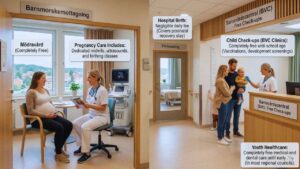
Taking care of mothers and children is an area where Sweden really outshines almost every other nation. Expectant mothers receive entirely free, highly comprehensive maternity care from the moment they discover they are pregnant. They get assigned a dedicated midwife who handles their routine check-ups, blood tests, and emotional support throughout the entire pregnancy. Hospital deliveries cost almost nothing, usually just a tiny daily fee for the food eaten during the postnatal stay.
Once a child is born, the family immediately enrols in the local child health centre, known as the BVC. Here, kids receive free developmental screenings, growth charts, and vaccinations. In most regional councils across the country, all medical and dental care remains absolutely free of charge until a person reaches their early twenties, giving children a perfect healthy start in life.
11. Dental Care Coverage Limits
| Patient Age | Cost Structure | Government Subsidy |
| Children & Youth | Free | Completely covered up to age 23 in most regions. |
| Adults (Routine) | Out-of-pocket | Small annual allowance (300-600 SEK) provided. |
| Adults (Major Work) | High-cost protection | State pays 50% over 3000 SEK, and 85% over 15000 SEK. |
| Private Dentists | Free pricing | Clinics can set their own prices for check-ups. |
You must remember not to expect the government to pay for your root canal once you reach adulthood. Adult dental care operates entirely outside the standard medical safety net and requires a different financial mindset. Once you pass your early twenties, you pay a significant chunk of your dentist bills straight out of your own pocket. The government provides a small annual dental grant, usually between 300 and 600 Krona, designed strictly to encourage yearly preventative cleanings.
There is a separate high-cost protection plan for massively expensive oral surgeries, where the state steps in to cover half the cost once your bill passes 3,000 Krona. Even with these specific subsidies in place, routine dental maintenance hits the wallet much harder than visiting a general practitioner, leading many Swedes to budget carefully for their teeth.
12. Prescription Medications and Subsidies
| Subsidy Tier | Patient Spending | Discount Applied |
| Tier 1 | 0 to 1400 SEK | Patient pays 100% of the medication cost. |
| Tier 2 | 1401 to 2850 SEK | Discount scales up rapidly (50% to 90% covered). |
| Tier 3 | Above 2850 SEK | All covered prescriptions become 100% free. |
| Pharmacy Choice | Any pharmacy | Patients must accept the cheapest generic equivalent. |
Picking up medication at the local pharmacy follows a brilliant stepped discount model designed to protect the chronically ill. Prescription drugs have their own separate high-cost ceiling, which operates completely independent of your doctor visit ceiling. Currently, the system caps your out-of-pocket medication costs at roughly 2,850 Swedish Krona for a full twelve-month period. As you buy necessary medicines throughout the year, the state steps in and covers a progressively larger percentage of the retail price.
Once your personal spending finally hits that absolute cap, all your covered prescriptions become totally free until your yearly period resets. To keep national costs down, the pharmacist is legally required to offer you the cheapest generic version of your prescribed drug, though you can choose to pay the difference if you insist on a specific brand name.
The Role of Private Healthcare in Sweden
For decades, the public system held an absolute, unshakeable monopoly on medical treatment across the country. Over the last twenty years, however, that landscape shifted dramatically. Private providers and insurance companies now interact heavily with the Sweden universal healthcare model, creating a complex hybrid environment. This modern approach helps clear out some of the public waiting lists, but it also sparks heated ideological debates about fairness. Critics worry deeply that introducing private money creates a two-tier system where wealthy citizens can simply buy their way to faster, better care.
13. The Rise of Private Health Insurance
| Insurance Aspect | Detail | Social Consequence |
| Policy Holders | Over 700,000 Swedes | Represents roughly 10% of the working population. |
| Main Buyers | Corporate employers | Offered as a perk to keep key staff healthy and working. |
| Core Benefit | Queue jumping | Allows patients to bypass the 90-day public wait lists. |
| Political Debate | Highly controversial | Challenges the foundational ideal of equal medical access. |
Waiting months for a knee surgery gets old quickly, even in a welfare state. Because of those notorious public surgical queues, the private health insurance market is absolutely booming. Today, well over seven hundred thousand Swedes hold some form of private medical policy. In the vast majority of cases, employers buy these premium plans as a corporate perk to ensure their workers bounce back from illnesses quickly without languishing on a county wait list.
With private insurance in hand, you skip the public line entirely and see a private specialist within a matter of days. This growing trend causes serious political friction across the country, as traditionalists argue fiercely that it breaks the fundamental social democratic promise of equal treatment for absolutely everyone regardless of their job title.
14. Private Clinics vs. Public Hospitals
| Clinic Type | Funding Source | Cost to Patient |
| Publicly Owned | Regional taxes | Standard co-pay (150-300 SEK). |
| Privately Run (Contracted) | Regional taxes | Standard co-pay (150-300 SEK). |
| Fully Private | Cash or Insurance | Full market price paid directly by the patient. |
| Digital Clinics | Regional taxes | Standard co-pay or free, depending on the county rules. |
You need to understand exactly how private doctors fit into the broader public budget. There are hundreds of privately owned health centres, operated by massive corporate medical groups, scattered across the country. However, regional councils contract the vast majority of them to provide standard care. That means you can walk into a shiny private clinic, show your identity number, and still only pay the heavily subsidised 200 Krona fee.
The regional government pays the corporate clinic the rest of the bill. Completely independent clinics do exist outside this network, but they rely strictly on massive cash payments from wealthy patients or direct billing to private insurance providers. This freedom of choice reform, allowing private companies to use public tax money, remains a major topic of debate regarding where taxpayer money should ultimately go.
Future Outlook and Challenges
No welfare state operates in a vacuum, and massive demographic shifts are aggressively testing the absolute limits of the Swedish welfare state. The system requires constant tweaking and massive financial injections to handle modern realities. Rising drug costs, changing population dynamics, and a severely burnt-out medical workforce force lawmakers to make incredibly difficult budget decisions. Keeping the medical quality high without hiking taxes to unbearable levels remains the ultimate tightrope walk for regional governments today.
15. Ageing Population and Staff Shortages
| Major Challenge | Root Cause | Systemic Impact |
| Demographic Shift | High life expectancy | Massive increase in the need for complex geriatric care. |
| Nursing Shortages | Stress and wage disputes | Forces hospitals to temporarily close desperately needed beds. |
| Staffing Agencies | Hospital desperation | Regions spend heavily on expensive temporary freelance nurses. |
| Rural Access | Urban migration | Northern counties struggle to attract permanent specialist doctors. |
Sweden faces a demographic ticking clock that threatens the stability of the entire welfare system. People are living much longer, which is a massive, beautiful victory for public health. However, a much larger elderly population demands incredibly complex, expensive, and long-term medical care. At the exact same time, the medical sector is actively bleeding experienced talent. Nurses and specialised technicians frequently strike or quit the profession entirely due to stressful conditions, heavy administrative workloads, and ongoing salary disputes.
You simply cannot open a hospital ward if you do not have the qualified nurses to staff it safely. Regions are bleeding money hiring expensive temporary agency staff just to keep emergency rooms open. Solving this profound workforce crisis stands out as the single greatest hurdle for the future survival of Swedish medicine.
Final Thoughts
The Sweden universal healthcare model gives us a brilliant masterclass in how a society can choose to take care of its people. By leaning heavily on local management, smart high-cost ceilings, and incredibly efficient digital portals like the 1177 system, the country guarantees that nobody goes bankrupt just because they get sick. The overall medical outcomes are phenomenal, keeping life expectancy incredibly high and infant mortality remarkably low across all social classes.
But it is definitely not an instant-fix utopia. If you live there, you must learn to navigate the notoriously sluggish queues for non-urgent care and understand the strict boundaries of what the state will actually pay for. The rapid rise of private insurance proves that even the best public systems have massive blind spots. By accepting both its brilliant financial safety nets and its frustrating bureaucratic flaws, you get a much clearer, realistic picture of what true universal care looks like in the demanding modern world.
Frequently Asked Questions (FAQs) About Sweden Universal Healthcare Model
1. Are prescription glasses covered by Swedish healthcare?
No, for adults, prescription glasses and contact lenses are entirely out-of-pocket expenses. There are some minor county subsidies available for young children and teenagers who need vision correction, but once you reach adulthood, the public medical system does not cover optometry hardware or standard eye exams.
2. How does sick leave work if I need a long medical recovery?
Sweden has an extremely generous sick leave policy designed to aid recovery. The first day of sickness is an unpaid qualifying day. After that, your employer pays 80% of your salary up to day fourteen. If your doctor declares you unfit to work beyond two weeks, the Swedish Social Insurance Agency takes over and provides continuous sickness benefits.
3. Can I choose my own doctor in Sweden?
Yes. The system provides complete freedom of choice for primary care. You can register at any primary care centre you prefer, whether it is publicly run or privately owned but publicly contracted. You can even choose a specific clinic located entirely outside your home municipality if you are willing to travel there for your appointments.
4. Do expats and international students get healthcare in Sweden?
Yes. If you move to the country to work or study for twelve months or longer, you must register with the Swedish Tax Agency. They will issue you a personal identity number, which instantly grants you the exact same healthcare rights, queue positions, and subsidised costs as a native-born citizen.
5. What happens if I need emergency care while visiting as a tourist?
If you have a severe, life-threatening emergency, you should immediately dial 112. Emergency rooms treat everyone based on medical urgency, regardless of nationality or visa status. If you are an EU citizen carrying a European Health Insurance Card, you pay the standard subsidised fee. Non-EU visitors will eventually be billed for the total, unsubsidised cost of their care, which is why comprehensive travel insurance is highly recommended.