In an industry obsessed with photo-realistic military shooters and 100-hour RPGs, the “AA” stealth genre has largely evaporated. Franchises like Splinter Cell have gone dark, and Dishonored is on indefinite hiatus. Into this vacuum steps Styx, the foul-mouthed, centuries-old goblin assassin, returning for his third outing in Styx: Blades of Greed.
After a frustrating delay that pushed the title out of its initial Fall 2025 window, developer Cyanide Studio and publisher Nacon have finally broken their silence. On January 5, 2026, they dropped a massive 9-minute gameplay trailer alongside a confirmed release date: February 19, 2026.
But this isn’t just a sequel; it is a structural reboot. The footage confirms that Cyanide has abandoned the linear, mission-based structure of Master of Shadows (2014) and Shards of Darkness (2017) in favor of a semi-open world Metroidvania design. This ambitious pivot aims to transform Styx from a niche cult classic into a genre-defining heavyweight. The question is: Can the technical polish of Unreal Engine 5 finally match the studio’s ambition?
Key Takeaways
-
Release Date: February 19, 2026 (PC, PS5, Xbox Series X|S).
-
Genre: Single-Player Open-World Stealth Metroidvania.
-
New Mechanics: Glider, Grappling Hook, Wall Claws.
-
Magic: Dual system (Amber for Stealth, Quartz for Aggression).
-
Controversy: No Co-op mode; Single-player only.
The “Metroidvania” Pivot: A World, Not Just Levels
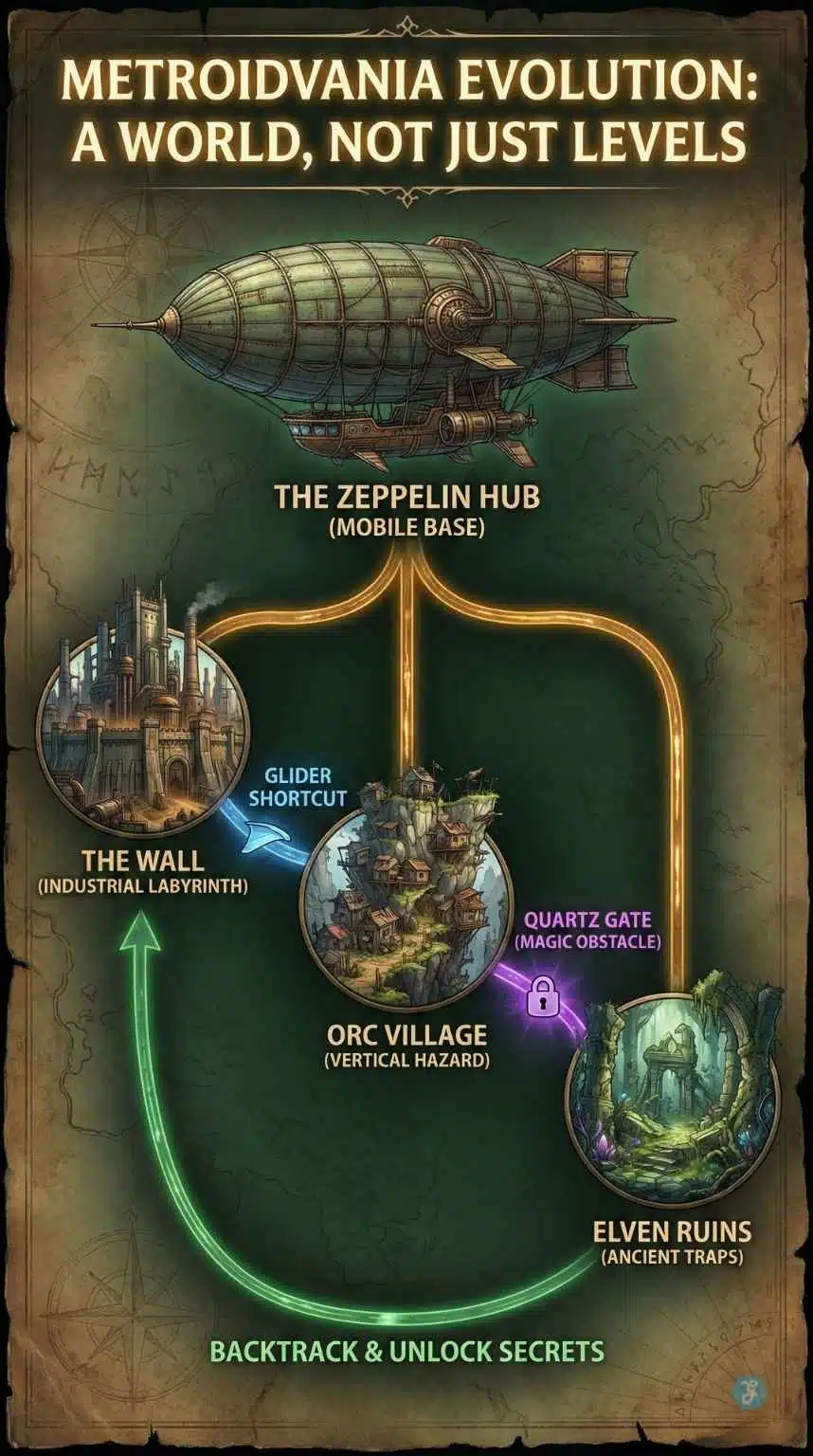
The most radical change in Blades of Greed is the map design. Previous entries were strictly episodic: you entered a level, completed the objective, and extracted. The new game introduces a persistent, interconnected world structure that fundamentally alters the pacing.
The Three Pillars of Iserian
The game world is divided into three massive, distinct biomes that players can travel between freely via their airship hub:
-
The Wall: An industrial, vertical labyrinth of stone and steam, reminiscent of the first game’s Tower of Akenash but on a city-wide scale.
-
The Orc Village: A chaotic, shanty-town structure built into cliff faces, emphasizing perilous jumps and unstable footing.
-
The Elven Ruins: A crumbling, overgrown zone filled with ancient magic and biological traps.
Backtracking with Intent
The trailer showcased the “Metroidvania” loop explicitly. Early in the game, players will encounter “Quartz-Locked Gates” or chasms too wide to cross. These aren’t invisible walls; they are invitations. As Styx acquires new tools (specifically the Glider and Quartz magic), he must return to these early zones.
This design choice solves the “one-and-done” problem of stealth games. By forcing players to re-traverse areas with new powers, the developers encourage mastery of the environment. You aren’t just memorizing a patrol route for five minutes; you are learning the geography of a living world.
Traversal 2.0: The Trinity of Movement
Styx has always been a fragile protagonist—a “glass cannon” without the cannon. In Blades of Greed, his fragility is offset by a completely overhauled movement system designed to keep him off the ground.
1. The Glider (The Scale Enabler)
The headline addition. Styx can now deploy a leather-and-bone glider. This isn’t just for show; it allows for massive horizontal traversal.
-
Tactical Use: The trailer shows Styx leaping from a watchtower, gliding silently over a courtyard of guards, and landing on a distant balcony. This bypasses the “floor is lava” gameplay of old, allowing players to skip entire combat encounters if they have the height advantage.
2. The Grappling Hook (The Pacing Fix)
Previous Styx games suffered from slow, methodical climbing. The new grappling hook allows for rapid vertical ascension.
-
Tactical Use: It serves as a “panic button.” If spotted, Styx can zip into the rafters in seconds, breaking the line of sight immediately. However, it creates noise, balancing its power with risk.
3. Metal Claws (The Feral Touch)
Styx can now craft metal claws that allow him to scale rough surfaces (rock faces, brickwork) that aren’t marked as traditional “climbing zones.” This organic approach to climbing brings the game closer to the freedom of Breath of the Wild than the rigid ledges of Assassin’s Creed.
The “Hardcore” Ecosystem: AI and Bestiary
Cyanide Studio has doubled down on the “Hardcore Stealth” tag. The developer commentary explicitly states: “If you are fighting, you have already failed.” To enforce this, the AI ecosystem has been upgraded to counter Styx’s specific tricks.
The Hierarchy of Threats
-
Inquisition Elites: Heavily armored knights who are immune to frontal assaults and standard dagger kills. The only way to eliminate them is via environmental traps (dropping chandeliers, poisoning food) or Quartz magic.
-
The Roaches: A terrifying new enemy type found in the Elven Ruins. These blind, insectoid creatures rely entirely on sound. If Styx moves too fast (even while invisible), they will screech, alerting every guard in the sector. They act as living proximity alarms.
-
Shaman Orcs: These enemies can “smell” Styx’s amber scent. Invisibility is useless near them, forcing players to rely on verticality and distance rather than magical camouflage.
Adaptive AI
The “alert phases” have been refined. Guards no longer just return to their posts after searching. If an alarm is triggered, patrol routes change permanently for that session. Guards will start checking rafters and looking up—a direct counter to the new vertical gameplay.
Magic & Economy: Amber vs. Quartz
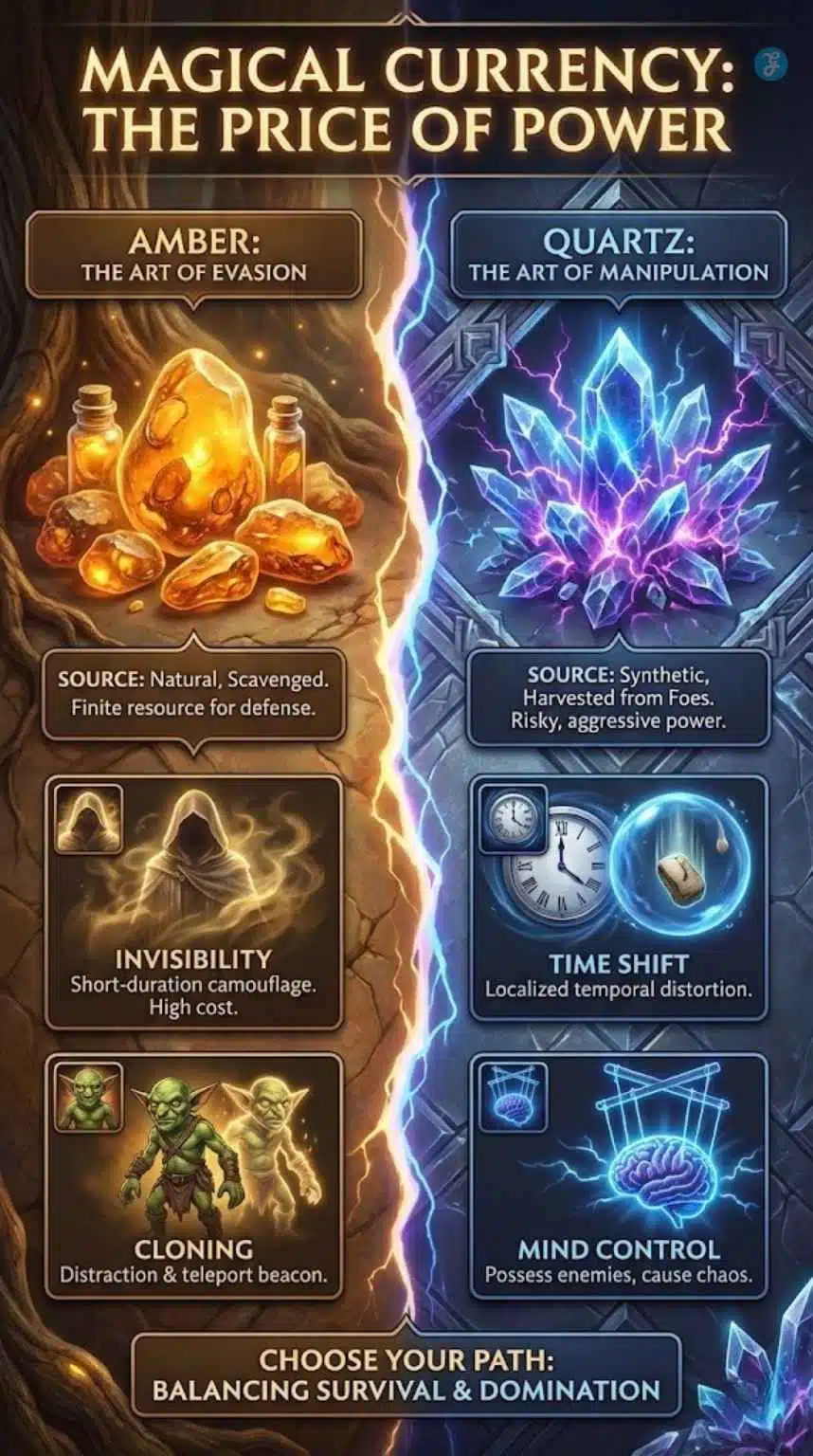
The resource system has evolved into a dual-currency economy, forcing players to specialize.
Amber: The Art of Evasion
Amber remains the defensive resource, fueling the classic powers:
-
Cloning: The signature ability returns. Styx can vomit a clone to distract guards, trigger pressure plates, or act as a teleport beacon.
-
Invisibility: Short-duration camouflage, now balanced by a high mana cost.
Quartz: The Art of Manipulation
This is the new, aggressive magic source introduced in the lore of Blades of Greed.
-
Time Shift: Styx can create a localized “time bubble.” The trailer showed a player slowing down a falling portcullis to slip under it, or slowing a guard’s reaction time to pickpocket a key from his belt mid-stride.
-
Mind Control: A violent evolution of the clone mechanic. Styx can possess an enemy, forcing them to attack their allies or walk off a ledge. This is a “loud” ability that causes chaos, perfect for clearing a room without risking Styx’s skin.
The Zeppelin Hub: From Rat to Captain
Narratively, this game bridges the gap between the Styx spin-offs and the original Of Orcs and Men RPG. It tells the origin story of the “Black Hand” mercenary company.
Styx is no longer a servant. He is the captain of his own Zeppelin. This mobile hub serves as the game’s menu and preparation phase.
-
Crafting Matters: You can no longer find unlimited supplies in the field. Before deploying to a region, players must craft items using resources scavenged from previous runs.
-
The Acid Trap: A new tool highlighted in previews. It dissolves enemy corpses, removing the need to hide bodies.
-
Finite Resources: Items like “Glass Bottles” (for distraction) are now craftable and limited. You can’t just spam noise; you have to budget your distractions.
The Controversy: The Death of Co-op
Perhaps the most divisive revelation from the store listings and press release is the player count. Styx Blades of Greed is a single-player only experience.
-
The Loss: Styx: Shards of Darkness was beloved for its chaotic two-player co-op mode. The removal of this feature has already sparked heated debate on Steam forums and Reddit.
-
The Analysis: This is likely a technical trade-off. Synchronizing a semi-open world with complex physics (gliding, grappling, time-shifting) across two clients is significantly harder than in linear corridors. Cyanide likely chose to focus their budget on the “Metroidvania” complexity rather than networking. While this ensures a tighter, more immersive solo narrative, it alienates a portion of the fanbase who viewed Styx as a “buddy comedy” simulator.
Technical Analysis: Unreal Engine 5 & Audio
Powered by Unreal Engine 5, Styx Blades of Greed delivers a significant visual leap, utilizing volumetric fog and dynamic lighting that actively influence stealth mechanics. This graphical fidelity is paired with an immersive 3D audio landscape, turning every shadow and creaking floorboard into a critical tactical element.
Visuals
The shift to Unreal Engine 5 is palpable. The lighting is no longer just aesthetic; it is mechanical. Volumetric fog in the “Wall” level obscures vision for both Styx and the guards. Dynamic shadows mean Styx’s own shadow can give him away if cast against a lit wall—a detail rarely seen since Splinter Cell: Chaos Theory.
Audio & Tone
The “fourth-wall-breaking” humor returns. Styx (voiced again by the gravelly Saul Jephcott) narrates his own deaths and mocks the player for failing. However, some previewers noted that the “quips” were relentless in the trailer. Balancing the humor with the dark, gritty atmosphere will be key to the game’s tone.
Market Analysis: Editions & Release Window
Launching on February 19, 2026, puts Styx in a favorable window, avoiding the holiday rush of late 2025. Nacon has detailed the monetization strategy:
-
Standard Edition: Base game ($49.99 / €49.99).
-
Quartz Edition: Includes the Greedy Skin Pack (Gold/Crystal skins), Legacy Skin Pack (Classic outfits), and a crafting “Starter Pack.”
-
Pre-order Bonus: The “Master of Shadows” outfit (the original hood from the 2014 game).
This pricing strategy (sub-$60/€60) positions it aggressively against $70 AAA titles, making it an attractive “AA” alternative for early 2026.
Final Words: The Evolution of the Genre Needs?
Styx Blades of Greed is a massive gamble. By abandoning the safe, linear structure of its predecessors for a complex, open-ended Metroidvania design, Cyanide Studio is trying to punch above its weight class.
The removal of co-op is a painful cut, but if the trade-off delivers a rich, interconnected world with the depth of Dishonored and the verticality of Batman: Arkham, it will be a worthy sacrifice. For a genre starved of innovation, the Goblin’s return might just be the most refreshing thing to happen to stealth in years.