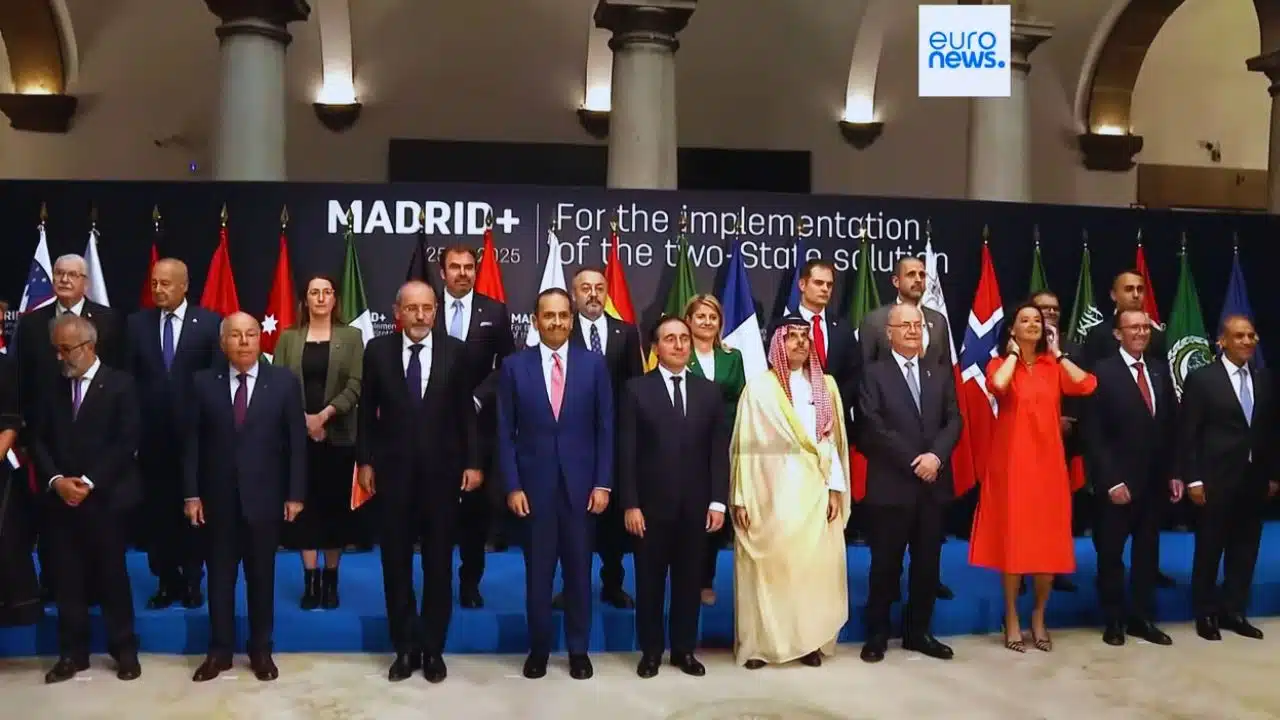
On Sunday, May 26, 2025, Spain brought together a group of top diplomats from more than 20 European and Arab nations in Madrid to discuss urgent solutions to the ongoing Israel-Gaza conflict and to revive efforts for a two-state resolution to the long-standing Israeli-Palestinian crisis.
The meeting—framed as part of the Madrid Group, also referred to as G5+—aimed to build consensus on ending hostilities, ensuring humanitarian access to Gaza, and increasing global recognition for a Palestinian state.
Spain’s Strong Call for Peace: Ending the War in Gaza
Spain’s Minister of Foreign Affairs, José Manuel Albares, opened the meeting with powerful language, declaring Gaza “an open wound in humanity” and calling for immediate global action to stop what he described as “an unjust, cruel, and inhumane war” by Israel in the besieged territory.
“The only interest that all of us who are gathered here today have is to stop this war, to break the blockade on humanitarian aid, and to move definitively toward a two-state solution,” said Albares during a press briefing.
He cautioned that international silence in the face of Israel’s escalating military campaign was akin to complicity and emphasized that the world must act not just as observers, but as responsible stakeholders.
G5+ and the Madrid Group: Who Are They?
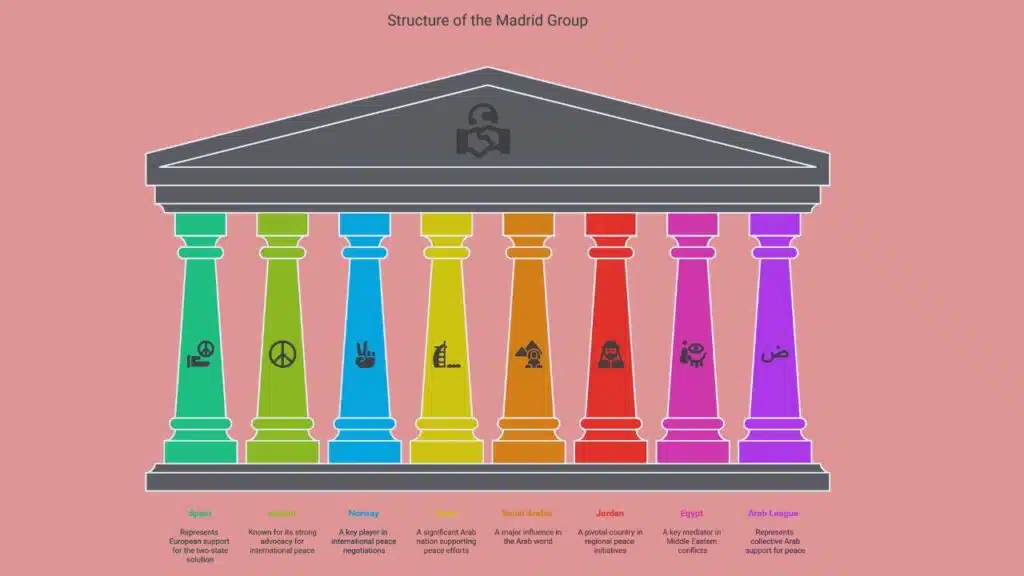
The Madrid Group, informally known as G5+, is a coalition of European and Arab countries that supports the two-state solution framework—an internationally backed proposal that envisions a sovereign State of Palestine existing peacefully alongside Israel.
This Sunday marked the fifth meeting of the group. Attendees included representatives from Spain, Ireland, Norway, Qatar, Saudi Arabia, Jordan, Egypt, and the Arab League, among others. Their objective was clear: to unify international voices around diplomatic pressure and concrete policy measures that could finally advance peace negotiations.
Recognizing Palestine: A Growing Diplomatic Movement
During the summit, Spain officially proposed a “major movement” to recognize the State of Palestine, describing this initiative not as a move against Israel, but as a vital step toward the realization of a peaceful two-state coexistence.
“Spain is going to propose here in Madrid that there should be a major movement to recognize the Palestinian State. Again, not against the State of Israel, but in favor of the two-state solution,” Albares reaffirmed.
In the days leading up to the summit, Spain, Ireland, and Norway had already announced their official recognition of Palestinian statehood. Other countries such as Slovenia and Malta are reportedly considering similar steps. These moves are widely seen as symbolic efforts to reignite diplomatic engagement and signal frustration with the deteriorating situation on the ground in Gaza.
Threat of EU Action Against Israel
One of the most significant policy discussions at the summit involved the possible suspension of the EU-Israel Association Agreement, a key trade and political partnership deal. Spain floated this measure as a way to pressure Israel to halt its military operations in Gaza, which have recently intensified.
Spain also pushed for the tightening of sanctions on individuals or entities found to be obstructing peace efforts, as well as the activation of an arms embargo against Israel by countries that are party to the EU Common Position on arms exports.
These proposals are gaining traction among EU states and human rights advocates, especially as reports from Gaza point to worsening humanitarian conditions and violations of international law.
The Humanitarian Emergency in Gaza
The summit comes at a time of immense humanitarian suffering in Gaza. According to the Gaza Health Ministry, at least 38 Palestinians were killed in a single day due to Israeli airstrikes, and more than 200 others were injured. These numbers do not account for those in northern Gaza, where access to hospitals remains extremely limited due to conflict and road blockades.
The UN and humanitarian organizations have repeatedly warned that famine is imminent, as Israel’s near-total blockade of aid into Gaza has now lasted almost three months. Food, clean water, medicine, and fuel are all in critically short supply.
“We must end the humanitarian disaster,” said Albares, urging countries to take bold political action rather than merely issuing statements of concern.
A Shift in European and Arab Consensus
Beyond Spain, several other countries voiced similar urgency and commitment:
- Norway reiterated its recognition of Palestine and urged other European nations to follow suit.
- Qatar and Saudi Arabia emphasized their willingness to support post-conflict reconstruction if a ceasefire and political roadmap could be achieved.
- Egypt and Jordan, two countries that share borders with Gaza, warned that the conflict could spiral into a regional crisis unless a diplomatic resolution was reached soon.
These declarations reflect an emerging consensus among European and Arab states that the time has come for concrete international steps to end the conflict and move beyond failed negotiations.
Role of the United States and Upcoming UN Summit
The Madrid summit also served as a precursor to a high-level UN conference on the two-state solution scheduled for mid-June in New York, to be co-hosted by France and Saudi Arabia.
Palestinian Prime Minister Mohammad Mustafa expressed hope that U.S. President Donald Trump would attend the New York conference, saying:
“We would like to see the United States engaged as much as possible. Their recent efforts in the Gaza ceasefire process are appreciated, but we hope for deeper and more positive engagement that can bring stability to the region.”
The Biden administration has remained cautious about directly endorsing recognition of Palestinian statehood but has urged Israel to scale down its military activity and avoid civilian casualties.
A Defining Moment for Global Diplomacy
Sunday’s Madrid meeting reflects a growing shift in international diplomacy—from passive observation to active intervention.
Spain’s leadership in organizing the summit, its push for Palestinian recognition, and its call for stronger EU action against Israeli military operations mark a pivotal moment. With the UN conference approaching and global attention fixed on the crisis, the outcome of these diplomatic efforts could shape the future of Middle East peace negotiations.
The world watches as the international community decides whether it will merely speak of peace or finally act to bring it closer.
The Information is Collected from Euronews and MSN.