You know the feeling. You hop on a Monday morning Zoom call, expecting the usual banter about weekends, sports, or the latest Netflix binge. Instead, you get silence. Cameras are turned off. Responses are monosyllabic. The energy in the “room” feels heavy, like everyone is wading through molasses to get a simple sentence out.
Your first instinct might be to push harder—to rally the troops with a high-energy pep talk about Q3 goals or remind them of the looming deadlines. But if your team is suffering from burnout, a pep talk is the last thing they need. In fact, it might be the spark that burns the whole house down.
Burnout isn’t just “having a bad week” or needing a long weekend. It is a slow, creeping erosion of engagement that often goes unnoticed until a top performer hands in their resignation letter, leaving you shocked. The data for 2025 is sobering and demands attention: according to recent reports from major HR firms like DHR Global, nearly 82% of workers now report feeling burned out, with managers often hit the hardest. The World Health Organization (WHO) classifies it not as a medical condition, but as an “occupational phenomenon.” Translation? It’s not their fault; it’s a workplace injury caused by chronic, unmanaged stress.
In this comprehensive guide, we’ll move beyond the obvious indicators—like exhaustion—to uncover the subtle, often invisible signs of employee burnout that you might be missing right now. Then, we’ll look at a practical, human-first framework to fix it before you lose your best talent to the competition.
Why Your Team Is Really Burning Out (It’s Not Just “Too Much Work”)
We tend to think burnout comes simply from working 80-hour weeks. While workload is a massive factor, it is rarely the sole cause. If you want to fix the problem, you have to understand the root mechanics of why it happens. It usually boils down to structural failures in how work is designed and managed. It’s about the nature of the work, not just the volume. When humans feel trapped, unseen, or out of control, their biological stress response stays permanently switched “on,” leading to a crash.
The “Always-On” Trap
The boundaries between “work” and “life” have dissolved, perhaps permanently. In our hybrid world, we are seeing a damaging phenomenon called “Digital Presenteeism.” This is the intense pressure employees feel to show a green “Active” dot on Slack or Teams, even when they aren’t working productively. They answer emails at 9 PM not because it’s urgent, but because they are terrified of looking like they aren’t working. It creates a state of hyper-vigilance where the brain never truly rests. Microsoft data has shown double-digit spikes in meetings scheduled after hours—a clear signal that for many, the workday has lost its “off” switch, leaving the brain in a constant state of low-grade panic.
The Control Gap
Burnout thrives in a specific, toxic environment: High Responsibility, Low Authority. Imagine being held responsible for hitting a massive sales quota, but having zero say in the marketing budget, the pricing strategy, or the product roadmap. That gap creates a profound sense of helplessness. When people feel like passengers in their own careers rather than drivers, stress transforms into burnout. Humans need agency; when we are stripped of our ability to influence outcomes, we stop caring about the results because the emotional cost of caring becomes too high.
Lack of Recognition & Reward
This isn’t just about salary, though fair pay is the baseline. It’s about the “Effort-Reward Imbalance.” When a team member pulls a miracle to save a client account—working late, skipping lunch, managing crisis calls—and gets nothing but a generic “thanks” and more work piled on top, their brain registers it as a threat. The effort was high, but the reward (emotional validation, public praise, or financial bonus) was low. Over time, this imbalance breeds deep cynicism. They start to ask, “Why am I doing this?” and when they can’t find an answer, they check out.
| Cause | What It Looks Like in Daily Work | Why It Burns People Out |
| Digital Presenteeism | Answering Slack messages at 10 PM just to appear “online.” | Prevents cognitive recovery; the brain never “powers down” or enters rest mode. |
| The Control Gap | Responsibility for outcomes without the authority to make decisions. | Creates anxiety and a feeling of helplessness/futility. |
| Effort-Reward Imbalance | High output met with low recognition, stagnated pay, or generic praise. | Breaks the psychological contract of work; leads to resentment and disengagement. |
| Value Mismatch | Working on projects that feel ethically compromising or pointless. | Creates cognitive dissonance; the work feels “meaningless.” |
The 6 Warning Signs of Employee Burnout
If you are waiting for your employees to come to you and say, “Boss, I’m burned out,” you will wait too long. High achievers often hide their struggles because they fear looking weak, or they believe that if they just push a little harder, they will break through the wall. As a leader, you need to play detective. You need to look for the subtle behavioral shifts that signal a crash is coming. Here are the signs of employee burnout that often fly under the radar until it’s too late.
1. The “Star Performer” Slump (Decreased Productivity)

This is often the first and most confusing sign. Your most reliable employee—the one who never misses a deadline and produces flawless work—suddenly starts dropping the ball. You see typos in their client presentations. They forget to CC you on important emails. They miss a deadline they would usually hit with days to spare. This isn’t laziness, and it isn’t a sudden lack of skill. Burnout physically impacts the prefrontal cortex, the part of the brain responsible for executive function, memory, and focus. They literally cannot focus. It’s like trying to run a high-performance software on a computer that is overheating; the system just lags.
| Behavior | Healthy “Star Performer” | Burned Out “Star Performer” |
| Deadlines | Submits work early or on time. | Misses deadlines or asks for last-minute extensions. |
| Attention to Detail | Spotless work; catches others’ errors. | Frequent typos, calculation errors, or formatting issues. |
| Innovation | Suggests new ideas or improvements. | Sticks strictly to the basics; “autopilot” mode. |
| Response Time | Prompt and clear communication. | Delayed responses; forgets to reply to emails entirely. |
2. Cynicism and Detachment (The Attitude Shift)
Watch out for the “Quiet Quitting” behaviors or a sudden shift in personality. This might look like a team member who used to lead brainstorming sessions suddenly sitting silently in the back, offering no ideas. Or perhaps they have developed a dark, biting sense of humor, making sarcastic jokes about company leadership, new initiatives, or client demands. This cynicism is a defense mechanism. Their brain is trying to distance itself from the source of the pain (the job) to protect their ego. By pretending they don’t care, they are trying to stop the work from hurting them.
| Attitude Type | What You Might Hear or See | Underlying Meaning |
| The Sarcastic Joker | “Here comes another ‘priority’ that will change next week.” | A defense mechanism against disappointment. |
| The Silent Observer | Stops contributing in meetings; cameras off. | “Disengaging is the only way I can survive this.” |
| The Complainer | Focuses heavily on minor inconveniences. | Projected frustration from larger, structural issues. |
| The Pessimist | “This project is going to fail anyway.” | Loss of hope and belief in the organization’s mission. |
3. Isolation and Withdrawal
In a physical office, this person stops going to lunch with the crew or closes their office door more often. In a remote or hybrid setting, the signs are more digital: they are the ones who keep their camera off during every meeting, take hours to reply to a simple “How are you?” message, and ghost the group chat. They are conserving energy. Social interaction costs emotional bandwidth, and a burned-out employee is running on empty. They aren’t being anti-social on purpose; they are in “power-saving mode” because they have nothing left to give.
| Context | Normal Social Behavior | Burnout Warning Signal |
| Video Calls | Camera on, nodding, reacting. | Camera off, muted, no visual feedback. |
| Slack/Teams | Participates in “random” or fun channels. | Only replies to direct, urgent work tags. |
| Lunch/Breaks | Joins virtual coffees or team lunches. | consistently declines social invites; “too busy.” |
| Feedback | Open to chatting about work. | Avoids 1:1s; keeps conversations purely transactional. |
4. Increased Sensitivity and Irritability
Have you noticed a team member snapping at minor feedback? Maybe a small request to change a font size in a deck results in a defensive, three-paragraph email explaining why they did it that way. Or perhaps tension between team members is rising without a clear cause. When our emotional reserves are depleted, we lose the ability to regulate our reactions. The “buffer” that usually stops us from snapping is gone. Small stressors that used to be manageable now feel like massive, personal attacks, leading to disproportionate outbursts.
| Trigger Event | Regulated Response (Healthy) | Dysregulated Response (Burnout) |
| Constructive Feedback | “Got it, I’ll make those edits.” | “Why are you picking this apart? I worked all night!” |
| New Task Assigned | “Okay, let me check my bandwidth.” | Audible sigh, eye roll, or immediate refusal. |
| Tech Issue | Frustrated but handles it. | Extreme anger; slamming the mouse or desk. |
| Team Questions | Helpful and collaborative. | Curt, one-word answers; treats questions as interruptions. |
5. Physical Exhaustion and Absenteeism
Burnout eventually manifests physically—the body says “no” when the mind won’t. You might see dark circles under their eyes on video calls, or a general slowness in their movement. More tellingly, look for a spike in sick days or vague appointments. Somatic symptoms are incredibly common in burned-out teams: complaints about headaches, back pain, stomach issues, and especially insomnia. If your team member mentions they “just can’t sleep lately” or are waking up at 3 AM thinking about work, take that as a major red flag.
| Symptom Category | Specific Indicators to Watch For |
| Visual Appearance | Dark circles, disheveled appearance, looking “drained” on camera. |
| Attendance Patterns | Frequent “sick days” (Monday/Friday usually), or late starts. |
| Somatic Complaints | Recurring headaches, migraines, back pain, or stomach issues. |
| Sleep Issues | Mentions of insomnia, waking up tired, or sending emails at 4 AM. |
6. The “Overworking” Illusion (Compensatory Effort)
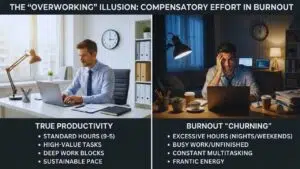
This is the most dangerous sign because it looks like hard work. The burned-out employee often works more hours, not fewer. They stay late, log on weekends, and send emails at odd hours. Why? Because they feel inefficient during the day (due to the “brain fog” mentioned in sign #1). They are trying to “brute force” their way through the exhaustion, compensating for their lack of focus with sheer hours. It becomes a tragic cycle: they work longer to catch up, which makes them more tired, which makes them less efficient, so they work even longer.
| Factor | True Productivity | Burnout “Churning” |
| Hours Worked | Standard hours (e.g., 9-5). | Excessive hours (nights/weekends). |
| Output Quality | High value, completed tasks. | Low value, “busy work,” or unfinished drafts. |
| Focus State | Deep work blocks. | Constant multitasking, tab switching, and distraction. |
| Energy Level | Sustainable pace. | Frantic, anxious energy (“I have to catch up!”). |
How to Fix Team Burnout: A Manager’s Recovery Framework
You’ve spotted the signs of employee burnout. Now what? You can’t just tell them to “relax” or suggest they take a yoga class. Burnout is a structural issue, so it requires a structural fix. You need to engineer an environment where recovery is actually possible, not just talked about.
Phase 1: The Triage (Immediate Actions)
You need to stop the bleeding immediately. Schedule a 1:1, but don’t call it a performance review, which will only spike their anxiety. Call it a “well-being check-in.” Be honest and vulnerable: “I’ve noticed you seem stretched thin, and I want to help you take some things off your plate.” Then, do the “20% Cut.” Look at their project list together and immediately pause, delegate, or delete 20% of their workload. This signals that you prioritize their health over output. If possible, enforce a mandatory disconnect—a long weekend where you strictly forbid them from checking email, perhaps even locking them out of the system if necessary.
Phase 2: Structural Changes (Medium Term)
Once the immediate crisis is managed, look at the workflow that caused the burnout in the first place. Use the Eisenhower Matrix to audit their tasks. Are they drowning in “busy work” (low value, high urgency)? Automate or eliminate it. Next, attack your meeting culture. Meetings are often the biggest enemy of deep work and mental peace. Implement “No-Meeting Fridays” or “Deep Work Wednesdays” to give your team uninterrupted time to think. A good rule of thumb: if a meeting doesn’t have a clear agenda and a desired outcome, cancel it. Give them their time back.
Phase 3: Cultural Prevention (Long Term)
This is about building psychological safety. You need to create a culture where saying “I’m overwhelmed” is treated as a responsible disclosure, not a weakness. Introduce simple rituals, like a “Traffic Light” check-in at the start of sprint meetings (Red = Overwhelmed/Need Help, Yellow = Stressed but managing, Green = Good). This gives people a language to discuss capacity without feeling shame. Most importantly, you must model the behavior. If you send emails at 10 PM, your team will feel pressured to do the same, no matter what you say. You have to “leave loudly.” Announce you are signing off at 5:30 PM and actually do it.
| Phase | Action Step | Goal |
| 1. Triage | The “20% Cut” & Mandatory Disconnect. | Immediate relief of pressure to stop the spiral. |
| 2. Structure | No-Meeting Fridays & Workload Audit. | Create space for deep work and reduce cognitive switching costs. |
| 3. Culture | “Traffic Light” check-ins; Leader modeling. | Normalize conversations about capacity and mental health. |
| 4. Maintenance | Regular “Stay Interviews.” | Proactively ask what keeps them engaged and what frustrates them. |
The “Manager Effect”: Put Your Own Mask on First
Here is the hard truth that many organizations ignore: you cannot help a burning team if you are on fire yourself. Managers are often the “shock absorbers” of an organization, shielding their teams from executive pressure while absorbing employee stress and complaints. This position is incredibly draining. If you are running on fumes, you are less patient, less empathetic, and less effective.
If you are burned out, you are likely spreading it through “emotional contagion.” Humans are wired to mimic the emotions of their leaders. Your stress becomes their stress. Before you overhaul your team’s workflow, audit your own. Are you taking breaks? Do you have a support network of other peers? You need to put your own oxygen mask on first. Your team takes their cues from you—if you are frantic, disorganized, and exhausted, they will be too. You have to lead by example, which means prioritizing your own rest.
| Question | Why It Matters |
| “When was the last time I fully unplugged?” | If you can’t remember, you are modeling poor boundaries. |
| “Am I shielding the team or just passing down stress?” | Managers must be filters, not funnels, for organizational stress. |
| “Do I have a safe space to vent?” | You need a peer group or mentor so you don’t vent to your team. |
| “Am I skipping my own lunch breaks?” | Basic physical needs must be met to maintain emotional regulation. |
Final Thoughts
Burnout isn’t a sign of weakness; it is often a sign of a “star performer” who cares deeply about their work but has been running on empty for too long without the right support. By spotting these signs of employee burnout early—the cynicism, the withdrawal, the overworking—you can intervene before it becomes a resignation letter or a health crisis.
Don’t wait for the exit interview to ask what went wrong. Schedule that check-in today. Ask the hard questions. And remember, the goal isn’t just to have a productive team; it’s to have a team that is healthy enough to want to be productive. Your role as a leader is to protect your people, sometimes even from themselves.