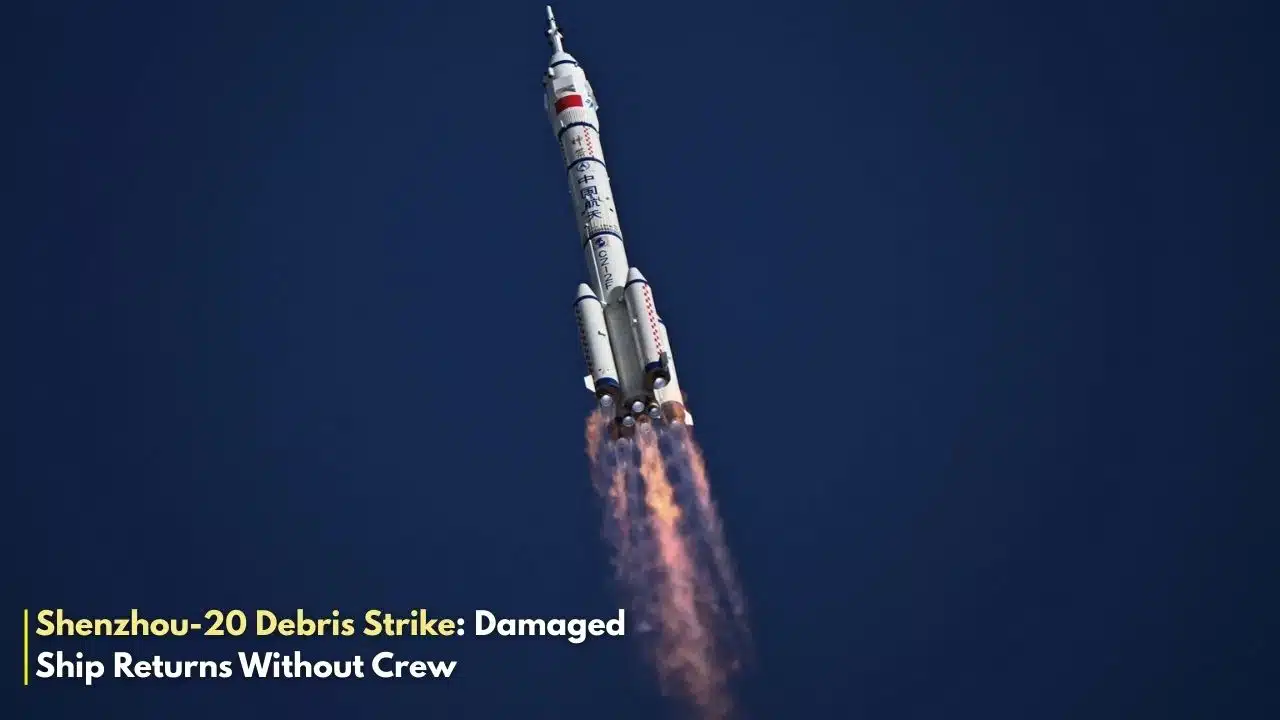
China’s Shenzhou-20 spacecraft, damaged by a suspected strike from orbital debris, is set to make an uncrewed return to Earth after the safe evacuation of its crew. The incident marks a rare and dramatic event in China’s space program, highlighting the growing risks posed by space debris and the resilience of modern mission protocols. The three taikonauts originally assigned to Shenzhou-20 returned to Earth safely aboard the Shenzhou-21 spacecraft, nine days after their planned departure, following a thorough risk assessment by the China Manned Space Agency (CMSA).
Mission Background and Crew
Shenzhou-20 was launched on April 24, 2025, from the Jiuquan Satellite Launching Center, carrying Commander Chen Dong, astronaut Chen Zhongrui, and Wang Jie. The mission was the 15th crewed flight in China’s Shenzhou program and the ninth visit to the Tiangong space station. The crew was scheduled to spend approximately six months aboard the orbital outpost, conducting scientific experiments, maintenance tasks, and supporting the station’s expansion.
The Tiangong space station, currently T-shaped with a core module and two laboratory capsules, provides a living space of up to 110 cubic meters for its crew. The station orbits between 340 and 450 kilometers above Earth and is designed to operate for more than a decade. Shenzhou-20 docked with Tiangong on April 24, 2025, and its crew became part of the Tiangong Crew-8 and later Crew-9.
The Debris Incident
In early November 2025, routine pre-return checks revealed that the Shenzhou-20 spacecraft had sustained a minor crack in the window of its return capsule, likely caused by a collision with a small piece of space debris. The crack was deemed unsafe for a crewed reentry, prompting CMSA to delay the planned return and activate emergency protocols.
The incident was first reported on November 4, with CMSA confirming that the return of the Shenzhou-20 crew had been postponed indefinitely. Over the next several days, the agency conducted a comprehensive impact analysis, simulation reviews, and risk assessments to determine the safest course of action. On November 11, CMSA announced that emergency measures were in place, and the crew would return aboard the Shenzhou-21 spacecraft, which had arrived at Tiangong on October 31 to deliver the next crew rotation.
Crew Evacuation and Safe Return
On November 14, 2025, the three taikonauts—Chen Dong, Chen Zhongrui, and Wang Jie—successfully returned to Earth aboard Shenzhou-21, landing in the Baron Desert of northern Inner Mongolia. Medical teams quickly assessed the astronauts and confirmed that all were in good health following their extended stay in space.
Commander Chen Dong expressed pride in the mission’s completion, stating, “The journey of humanity’s quest for space is not easy. It is filled with challenges and obstacles, which is part of the reason we choose to pursue this path. I am immensely proud that we successfully finished our mission… We have returned home safely”.
Shenzhou-20’s Uncrewed Return and Scientific Mission
With the crew safely evacuated, the damaged Shenzhou-20 spacecraft remains in orbit, attached to Tiangong. CMSA has announced that Shenzhou-20 will return to Earth uncrewed in the coming weeks, carrying out scientific experiments and collecting data during its descent. This decision allows engineers to gather valuable information on the effects of space debris impacts and the integrity of spacecraft structures under real-world conditions.
The uncrewed return of Shenzhou-20 is scheduled for December 2025, with the spacecraft expected to land in a remote region of China. Engineers will conduct a thorough inspection of the vehicle upon recovery, focusing on the damaged window and other potential points of impact. This data will be crucial for improving spacecraft design and enhancing safety measures for future missions.
Implications for Space Debris and Future Missions
The Shenzhou-20 incident underscores the growing threat posed by orbital debris, which has become a major concern for all spacefaring nations. As the number of satellites and spacecraft in orbit continues to rise, the risk of collisions increases, potentially endangering both crewed and uncrewed missions.
China has responded to the incident by accelerating its efforts to develop debris mitigation technologies and improve spacecraft shielding. The Shenzhou-20 event is expected to influence future mission planning, with increased emphasis on real-time debris tracking, emergency protocols, and spacecraft redundancy.
International Reactions and Collaborative Efforts
The Shenzhou-20 debris strike has drawn international attention, with space agencies and experts around the world expressing concern over the risks posed by space debris. The incident has sparked renewed calls for global cooperation on debris tracking, mitigation, and the development of sustainable space practices.
China has stated its willingness to share data and collaborate with other nations on debris research and risk reduction. The uncrewed return of Shenzhou-20 will provide valuable insights for the global space community, contributing to the collective effort to ensure the safety and sustainability of space exploration.
Conclusion
The damaged Shenzhou-20 spacecraft’s uncrewed return to Earth marks a significant milestone in China’s space program and a sobering reminder of the challenges posed by orbital debris. The safe evacuation of its crew and the subsequent scientific mission highlight the resilience and adaptability of modern space operations. As the global space community continues to grapple with the risks of debris, incidents like Shenzhou-20 serve as a call to action for enhanced collaboration, innovation, and vigilance in safeguarding humanity’s presence in space.