A Russian ship full with sailors and, bizarrely, penguins destined for the men’s dinner noticed a towering ice shore on the horizon in 1820. The Fimbul Ice Shelf was discovered for the first time, and it represented the official discovery of a new continent: Antarctica. It also solidified the present notion, supported by most maps in the English-speaking world, that the Earth is divided into seven primary landmasses.
Today, most students, explorers, and politicians accept the clean division of the world’s land into these easy units, which include Europe, Asia, Africa, North America, South America, Australia, and Antarctica.
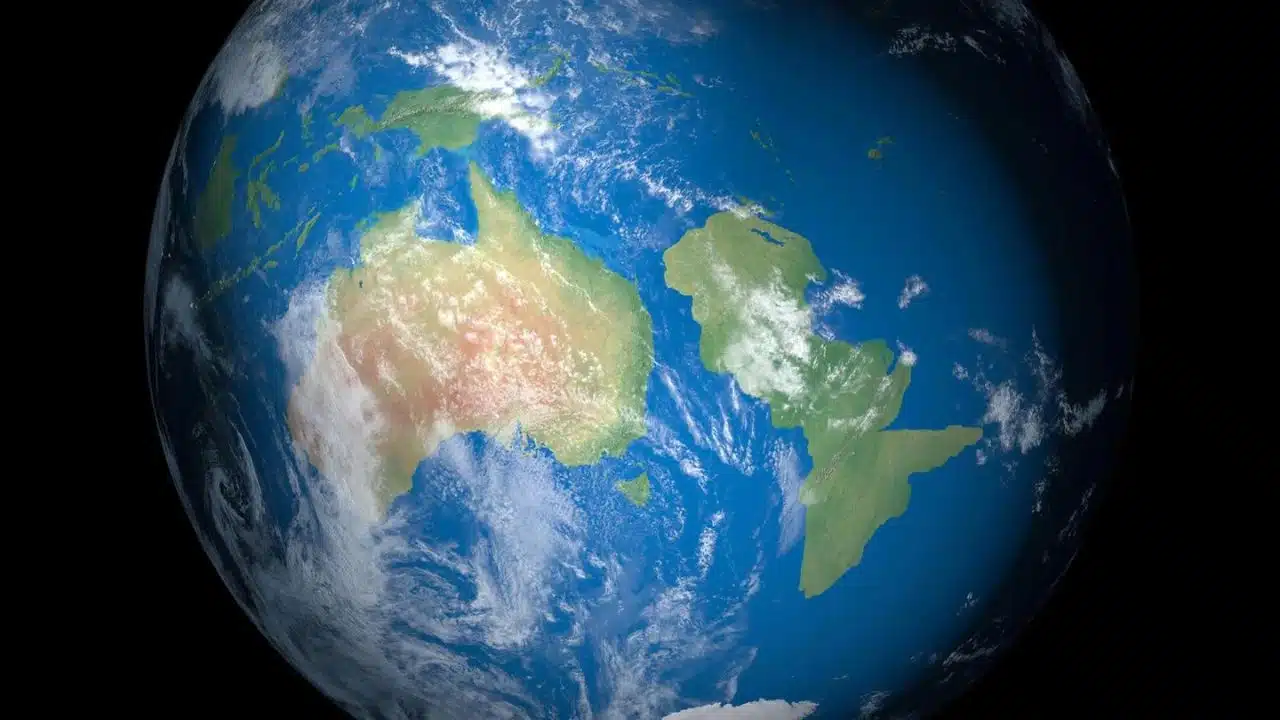
However, the story took an unexpected turn in 2017 when it was revealed that the seven-continent model had been a mistake all along. Enter Zealandia, the planet’s forgotten eighth continent, a long-lost land to the southeast of Australia. Scientists have long predicted the existence of this extra southern continent, but it has gone unnoticed for 375 years, owing to the fact that it is almost fully submerged under 1-2 km (0.6-1.2 miles) of water. They are only now beginning to uncover its mysteries.
An multinational team of researchers published the most precise maps of Zealandia to date this month, encompassing the whole five million square kilometers (two million square miles) of this undersea continent and its geology. They’ve unearthed clues as to how this enigmatic continent evolved – and why it’s been hidden beneath the waves for the last 25 million years.
An Ancient Beginning
Zealandia is considered to have developed 83 million years ago, during the Late Cretaceous period. However, its voyage began up to 100 million years before then, when the supercontinent of Gondwana began to break up, congealing most of today’s territory into one enormous lump. As it disintegrated, the world’s smallest, thinnest, and youngest continent broke away from Gondwana, and the portions of Gondwana that had earlier been directly to its north and south west became Australia and Antarctica, respectively.
It is thought that Zealandia may have existed as an island for a time. However, it vanished beneath the sea some 25 million years ago.
The first real indications that New Zealand is only a tiny, visible fraction of a massive unknown landmass occurred in 2002, when scientists employed bathymetry – the study of the depth of bodies of water – to analyze the region. The water above what is now known as Zealandia is far shallower than that surrounding it, indicating that the area was not underlain by an oceanic tectonic plate, as most oceans are, but by a continental one. Additionally, you can also read about- Learn the Secrets of Timing In New Zealand.
The clincher came in 2017, when scientists combined numerous lines of evidence, including data on the types of rocks it contains and its relative thickness – oceanic plates are thinner – to conclude that this is, in fact, a new continent. This is not a mere continental fragment or microcontinent, as previously postulated, but the real thing, with 95% of it submerged underwater.
Despite the enthusiasm surrounding the discovery of a new continent and more than a decade of diligent research, many aspects about Zealandia’s early development remain unknown. This is due in part to an unusual incident that occurred when it split from Gondwana.
A Tricky Unravelling
An interdisciplinary team of experts mapped the geology of South Zealandia in 2019. Their research found that Zealandia was stretched – forced apart by tectonic pressures – at some stage, weakening the continent compared to ordinary continental plates and causing ruptures that subsequently produced oceanic crust. It became twisted in the process, making reconstructing its history to determine its original form considerably more difficult.
The study of rocks from the lost continent by the experts revealed that the stretching occurred in two stages. The first occurred between 89 and 101 million years ago and resulted in a rupture that produced the Tasman Sea between Australia and New Zealand. The second phase began 80-90 million years ago, when Zealandia separated from West Antarctica, resulting in the formation of the Pacific Ocean. However, many riddles remained unsolved, and the other half of this continent had yet to be thoroughly examined.
A Gradual Sinking
Another research group, including many of the same geologists as before, charted North Zealandia for the latest study.
They looked at rocks dredged up from the Fairway Ridge, a region of the South Pacific off the coast of Australia that constitutes the northernmost tip of Zealandia. These ancient relics, which haven’t seen the light of day in 25 million years, were made up of igneous rocks – those generated by volcanic processes – and sedimentary rocks – those developed in shallow basins off the coast of Zealandia.
The scientists calculated their age and origins by analyzing their chemistry and radioactive isotopes deep within. The oldest were Early Cretaceous pebbles (approximately 130-110 million years old), followed by Late Cretaceous sandstone (about 95 million years old), and comparatively youthful Eocene basalts (roughly 40 million years old).
The resulting maps of Zealandia change it from a featureless mass to a region with numerous bands of unique geology flowing from northwest to southeast. These fit together like a jigsaw puzzle with the geology of West Antarctica, demonstrating that this region and Zealandia were formerly connected..
The team then moved on to measurements of magnetic anomalies on the ocean floor near Zealandia. Variations in the intensity of the Earth’s magnetic field create an invisible record of how tectonic plates have moved over time. They’ve discovered more about the continent’s ancient stretching, which lasted millions of years and even changed direction, resulting in an ultra-thin continent that eventually sank.
Zealandia is finally beginning to reveal its mysteries. But, with the vast majority of this intriguing island submerged beneath kilometres of water, it will take some time to uncover them all.