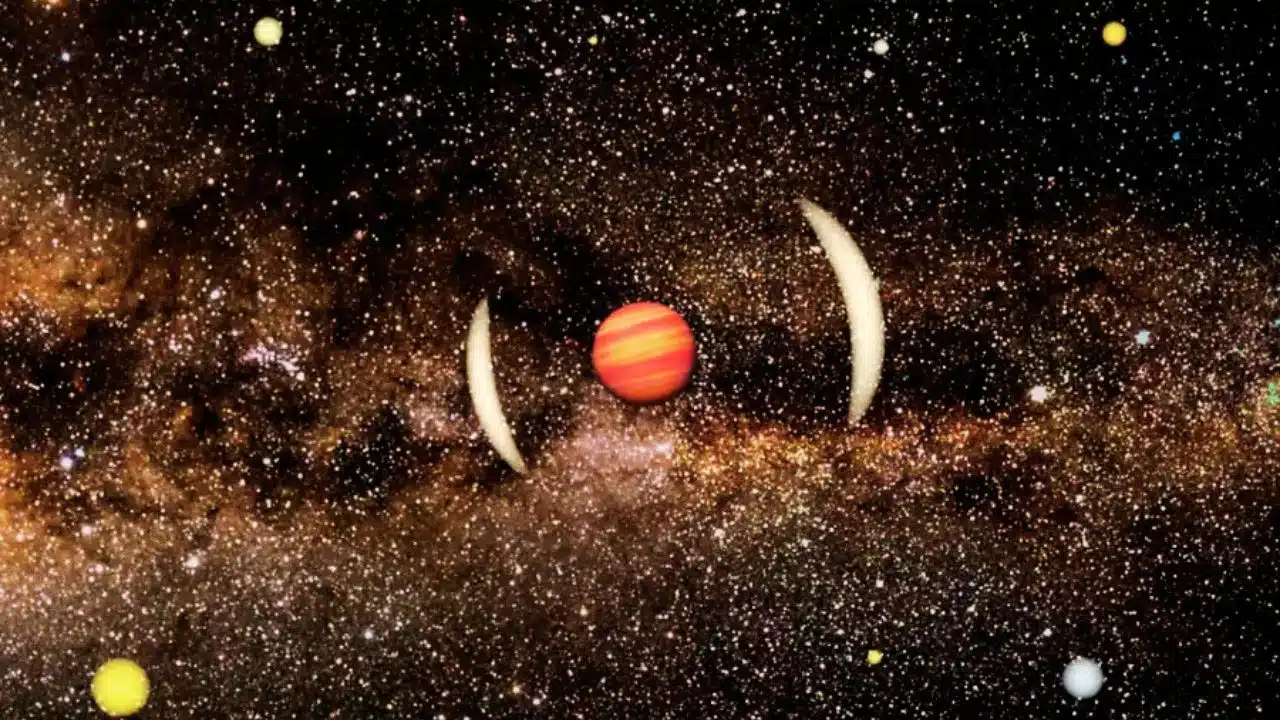
Astronomers have measured the mass of a Saturn-sized rogue planet, KMT-2024-BLG-0792, by pairing ground-based microlensing data with ESA’s Gaia spacecraft observations during the same brief event.
A rare “weigh-in” for a starless world
Rogue planets (also called free-floating planets) drift through space without orbiting a star, which makes them extremely hard to detect because they emit little to no light of their own.
In the new result, researchers reported a Saturn-mass-class object identified through a short-lived gravitational microlensing event—an alignment where gravity from a foreground object briefly magnifies a background star.
The key advance was turning that brief brightening into a direct mass estimate, something that is often difficult in microlensing because the signal can be ambiguous without extra geometric information.
What was found: KMT-2024-BLG-0792
The newly reported rogue planet is designated KMT-2024-BLG-0792 and was described by an international team that included South Korea’s Korea Astronomy and Space Science Institute (KASI), using combined observations from KMTNet and ESA’s Gaia.
Its mass was estimated at about 0.7 times Saturn’s mass, placing it in the Saturn-mass range.
The team also reported it is located roughly 10,000 light-years from Earth, an unusually specific distance for a rogue planet detected via microlensing.
How astronomers measured the mass
Microlensing: detecting the invisible
Gravitational microlensing works when the gravity of an unseen foreground object bends and magnifies light from a background star, making that star appear temporarily brighter to observers.
By analyzing the shape and duration of the brightening, astronomers can infer properties of the foreground “lens,” which may be a star, planet, or—more rarely—a planet without a star.
The “two views” that made the difference
In this case, the microlensing event was captured by the Korea Microlensing Telescope Network (KMTNet), which uses three telescopes distributed across Chile, Australia, and South Africa to enable near-continuous monitoring of fast microlensing signals.
Gaia also observed the same patch of sky multiple times during the event—reported as six observations across about 16 hours—allowing researchers to combine space-based and ground-based timing/geometry to better pin down the lens.
A Science journal commentary on the work highlighted that combining Earth and space observations enabled the team to estimate the object’s mass at about 22% of Jupiter’s mass, consistent with a Saturn-class planet.
Why this matters for rogue-planet science
Rogue planets are important because they can be remnants of violent gravitational interactions that eject planets from their original systems, offering clues about how planetary systems evolve over time.
The team said the detection helps address an observational gap sometimes described as an “Einstein desert,” where certain microlensing signatures (expressed in microarcseconds) are difficult to measure, limiting how many rogue planets can be confidently characterized.
More broadly, mission-planning research for NASA’s upcoming Roman Space Telescope has emphasized that measuring (not just detecting) free-floating planet masses often requires microlensing parallax information—exactly the type of leverage that coordinated space-and-ground viewing can provide.
Key data at a glance
| Item | What was reported | Why it’s important |
| Object name | KMT-2024-BLG-0792 | Identifies the specific microlensing event/planet candidate. |
| Planet type | Rogue (free-floating) planet | Not bound to a star, so direct imaging is extremely difficult. |
| Mass estimate | ~0.7 Saturn masses (also described as ~22% Jupiter mass) | Puts it firmly in the Saturn-mass regime with a quantified “weighing.” |
| Distance | ~10,000 light-years from Earth | Distance constraints are unusually valuable for rogue-planet microlensing. |
| Method | Gravitational microlensing + Earth/space “two-view” observations | Helps break microlensing degeneracies to estimate mass more directly. |
| Instruments | KMTNet (Chile/Australia/South Africa) + ESA Gaia | Demonstrates a practical blueprint for coordinated observing. |
Final thoughts
This Saturn-sized rogue planet result strengthens the case that coordinated Earth-and-space observations can turn fleeting microlensing flashes into real physical measurements—especially mass, which is central to understanding how these worlds formed.
As more time-domain surveys and space missions prioritize microlensing, the approach demonstrated here could help build a clearer census of starless planets and distinguish between planets that were ejected from solar systems and objects that may have formed in isolation.