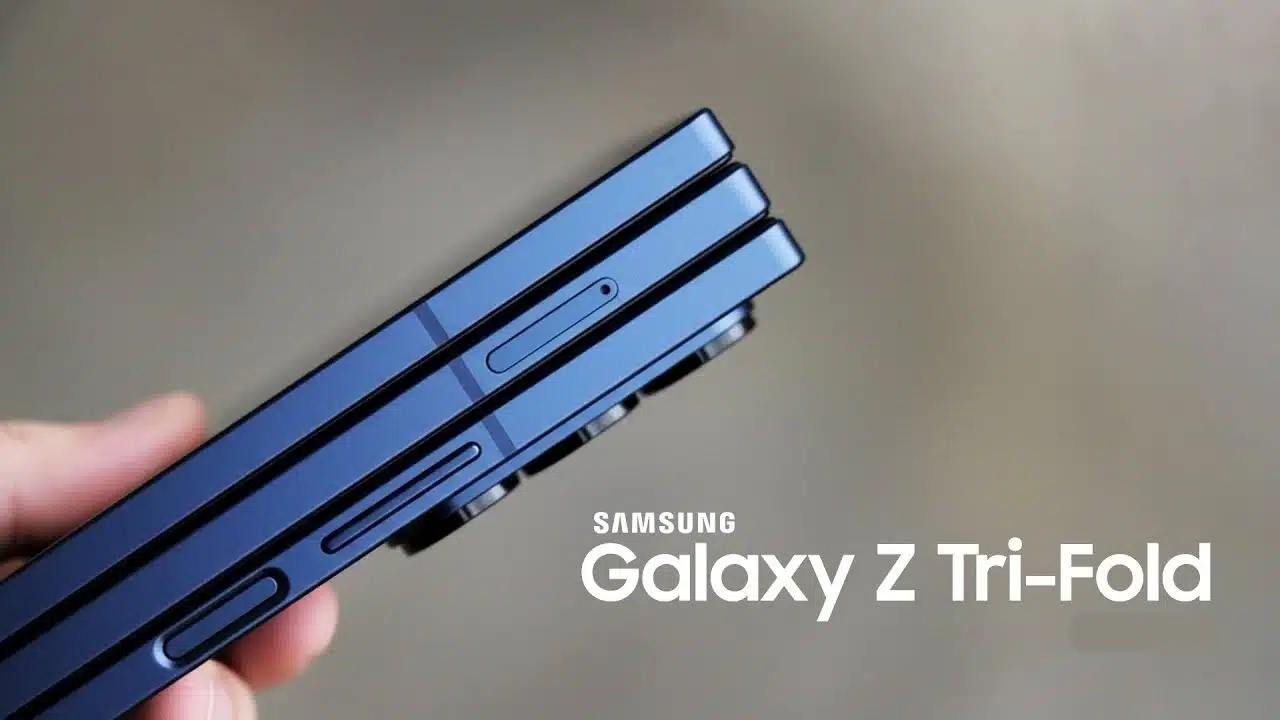
Samsung has officially stepped into the next chapter of smartphone design — unveiling the Galaxy Z TriFold on December 1st, 2025. The device marks Samsung’s first-ever tri-folding smartphone, featuring a large 10-inch display that folds twice, signaling the company’s bold ambition to lead in the evolving foldable market.
The Galaxy Z TriFold is designed to deliver the portability of a phone with the screen real estate of a tablet. When folded, it hides its full display behind a 6.5-inch external screen; unfold it, and you get a roomy 10-inch OLED panel, paired with a 21:9 outer aspect ratio for the cover screen. With the market heating up — especially as rivals like Huawei and potential new players such as Apple step in — Samsung appears to be making a statement:
It’s not just trying to catch up — it’s redefining what a smartphone can be.
Premium Hardware, Big Ambitions
Under the hood, the Galaxy Z TriFold packs substantial strengths. It runs on Qualcomm’s Snapdragon 8 Elite for Galaxy chipset, along with 16 GB of RAM and 512 GB of storage at launch. The folding device is powered by a 5,600 mAh battery — reportedly the largest ever fitted in a Samsung foldable — with battery cells carefully distributed across its three panels for balanced power delivery.
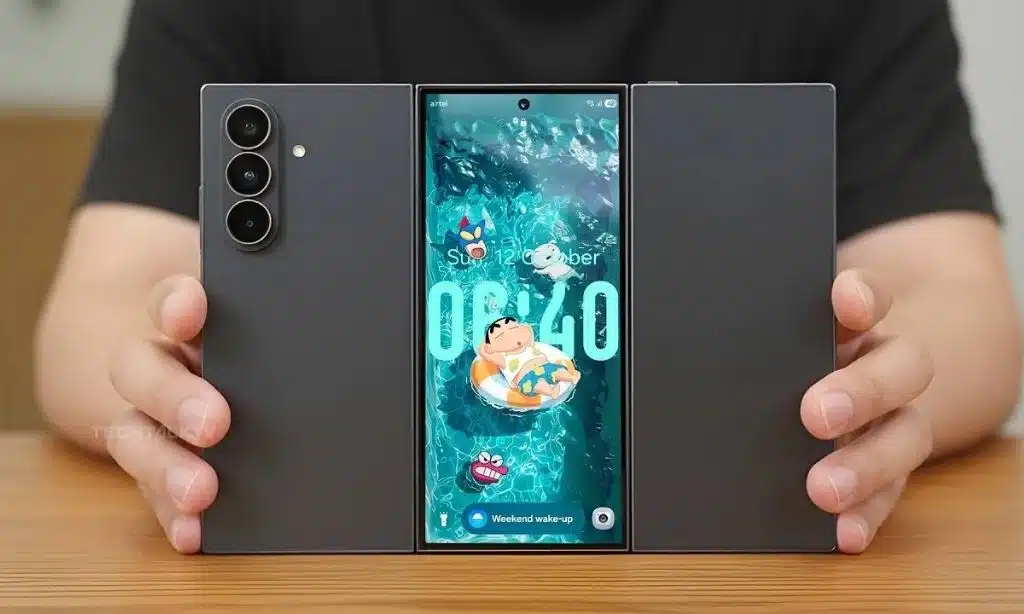
Photography won’t be sacrificed either. The rear setup includes a 200 MP main camera, joined by a 12 MP ultrawide and a 10 MP telephoto lens. Selfies come from dual 10 MP front cameras — one on the cover screen and another inside. For productivity, the foldable supports running three apps side-by-side on its expansive display, and even offers standalone DeX mode, allowing users to enjoy a desktop-like workspace without needing an external monitor.
At 309 g and with a folded thickness of around 12.9 mm, the TriFold is comparatively sleek. When unfolded, panel thinness varies between 3.9 mm and 4.2 mm depending on the section — impressive given the complexity of a triple-hinge design.
A Different Approach to Folding
What distinguishes the TriFold from other multi-fold phones is its inward-folding architecture. Unlike some competitors that fold outward — leaving parts of the display vulnerable — Samsung’s design ensures the 10-inch screen is safely enclosed when closed. The hinge system uses dual-rail mechanisms housed in titanium, and the back panel is crafted from a ceramic-glass fiber-reinforced polymer to reinforce durability and reduce cracking risk.
Samsung rates the folding mechanism for about 200,000 folds — roughly equivalent to folding and unfolding the phone 100 times daily for five years. While that’s less than the 500,000-fold rating of its Z Fold 7, Samsung argues the complexity of a tri-fold mechanism naturally involves trade-offs. The TriFold also carries an IP48 rating, offering good protection against water splashes (though it’s not fully dust-sealed).
Despite skipping stylus support — unlike some of Samsung’s past foldable models — the TriFold leans heavily into productivity and multitasking. Its 10-inch screen, triple-split multitasking, and large battery point toward a use case more akin to a compact tablet or mini-laptop than a simple smartphone.
Launch Timeline and Cost
The Galaxy Z TriFold is set to hit shelves in its home market — South Korea — on December 12, 2025, with a price tag of 3.59 million won (roughly $2,440–$2,500) for the 16 GB/512 GB variant. International rollout will include markets like China, Singapore, Taiwan, and the UAE before the end of 2025. In the United States, Samsung plans a release in the first quarter of 2026, though pricing details remain under wraps.
Given the steep price and niche form factor, Samsung executives acknowledge the TriFold is not designed for mass-market dominance — but rather as a “halo product” aimed at enthusiasts, early adopters, and those craving a device where productivity, portability, and premium design converge.
Market Context: Where Samsung Stands
Samsung’s release comes at a delicate moment. Earlier in 2025, Huawei surged ahead in foldable shipments, capturing a substantial share of the market. Samsung, once leading, slipped — but regained momentum in the third quarter thanks to new launches. The TriFold is thus as much a strategic move as a technological one: it’s a bid to reclaim leadership in public perception even if actual sales volumes remain modest.
Foldable phones still account for a small slice of the broader smartphone market — under 2% globally in 2025. Growth is expected, but gradual: analysts forecast foldables will reach just under 3% of total shipments by 2027. The forecast, however, brightens significantly if Apple enters the foldable fray, as widely expected around 2026.
Samsung seems to be hedging its bets — establishing a high-end, cutting-edge baseline now, ahead of broader market expansion. The TriFold offers a vivid demonstration of what foldable phones can be when design ambition meets engineering finesse.
A Bold Statement, But Will It Stick?
The Galaxy Z TriFold opens a new chapter in foldable design — one that blends smartphone convenience with tablet-sized functionality. It’s sleek, powerful, and packed with features for productivity-minded users. But at over $2,400, with compromises in dust sealing and stylus support, its appeal is inherently niche.
For power users, early adopters, and tech connoisseurs, TriFold may well hit the sweet spot between gadget and workstation. For the average user — who values affordability, robustness, and simplicity — it’s more of a statement piece: a hint at the future of mobile devices, but probably not the future itself.
In the coming months, Samsung’s true challenge will be to see if the TriFold resonates beyond a core of enthusiasts — and whether foldables, tri-folds included, can grow from novelty to norm.