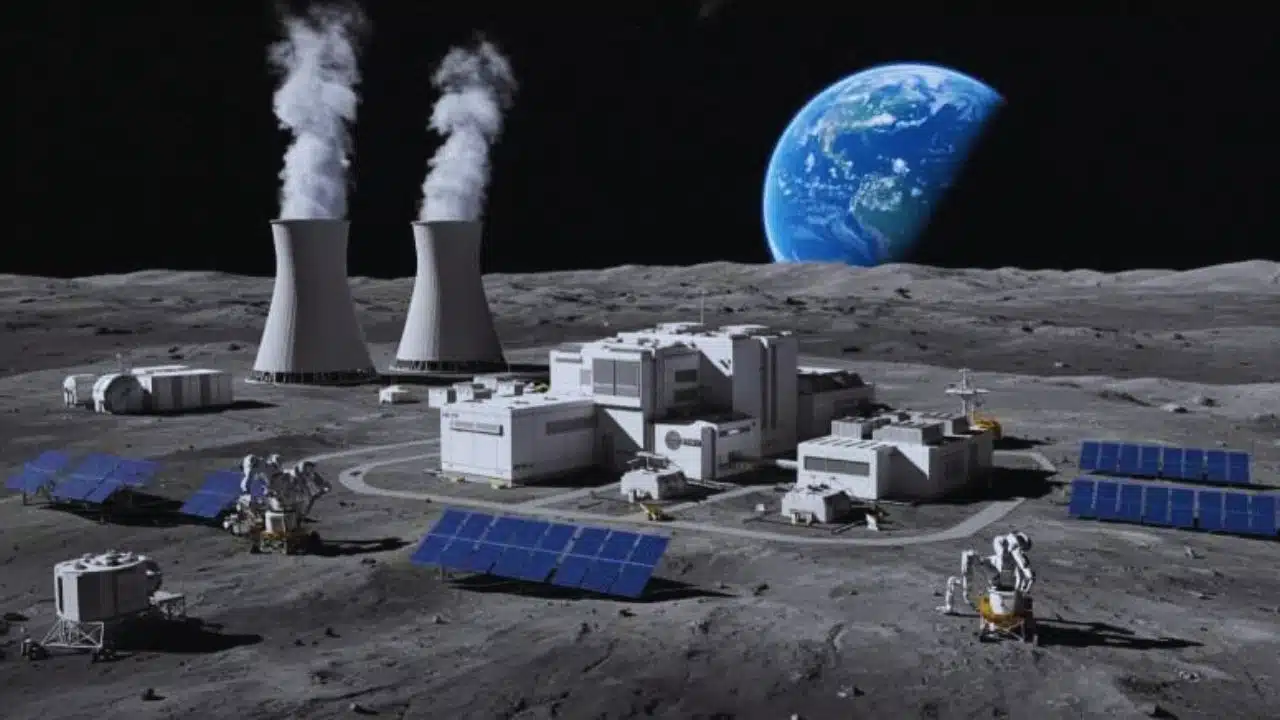
Russia lunar power plant 2036: Roscosmos says it has signed a state contract with NPO Lavochkin to develop a lunar power station, targeting completion by 2036 and aiming to support Russian lunar missions and the International Lunar Research Station.
What Russia announced now
Roscosmos said it signed a state contract with the Lavochkin Association (NPO Lavochkin) tied to work toward creating a Russian lunar power plant by 2036.
Roscosmos said the contract term is 2025–2026, while the broader plan described by the agency runs through 2036 and includes spacecraft development, ground testing, flight tests, and deploying infrastructure on the Moon.
Roscosmos described the power station’s role as long-term electricity supply for Russian lunar program “consumers” such as rovers and observatories, and for infrastructure tied to the International Lunar Research Station (ILRS), including facilities connected to foreign partners.
Who is involved and why it matters
Roscosmos said Rosatom and the Kurchatov Institute will participate in the lunar power plant effort.
While Roscosmos did not publicly frame the facility in its statement as explicitly nuclear, reporting on the announcement notes the participation of Rosatom and the Kurchatov Institute as a key indicator that nuclear technology is likely part of the plan.
The announcement positions the project as a shift from single lunar missions toward infrastructure meant for sustained operations on the lunar surface.
The “second” linked story: Russia–China lunar reactor cooperation
In May 2025, coverage of Russia–China space cooperation described an agreement/memorandum framework aimed at building a lunar nuclear power source to support the ILRS, with the station’s operational target commonly cited around 2036.
This earlier Russia–China cooperation story matters because Roscosmos’ latest statement explicitly connects the new power-plant work to ILRS infrastructure and foreign partner facilities.
Separately, Roscosmos leadership had previously discussed Russia–China plans to deliver and deploy a lunar nuclear power plant in the 2033–2035 timeframe, which aligns with the wider mid-2030s ILRS construction window.
How ILRS timelines fit the 2036 target
A published ILRS roadmap has described a sequence that includes site selection by around 2025 and construction steps running through roughly 2026–2035, with the station becoming operational from 2036 onward.
China has also publicly outlined a two-phase ILRS blueprint that projects a basic model by 2035 near the lunar south pole region and an expanded model by about 2050.
Against that backdrop, a lunar power system targeted for 2036 fits the operational phase of a permanent or semi-permanent research outpost, where stable energy is required for communications, science payloads, thermal management, and surface mobility.
Why lunar power is a central issue
The Moon’s environment creates long-duration power challenges, including long lunar nights and temperature extremes, which is why agencies evaluate combinations of solar, storage, and nuclear options for continuous energy.
NASA’s Fission Surface Power program, for example, describes a 40-kilowatt-class fission system designed to operate on the Moon by the early 2030s and provide continuous power for about 10 years.
NASA also states it is working with the U.S. Department of Energy and industry on the effort, highlighting how lunar surface power is increasingly treated as critical infrastructure rather than a “payload.”
Russia’s recent lunar track record
Russia’s most recent lunar lander attempt, Luna-25, ended in a crash in August 2023 after an off-nominal maneuver and loss of the spacecraft.
That failure increased scrutiny around Russia’s lunar program timelines, making the new long-horizon infrastructure announcement notable for its ambition and duration through 2036.
Roscosmos now appears to be emphasizing systems that enable sustained presence—like power generation—rather than only one-off surface missions.
Key data at a glance
Timeline of major milestones mentioned publicly
| Item | Date/Window | What was stated | Why it matters |
| Roscosmos–Lavochkin state contract (term) | 2025–2026 | Roscosmos said a state contract was signed with NPO Lavochkin. | Starts funded/contracted work packages that feed the longer program. |
| Power plant target | By 2036 | Roscosmos said the lunar power plant is to be built by 2036. | Matches ILRS operational timeframe often cited for mid-2030s. |
| Lunar nuclear deployment discussion | 2033–2035 | Roscosmos leadership previously referenced Russia–China nuclear plant delivery/deployment timing. | Suggests power may be needed before or during station activation. |
| ILRS “basic model” (China blueprint) | By 2035 | China described a basic ILRS model by 2035 and extended model by ~2050. | Reinforces mid-2030s as the buildout phase. |
| NASA fission surface power goal | Early 2030s | NASA describes operating a fission surface power system on the Moon by early 2030s. | Shows parallel push by other major space powers on lunar nuclear systems. |
Lunar surface power approaches (publicly described)
| Program/Actor | Power approach described publicly | Public target timeframe |
| Roscosmos lunar power plant | Roscosmos describes a lunar power station for long-term supply and notes participation by Rosatom and Kurchatov Institute. | By 2036. |
| ILRS (China blueprint) | Public blueprint emphasizes staged buildout (basic then extended), implying infrastructure-scale power needs. | Basic by 2035; extended by ~2050. |
| NASA Fission Surface Power | NASA describes a 40-kilowatt-class fission power system to operate on the Moon, designed for long-duration continuous power. | Early 2030s. |
Final thoughts
Roscosmos’ contract announcement ties Russia’s lunar ambitions to a practical bottleneck—power—while also explicitly linking the project to the multinational ILRS infrastructure expected to mature in the mid-2030s.
If Russia and its partners can sustain funding, testing, and launch capacity over the next decade, a working lunar power station would enable longer rover missions, continuous science operations, and more permanent surface systems than earlier one-off missions.
The next milestones to watch are additional technical disclosures (power type, output, mass, delivery architecture) and any public updates to ILRS construction sequencing as 2030 approaches.