

Have you ever wanted to know more about Runa Laila but found almost nothing when you searched online? You’re definitely not alone. So many people try to dig deeper into her incredible music career, but there just isn’t that one complete story that really tells you who she is.
Here’s what I can tell you right away. Runa Laila is one of those rare voices that touched the hearts of millions across Bangladesh, Pakistan, and India. She gave us unforgettable hits in Bengali, Urdu, and Hindi films, and her voice is the kind you recognize in just a few notes.
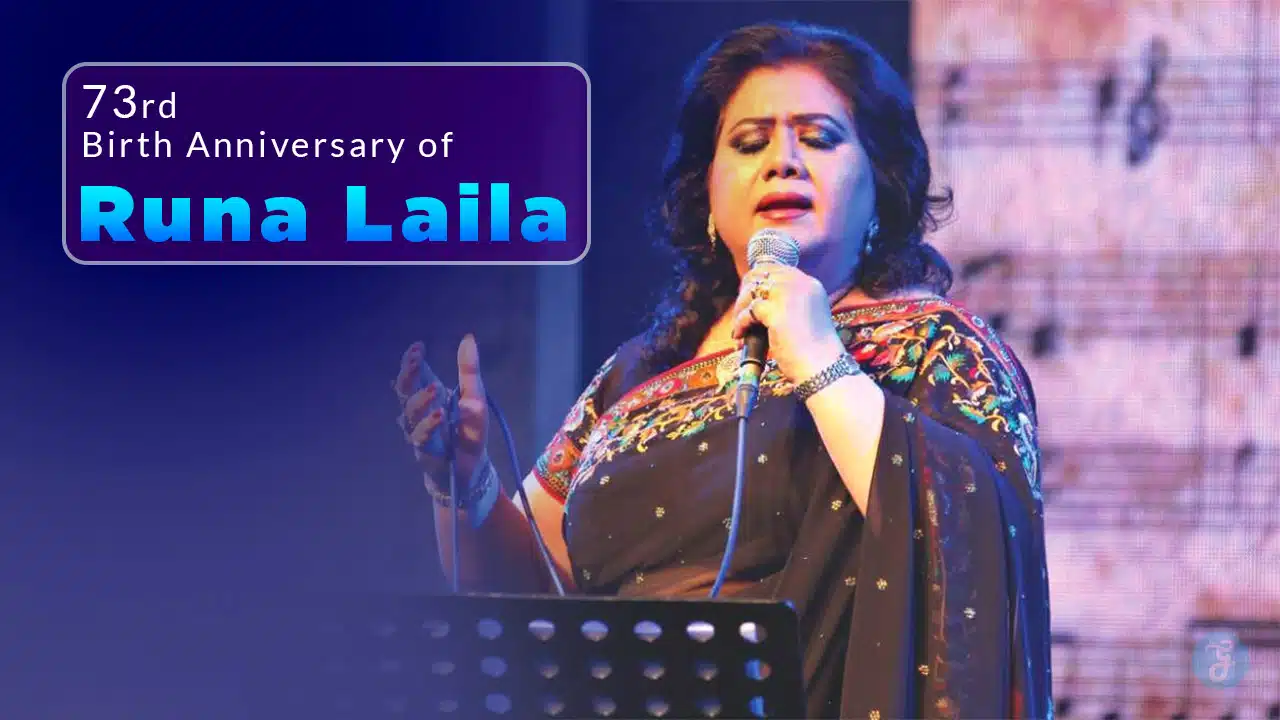
Today is the 73rd birth anniversary of the legendary singer Runa Laila. I’m going to walk you through the best of Runa Laila’s career. We’ll explore her early days, discover classic songs like “Dama Dam Mast Qalandar” and “Jadur Banshi,” and find out exactly why people still call her a legend.
So grab a cup of tea and let’s dive into her amazing journey together. I think you’ll be surprised at just how much she accomplished.
Key Takeaways
- Runa Laila is a famous South Asian playback singer known for singing in Bengali, Urdu, Hindi, Punjabi, Sindhi, Pashto, Persian, French, and Nepali.
- In the late 1960s, she started her career by stepping in for singer Mala Begum in Pakistani cinema, drawing inspiration from the legendary Ahmed Rushdi.
- Her songs, such as “Dama Dam Mast Qalandar,” became massive hits across Bangladesh, Pakistan, and India. She worked with celebrated composers like Bappi Lahiri and Jaidev.
- Runa Laila won seven Bangladesh National Film Awards for Best Female Playback Singer and received over 300 awards throughout her career.
- Her legacy is her voice that connects families across borders and generations through timeless classics played on radio and television platforms.
Early Life and Career of Runa Laila
Runa Laila’s passion for singing started early in her days in Sylhet, East Bengal. Born on November 17, 1952, she grew up in a household where music was part of the daily rhythm. Her mother, Amina Laila, was a musical artist, and her maternal uncle, Subir Sen, was a notable Indian playback singer.
She wowed listeners when she stepped into Pakistani cinema. Her fresh style and powerful voice soon made her a star across South Asia.
How did Runa Laila start her career in the Pakistani film industry?
Runa’s journey into music began by accident. Her elder sister, Dina Laila, was taking classical music lessons from renowned teachers like Ustad Abdul Kader Peyarang and Ustad Habibuddin Ahmed. Young Runa would sit in the next room and memorize every song she heard.
One day, when Runa was just 12 years old, she got her big break. She recorded her first playback song, “Gudia Si Munni Meri,” for the 1965 Urdu film Jugnu. According to reports, this recording took place on June 24, 1964, at Karachi’s Eastern Studio.
Her breakthrough came in 1966 with the song “Unki Nazron Sey Mohabbat Ka Jo Paigham Mila” for the Urdu film Hum Dono. This song launched her into stardom and marked the beginning of a remarkable career in Pakistani cinema.
She later replaced another singer, Mala Begum, in several film projects, which helped her establish a strong foothold in the industry during the late 1960s.
What led to Runa Laila’s rise to fame across South Asia?
Pakistani playback singer Ahmed Rushdi, whom she considered her guru, deeply inspired Runa Laila’s singing style. She didn’t just copy his vocals. She studied the way he performed on stage, blending Eastern and Western music in a way that felt fresh and exciting.
Here’s what made her stand out from other singers of that era:
- She sang in many languages, including Bengali, Urdu, Hindi, Punjabi, Sindhi, Pashto, and Persian. This made her voice familiar, from Mumbai to Dhaka to Delhi.
- She had her television show in Pakistan called “Bazm E Laila” when she was just 19 years old. This was a groundbreaking moment where she introduced the concept of performing alongside singing.
- According to a 2024 report by The Daily Star, she recorded more than 30 songs in just three days for a Mumbai studio project, earning her a place in the Guinness Book of Records.
- Big-name composers such as Bappi Lahiri, Jaidev, and Kalyanji-Anandji wanted to work with her because of her versatility and clarity of diction.
Her song “Dama Dam Mast Qalandar” played everywhere across South Asia. It became the kind of song you couldn’t escape at weddings, radio shows, and family gatherings. Later hits like “Ontore Ontore” and “O Mera Babu Chail Chabila” kept her at the top, and newspapers like The Times of India and Prothom Alo said that her music reached people all over the world.
Runa Laila’s voice joined families together over radios from Rajshahi all the way to Hyderabad, building bridges with every note she sang.
Iconic Songs and Timeless Classics of Runa Laila
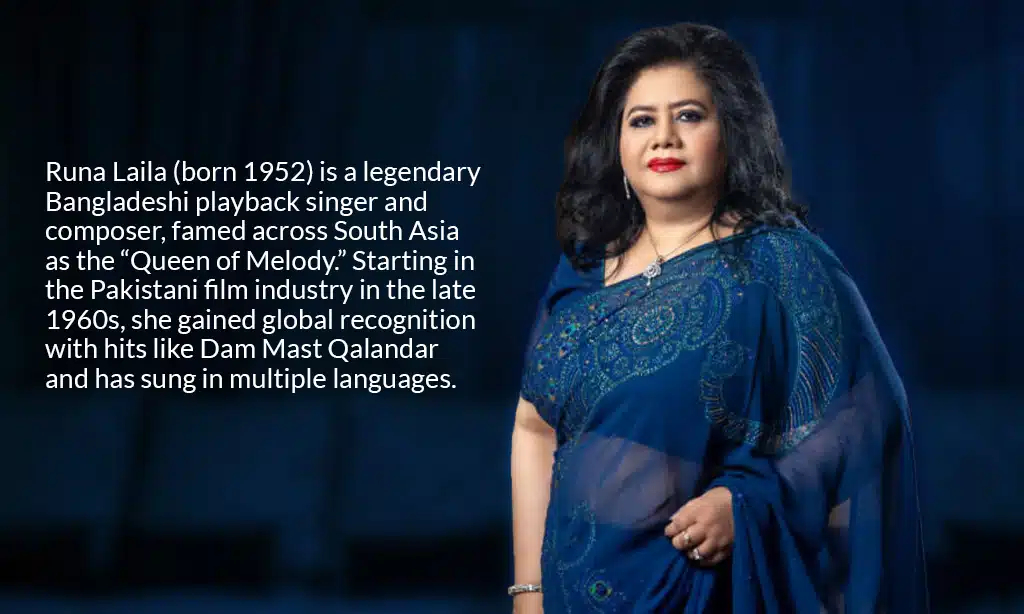
Many music lovers still play Runa Laila’s greatest hits in Bengali, Urdu, and Hindi on streaming platforms and radio today. Her collection of heartfelt ghazals and film tracks has inspired singers like Sabina Yasmin and worked alongside legendary composers like Jaidev and Bappi Lahiri.
What are some of the best ghazals sung by Runa Laila?
Runa Laila is known for her soulful voice in South Asian music. Her ghazal performances carry deep emotion that connects with listeners across generations.
She sang Urdu ghazals with grace during her career in Pakistani cinema. Her powerful renditions often stood out, which helped her build a unique identity in the industry. She brought influences from classical dance forms like Kathak and Bharatanatyam into her expressive singing style.
Here are some highlights of her ghazal work:
- She performed on Indian television platforms like Doordarshan and the singing competition “Sur Kshetra,” where she served as a judge in 2012 alongside Asha Bhosle.
- Films like “Devdas” and “Hum Dono,” deeply rooted in South Asian music history, inspired several of her famous performances.
- She performed ghazals not only in Urdu but also touched on Persian language and Arabic influences, showcasing her range across different musical traditions.
- The Bangladesh National Film Award for Best Female Playback Singer, which she won seven times, honored her expressive singing and the high quality of her work.
Throughout all these stages, Runa Laila kept the art form alive for future generations who cherish outstanding female playback singers and timeless ghazal collections.
Which Bengali, Urdu, and Hindi hits made Runa Laila memorable?
Runa Laila has charmed millions with her songs across multiple film industries. Her powerful voice helped her shine in productions throughout South Asia.
| Language | Notable Songs | Film/Album |
|---|---|---|
| Bengali | “O Amar Jibon Shathi” | Jibon Shathi (1976) |
| Bengali | “Ganeri Khatay Swarlipi Likhe” | Swarlipi (1970) |
| Urdu/Hindi | “Dama Dam Mast Qalandar” | Various Albums |
| Hindi | “Tumhe Ho Na Ho” | Gharonda (1977) |
| Hindi | “Do Deewane Shaher Mein” | Gharonda (1977) |
| Punjabi | “Kala Sha Kala” (Collection) | Released October 2009 |
Here are the key moments and achievements that made her unforgettable:
- She performed playback singing in the 1990 film Agneepath, starring Amitabh Bachchan, which brought her voice to a massive Bollywood audience.
- In 1982, her album “Super Runa,” composed by Bappi Lahiri and produced at London’s Abbey Road Studios, sold over 100,000 copies on its first day, earning her a Golden Disk Award.
- She worked as a composer and won the Best Music Composer award for the film Ekti Cinemar Golpo in 2018, showing her talent extended beyond singing.
- The wonderful music from her collaboration with composer Jaidev on the film Gharonda provided a refreshing change from the usual voices that people were accustomed to at the time.
- In 2014, she collaborated with Sabina Yasmin on a song for the television play “Dalchhut Projapoti,” marking the first time these two legendary singers worked together.
According to a recent article by Cinestaan, “Dama Dam Mast Qalandar” began playing on radio stations in 1970, and since then, the song has taken on a life of its own, spawning a thousand covers.
Her tracks built bridges between languages and people all over South Asia and beyond.
Awards and Recognitions of Runa Laila
Runa Laila has picked up many national and international music honors from Bangladesh, Pakistan, and India. Her gifted voice sings in Urdu, Hindi, Bengali, and even French and Nepali, earning her praise from critics and audiences alike.
What national and international honors has Runa Laila received?
Runa Laila is loved as a Bangladeshi playback singer and composer. Her work spans many languages, making her music shine throughout South Asia.
Here are the major awards and recognitions she has received:
- She won seven Bangladesh National Film Awards for Best Female Playback Singer for her work in films including The Rain (1976), Jadur Banshi (1977), Accident (1989), Ontore Ontore (1994), Devdas (2013), and Priya Tumi Shukhi Hou (2014).
- She received the prestigious Independence Day Award from Bangladesh in 1977, which she considers the highest civilian honor she has ever received.
- From India, she received awards like the Radio Mirchi Music Award and the Saigal Award, recognizing her contribution to Indian music.
- From Pakistan, she was awarded the Nigar Award twice (in 1968 and 1970), along with the Critics Award and Graduate Award.
- According to multiple sources, Runa Laila has received over 300 awards throughout her long career, including the Sheltech Award, the Lux-Channel I Lifetime Performance Award, and the Firoza Begum Memorial Gold Medal.
- She was named a SAARC Goodwill Ambassador for HIV/AIDS, becoming the first Bangladeshi to hold this important post. She visited New Delhi in 2013 on her first trip as the SAARC ambassador, where she met India’s external and health ministers.
Her story stands big because she worked with dedication and drew respect through sheer talent. Fans from India, Pakistan, and Bangladesh know her songs even if they don’t recall every word.
How Has Runa Laila Influenced Music and What is Her Legacy?
Songs in Bengali, Urdu, Hindi, Punjabi, and Sindhi now carry her voice and style. The heart of South Asia inspires her singing, and her influence transcends national boundaries.
She stepped into the spotlight after replacing another singer named Mala Begum, showing outstanding skill early on. Her work crossed borders, touching people who spoke different languages and came from different backgrounds.
Here’s why her legacy matters so much today:
- She has sung over 10,000 songs in 17 different languages, including Bengali, Hindi, Urdu, Punjabi, Sindhi, Gujarati, Pashto, Baluchi, Arabic, Persian, Malay, Nepalese, Japanese, Italian, Spanish, French, and English.
- According to a 2024 report from The Daily Star, Runa Laila has remained one of South Asia’s most enduring voices for over six decades. She is revered as a bridge between cultures and generations.
- After her sister died from cancer in 1976, she held several charity concerts in Dhaka. She committed to giving back to the community by using the raised money to build a cancer hospital in her sister’s name.
- She performed at major venues across the globe, from Madison Square Garden in New York to the Sydney Opera House in Australia, proudly carrying the legacy of Bangladesh.
- She inspired future generations of artists, including contemporary singers who still look up to her technique and stage presence.
She sang about love and life with a power that made listeners stop in their tracks. People from India, Pakistan, and Bangladesh know her songs. Mothers hum them to their children at home without thinking twice about where the music came from.
A recent special by Maasranga Television in 2024 celebrated her six decades in music, featuring rare footage, photographs, and tributes from leading artists across Bangladesh, India, and Pakistan.
Takeaways
Runa Laila’s songs echo through time, lighting up hearts with melody and soul. Her rise from a young girl listening to her sister’s music lessons to becoming a legend inspires so many people.
Fans from Bangladesh to Pakistan can hum her classics in Bengali, Urdu, and Hindi even today. Her style of singing is inspired yet fresh, planting seeds for artists who come after her.
Runa Laila remains proof that a great voice never fades away. It only grows stronger in memory and music.
FAQs on Runa Laila
1. How did Runa Laila start her singing career?
Runa Laila’s career began at age 12 with a song in the film Jugnu. Her major breakthrough in the Pakistani film industry came after replacing another singer, Mala, which led to her singing the hit song “Unki Nazron Sey Mohabbat Ka Jo Paighamila.”
2. What makes Runa Laila’s singing style special?
Her unique style of singing is inspired by Pakistani singer Ahmed Rushdi and blends traditional genres like Ghazal with modern pop and disco sounds. This fusion created an energetic and fresh sound that captivated audiences across South Asia.
3. Did Runa Laila only sing in one language?
No, she is a global icon who has recorded songs in 18 different languages, including Bengali, Hindi, Urdu, Punjabi, and English.
4. Why do people still love Runa Laila’s songs today?
Her songs, like the iconic “Dama Dam Mast Qalandar,” have a timeless quality that connects with listeners across every generation. Its energy is so powerful that Coke Studio Bangla introduced a new version in 2025, bringing it to a whole new audience.






























