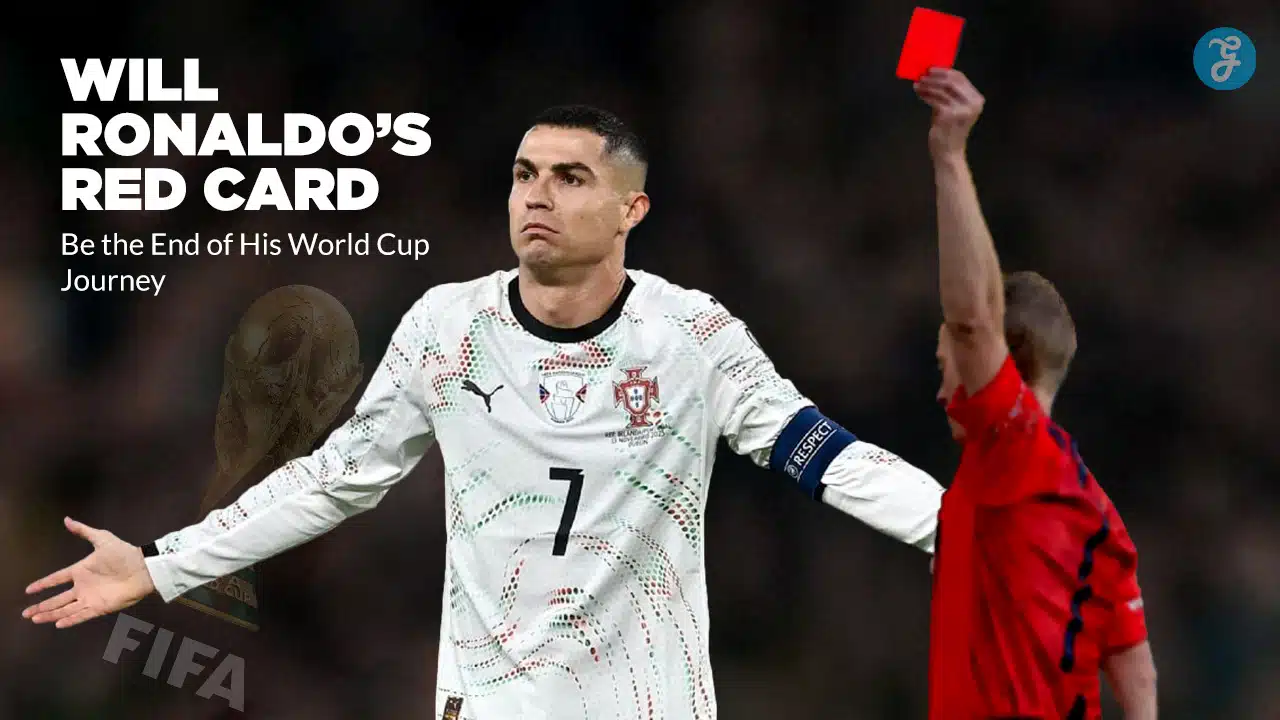
On 13 November 2025, in a pivotal qualifier for the 2026 FIFA World Cup, Ronaldo was sent off for the first time in his senior international career: an elbow on Ireland’s Dara O’Shea that, via VAR, was upgraded from yellow to red.
This incident presents numerous potential turning points: for Ronaldo personally, for the Portugal national football team’s qualification campaign, and for his global legacy. This article examines the likelihood that this event could mark an effective end to his World Cup journey—and if so, what the implications are.
This article provides a detailed analysis of FIFA’s disciplinary regime for red cards in qualifiers and World Cups, and it explains how it applies to this situation.
Key Takeaways
- Ronaldo’s red card could potentially shorten his World Cup journey and significantly increase the risk of his final bow becoming diminished.
- Portugal, while strong, now faces increased pressure in the qualifiers and group stage of the finals.
- Ronaldo’s past contributions are immense, but this incident occurs at a fragile juncture in his career (age 40, potential last World Cup).
- The disciplinary procedures ensure that even a single moment can affect multiple matches—and thus affect participation and legacy.
Portugal’s Qualification Chances: With or Without Ronaldo
Portugal is in UEFA Qualifying Group F for the 2026 World Cup. The group includes Portugal, Armenia, Hungary and the Republic of Ireland. The group winner qualifies directly; the runner‑up goes to the playoff round.
At the time of the red card incident:
-
Portugal had lost 2‑0 to Ireland (the match in question).
-
Ronaldo’s red card guarantees at least a one‑match suspension (the next match vs. Armenia).
Impact of Ronaldo’s Suspension
The question is how much Ronaldo’s absence, as he will definitely miss the next match against Armenia and possibly more depending on the severity of the ban, affects Portugal’s probability of direct qualification.
Let’s assess using available data and logical estimation:
Squad strength without Ronaldo
-
Portugal’s roster remains strong: players such as Diogo Costa (goalkeeper), Nuno Mendes (left defender), and the likes of Bruno Fernandes, João Felix, etc. are present.
-
That suggests Portugal is not wholly dependent on Ronaldo for qualification.
-
But in knockout or decisive group stage games, having a talisman like Ronaldo can swing outcomes.
Qualitative risk analysis
-
If Ronaldo misses just one match and Portugal wins comfortably, the damage would be minimal.
-
If Portugal stumbles (as they already did vs. Ireland) without him in the next match, then the risk of losing the top spot increases.
-
For instance, if Portugal draws or loses vs. Armenia, then Hungary or Ireland might overtake them.
Quantitative estimate (back‑of‑envelope)
-
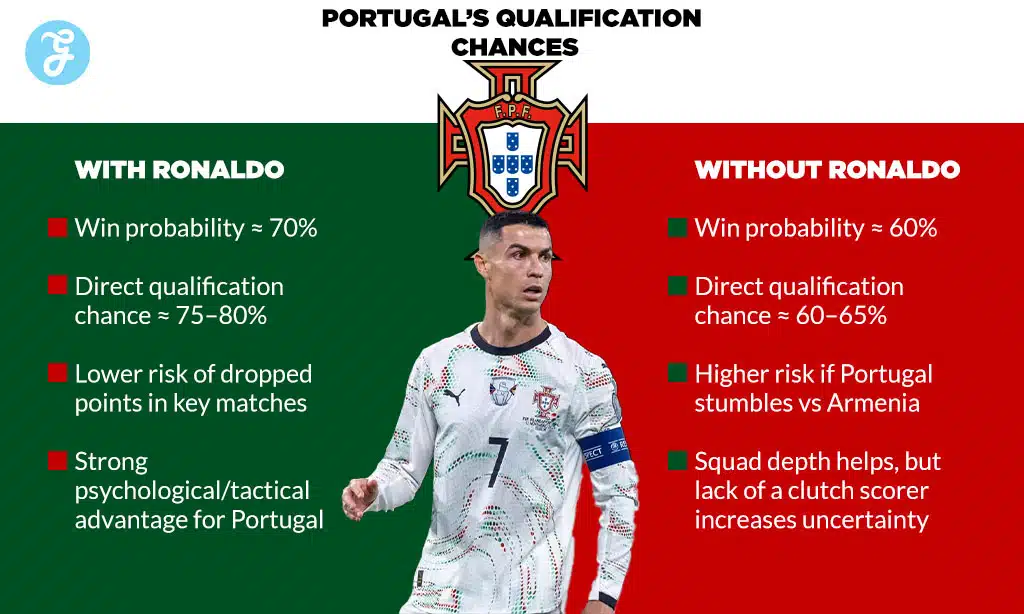
Suppose Portugal’s probability of winning a qualifier with Ronaldo is ~70% given their strength and opponent. Without Ronaldo, perhaps this falls to ~60%.
-
Losing a match has significant knock‑on effects: goal‑difference, head‑to‑head, and momentum.
-
Given only one more direct qualification place, any dropped points magnify risk.
While Portugal remains a favorite, Ronaldo’s suspension does increase the risk of not securing direct qualification—and therefore potentially limiting his presence at the finals.
Additional Variables
-
Ronaldo is 40 years old. So the margin for error is smaller. The team cannot entirely be built around a declining asset.
-
Opponents (Ireland, Hungary) will sense vulnerability and may raise performance.
-
The psychological impact on the squad: losing a captain to suspension shifts dynamics.
Verdict
If Portugal maintains form and wins the remaining matches, Ronaldo missing one or two games may not prevent qualification. But if they falter, his absence becomes a material risk to direct qualification—and by extension, his World Cup future.
Ronaldo’s Performance History in World Cups: How Pivotal Has He Been?
- Ronaldo has appeared in five World Cups (2006, 2010, 2014, 2018, 2022).
- He has scored 8 goals in World Cup finals tournaments.
- In qualifiers, he is the all‑time leading scorer for men’s international matches with 41 goals in World Cup qualifiers.
Role & Impact
- Ronaldo has been the face of Portugal’s attack for nearly two decades: his goals, presence, and leadership have anchored Portugal’s major tournament campaigns.
- However, his World Cup knockout record is less dominant than one might expect for his stature: some sources show that his contributions in knockout rounds are limited.
- For example, in the 2018 World Cup, he scored 4 goals (the most prolific of his tournaments) but Portugal still exited in the Round of 16.
Analytical Insight
- The data suggests that Ronaldo’s most substantial impact has been in qualifiers rather than World Cup finals. His ability to deliver goals to get Portugal into tournaments is very strong.
- In finals, the incremental value of one player diminishes: the team, tactical setup, and emerging stars matter.
- At age 40, while he still delivers at the club and international level, the expected marginal return may be decreasing.
Legacy Context
- Ronaldo’s participation meant Portugal could be built around his brand, his threat, and his global draw. That spurred sponsorship and attention.
- But if this World Cup is final for him (he signaled that might be the case). Then his ability to perform in finals is part of the legacy calculus.
Bottom line
Ronaldo remains a critical asset for Portugal, especially in qualification. However, his relative contribution in tournament finals is narrower. Thus, missing matches in a World Cup final—or missing the final altogether—would represent an important transition.
Scenario Analysis: What If Portugal Doesn’t Qualify or Ronaldo Is Banned?
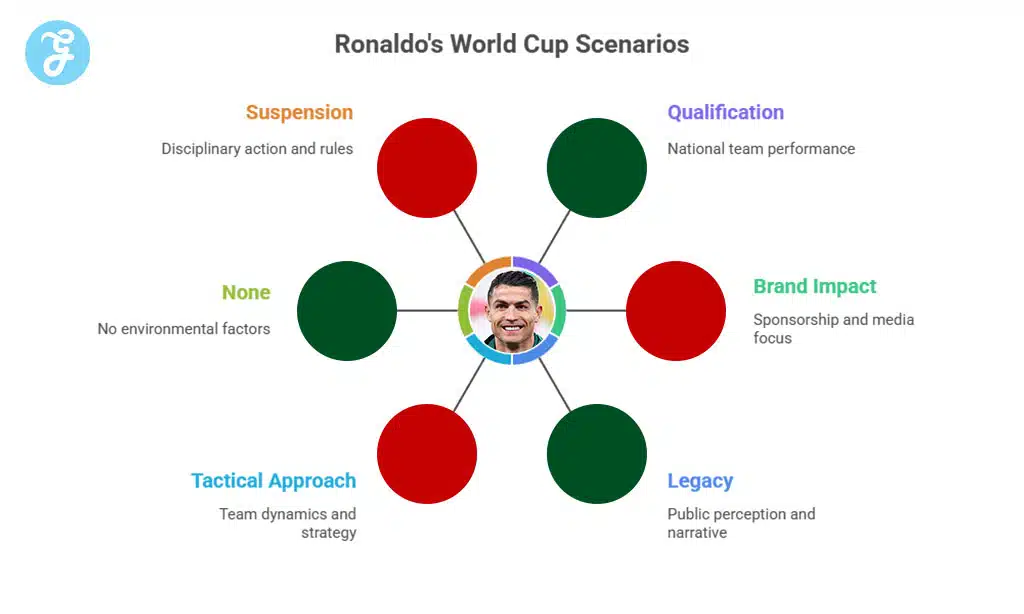
Here we map out three possible scenarios and assess implications for Ronaldo’s World Cup journey and legacy.
Scenario A: Portugal Qualifies; Ronaldo Serves Minimal Suspension (1‑game), Participates in Finals
What happens
-
Ronaldo returns in the group phase of 2026 and makes an appearance for his record sixth World Cup.
-
He may or may not feature prominently, but his presence is felt.
Implications
-
Legacy: the “Last Dance” narrative is intact. Even if not in peak form, the final appearance ensures a symbolically strong exit.
-
Commercial/branding: Continues global relevance—especially if he plays in the finals and possibly scores.
-
Risk: If he is fit but underperforms, critics may say his best days are done, but the absence of major injury or ban keeps the narrative positive.
Scenario B: Portugal qualifies; Ronaldo is Banned for 2‑3 games (e.g., first two group matches)
What happens
-
If the ban is for violent conduct (as appears likely), then a 3-match suspension could apply.
-
He may miss the group stage and possibly a knockout match depending on scheduling.
Implications
-
Legacy: He may appear in the tournament, but missing initial matches reduces his impact. The “farewell tour” metaphor starts to falter.
-
Team dynamics: Portugal may have to function without him in the early phase, shaping a different tactical approach.
-
Brand impact: Sponsors and media might shift focus to emerging stars rather than Ronaldo.
-
Risk: If Portugal falters without him early, it may tarnish his final chapter.
Scenario C: Portugal Fails to Qualify
What happens
-
If Portugal drops out of direct qualification and loses the playoff or fails entirely, Ronaldo’s career ends without that final World Cup appearance (or with minimal contribution).
Implications
-
Legacy: The “sixth World Cup” dream is deferred or undone. His international career ends one step short of a full finale.
-
Historical narrative: For a player of his caliber, missing the finals is a blemish—especially given his longevity and records.
-
Brand risk: Global exposure decreases; the narrative shifts from “still going strong” to “waning star clipped in final act.”
-
Strategic shift: Portugal will move into the post‑Ronaldo era; his role becomes symbolic rather than central.
Comparative Magnitude
-
The difference between Scenario A and C is large: from a successful farewell to an unceremonious exit.
-
Statistically, given Portugal’s strength, outright failure is unlikely, but possible. A missed qualification would represent a surprise shock and thus highly impactful.
-
The risk of absence in finals (via ban) is moderate given his age and the nature of the infraction.
Strategic Recommendation for Ronaldo/Portugal
-
Reduce additional risk by avoiding bookings, upholding discipline in the remaining qualifiers, and setting a positive example.
-
Transition plan: Portugal should prepare alternative attacking plans (without Ronaldo) to mitigate his absence.
-
Legacy management: Both player and federation should publicly frame the incident as isolated and reinforce Ronaldo’s positive contribution.
FIFA’s Disciplinary Procedures for Red Cards—Relevance to Ronaldo’s Case
Basic Rules
- A straight red card leads to an automatic minimum one‑match suspension in the next competitive fixture.
- For more serious offenses—“serious foul play” or “violent conduct”—the suspension can be extended (often two to three matches or more) depending on review.
- Yellow-card accumulations have different carry-over rules depending on stage and tournament.
Specifics to World Cup Qualifiers & Finals
- In UEFA qualifiers for the World Cup, a red card may result in suspension for the next qualifier or the next competitive match.
- The suspension can carry into the finals tournament if the offense occurs late in qualification.
Ronaldo’s Incident – Application
- The red card occurred in a qualifier against Republic of Ireland. Thus, the next match (vs. Armenia) is obviously impacted.
- The offense was described as elbowing—potentially “violent conduct” under the FIFA Charter. Various outlets report that a three‑match suspension may apply.
- The longer the suspension, the more likely it will extend into tournament group matches of the 2026 World Cup (should Portugal qualify).
Implications
- If Ronaldo is suspended for 3 matches and Portugal qualifies, he may miss their first two group games in the finals.
- That reduces his participation and maximum exposure at the showpiece.
- The federation and legal team will likely appeal or mitigate via reflection, but the risk is real.
Strategic Interpretation
- This is a classic case of governance risk in sport: elite athletes are not immune from rules, and the multi‑game suspension regime means even one incident can have cascading effects.
- For Ronaldo, the timing is critical: at his “farewell” World Cup, missing matches undermines the narrative.
- For Portugal, calendric discipline matters: they must build forward‑looking squad depth to ensure resilience against disciplinary shocks.
Final Words
Cristiano Ronaldo’s red card in Portugal’s World Cup qualifier against the Republic of Ireland represents far more than a moment of disciplinary error. It marks a potential turning point in the final chapter of one of football’s greatest careers. The consequences of his suspension—whether brief or prolonged—will undoubtedly ripple through Portugal’s World Cup qualification campaign and possibly the team’s performance in the tournament itself.
As we’ve seen, Ronaldo’s absence could significantly impact Portugal’s chances of qualification, especially given the high stakes and the group’s tight competition. While Portugal remains a formidable force, his leadership and goals are irreplaceable assets. Should Portugal qualify but Ronaldo miss key matches due to suspension, the team’s dynamic will inevitably shift, as will the global narrative surrounding his swan song on the world’s biggest stage.
More than just a player, Ronaldo has built a brand that transcends football. Whether he takes the field in 2026 or not, his legacy as one of the sport’s most influential icons is secured. However, the 2026 World Cup represents the final frontier in his footballing career—a platform that could either cement his legacy or leave unanswered questions.