Reshaping How We Learn In 2025 starts with a common worry, many lessons still feel one-size-fits-all. Students lose interest, some fall behind, and teachers drown in grading and admin, virtual classrooms and online learning can feel cold.
By 2025, artificial intelligence is central to education, it runs in schools from New York to Hyderabad, and helps build personalized learning with generative AI, virtual tutors, learning analytics, augmented reality and virtual reality.
This post will show how these tools cut teacher load, boost student engagement with gamified tasks and digital badges, and make remote learning kinder and fairer for all. Read on.
Key Takeaways
- By 2025, AI tools (generative AI, virtual tutors, AR/VR, learning analytics) run in schools worldwide, from New York to Hyderabad, reshaping personalized learning.
- Gamification, badges, and simulations raised engagement up to 60% and improved retention up to 40% in 2025 deployments.
- AI automates grading, attendance, and paperwork, freeing teachers for mentorship and cutting administrative load in Berlin, Houston, Atlanta, and Dublin.
- Programs like Tallinn AI Leap 2025 trained 3,000 teachers; Beijing mandates eight AI class hours per semester; California and New Jersey require AI literacy.
Customizing Learning with AI

Generative AI builds learning paths from user profiles and LMS logs, like a GPS for study routes. Instructional designers and edtech companies stitch AR, VR, adaptive quizzes, and career-focused curricula together, so students get fast feedback, real labs, and clearer next steps.
How can AI design tailored learning experiences?
AI analyzes student data and adapts lessons in real time to support personalized learning, acting like a coach that spots weak skills. In New York City, K-12 platforms assign individualized work and give faster feedback.
Vikas The Concept School in Hyderabad uses interactive dashboards to set practice and challenge levels for each learner. Mumbai schools use creative writing tools to spark curiosity and match topics to student interests.
Learning management systems automate learning paths, analyze performance, and flag gaps for instructional designers and teachers.
Parents in Miami and Melbourne use AI tools to support children with homework and study after school. Adaptive assessments replace standardized tests, and they show student growth more clearly.
In Atlanta and Dublin, AI grading platforms return rapid, targeted feedback to speed review cycles. Startups in San Francisco and Amsterdam build custom AI solutions that fit local curricula and learning spaces.
Instructional designers use LMS data, generative AI, and AR, VR tools to craft elearning modules, support continuing medical education, and scale to higher education or vocational training.
How do AI virtual tutors provide 24/7 learning assistance?
In Seattle, Toronto, and Bangalore, virtual tutors and conversational agents powered by artificial intelligence (ai) work around the clock, giving students on-demand help. Parents in Miami and Melbourne tap these tools after dinner and on weekends, for homework support and extra practice.
Speech recognition, machine translation, and natural language processing let the systems offer multilingual translation, so children from diverse backgrounds get answers in their language.
Montreal schools use real-time translation so immigrant students can join class talk and activities. LMSS and learning bots send alerts, give instant feedback, and flag gaps for instructional designers and teachers.
Think of a study buddy that never sleeps.
Generative AI, part of modern educational technology, runs inside LMSS. It automates grading, attendance, and routine paperwork, so teachers spend more time on mentorship and lesson plans.
Detailed reports from these platforms show trends in math, reading, and participation, they help instructional designers target weak spots and build personalized learning paths. Teachers use the data to coach students, to boost confidence and critical thinking.
That human touch remains vital, the technology supports, it does not replace expertise, empathy, or mentorship.
How does AI use AR, VR, and gamification to boost engagement?
AI mixes augmented reality (AR), virtual reality (VR), and gamification to make lessons stick. Schools in Dallas and Dubai run immersive simulations and virtual field trips for digital learning, where students explore ruins, experiment in labs, and practice complex tasks without risk.
AR overlays step-by-step instructions onto machinery repair, letting trainees complete repairs on real equipment, safely. In 2025, gamification became a major strategy; rankings, rewards, achievements, and progress tracking raised engagement up to 60% and improved retention up to 40%.
Head-mounted displays and mobile AR apps bring content close to learners, and Mumbai schools use creative AI apps to gamify art and coding, sparking creativity. Seventy percent of consumers see AR as enhancing skill development, pushing augmented training into vocational schools and higher education.
Video tutorials give on-demand, consistent lessons, with points, badges, and leaderboards built in. Gamified training uses simulations, role-playing, real-time scenarios, and multiplayer features for collaboration and competition.
Instructional designers tie generative ai, multimedia, learning management systems, and the metaverse together to scale personalized learning, teach applications of artificial intelligence, and build ai literacy.
What are real-time learning analytics and how do they help?
AI-driven learning analytics provide real-time progress insights in Boston, Cape Town, and Sydney. They track quizzes, modules, engagement, and time spent, so gaps show up fast. Think of this system like a fitness tracker for learning, it nudges teachers and students to act.
Educators receive instant alerts, and they adjust teaching strategies, moving beyond traditional report cards. Instructional designers and faculty in higher education use course platforms and visual reports to shape personalized learning.
Learning analytics from digital platforms inform instruction and improve outcomes.
Vikas The Concept School in Hyderabad runs AI-powered dashboards that enable immersive, data-driven learning. Cloud learning gives managers real-time monitoring, and it highlights employee performance and improvement areas.
Reports generated by artificial intelligence (ai) let instructors target and support students who fall behind on key modules. Learning analytics platforms and predictive analytics models flag risks, and they suggest next steps for remediation.
Continuous feedback and data-driven refinement improve training programs, raising outcomes for schools and workplaces. Educational technology connects to networks, cookies, and data visualization tools, which help with fact-checking and ethical review.
How is AI expanding access and inclusivity in education?
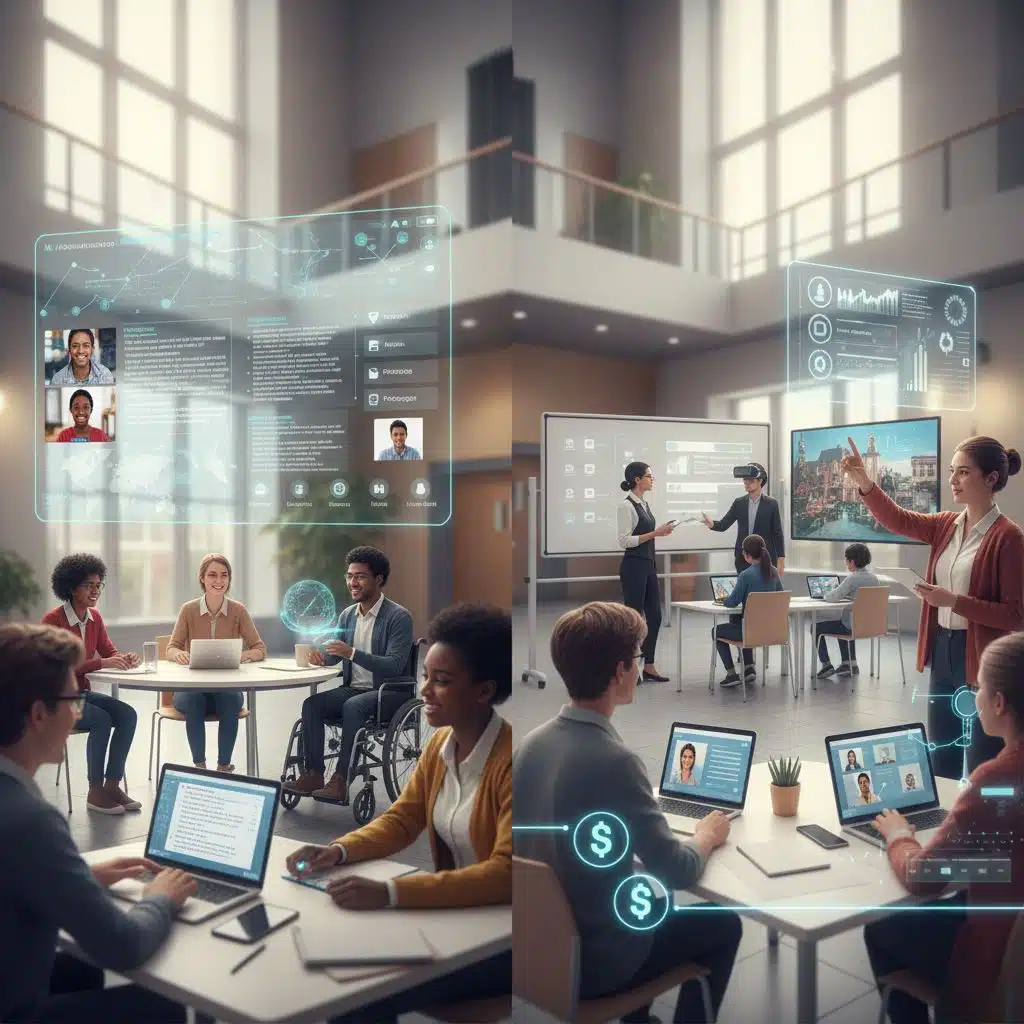
Schools use multilingual translation, so children from diverse backgrounds access lessons in their home languages. Montreal offers real-time translation, and immigrant students join class discussions and group work.
Nairobi and Lisbon schools deploy speech-to-text tools to help hearing-impaired students, and mobility apps assist students with limited movement. In 2025, remote learning platforms include multiple languages, screen readers, captioning, and sign language as standard features.
Remote learning raises flexibility, it removes barriers for students with diverse needs across higher education and K-12 via the internet.
California and New Jersey now require AI literacy in curriculums to ready students for job markets shaped by artificial intelligence (ai). Instructional designers and educational technology teams use touchpoints from digital learning platforms, generative ai, ar and vr to craft personalized learning paths, while keeping an eye on ai ethics.
Hybrid models blend online and in-person time, they boost accessibility and keep human connections that fuel deeper learning. Instructional technology groups debate facial recognition, standardized testing shifts, and the promise of blockchain technology for secure records.
Employee-centered programs, virtual tutors, automating captioning, and emotional intelligence training help make digital learning fairer, more interactive, and sustainable.
How does AI streamline administrative tasks in schools?
Artificial intelligence (ai) cuts paperwork and saves time. It automates lesson planning and school operations, reducing teacher burnout in resource-scarce areas. In Berlin and Houston, systems handle scheduling, attendance, grading, and electronic communications.
Grade automation tools in Atlanta and Dublin supply rapid feedback, freeing teachers for one-on-one support.
Learning management systems, linked to student records systems and analytics dashboards, route data to leaders. AI-generated reports let administrators spot trends and target interventions fast.
Generative ai drafts lessons, and instructional designers tune them for personalized learning in higher education and K-12 digital learning. Cloud platforms and modern information technologies reshape employee education strategies, improving operational efficiency, and analytics support continuous improvement through automated data collection and analysis.
How can educators collaborate effectively with AI?
Educators in Seoul and Chicago treat artificial intelligence (ai) as a partner for lesson planning, and for tracking student engagement. Instructional designers and higher education faculty use learning platforms, conversational agents, data dashboards, and AI tutoring systems to build digital learning paths that support personalized learning.
The AI Leap 2025 in Tallinn, Estonia, trains 3,000 teachers in AI-based software, a big push for classroom skills. Professional development programs in Copenhagen and Warsaw focus on hands-on work with educational technology and generative ai tools.
Teachers in Melbourne and Chicago rewrite assessment policies to keep grading fair as classroom ai use grows.
Schools, colleges, and businesses form partnerships that link courses to workforce needs and high-tech vocational training. Teachers embed soft skills via projects, debates, and problem solving, while institutions add experiential learning and mentorship alongside AR and VR kits, augmented reality (ar) and virtual reality (vr).
Organizations adapt training for the digital age, they adopt tech-driven, flexible programs to build workforce skills and to match modern educational technology. A teacher in Chicago drafts prompts with generative AI content tools, tests them in class using augmented reality (ar) and virtual reality (vr), then refines tasks with student feedback.
What essential AI literacy skills should students learn?
Students must learn core concepts like machine learning, data literacy, model evaluation, and ethics in artificial intelligence (ai). Classrooms in Sacramento, Pune, and Edinburgh already teach these foundational topics and real applications.
State policies in California and New Jersey now require AI literacy in curricula. Vocational schools in Delhi and London focus on practical skills, so graduates can get jobs using AI tools.
High schools and colleges in Mumbai and New York add AI-driven upskilling to courses by 2025. Learners should practice prompt engineering, basic Python, and using Jupyter Notebook, plus open source frameworks for experiments.
Instructional designers and higher education teams use educational technology to build personalized learning paths and digital learning experiences. Generative AI, augmented reality (ar), and conversational AI tools support on-demand tutoring, while post-secondary programs make workforce training common.
Students set goals, steer study plans with AI, and use modular online platforms for flexible, lifelong upskilling. Ethics, bias detection, and knowing AI limits remain essential skills for safe, responsible use.
How does AI support lifelong learning and career development?
AI tools power continuous professional development, CPD. Remote learning cuts costs and scales training, versus in-person classes. Online workshops and webinars teach technical and soft skills, on demand.
Microlearning and nanolearning break lessons into short, active chunks, like Duolingo. Cloud academies and virtual workspaces give safe, hands-on labs for practice. These systems use artificial intelligence (ai) and generative ai to create personalized learning paths, and to give fast feedback, like a coach in your pocket.
VR simulators and AR labs let people rehearse real work, ideal for technicians. Gamification drives mastery in cybersecurity and troubleshooting, and boosts motivation. Higher education and instructional designers adopt educational technology and digital learning in courses.
Companies that invest in AI, VR, and online learning gain an edge in the tech industry, and in hiring. In 2025 remote learning moves to the center of workforce development, changing how careers grow.
Instructional designers use these digital tools to help career shifts, promote skill stacking, and shorten training cycles.
What ethical challenges arise with AI in education?
Student data leaks can harm trust, and that risk grows with digital learning platforms. Toronto and Johannesburg report gaps in access, and those gaps show who gains from personalized learning.
Administrators in Mexico City and London write policies to protect records, and to guide artificial intelligence (ai) use. Machine learning models can grade essays fast, yet algorithmic bias can misread dialects or cultural references, like a blunt tool at a craft fair.
Instructional designers must audit fairness, they tweak adaptive learning platforms and learning platform settings. Proctoring software and plagiarism detectors help catch cheating, but they also raise privacy and bias concerns.
Students, parents, and faculty demand clear rules, for safeguarding well being and belonging.
Academic integrity worries rise, many students lean on natural language processing chat assistants for essays. Teachers in Melbourne and Chicago change tests and rubrics, to keep grading fair and valid.
Higher education programs train faculty on audit trails, they review logs from learning platform dashboards. Deep models can reflect bias, and data anonymization tools plus auditing routines must run often.
Instructional designers and policymakers must work together, parents should join the conversation too. Human instructors still matter, they bring empathy, context, and flexible help that algorithms miss.
City officials in London and Mexico City share templates, they help districts adopt responsible approaches.
What are some global case studies of AI transforming teaching?
These case studies show how AI reshapes classrooms worldwide. They offer clear models for higher education, instructional designers, educational technology, and digital learning leaders, and yes, teachers smile.
- Vikas The Concept School in Hyderabad uses AI dashboards and immersive learning labs, giving teachers real-time data and students AR modules. Instructional designers use data to craft personalized learning paths.
- Beijing’s universal AI curriculum mandates at least eight class hours per semester, reaching millions of primary and secondary pupils. The policy scales digital learning and trains educators in basic AI skills.
- Tallinn’s AI Leap 2025 trained 3,000 teachers and reached over 20,000 students, with plans for rapid expansion. OpenAI and Anthropic helped build classroom apps that aid instructional designers.
- Mumbai and New York embed AI-driven upskilling across high school and college programs, linking learners to industry skills. Higher education partners pilot micro-credentials and modular digital learning stacks.
- San Francisco and Amsterdam craft custom AI solutions, including recommendation engines and virtual tutors, tuned for local curricula. Instructional designers run pilots, then scale proven tools.
- Berlin and Houston deploy AI to cut paperwork, speed enrollment, and optimize schedules, freeing staff for teaching. Educational technology platforms automate admin tasks and surface learning analytics.
- Nairobi and Lisbon use AI-driven assistive apps, like speech-to-text and adaptive interfaces, to boost inclusivity for students with disabilities. These tools support personalized learning and classroom access.
- OpenAI and Anthropic partner with leaders in Tallinn, Mumbai, and San Francisco to build next-gen learning apps and virtual assistants. Schools test these tools for scalable, classroom-ready personalized learning.
What does the future of AI-integrated learning environments look like?
Classrooms will blend AI, AR, VR, and gamification to make learning active and hands-on, moving away from one-size-fits-all models. Adaptive engines in LMS and cloud platforms will push microlearning units, skills-based learning tracks, and on-demand virtual tutors that never sleep, so students progress at their own pace.
Learning analytics will feed instructors clear insights, helping instructional designers and higher education faculty tweak lessons, boost outcomes, and map skills to jobs.
Hybrid models will mix online and in-person formats, giving flexibility and wider access to diverse learners. Large language models, neural libraries, game engines, and mixed reality hardware will power simulations, while partnerships among schools, corporations, educational technology firms, and EdTech providers will scale pilots into campus-wide programs.
Human-centered skills like critical thinking, creativity, and communication will stay central, and instructional designers will use digital learning tools to align curricula with real workplace needs in 2025.
Takeaways
14. Conclusion: AI shapes learning across schools and higher education. Instructional designers use machine learning, natural language processing, and learning analytics to craft smarter lessons.
Teachers rely on virtual tutors, conversational agents, AR, VR, and learning platforms for on demand help. Yes, AI does heavy lifting, but teachers keep the heart of learning. Cities from New York to Bangalore show quick wins, and schools add AI literacy to prepare students for future jobs.
FAQs on Reshaping How We Learn in 2025
1. What is AI doing in education in 2025?
AI helps teach, grade, and coach students, it speeds up work for teachers, it finds where students struggle. It works in higher education and in schools, it builds lessons and pulls data to guide choices.
2. Will AI replace teachers?
No, AI will not take over classrooms. It acts like a power tool, not the carpenter, it gives fast feedback, it frees teachers to do human work, like explaining, mentoring, and setting goals.
3. Is student data safe with AI?
Safety depends on rules, and on clear limits, schools must remove names, and follow privacy laws. Technical guards, audits, and human checks help keep data private.
4. How will AI change learning outcomes by 2025?
Students will get more personal help, they will learn at their own pace, teachers will spot gaps sooner. Costs may drop, access may grow, and more people can join higher education, with better support.