It is another January in India.
The air is cold in the mornings. Crisp in the evenings too. But in every part of the country, something warmer is happening inside people’s hearts. People are talking. Smiling. Walking with a hint of pride. They are talking about Republic Day. Republic Day is more than a date. More than a holiday. More than a parade on Rajpath. It is a day that feels like the soul of India itself, a day when the Republic Day Padma Awards remind the nation that service, sacrifice, and quiet contribution matter as much as power or fame. It reminds us that India’s people, all of them, matter. That the Constitution of India is not just words on paper. That every citizen has rights. Duties. And dignity.
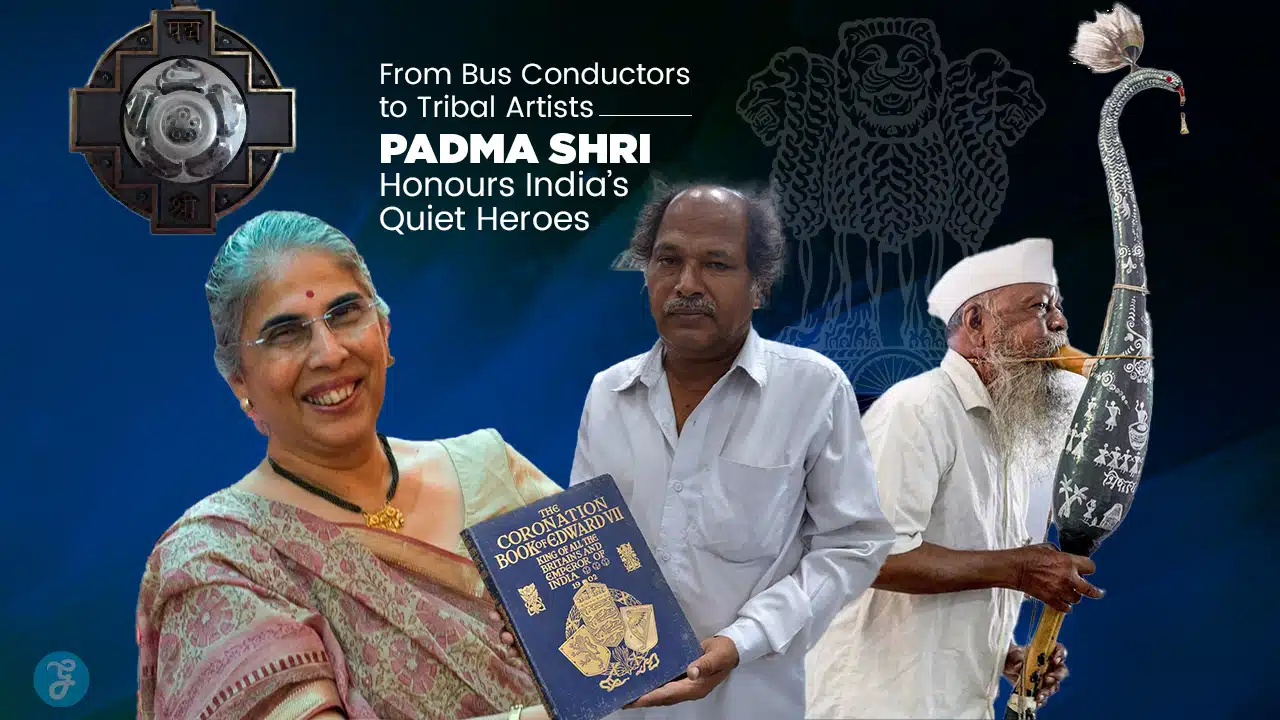
This year, like every year, Republic Day brought with it the announcement of the Padma Awards, and this year’s Padma Awards, in particular, reflected a deeper idea of honour rooted in service, persistence, and quiet contribution rather than fame. These are some of India’s oldest and most respected civilian honours, recognising people who have, in ordinary or extraordinary ways, made India better.
But this year, something special happened. The names that came out were not just famous leaders or big names in the media. Instead, among the list were people whose stories felt like the heartbeat of the nation.
People with humble beginnings. People whose work changed lives quietly. People who never asked for glory. And that is what made this Republic Day so unforgettable.
Let me tell you about three of them.
Republic Day Padma Awards: Anke Gowda, The Bus Conductor Who Built a Library for All
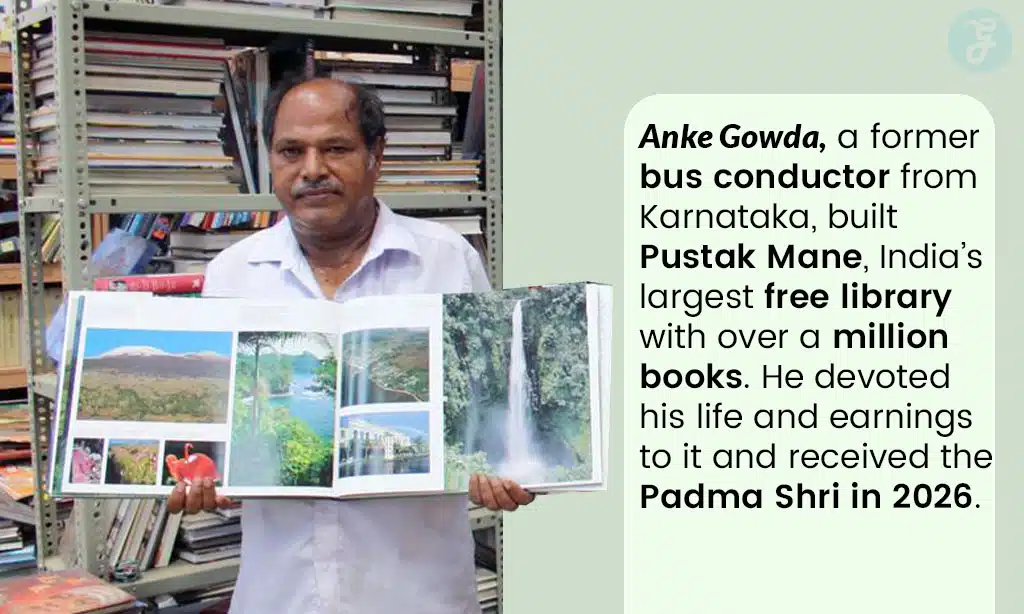
In the state of Karnataka, in a small village called Haralahalli near Mysuru, lives a man named Anke Gowda.
Most of his life, he was an ordinary working man. He worked as a bus conductor in his youth.
Then he worked at a sugar factory. He lived simply. But he had one great love… books.
At the age of 20, when he first started working, he began collecting books. Books on literature. Science. Philosophy. History. Almost every subject. Slowly, his collection kept growing. Soon, it outgrew his home. So he built a space to house them… and he called it Pustak Mane, which means House of Books.
This was no ordinary library. Within decades, it became what many media reports now call India’s largest free-access library. It holds over a million books in more than 20 languages, including rare foreign books and manuscripts.
People come from everywhere to read and learn. Students preparing for exams. Researchers studying ancient texts. Writers and thinkers. Even civil service aspirants and scholars consult books here.
Anke didn’t stop there. He put no fees on his library. No one needs a membership card.
Anyone can walk in and read.
To fund this dream, Anke spent most of his income over five decades buying books. He even sold his own house in Mysuru to expand the library.
On Republic Day, the Government of India honoured him with the Padma Shri, one of the nation’s highest civilian awards. A man who came from humble beginnings, now recognised for creating a sanctuary of knowledge for all.
And Anke Gowda still lives amid his books. Quietly guarding them. Quietly welcoming visitors. Quietly believing that books should be free for everyone.
Dr Armida Fernandes: The Doctor Who Helped Babies Live Better Lives
In the bustling city of Mumbai, another story of quiet determination unfolded.
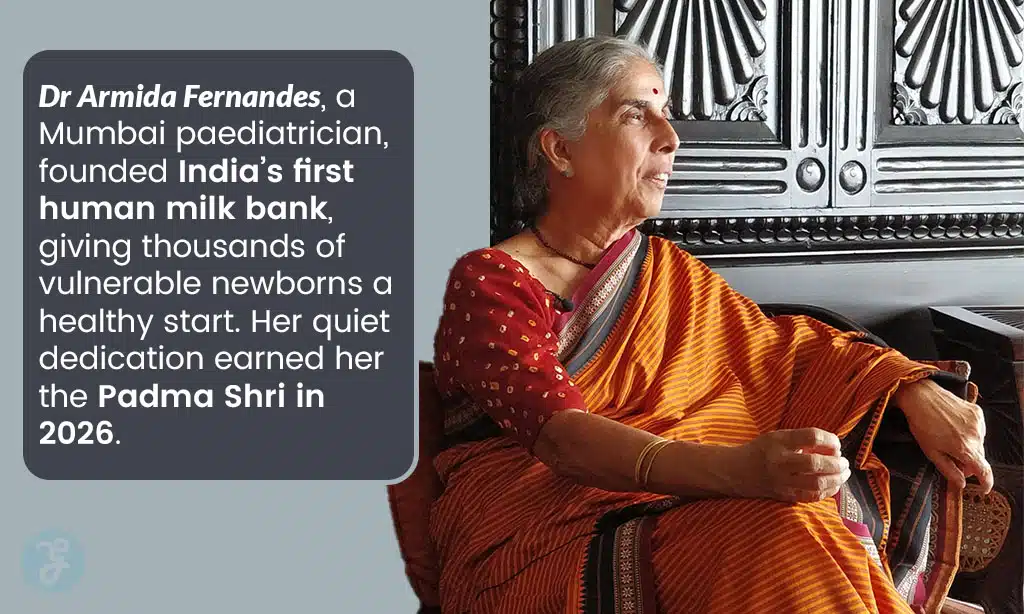
Here lives Dr Armida Fernandes, a paediatrician whose work has saved countless lives, though few outside medical circles knew her name until now.
Dr Fernandes had a simple belief: Every baby deserves a strong start in life. In many hospitals, when newborns are too weak or premature, formula milk is an option. It helps, but it isn’t the natural nourishment a mother’s milk provides. Breast milk has nutrients, antibodies, and life itself.
So Dr Fernandes helped create something new in India, Asia’s first human milk bank.
A human milk bank is a place where healthy mothers donate their breast milk. The milk is carefully screened and processed. Then it is given to newborns who desperately need it, babies whose mothers cannot produce enough, or whose tiny bodies struggle to survive without that nourishment.
Because of this milk bank, thousands of infants now have a fighting chance. They grow stronger. They live longer. Families have hope.
Dr Fernandes never set out to make headlines. She just saw a need. And met it. She worked quietly. She worked persistently. And on Republic Day, she too stood with other Padma Shri awardees, recognised for her life-saving contribution.
Bhiklya Ladakya Dhinda: The Tribal Musician Who Kept a Cultural Beat Alive
Then there is Bhiklya Ladakya Dhinda, a name that may be unfamiliar to many, but now is etched in the nation’s memory.
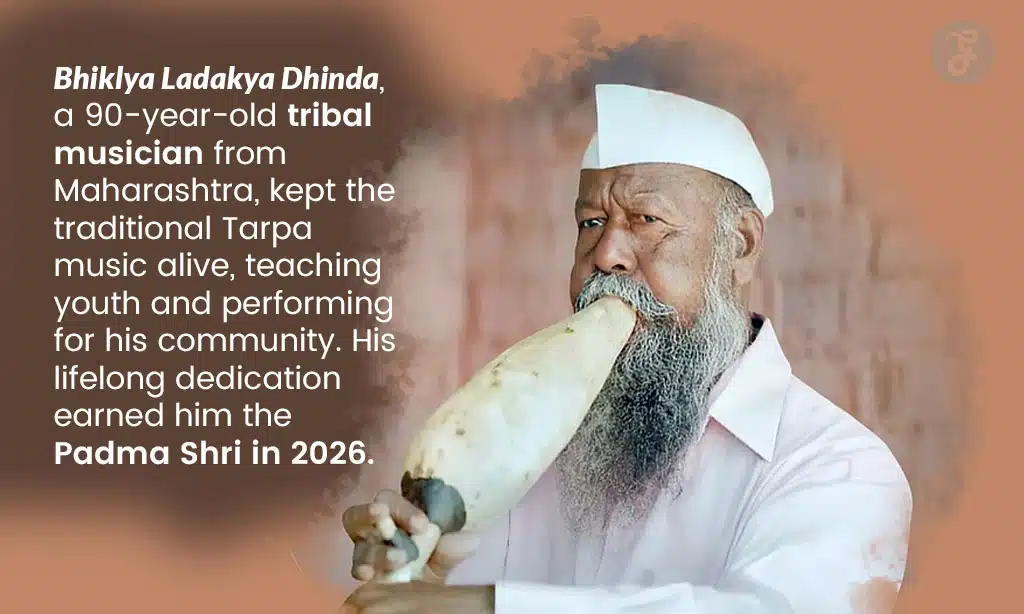
Bhiklya is a 90-year-old tribal musician from Maharashtra. He plays the Tarpa, a traditional instrument made of bottle gourd and bamboo that produces rich, rhythmic tones unique to his community. For decades, as modern music grew louder and more global, instruments like the Tarpa risked fading into silence. But not with Bhiklya around.
Every day, he played. At festivals. At gatherings. For children who had never heard this music before. For neighbours. For anyone willing to listen.
He did not play for fame. He did not seek awards. He played because the music was part of who he was, and part of where he came from.
He taught young people how to hold the instrument. How to breathe with the beat. How to make the sound rise from silence. He became a living link between his community’s past and its future.
On Republic Day, the nation recognised his lifelong devotion and awarded him the Padma Shri.
At 90, his story reminds us that culture is a living thing. Not something only preserved in museums or textbooks. But something that survives when people choose to keep it alive.
What These Stories Tell Us
These three lives have nothing in common on the surface. A bus conductor. A doctor. A tribal artist.
But dig deeper, and their stories converge. They all served others. Not for money. Not for praise. Not for fame.
They served because they could make a difference. They stepped up when no one asked them to. They believed that life was more than just routines. And that belief changed thousands of lives.
This is what Republic Day is rooted in. On January 26, 1950, India became a republic. Not just free, but governed by its people, under a constitution they built for themselves. A constitution that declares every citizen equal. Every voice is valuable. Every life is meaningful.
And when the nation announces honours like the Padma Awards, it isn’t just giving medals.
It is telling everyone: “We see you. We hear you. We value you.”
This year, that message rang louder than ever. In a world where many voices shout for attention, these quiet heroes stood out. Not for noise. But for impact.
Republic Day Across India
Across India, Republic Day was celebrated with the usual grandeur. There were parades. Flags. Music. And cheers.
In New Delhi, children stood with their parents on Rajpath. Soldiers marched in perfect formation. The national flag unfurled at sunrise. The songs of the nation filled the air.
But there were smaller moments too. In tiny villages, children saluted the flag with pride. In towns, teachers explained the Constitution to their students. In homes, families sat down to watch the parade on television. And in hospitals, libraries, and community centres, ordinary citizens continued their work.
This is Republic Day. A day that belongs to everyone. It is not just about grand gestures. But the small acts that shape a nation.
Because a nation is not its buildings alone.
It is not its laws. It is its people.
The millions of people who wake up each day and choose, choose to help, to build, to protect, to teach, to heal, to create. That choice, repeated millions of times, makes a republic.
And that is why Republic Day matters.
Why Stories Like These Matter
In India, we hear news every day. Some of it is good. Some of it is bad. Most of it in between.
But stories like Anke’s. Like Dr Fernandes’. Like Bhiklya’s. They remind us of something real.
They remind us that greatness does not always come from power. Often, it comes from purpose. That serving others doesn’t require a title. Just a willingness to act.
That even the quietest life can inspire millions.
When you read these stories, you don’t just feel pride for the nation. You feel belief in people. In humanity. What can happen when someone says, “I can help.” And does.
Republic Day is a celebration of that. Not just of history. Not just of institutions. But of human potential.
Every time a person lifts another up… intellectually, socially, emotionally, the Republic Day spirit lives on.
So this Republic Day…
Take a moment.
Remember what it stands for.
Not just parades.
Not just awards.
Not just speeches.
Remember the people. The millions of Indians building a better tomorrow. People like those honoured with the Padma Shri this year, unsung heroes, whose work may not make front pages every day, but whose impact shines brighter than any headline.
Ordinary people doing extraordinary things. Serving without seeking. Giving without wanting in return. Making lives better.
That is the real story of Republic Day.