

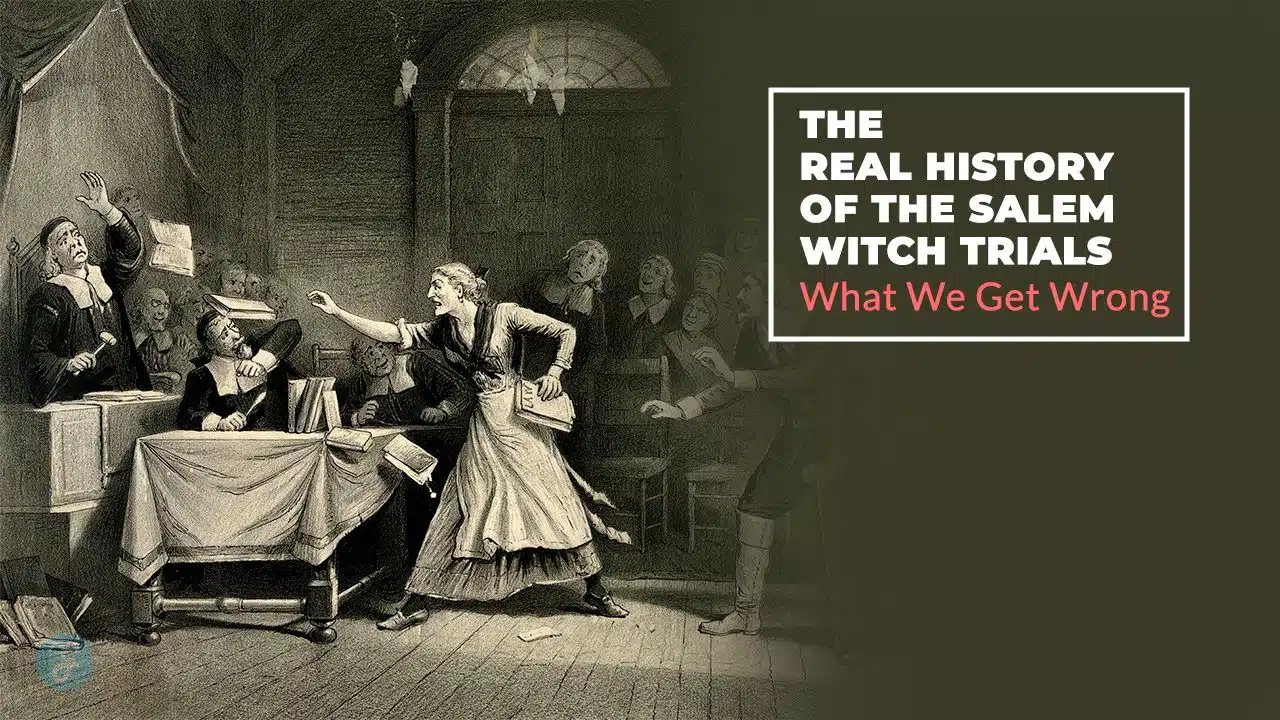
The story of the Salem Witch Trials (1692–1693) has captured public imagination for centuries. Images of wild hysteria, witches tied to stakes, and children pointing with terror swirl in our minds. But many of those images are more myth than fact.
When we strip away the dramatized versions, the true history reveals a complex mixture of social tension, religious fear, legal breakdown, and human tragedy.
Salem witch trials, witch‑hunt, colonial Massachusetts, spectral evidence, witchcraft accusations, Puritan society, and colonial justice.
Colonial Massachusetts in 1692
To understand what happened at Salem, we must first look at the broader setting — the society, the legal system, and the cultural climate.
Puritan Society & Frontier Tensions
- The events happened in the Salem Village (now Danvers, Massachusetts) and surrounding towns in the Massachusetts Bay Colony.
- This was a Puritan society: strict religious beliefs, strong sense of communal conformity, fear of the devil and witchcraft.
- At the same time, frontier pressures loomed: the region faced threats from Native American conflicts, economic strain in farms, land‐ownership disputes and divisions between “village” and “town” sectors.
Legal & Cultural Background on Witchcraft
- Witchcraft was a crime under colonial law. The idea of the devil, of witches harming others through supernatural means, was taken seriously in 17th‑century New England.
- The legal norms, however, were not as robust as modern systems: some evidentiary standards were weak or unusual (we’ll explore that in section 4).
- Importantly: The major wave of witch‐hunting in Europe had mostly passed by this time, but the cultural idea of witchcraft still resonated in America.
In sum: the community was vulnerable — belief in witchcraft existed, social tensions were present, the legal framework was pliable. That combination set the stage.
What Actually Happened: Timeline, Numbers & Key Players
Timeline of the Crisis
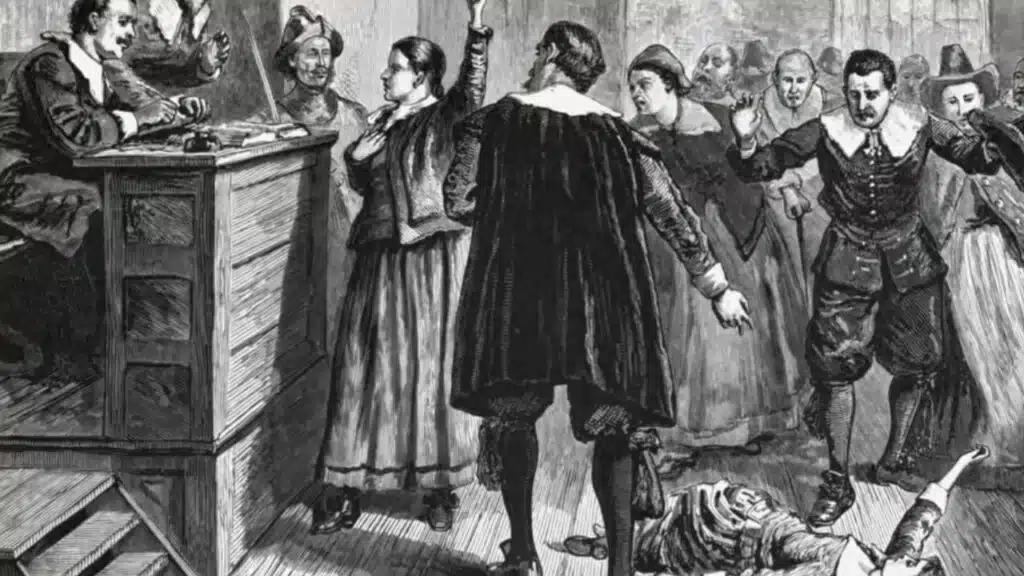
- February 1692: Several young girls in Salem Village (like Betty Parris and Abigail Williams) began having inexplicable fits and claiming affliction.
- March 1692: The first formal accusations were made — e.g., Tituba (an enslaved woman in Salem Village), Sarah Good and Sarah Osborne.
- June 10, 1692: The first person executed: Bridget Bishop.
- Summer to autumn 1692: The hysteria spread. A special court (the Court of Oyer and Terminer) heard many cases. Executions took place.
- October 1692: Governor William Phips dissolved the special court and reformed the process.
- Spring 1693: The wave largely ended; many freed, public opinion changed.
Key Numbers & Data
| Metric | Detail |
| Estimated number of accused | More than ~200 people. |
| Number of executions | At least 19 hanged (14 women, 5 men) + 1 pressed to death (Giles Corey) in the Salem wave. |
| Number who died in prison | At least 5 died in jail. |
| Major period of activity | February 1692 to May 1693. |
Some Key People
- Tituba: enslaved woman, one of the first to be accused and to confess.
- Bridget Bishop: first person executed.
- Giles Corey: refused to plead, was pressed to death.
Understanding these facts gives a real foundation — not myth or legend.
What We Often Get Wrong: Myth vs Reality
Many widely held beliefs about Salem are incorrect. Let’s unpack several of them.
Myth 1: “They burned witches at the stake.”
Reality: Not in Salem. The executions were by hanging (and one by pressing). No one was burned alive.
Why it matters: The burn‑at‑the‑stake image comes from European witch trials, not this American case. Using that myth skews understanding of colonial justice.
Myth 2: “Only women were accused.”
Reality: While women made up the majority, men were also accused and executed.
Why it matters: It reveals the witch‑hunt was less about gender alone, and more about social dynamics and perceived threat.
Myth 3: “Only one village was involved.”
Reality: Although Salem Village was central, accusations spread across many towns in Massachusetts Bay Colony.
Why it matters: It points to regional structural issues rather than isolated local hysteria.
Myth 4: “It dragged on for years.”
Reality: The main burst lasted about one year (1692‑93).
Why it matters: Recognising the speed underlines how swiftly social panic can escalate and then be checked.
Myth 5: “The accused were all witches, folk healers, strange outsiders.”
Reality: Many accused were ordinary community members; the accusations often sprung from neighbour disputes, property issues, and fear, not necessarily from proven occult practices.
Why it matters: It shifts the narrative from supernatural fantasy to social processes: scapegoating, social stress, legal vulnerability.
By identifying these misunderstandings, the reader can approach Salem with a clearer, fact‑based lens.
Deeper Causes: Why Did the Witch Trials Happen?
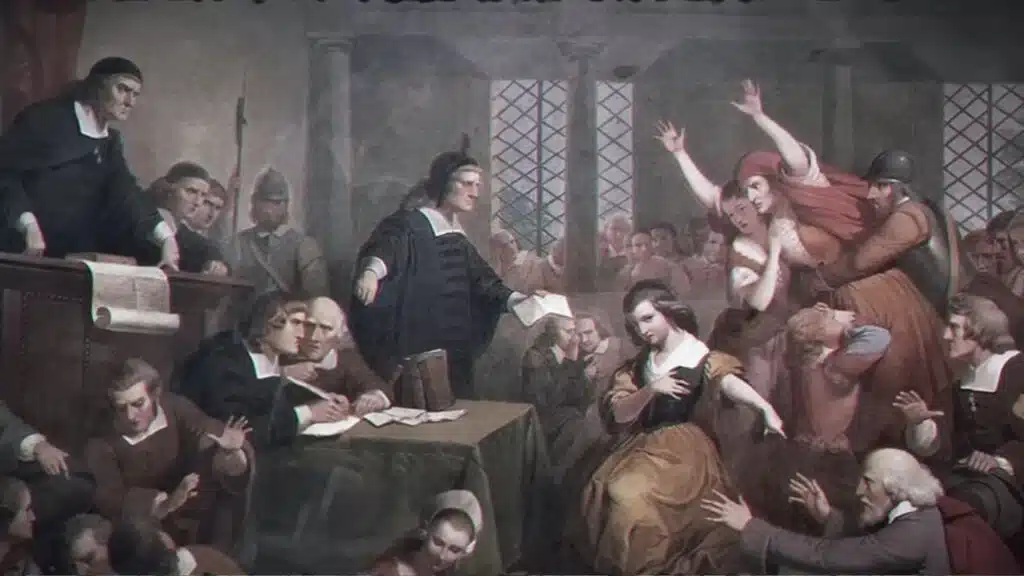
To avoid shallow explanations, we dig deeper into the root‑causes. I’ll break them into three key pillars: legal/institutional, social/community, and cultural/psychological.
Legal & Institutional Pillar
- Spectral evidence: Courts accepted “testimony” that the accused’s spirit or spectre appeared to the afflicted. This kind of proof would be inconceivable today.
- Court of Oyer and Terminer: A special court set up to hear witchcraft cases. It operated with lax standards and a presumption of guilt.
- Weak safeguards: Accused lacked good legal defence, given the assumptions of evil and the supernatural. The normal rule of “innocent until proven guilty” was stretched.
Social & Community Pillar
- Land and economic stress: Salem Village was under pressure — dividing land, younger members wanting property, older ones holding on. These strains fuelled tensions.
- Church membership and identity: Being a full church member mattered socially and economically. The village had divisions between members and non‑members.
- Neighbour disputes: Many accusations can be traced to personal conflicts — someone slighted someone else, someone lost livestock, someone blamed an “evil eye”. These micro‑conflicts scaled.
Cultural & Psychological Pillar
- Religious belief in the devil and witchcraft: Puritans believed literal evil forces were at work. That mindset made accusations credible.
- Mass hysteria and suggestion: When a few began to have fits, it triggered others; the community entered a feedback loop of fear, accusation, reaction.
- Scapegoating: In times of instability, societies often find internal scapegoats. The witch trials can be read as a way in which a community under stress off‑loaded its anxieties onto real people.
Why Did It Escalate So Fast?
Because all three pillars aligned: the legal structure permitted extraordinary evidence, the social framework was tense, and the cultural expectation of evil made the fear credible. Once the first accusations surfaced, it allowed the system to spiral.
The End, Aftermath & Legacy
How the Panic Ended
- Public and elite opinion turned: leading ministers and legal voices (e.g., Increase Mather) challenged the validity of spectral evidence.
- Governor William Phips disbanded the special court (October 1692) and replaced it. The new court forbade spectral evidence.
- By spring 1693 most remaining accused were released, trials waned.
Aftermath: Redress and Reflection
- In 1711 the colony passed legislation restoring the good names of convicted witches and provided compensation.
- As late as 1957, Massachusetts formally issued an apology.
- The event became a cautionary tale about justice, fear and mass‑hysteria.
Why It Still Matters
- Symbol of injustice: The Salem Witch Trials show what happens when legal process, rational evidence and due‑process are compromised.
- Cultural metaphor: “Witch‑hunt” now serves as a metaphor for political or social persecution without basis.
- Historic reflection: For a modern audience — including your Editorialge readers — the story speaks to how communities handle fear, difference, rejection, and legal fairness.
Key Facts at a Glance
Here’s a reader‑friendly table summarizing the major facts we’ve covered. Good for quick reference and shareable on social media.
| Item | Detail |
| Years of main activity | 1692–1693. |
| Estimated number of accused | More than 200. |
| Number executed | At least 19 hanged + 1 pressed to death (≈20). |
| Number who died in jail without formal execution | At least 5. |
| First person executed | Bridget Bishop, June 10 1692. |
| Major legal shift | October 1692: special court dissolved and spectral evidence banned. |
| Formal public apology / name clearing | 1711 compensation legislation; 1957 formal apology. |
Takeaways
The Salem Witch Trials are far more than a historical oddity or a Halloween tale. They were a real crisis of justice, religion and community in colonial America. When we peel away the myths — stones, stakes, floating tests — we arrive at a deeper truth: a society under pressure, a legal system ill‑equipped for mass panic, and a community that turned fear into accusation.
In short: Witches were not burned at the stake in Salem; men as well as women were accused; the legal system failed many innocent people; the panic lasted only about a year; and the legacy continues in our understanding of justice and fear.






























