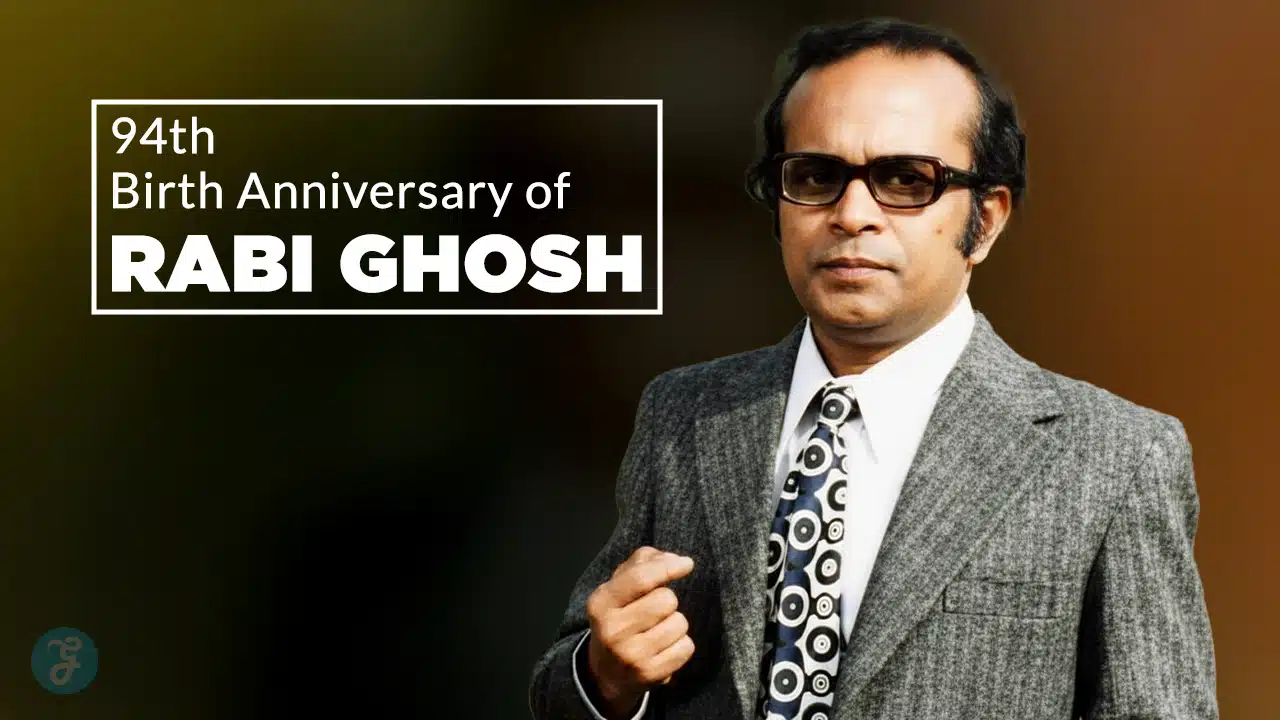
On a winter evening, many homes in Bengal still play Goopy Gyne Bagha Byne. Goopy sings. The ghosts dance. And beside him stands a thin man with a dhol, big eyes and a half-nervous smile.
That man is Bagha. That man is Rabi Ghosh.
Even before he speaks, we smile. That is the power of his presence.
Every year, on 24 November, fans and film lovers mark Rabi Ghosh’s birth anniversary. He was born on 24 November 1931 in Calcutta (now Kolkata). He passed away on 4 February 1997, but his work has not faded. His roles live on in films, TV reruns, YouTube clips, festival screenings and now in 4K restorations of classics.
Who Was Rabi Ghosh and Why He Still Matters
Rabi Ghosh (full name Robindra Nath Ghosh Dostidar) was one of the most loved Bengali actors of the 20th century. Most people remember him as a comic actor, but he was much more:
- A serious theatre performer
- A sharp and sensitive character actor
- A key part of the worlds created by Satyajit Ray, Tapan Sinha and others
Key facts at a glance
| Key Fact | Details |
| Full name | Robindra Nath Ghosh Dostidar (popularly Rabi or Robi Ghosh) |
| Birth | 24 November 1931, Calcutta, Bengal Presidency (British India) |
| Death | 4 February 1997, Kolkata, West Bengal |
| Main professions | Film and theatre actor, occasional director |
| Famous image | Comic genius, but respected as a deep character actor |
| Most iconic roles | Bagha in Goopy Gyne Bagha Byne, servant in Galpo Holeo Satti, roles in many Bengali classics |
| Core strength | Human, empathetic comedy based on real people, not cheap jokes |
Today, his films are available on TV, OTT and restoring projects. His scenes appear as short clips on social media around his birth anniversary. Young viewers discover him for the first time, while older viewers feel the comfort of memory.
Early Life and the Road to Acting
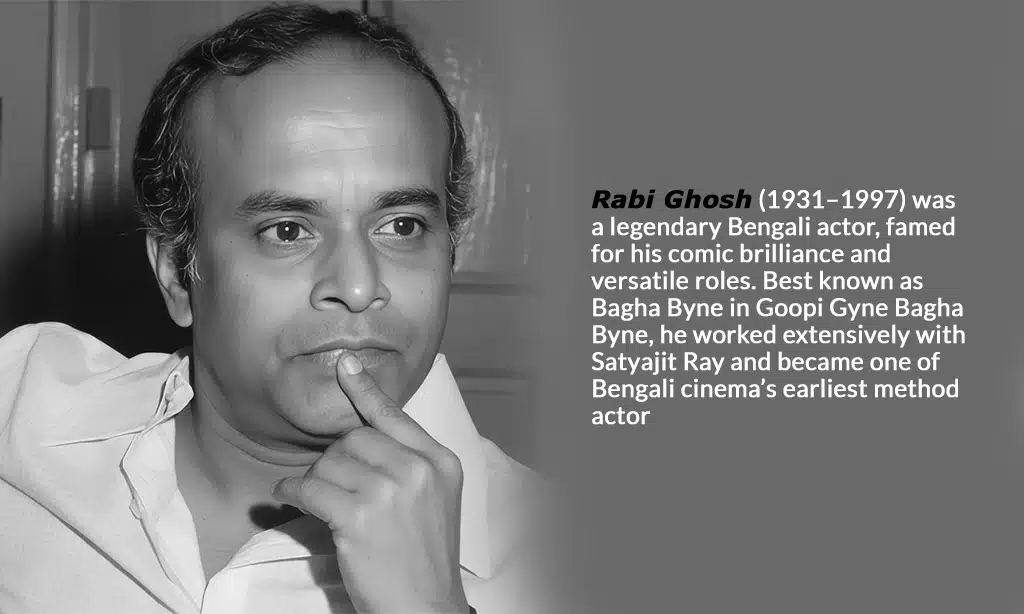
Childhood, studies and early work
Rabi Ghosh grew up in a middle-class Bengali family in Calcutta. His roots were connected to East Bengal (now Bangladesh), like many Kolkata families of that time.
He studied at South Suburban Main School, where he passed his matriculation exam in 1949. Later, he took Intermediate in Science and then joined Asutosh College. Like many young men of his generation, he soon needed a job. He worked at Bankshall Court in Kolkata from the early 1950s until around 1959.
He was also known in his youth for a strong interest in bodybuilding and physical fitness. This may sound like a fun detail, but it mattered: it gave him control over his posture and movement, which later became crucial in his physical comedy and stage work.
| Aspect | Details |
| School | South Suburban Main School (matriculation, 1949) |
| College | Intermediate Science, then Asutosh College |
| Early job | Staff at Bankshall Court, Kolkata (1953–1959 approx.) |
| Early passion | Physical fitness and bodybuilding |
In these years, he was not a film star, not even an actor. He was a disciplined young man with a steady job and a strong body. But Kolkata was a city of theatre and politics. Slowly, that world pulled him in.
Discovering theatre and Utpal Dutt
In 1950s Calcutta, theatre was intense and alive. Political plays, social plays and experimental groups were changing how people saw performance. Rabi Ghosh joined Utpal Dutt’s Little Theatre Group, one of the most important theatre groups in India.
There he learned:
- Voice training
- Stage movement
- Ensemble acting
- How to mix politics and social issues with art
He performed in the famous play “Angar”, a drama about coal miners and class struggle. The play ran for around 300 nights, a huge success for that period. His performance was so strong that he received the Ultorath Award around 1960. A film director, Aurobindo Mukherjee, noticed him in this play and cast him in the film “Ahoban” (1959).
This is how a court employee and aspiring bodybuilder became a professional actor.
Breakthrough in Cinema – Galpo Holeo Satti and Beyond
Early screen years
In the early 1960s, Rabi Ghosh appeared in several Bengali films in smaller roles. These were often supporting parts – a clerk here, a friend there – but people in the industry began to notice his timing and screen presence.
Galpo Holeo Satti – the big turning point
The real breakthrough came in 1966 with Tapan Sinha’s film Galpo Holeo Satti (also written as Golpo Holeo Satti).
The story is simple but powerful: a joint family in Kolkata is full of fights, complaints and confusion. A new servant enters the house. Without shouting or preaching, he changes the entire family through discipline, kindness and example.
Rabi Ghosh plays this servant.
Why this role was special:
- The character is a domestic worker, but he is not treated as a joke.
- He is quiet and polite, but emotionally strong.
- The humour comes from his calm reactions to the family’s madness, not from insulting him.
- The film became a cult classic and was later remade in Hindi as “Bawarchi” and in other languages.
This role showed that Rabi Ghosh could be the emotional centre of a film. He was not only a side clown. He could carry a story on his shoulders.
The Art of Human Comedy
The title of this article calls him an artist of “human comedy”. What does that mean?
Comedy rooted in vulnerability
In many films, especially older ones, comic characters are often:
- Loud
- Foolish
- Far from real life
Rabi Ghosh was different.
He often played:
- Clerks who feared their bosses
- Servants who needed job security
- Poor musicians and workers
- Lower middle-class men struggling with money and pride
Yet he never mocked their pain. His comedy came from:
- Their small fears
- Their awkwardness
- Their little dreams
You laughed, but you could also see your own uncle, neighbour or even yourself in him. You were laughing with the character, not at him. That is why his work feels gentle and respectful, even decades later.
Eyes, pauses and tiny gestures
Rabi Ghosh’s face, especially his eyes, was one of his greatest tools.
Watch him as Bagha in Goopy Gyne Bagha Byne:
- His eyes become big when he sees ghosts.
- They turn narrow when he becomes suspicious or clever.
- They shine with joy when the magic works.
He uses:
- Pauses – a small silence before a reply, which makes the moment real.
- Stillness – often he stays very still, letting the chaos around him create the humour.
- Tiny movements – a small shrug, a half-step backwards, a quick glance.
Because his comedy is built on such small details, it feels natural. It does not feel like someone “performing jokes”; it feels like you are watching a real person in a slightly absurd situation.
An early “method” character actor
People who study Bengali cinema often call Rabi Ghosh one of the earliest “method” style character actors in the industry.
He did not use the same template in every film. Instead, he:
- Thought about the social class and background of each character
- Changed his voice, walk, and body language to match that life
- Looked for the emotional truth of each situation, even in comedy
This is why his servant in Galpo Holeo Satti does not behave like Bagha the drummer. And Bagha does not behave like a city office worker. Each one is different, and that variety keeps his work fresh.
Iconic Roles and Films
Key films at a glance
Here is a simple overview of some of his most important screen roles:
| Film / Work | Year | Director | Why It Matters |
| Galpo Holeo Satti | 1966 | Tapan Sinha | Breakthrough; servant who heals a family with discipline and warmth |
| Goopy Gyne Bagha Byne | 1969 | Satyajit Ray | As Bagha; iconic fantasy-comedy, beloved across generations |
| Aranyer Din Ratri | 1970 | Satyajit Ray | Modern classic; shows his quiet acting depth in a serious ensemble |
| Shriman Prithviraj | 1973 | Tarun Majumdar | Memorable comic character Haridas; very popular with Bengali audiences |
| Hirak Rajar Deshe | 1980 | Satyajit Ray | Political satire disguised as fantasy; continues Goopy–Bagha world |
| Goopy Bagha Phire Elo | 1991 | Sandip Ray | Sequel that reintroduced Bagha to a younger audience |
| Padma Nadir Majhi | 1993 | Goutam Ghose | Serious, literary adaptation; shows range beyond comedy |
| Byomkesh Bakshi (TV) | 1990s | Basu Chatterjee | Role of Badridas in episode Amrit Ki Maut; reached all-India TV fans |
Bagha in Goopy Gyne Bagha Byne
In “Goopy Gyne Bagha Byne”, Rabi Ghosh plays Bagha, a poor drummer who is thrown out of his village for bad playing. On the road he meets Goopy, and together they get three magical boons from the King of Ghosts.
Bagha is:
- Slightly more practical than Goopy
- More fearful, more cautious, and often more funny
- The one whose body language often steals the scene
The film became a huge success, running for many weeks in theatres. It also travelled to international festivals. Rabi Ghosh even went to the Berlin Film Festival with it, which raised his global profile.
Today, this film is being digitally restored in high resolution. As part of the wave of 4K restorations of Satyajit Ray’s films, Goopy Gyne Bagha Byne and related titles are being prepared for new screenings at festivals and on platforms. That means new eyes will again discover Bagha in crystal-clear detail.
Other much-loved comic roles
Fans also treasure him in films like:
- “Shriman Prithviraj” – where his character Haridas delivers absurd yet believable comedy in a family story.
- “Mouchak”, “Kapurus Mahapurush”, “Basant Bilap” – romantic and social comedies where he often appears in supporting roles but leaves a strong mark.
In these films you see his gift for turning a small role into a big memory. A side character becomes the scene people quote and share.
Television and national reach – Byomkesh Bakshi
In the 1990s, the Hindi TV series “Byomkesh Bakshi” became hugely popular on Doordarshan. In the episode “Amrit Ki Maut”, Rabi Ghosh appears as Badridas.
This was important because:
- It introduced him to non-Bengali audiences, especially in North India.
- The show is still repeated and is available online, so his performance continues to reach new viewers.
- It linked him with one of India’s most loved detective series.
Thanks to this, many people who did not grow up with Bengali films still recognise his face.
Not Just a Side Actor – Redefining Supporting Roles
In commercial cinema, the “hero” usually gets all the attention. But often, when people talk about older films, they remember a supporting actor’s scene more clearly. Rabi Ghosh is one of those actors.
He changed how people saw supporting roles:
- He gave them emotional depth.
- He showed that these characters can carry the heart of the story.
- He proved that a “character actor” can become a major star in memory, even if the billing says “supporting.”
Film essays on Bengali cinema often list him among the most influential character actors, not only as a comedian. Directors and co-actors have said that once he entered a frame, the energy of the scene changed.
Working With the Great Directors
Satyajit Ray
With Satyajit Ray, Rabi Ghosh created some of his most famous work:
- Goopy Gyne Bagha Byne
- Hirak Rajar Deshe
- Aranyer Din Ratri
- Appearances and collaborations in other projects as well
Ray’s films demanded:
- Control
- Realism
- Emotional truth
Rabi Ghosh fit perfectly into this style, while still keeping his natural comic flavour. Recent Ray restorations screened at major festivals like Cannes Classics have once again highlighted his acting in films such as Aranyer Din Ratri.
Tapan Sinha and others
With Tapan Sinha, he worked on films like Galpo Holeo Satti and more. Sinha often told social stories with a warm human tone. Rabi Ghosh’s style of human comedy and quiet strength suited this very well.
He also worked with directors like Goutam Ghose in serious films such as Padma Nadir Majhi, which showed he could fully handle non-comic, dramatic roles. This range is one reason critics see him as a complete actor, not only a comic specialist.
Theatre, Tours and Cultural Reach
Strong theatre roots
Even after becoming a film name, Rabi Ghosh never left theatre.
- He stayed active with Utpal Dutt’s group for many years.
- He later founded his own group, “Chalachal”, to continue stage work.
- He kept acting on stage alongside film schedules, which kept his skills sharp.
This explained his strong sense of timing and ensemble work on screen. A theatre actor knows how to listen to co-actors and react in real time, and you see that in his film scenes.
International tours
Rabi Ghosh also travelled abroad with theatre troupes and film delegations. Recorded accounts mention:
- Visits to Berlin around the time of the international festival runs of Ray’s films
- Performances in Mauritius in the late 1980s
- Tours in the USA and Europe in the mid-1990s with theatre groups
These tours took Bengali theatre and performance to international and diaspora audiences, and they also built his identity as an artist beyond regional boundaries.
Awards, Honours and New-Age Revival
Awards and recognition
Some key recognitions include:
- Ultorath Award for his performance in the play Angar – a major sign of respect in the Bengali theatre scene.
- Posthumous appreciation and special mentions in Bengali film awards and retrospectives.
- Constant presence in “top lists” of Bengali comic actors and character actors in print and online media.
While he may not have a long list of glamour awards like some mainstream heroes, his critical respect has grown over the decades and continues to grow.
Real-time revival: restorations and festivals
In recent years, there has been strong international interest in restoring Satyajit Ray’s films in 4K:
- Aranyer Din Ratri, where Rabi Ghosh appears, has been restored and shown at global festivals like Cannes Classics.
- Restoration work on Goopy Gyne Bagha Byne and related films is underway, bringing Bagha back to large screens with new visual clarity.
These projects matter for his legacy:
- They bring his performances to new global viewers.
- Film students worldwide can now study his face, timing and movement in high quality.
- Each festival screening generates new reviews and essays that discuss his contribution.
In simple terms: his work is not just history. It is being actively revived and re-shown right now.
Personal Life and Personality
Behind the roles on screen, there was a private man with his own joys and losses.
- He married actress Anubha Gupta. She passed away in 1972.
- Later, on 24 November 1982, his own birthday, he married Baishakhi Devi.
- He remained active in films and theatre until his death in 1997 at the age of 65.
People who worked with him often describe him as:
- Warm and modest
- Very serious about rehearsals and preparation
- Open to improvisation, but always within the rhythm of the scene
- Kind to younger actors and technicians
These personal qualities match the type of characters he played – humble, human, and full of quiet strength.
Legacy in Today’s Media Landscape
Influence on later actors
Modern Bengali actors often mention older greats as references. In the area of comedy and character acting, Rabi Ghosh is one of those reference points. His influence appears in:
- The way many actors now use underplayed humour instead of loud slapstick
- The fact that lots of younger performers prefer character roles and see them as prestigious
- Acting workshops and film clubs using his scenes to teach reaction shots and timing
Streaming, clips and new audiences
Today, his films reach viewers in many ways:
- Classic Bengali films like Goopy Gyne Bagha Byne and Galpo Holeo Satti are available on TV and OTT.
- YouTube clips and social media reels often share his funniest or most touching moments, especially around his birth anniversary.
- Film pages and blogs create listicles of “Best Rabi Ghosh movies” or “Must-watch Bengali comedies”, keeping his name visible.
For many Gen Z viewers, the journey starts with a 30-second clip. They laugh, they get curious, and then they go look for the full film. In this way, his work continues to travel.
Why his humour still works
His humour still feels modern because:
- It is kind, not cruel.
- It is built on everyday life – money problems, family fights, office pressure, nervous romance.
- It respects the dignity of poor and ordinary people.
In a world that is often noisy and fast, his simple, controlled, human comedy feels almost fresh again.
Emotional Conclusion: Remembering Rabi Ghosh on His Birth Anniversary
When we speak of Rabi Ghosh on his birth anniversary, we are not only remembering a man from old black-and-white films. We are remembering someone who showed us that:
- A servant can be the moral centre of a story.
- A poor drummer can carry more emotion than a king.
- A clerk’s small fear can be as dramatic as a big tragedy.
He took the small, often ignored people in society and gave them weight, humour and light.
Think again of Bagha: standing with his drum, eyes wide and unsure, caught between fear and wonder. Or of the servant in Galpo Holeo Satti, quietly bringing order to a broken home. These figures are funny, yes, but they are also deeply human.
Rabi Ghosh turned human weakness into art. He made us laugh, but he also made us feel seen. That is why, many years after his death, his work still speaks to us.
On every 24 November, when his scenes appear across TV channels, websites and social feeds, we are reminded of a simple truth:
- A great comedian is not someone who only makes us laugh.
- A great comedian is someone who helps us face life with a softer heart.
Rabi Ghosh was, and remains, more than a comedian. He was an artist of human comedy – and his art still lives wherever people watch, smile, and quietly recognise themselves in his eyes.