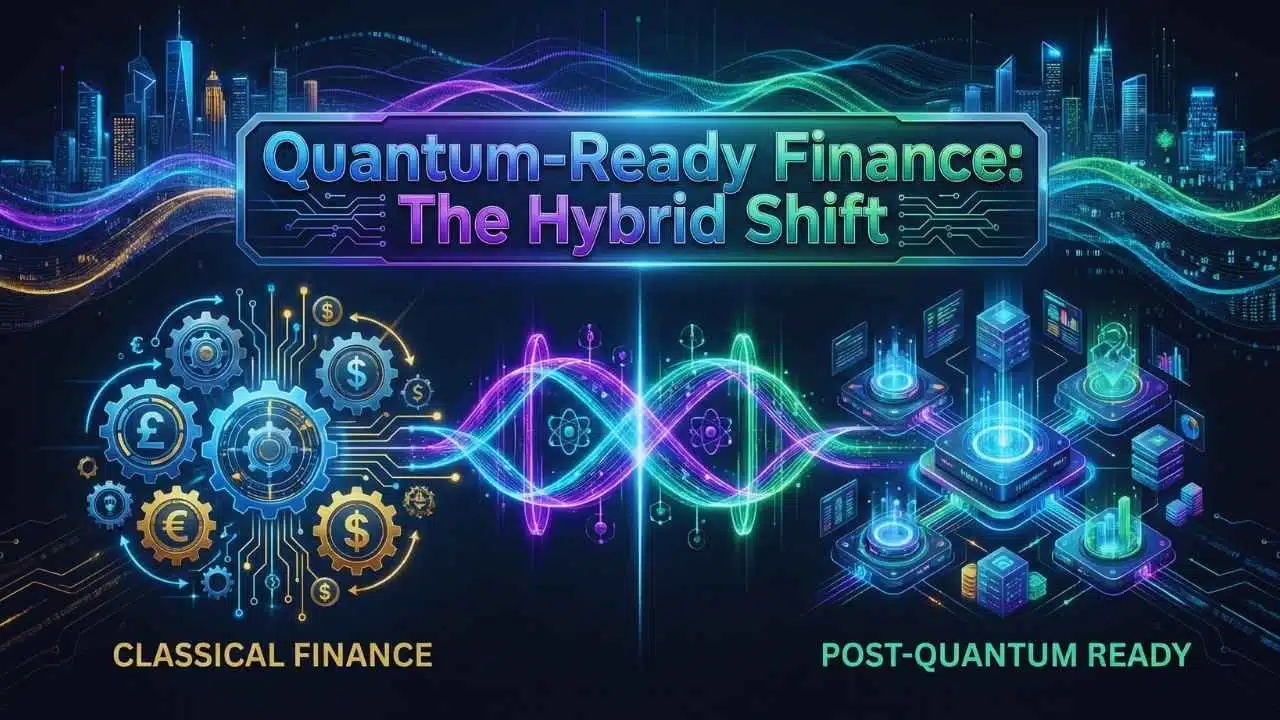
Quantum-Ready Finance is suddenly urgent because the standards are real, regulators have set clocks, and major internet platforms are already shipping hybrid post-quantum encryption. Finance now faces a rare risk: data stolen today can be decrypted years later, turning “future tech” into a current compliance and trust problem.
Why The Quantum Clock Started Ticking For Finance?
For decades, finance treated cryptography as a solved engineering layer: TLS for online banking, PKI for identities, HSMs for key custody, signatures for integrity, and a large supply chain of vendors that quietly refreshed algorithms over time. Quantum risk breaks that comfortable model because it targets the public-key math that underpins identity, key exchange, and digital signatures across the entire sector.
The shift is not theoretical anymore. Three things converged:
- Standards hardened into procurement reality. Once NIST finalized its first post-quantum cryptography (PQC) standards, “wait and see” stopped being a defensible strategy for critical systems that must stay secure for a decade or more.
- Governments turned timelines into policy. The EU issued a coordinated roadmap recommendation and explicitly framed PQC migration as urgent for public administration and critical infrastructure. The UK’s NCSC published a staged timeline (discovery, priority migrations, completion). The US government set a 2035 risk-mitigation target and required annual inventories of vulnerable cryptographic systems for high-impact assets.
- The internet began upgrading in production. Cloudflare publicly reported that by late October 2025, the majority of human-initiated traffic on its network was using post-quantum encryption in a hybrid mode. That matters for finance because it signals ecosystem readiness: browsers, CDNs, and TLS stacks are moving, which drags financial apps and vendors forward whether they planned for it or not.
Here is the “how we got here” timeline in one view:
| Moment That Moved The Market | What Happened | Why Finance Should Care |
| 1994 | Shor’s algorithm showed quantum computers could break RSA and ECC | Public-key foundations become time-limited if large quantum machines arrive |
| 2016 | NIST launched the PQC standardization process | Industry gained a credible path to replacement algorithms |
| Nov 2022 | US OMB issued PQC migration memo (inventories, 2035 goal) | “Quantum readiness” becomes auditable governance, not optional R&D |
| Aug 2024 | NIST published first finalized PQC standards (KEM + signatures) | Vendors can ship FIPS-referenced implementations, finance can buy, test, certify |
| Apr 2024 | EU recommended a coordinated PQC implementation roadmap | Cross-border interoperability becomes part of the security goal |
| Mar 2025 | UK NCSC published target dates through 2035 | Discovery and migration are framed as multi-year programs, not patches |
| Jul 2025 | BIS released a roadmap for quantum readiness in the financial system | Supervisory expectations start to align across jurisdictions |
| Oct 2025 | Cloudflare reported majority human traffic using PQ encryption | PQC is no longer “lab only”, it is now an operational default for parts of the internet |
The Risk Model: Harvest Now, Decrypt Later Meets Financial Data Lifecycles
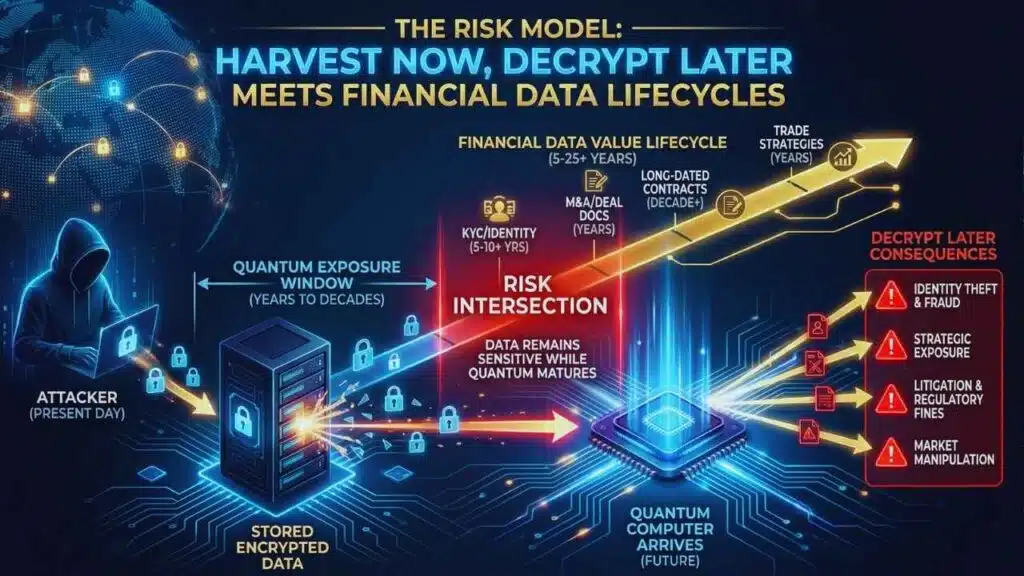
Quantum risk lands differently in finance than in many other sectors because finance has unusually long data value curves and unusually strict retention requirements. A retailer might worry about customer logins over months. A bank, insurer, exchange, or regulator may need confidentiality and integrity for many years.
“Harvest now, decrypt later” changes the threat model: attackers can steal encrypted traffic or encrypted databases today, store them, and later decrypt them once quantum capability is sufficient. That means the question is not only “When will a cryptanalytically relevant quantum computer arrive?” It is also “How long must this data remain confidential?”
A practical way to make this concrete is to map data lifetime to quantum exposure window:
| Financial Asset Or Data Type | Typical Security Lifetime | Why It Is Sensitive Later | Quantum Exposure If Stolen Today |
| Customer identity and KYC files | 5–10+ years | Identity theft, fraud, sanctions screening, long-tail extortion | High if encrypted records are retained and later decrypted |
| Corporate deal documents, M&A, term sheets | Years | Strategic exposure, insider trading risk, litigation | High for “quiet period” and post-deal disputes |
| Payment messages and settlement instructions | Years (audit, disputes) | Fraud reconstruction, legal proof, AML reviews | Medium to high depending on storage and encryption posture |
| Authentication credentials and session material | Hours to months | Account takeover, lateral movement | Lower if short-lived, but still critical for real-time fraud |
| Long-dated contracts and policy documents | Decade+ | Legal enforceability and privacy | High due to long retention and high value in litigation |
| Market-sensitive trading strategies | Years | Competitive harm, market manipulation | High for proprietary firms and desks |
Key Statistics Snapshot (As Of 2025–Early 2026)
- A major internet provider reported that over half of its human traffic was protected by post-quantum encryption in late October 2025.
- The UK’s NCSC set a 2028 discovery milestone and a 2035 completion milestone for PQC migration planning.
- The US government set a goal of mitigating quantum risk by 2035 and required annual inventories of vulnerable cryptographic systems for high-impact assets.
- A global Capgemini survey found 70% of organizations are assessing or deploying quantum-safe measures, but only 15% qualify as “champions” with mature execution.
The finance takeaway: the “quantum deadline” is not a single day. It is a widening zone where data stolen today can become readable tomorrow, while regulators increasingly ask what you did before the crisis, not after.
Standards Are Settling, But The Trade-Offs Are Getting Real
The PQC transition used to stall on one argument: “Which algorithms will win?” That argument is fading. NIST’s first standards give the market a stable base, and NIST has also selected HQC as an additional, backup encryption algorithm to diversify the portfolio.
But replacing RSA/ECC is not plug-and-play. PQC generally increases key and signature sizes, can stress bandwidth and latency at scale, and can expose hidden dependencies in legacy systems. In finance, those trade-offs show up in places executives do not expect: mobile app performance, call-center authentication resets, VPN throughput during incidents, certificate issuance pipelines, and HSM firmware lifecycles.
Here is a practical “what changes on the wire” view, using sizes derived from the finalized NIST standards:
| NIST Standard | What It Replaces In Many Systems | Parameter Set Often Considered “Default” | Public Key Size | Ciphertext / Signature Size | What Finance Feels First |
| ML-KEM (FIPS 203) | RSA/ECDH key exchange | ML-KEM-768 | 1,184 bytes | 1,088 bytes ciphertext | Larger TLS handshakes, more bandwidth during peak login events |
| ML-DSA (FIPS 204) | ECDSA signatures | ML-DSA-65 | 1,952 bytes | 3,309 bytes signature | Bigger certificates and signed objects, slower signing in high-volume workflows |
| SLH-DSA (FIPS 205) | High-assurance signatures | 128s / 128f (varies) | 32 bytes public key | 7,856 to 17,088 bytes signature | Very large signatures, best for niche high-integrity use, not mass web PKI |
This is why hybrid approaches are so attractive: they let institutions move forward while performance engineering catches up.
Why Hybrid Is The Default Migration Pattern?
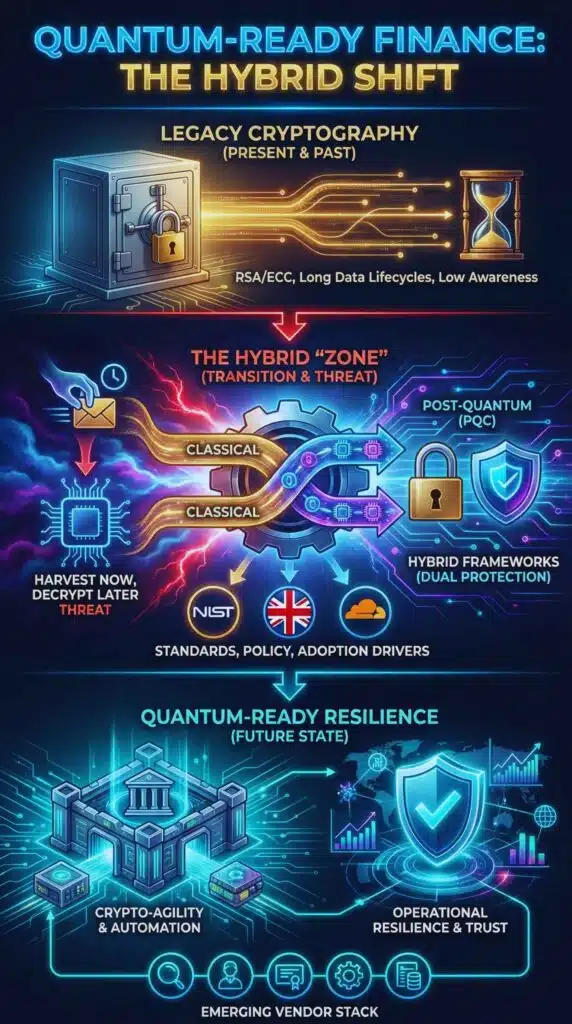
“Hybrid cryptographic frameworks” sound like jargon, but in practice they are an operational compromise that fits finance’s risk and uptime constraints.
A hybrid model typically means:
- Hybrid key exchange: use a classical algorithm and a post-quantum algorithm together, combine outputs, and remain secure as long as at least one holds.
- Dual signatures or staged signature migration: support both classical and PQC signatures during a transition window.
- Hybrid in architecture, not just math: use PQC for the most exposed channels first (internet-facing TLS, remote admin access, inter-bank gateways), while deeper systems migrate during normal modernization cycles.
This is not just industry improvisation. The IETF TLS working group produced an Internet-Draft describing constructions for hybrid key exchange in TLS 1.3, which formalizes the idea that hybrid key exchange can be negotiated using existing TLS mechanisms. When major platforms follow that pattern, finance inherits a workable path that does not require breaking compatibility overnight.
A “where hybrid shows up” map helps clarify what institutions should prioritize:
| Where Finance Uses Crypto | Practical Hybrid Approach | Why It Works | Common Constraint |
| Customer web and mobile sessions (TLS) | Hybrid key exchange (classical + PQC) | Protects against harvest-now attacks while preserving broad client support | Handshake size, CPU overhead, legacy devices |
| Bank-to-bank APIs and B2B portals | Hybrid TLS plus mutual auth | Moves high-value channels earlier, reduces systemic exposure | Certificate lifecycle and CA support |
| VPN and remote admin | Hybrid in tunnel establishment | Hardens incident response pathways and admin planes | Hardware appliances, firmware cadence |
| Internal service-to-service traffic | Gradual hybrid rollout by domain | Limits blast radius and isolates performance impacts | Inventory gaps, service sprawl |
| Code signing and software supply chain | Dual signing during transition | Avoids bricking legacy validators while adding PQ assurance | Tooling maturity and validation rules |
| Long-term archives and records | PQC signatures for durable integrity | Protects legal proof and audit artifacts longer | Storage growth, verification performance |
Hybrid frameworks are “proactive” because they acknowledge a basic governance truth: a perfect, final migration plan rarely survives contact with real infrastructure. Hybrid gives finance a safer bridge.
Regulators Turn Quantum Readiness Into Governance And Evidence
Finance is not moving toward PQC only because the math changed. It is moving because the accountability model changed.
Regulators do not want a promise that “we’ll upgrade later.” They want evidence that an institution can identify where cryptography lives, measure exposure, prioritize systems by data lifetime, and prove progress through a roadmap.
Three policy signals matter most:
- The EU encouraged member states to build a coordinated PQC implementation roadmap within two years of publication and explicitly referenced hybrid schemes that may combine PQC with existing cryptography or even quantum key distribution in some contexts.
- The UK NCSC published concrete target dates and framed PQC migration as “a mass technology change” that organizations must plan over years, including discovery by 2028 and completion by 2035.
- The US OMB required agencies to submit annual inventories of cryptographic systems vulnerable to a cryptanalytically relevant quantum computer, explicitly calling out that data encrypted today can be recorded and later decrypted.
Finance institutions should read these as “supervisory gravity.” Even if a bank is not directly under a specific memo, its cloud providers, critical vendors, and cross-border partners may be. That pressure travels through contracts, audits, and third-party risk assessments.
Here is a consolidated view of what “regulatory readiness” increasingly looks like:
| Policy Or Supervisory Signal | What It Asks For In Practice | What Auditors Will Likely Request |
| EU coordinated roadmap recommendation | National and sector roadmaps, interoperability focus, hybrid transition | Evidence of roadmap alignment, vendor plans, and cross-border dependencies |
| UK NCSC migration timeline | Discovery, planning, priority migrations, completion by target dates | Discovery outputs, dependency mapping, and a staged execution plan |
| US OMB migration memo | Annual crypto inventories for high-impact assets, 2035 risk target | Inventory completeness, prioritization logic, and funding/implementation plans |
| BIS financial system roadmap | Sector-wide planning and coordination, quantum readiness as resilience | Governance structure, scenario analysis, and ecosystem engagement |
The strategic insight: quantum readiness is becoming part of operational resilience. And resilience is already a supervisory priority globally.
Operational Reality: Crypto-Agility, Inventory, And The Hidden Dependencies
The hardest part of PQC migration is not swapping algorithms. It is finding where algorithms are embedded and proving you can change them safely.
In finance, cryptography hides in:
- vendor appliances (HSMs, network gear, payment gateways).
- third-party SDKs (mobile, fraud tooling, identity providers).
- legacy message brokers and middleware.
- bespoke integrations with market infrastructures.
- “silent crypto” in libraries compiled years ago.
This is why crypto-agility is now the center of serious planning. Crypto-agility means your systems can adopt new cryptographic primitives without rewriting half the stack. In practice, it requires an internal capability model, not a one-time project.
A “hidden dependency” checklist makes the risk tangible:
| Hidden Dependency | Why It Breaks PQC Transitions | What A Hybrid Strategy Does | What A Mature Program Builds |
| Hardcoded algorithms in legacy apps | No easy switch, high regression risk | Buys time with edge protection first | Abstraction layers and policy-driven crypto |
| Certificate tooling that assumes small signatures | Certificate chains can bloat | Phased rollout and selective adoption | PKI modernization and testing pipelines |
| Hardware devices with long refresh cycles | Firmware limits crypto options | Hybrid gateways protect upstream | Hardware roadmaps aligned with crypto timelines |
| Vendor compliance lag | One supplier can stall the whole program | Hybrid endpoints isolate weak links | Contractual PQC requirements and exit plans |
| Incomplete asset inventory | You cannot secure what you cannot see | Hybrid helps at perimeter | Automated discovery plus CMDB integration |
The best institutions treat PQC as a program with governance, budgets, testing environments, and vendor management. The weakest treat it as a future patch. In finance, that gap becomes competitive because trust, uptime, and regulatory confidence have direct monetary value.
Winners, Losers, And The Emerging Post-Quantum Vendor Stack
The transition will reshape budgets and vendor selection in predictable ways. The near-term “winners” are not necessarily the companies with the best quantum research. They are the companies that make migration operationally easy.
Look at it as a market shift from “crypto features” to “crypto change management.”
| Likely Winners | Why | Likely Losers | Why |
| Cloud and network providers shipping hybrid by default | They reduce customer effort and normalize PQC | Legacy hardware vendors without firmware roadmaps | Finance will not wait for multi-year refresh cycles |
| HSM and key management vendors with PQC plans | Keys are the choke point for compliance | Point solutions that cannot prove crypto inventories | Auditors will demand visibility and evidence |
| Identity, PKI, and certificate automation platforms | Certificate lifecycles get more complex | Custom, brittle integrations | PQC increases complexity and breaks assumptions |
| Firms with strong testing and observability | PQC needs performance and failure visibility | “Security by policy deck” programs | Regulators increasingly expect measurable progress |
Capgemini’s survey finding that 70% of organizations are assessing or deploying quantum-safe measures, while only 15% qualify as champions, suggests a market where many will buy tools, but fewer will execute end-to-end. That gap is an opening for vendors offering automation, discovery, and migration accelerators, not just cryptographic libraries.
Expert Perspectives And Counterarguments
A balanced analysis has to acknowledge why some leaders still hesitate.
The cautious view says: PQC is new, performance costs are real, standards will evolve, and premature rollouts can create outages or new vulnerabilities. That is rational in finance, where change risk can be as dangerous as cyber risk.
The proactive view responds: waiting is not “risk neutral” because harvest-now threats accumulate silently, and regulators increasingly judge preparedness, not excuses. Hybrid deployments reduce the downside by avoiding a forced, big-bang cutover.
A practical synthesis looks like this:
| Where Experts Converge | What They Disagree About | What A Neutral Strategy Looks Like |
| Start with discovery and data-lifetime prioritization | How fast to push PQC into customer-facing channels | Deploy hybrid at the edge first, then move inward |
| Build crypto-agility so changes are repeatable | Whether PQC is “urgent now” or “urgent soon” | Treat it like resilience: staged milestones with measurable progress |
| Vendor coordination is decisive | Which algorithms and parameter sets should dominate | Stick to standards, test, and design for swap-ability |
The key is to avoid false choices. Finance does not need to choose between “do nothing until 2035” and “rip out everything this year.” Hybrid frameworks exist precisely because the world between those extremes is where most institutions must operate.
What Comes Next For Quantum-Ready Finance?
Quantum-Ready Finance will be defined less by a single migration date and more by a rolling set of milestones across standards, vendor roadmaps, and supervisory expectations. The most likely “next chapter” is a procurement and audit cycle where institutions must prove that crypto dependencies are known, prioritized, and actively being reduced.
Watch these milestones:
| 2026–2030 Milestone | Why It Matters | What To Look For In Finance |
| 2026: EU coordinated roadmap window approaches | Interoperability and sector alignment become concrete | Contract clauses requiring PQC readiness, shared testing profiles |
| 2026–2027: Additional standards mature (eg, HQC draft to final) | Algorithm diversity reduces systemic monoculture risk | Updated procurement language and refreshed cryptographic policies |
| 2027–2028: Discovery becomes non-negotiable | Inventory and dependency mapping become baseline expectations | Automated discovery, CMDB integration, and measurable coverage rates |
| 2028–2030: High-priority migrations accelerate | Institutions focus on crown jewels and exposed channels | Hybrid at scale, PQC support in PKI and critical gateways |
Predictions (Clearly Labeled):
- Analysts are likely to interpret hybrid PQC adoption as the “new normal” for internet-facing finance by the late 2020s, because it matches how TLS and browser ecosystems evolve.
- Supervisors will likely treat crypto-agility as part of operational resilience, meaning institutions will need repeatable processes, not one-off projects.
- Market indicators point to rising spend on discovery, key management modernization, and certificate automation, because those are the bottlenecks that turn policy timelines into real migration.
The most important strategic implication is this: PQC is not a narrow cryptography upgrade. It is a systems modernization force multiplier. Institutions that use it to simplify architectures, harden identity planes, and standardize key management will reduce risk and reduce long-term cost. Institutions that postpone will face a compressed, expensive, regulator-driven scramble later.