

Python for kids coding is rapidly transforming from a niche hobby into the “new literacy” of the 21st century. A generation ago, being literate meant simply reading and writing text; today, true fluency requires understanding the language of the algorithms that shape our world. For parents navigating the explosive rise of Artificial Intelligence, the stakes have never been higher.
Is this just another educational trend, or is it a fundamental survival skill for the future? As the native language of AI and data science, Python offers children more than just technical know-how; it gives them the keys to unlock and control the technology around them.
This guide explores why educators now view Python not as an optional extracurricular but as the essential tool for future-proofing your child’s mind in an AI-driven era.
Key Takeaways
- A New Definition of Literacy: In the 21st century, digital fluency is essential. Python is widely regarded as the “new English” due to its role as the primary language of data science and AI.
- More Than Vocational: Teaching kids Python isn’t just about future jobs; it’s about developing crucial cognitive skills like computational thinking, problem-solving, and emotional resilience through debugging.
- Age Matters: Start with block coding (ages 6-9) to teach logic before introducing Python’s syntax (ages 10+). Rushing the process can lead to frustration.
- Tangible Learning: The best modern learning happens via gamification (Minecraft, CodeCombat) or physical computing (robotics, Raspberry Pi), making abstract concepts concrete.
- AI Enhances, Doesn’t Replace: Generative AI will not eliminate the need for coding. Instead, it necessitates that humans become skilled “editors” and auditors of code, requiring deep foundational knowledge of languages like Python.
Why Python? The “New English” of the Digital World
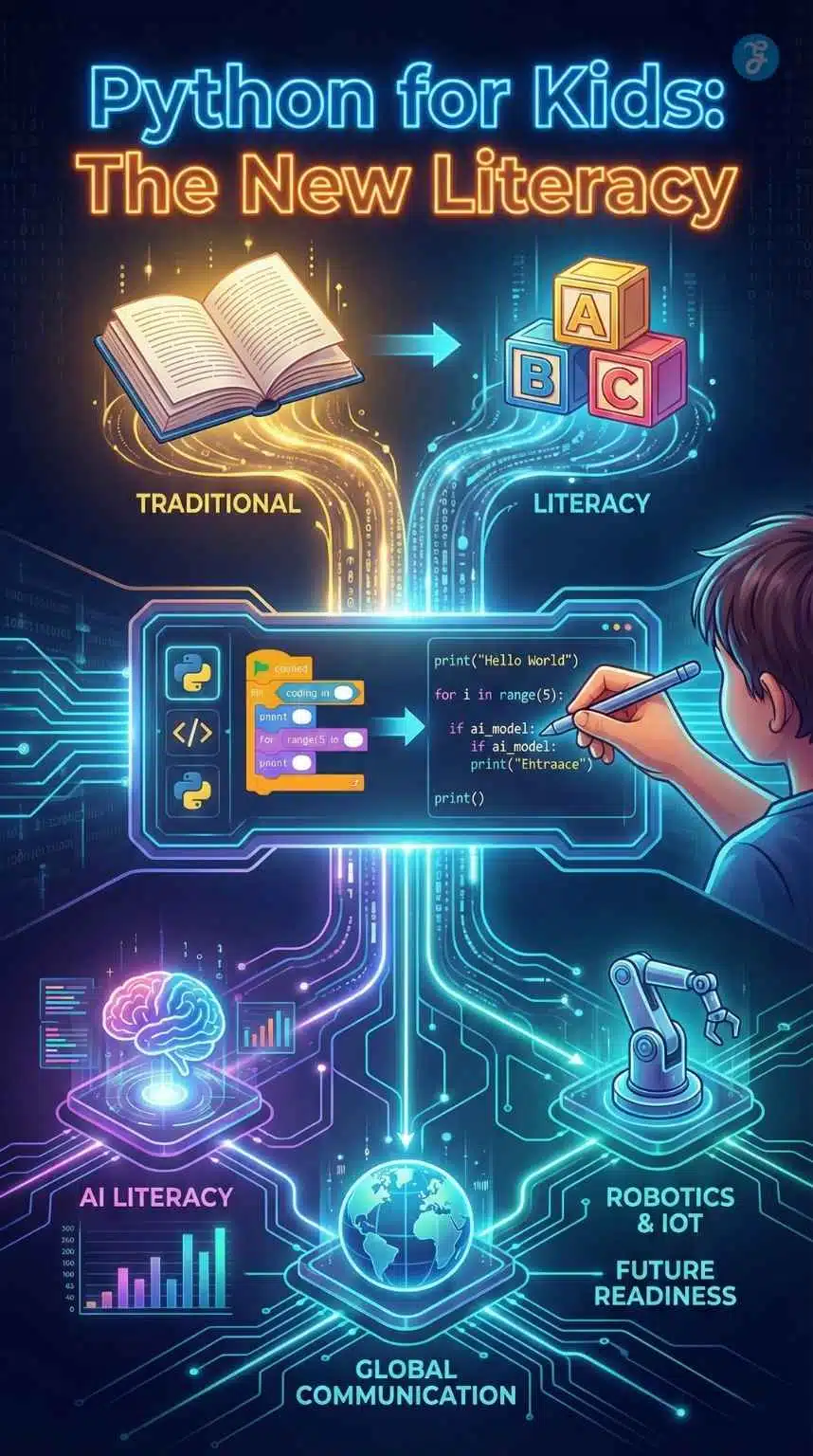
In the early days of computing, programming languages were notoriously difficult, laden with complex syntax and unforgiving rules that felt more like advanced calculus than communication. If you missed a single semicolon, the entire program crashed. This barrier made coding accessible only to a niche group of specialists.
Python changed everything. It was designed with a philosophy that emphasizes readability and simplicity.
The Readability Factor
The primary reason Python has become the gold standard for education—bridging the gap between elementary block coding and professional engineering—is that it reads remarkably like plain English.
Consider a simple command to make a computer say “Hello.” In older languages like C++ or Java, this might require five or six lines of setup code just to get started.
In Python, it is one line: print(“Hello, World!”)
For a child of ten or eleven transitioning from visual blocks to text-based coding, this is revolutionary. They are not fighting the language; they are immediately focusing on the logic of what they want to create. The cognitive load is placed on solving the problem, not on memorizing arcane syntax rules. This immediacy lowers frustration levels and keeps engagement high, which is critical in the early stages of learning.
The Native Language of AI
However, readability is only half the story. The dominant reason Python is considered the “new literacy” in 2025 and beyond is its unbreakable connection to Artificial Intelligence.
We are living through the AI revolution. The tools defining our future—from generative AI like ChatGPT to self-driving car systems and medical diagnosis algorithms—are predominantly built using Python. Major AI libraries and frameworks, such as TensorFlow, PyTorch, and Scikit-learn, call Python their native home.
By teaching a child Python, you are not just teaching them how to build a website or a simple calculator. You are handing them the keys to understand the “black box” of AI. In an era where AI literacy will be crucial for informed citizenship, knowing Python allows a young person to move from being a passive consumer of technology to an active understander and creator of it. They begin to grasp how data shapes models, how algorithms make decisions, and where biases might exist.
Real-World Dominance
Finally, Python is not a “toy” language restricted to classrooms. It is one of the most powerful and versatile professional tools in existence.
- Web Development: It powers the back-end of massive platforms like Instagram, Spotify, and Netflix.
- Data Science: It is the primary tool used by data analysts to process vast amounts of information.
- Scientific Research: NASA uses Python for analyzing mission data.
When kids learn Python, they are learning a skill with infinite upward mobility. The same language they use to build a text-based adventure game at age 12 is the same language they could use to model climate change data at age 22.
Beyond the Screen: The Cognitive Benefits
While the professional applications of Python are impressive, educators are far more interested in what coding does to a child’s developing brain. Even if a child never becomes a professional programmer, the process of learning to code in Python offers profound cognitive benefits that transfer to virtually every other academic discipline and life skill.
“Research into digital pedagogy suggests that coding is essentially applied critical thinking.”
Developing “Computational Thinking”
At its core, coding is about problem-solving. To write a successful Python script, a child must engage in “computational thinking.” This involves several key mental steps:
- Decomposition: Breaking a large, complex problem down into smaller, manageable pieces. (e.g., “How do I build a video game?” becomes “How do I make the character move left?” then “How do I make it jump?”)
- Pattern Recognition: Spotting similarities in different parts of the problem that can be solved with the same solution.
- Abstraction: Focusing on the important details and ignoring irrelevant information.
- An algorithmic thinking: Creating a step-by-step set of instructions to solve the problem.
These skills are not unique to computer science. They are the exact same skills required to write a structured essay, plan a scientific experiment, or solve a complex word problem in math. Python provides an immediate, tangible sandbox to practice these essential modes of thought.
Emotional Resilience and the Art of “Debugging”
Perhaps the most underrated benefit of coding is emotional training. In traditional schooling, getting a red “X” on a test feels like a failure. In coding, failure is not just common; it is guaranteed. Nothing works the first time.
A child writes a Python script, runs it, and it fails. They receive an error message. This moment is pivotal. They must learn to suppress the immediate emotional reaction of frustration and pivot to an analytical mode. They have to become detectives, reading their own code to find the “bug.”
This process of debugging builds immense emotional resilience and “grit.” Children learn that failure is not a reflection of their intelligence, but merely data, a clue to finding the solution. They learn to persist through difficulty, iterate on their ideas, and celebrate the eventual success. This resilience is perhaps the most valuable transferable skill for the future workplace.
Making Math Tangible
For many students, algebra is abstract and boring. Why does X + Y = Z? Python brings these concepts to life.
In Python, “variables” act exactly like algebraic variables. A child might write score = 10, and then later score = score + 5. Suddenly, algebra isn’t just letters on a page; it’s the mechanic that keeps track of their points in a game they are building. Coordinates (X and Y axes) cease to be boring graphs and become the tools necessary to place their spaceship on the screen. Python provides a practical application for mathematical concepts, often leading to improved engagement in traditional math classes.
The Roadmap: When and How to Start?
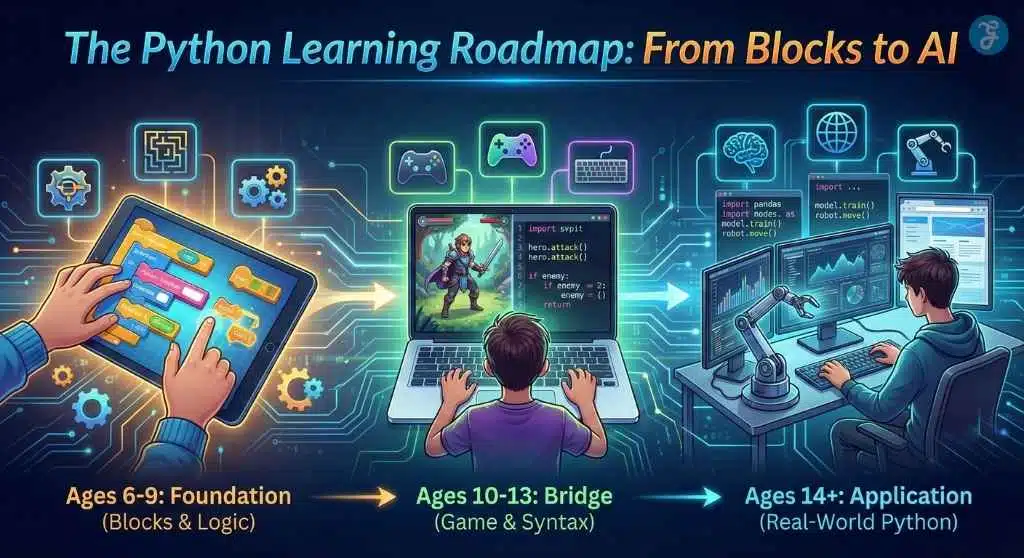
A common mistake parents make is rushing their children into text-based coding too early, leading to frustration and burnout. The human brain develops abstract reasoning capabilities in stages. A seven-year-old generally processes information differently from a thirteen-year-old.
The current best practice in educational technology involves a stepped approach, moving from visual, concrete concepts to more abstract, text-based languages like Python.
Here is a recommended roadmap for introducing Python based on age and cognitive development.
| Age Group | Recommended Stage | Focus Skills | Why This Works? |
| Ages 6–9 | Pre-Python (Block Coding)
(e.g., Scratch, Blockly) |
Logic, Sequencing, Loops, Cause-and-Effect. | At this age, typing and syntax rules are barriers. Visual blocks allow kids to learn the concepts of coding without worrying about missing commas. It builds the mental framework for programming. |
| Ages 10–13 | The Python Bridge
(e.g., Gamified platforms like CodeCombat, Minecraft Education) |
Syntax basics, Variables, Simple functions, Debugging. | Their abstract reasoning is developing. They are ready to transition from blocks to text. Python’s readability makes it the perfect bridge language here. Gamification keeps them engaged during the transition. |
| Ages 14+ | Applied Python
(e.g., Standard Python IDEs, Data projects, Web frameworks) |
Algorithms, Data structures, Real-world problem solving, AI concepts. | Teenagers are ready for “real” tools. They should move away from gamified platforms and start using standard development environments to build actual projects based on their interests (data, web, AI). |
The Importance of the “Bridge” Years (10-13)
The 10–13 age range is critical. If they stay on block coding for too long, they may get bored or feel limited. If they jump into a complex language like C++, they may get discouraged. Python sits perfectly in this middle ground.
In 2025/2026, educational platforms will have gotten very good at targeting this transitional phase. Platforms like Tynker or CodeCombat allow students to see side-by-side comparisons—showing how a familiar Scratch block translates directly into a line of Python code. This scaffolding helps them connect the logic they already know to the new syntax they are learning.
Python in 2026: Gamification and Robotics
A major shift in recent years is moving coding away from a solitary activity involving just a keyboard and a screen. Educators realized that to engage a wider variety of learners, coding needs to be tangible, social, and fun.
Gamifying the Learning Process
We know kids love video games. Modern educational strategies leverage this rather than fighting it. Platforms like Roblox and Minecraft have become accidental educational juggernauts.
While Roblox uses a variation of Lua, Minecraft Education Edition has robust support for Python. Kids can write Python scripts that interact with their Minecraft world—automatically building massive structures, teleporting characters, or creating mini-games within the game. Suddenly, learning “for loops” isn’t an academic exercise; it’s the most efficient way to build a castle wall.
Furthermore, platforms like CodeCombat turn learning Python into a literal RPG (Role Playing Game). To make their hero attack an ogre or navigate a dungeon maze, the player must type the correct Python code. The immediate feedback loop of seeing their code control an on-screen character is highly motivating.
Physical Computing: Robotics and IoT
Perhaps the most exciting trend is “physical computing”—using code to control objects in the real world. This is where Python truly shines for young learners.
Devices like the BBC micro: bit, Raspberry Pi, and various LEGO robotics kits (like Spike Prime) are designed to be controlled by Python.
When a child writes a Python script that causes a real-world sensor to detect motion and trigger an alarm buzzer, or makes a small robot navigate a maze on the floor, the abstraction of code becomes a concrete reality. This tactile approach is particularly effective for kinesthetic learners who struggle with purely screen-based activities. It bridges the digital and physical worlds, teaching them that code is the layer that controls the devices around them.
Common Myths vs. Reality
As we look toward the latter half of the 2020s, one significant question looms larger than the rest in the minds of parents.
The AI Myth: “Why learn to code if AI can do it for us?”
With the rise of powerful generative AI tools like GitHub Copilot and ChatGPT, which can generate functioning code snippets from simple text prompts, many parents naturally ask: Is coding obsolete? Is teaching my kid Python like teaching them how to operate a telegraph machine?
The Reality: The Human as the “Editor”
The consensus among tech experts and futurists is a resounding no. Coding is not obsolete; its role has shifted.
AI has lowered the barrier to entry for creating software, but it has raised the bar for understanding it. AI is an incredible assistant, but it is not an autonomous replacement. AI-generated code can be inefficient, insecure, or fundamentally flawed in subtle ways that only a human eye can detect.
In the near future, programmers will spend less time writing mundane boilerplate code from scratch and more time acting as highly skilled editors, architects, and auditors of AI-generated code.
To effectively prompt an AI to write code, you need to know the correct terminology (computational thinking). To verify if the AI’s output is safe and correct, you need to be able to read the language it outputs (Python literacy). To fix the code when the AI inevitably hallucinates an error, you need debugging skills.
Without foundational knowledge of Python, a person using AI tools is flying a plane on autopilot without knowing what any of the dials mean. If the autopilot disengages, they are helpless. Learning Python ensures the next generation remains in the pilot’s seat, directing the technology rather than just being a passenger.
Frequently Asked Questions (FAQs)
Is Python too difficult for an 11-year-old with no prior experience?
Not at all. Python is generally considered the most beginner-friendly text-based language because its syntax looks very similar to everyday English. While an 11-year-old might struggle with languages like C++ or Java, Python is the ideal “bridge” language for this age group, especially if introduced through gamified platforms that make learning fun.
Should my child start with Scratch or jump straight into Python?
For children under 10, starting with Scratch (or similar block-based coding) is highly recommended. It teaches the fundamental logic of programming—loops, variables, if/then statements—without the frustration of syntax errors (typing mistakes). Once they grasp the logic, transitioning to Python around age 10 or 11 becomes much smoother.
My child isn’t interested in being a software engineer. Is Python still useful?
Absolutely. Just as we teach children to write essays even if they won’t become professional novelists, we teach coding for the transferable skills. Python teaches structured thinking, logic, data analysis, and persistence. These skills are highly valued in fields ranging from biology and finance to digital marketing and design.
How much screen time is required to learn Python effectively?
Quality matters more than quantity. Short, focused sessions (e.g., 30-45 minutes, two or three times a week) are often more effective than marathon sessions that lead to burnout. Furthermore, many modern Python programs involve “physical computing”, using code to control robots or hardware kits, which gets kids working with their hands off the screen.
Will AI tools like ChatGPT make learning to code useless by the time my child grows up?
No. AI will change how we code, but not the need to understand it. Humans will need to act as the architects who define the problems for AI to solve, and the skilled editors who review, secure, and integrate the AI’s work. You cannot effectively manage or audit an AI system if you don’t understand the language it speaks.
Final Thought: The Power to Create
Ultimately, the debate around “coding as the new literacy” isn’t about forcing every child to become a Silicon Valley engineer. It is about empowerment in a digital age.
We teach children to read and write not just so they can follow instructions, but so they can express their own ideas, challenge existing ones, and write their own stories. Teaching them Python serves the same purpose in the 21st century. It moves them from merely consuming the digital world that others have built to having the agency, the skills, and the confidence to build it themselves. In a future defined by technology, the ability to create is the ultimate literacy.






























