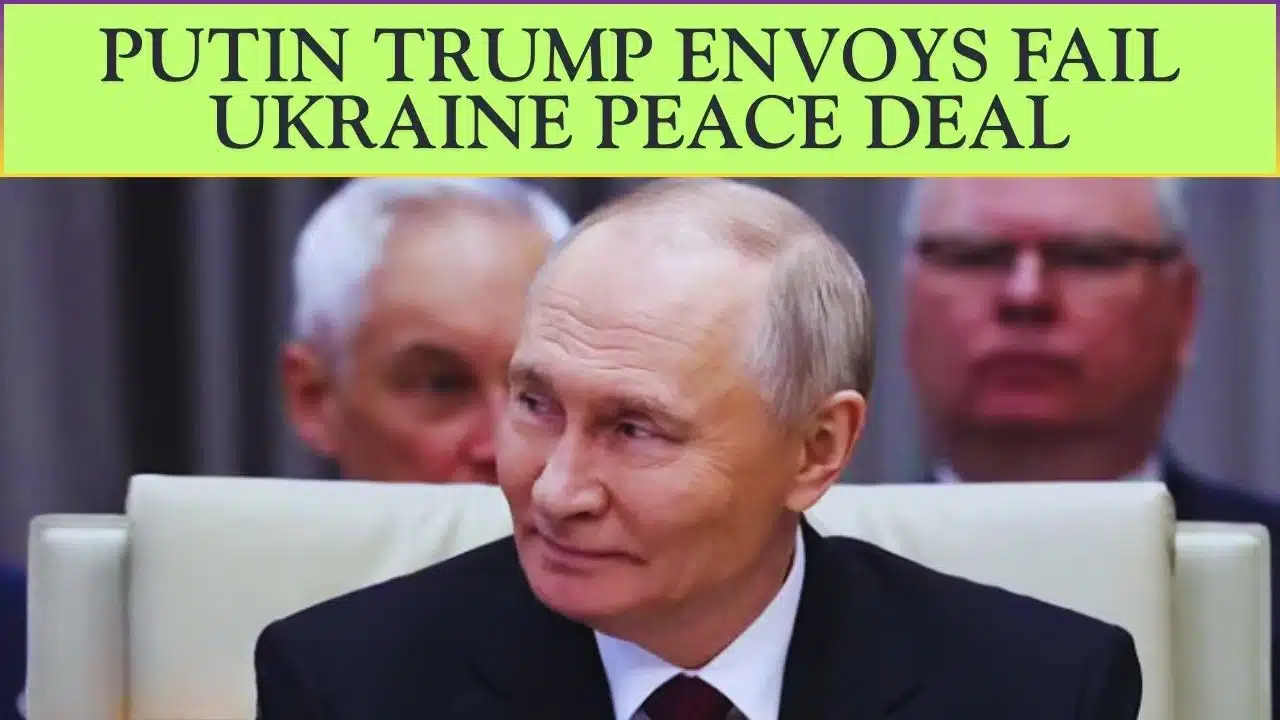
Russian President Vladimir Putin hosted a marathon five-hour meeting at the Kremlin with U.S. special envoy Steve Witkoff and President Donald Trump’s son-in-law Jared Kushner on Tuesday to explore paths to end the Ukraine war. The discussions, which began around 4:30 p.m. Moscow time and stretched past midnight, centered on a revised U.S. peace proposal now trimmed to about 19-20 points from an original 28-point draft widely seen as tilting toward Russian interests. Kremlin foreign policy aide Yuri Ushakov told reporters early Wednesday that the talks proved constructive overall, with some American ideas finding acceptance, but no compromise emerged on core territorial disputes.
Putin’s side included key figures like Ushakov and special envoy Kirill Dmitriev, head of the Russian Direct Investment Fund, who posted on social media that the session felt productive, adding a dove emoji to signal cautious optimism. Witkoff, a billionaire real estate developer with ties to Trump dating back to the 1980s, and Kushner—who recently helped broker a Gaza deal—arrived fresh from weekend talks with Ukrainian officials in Florida and Geneva, where they fine-tuned the plan to address Kyiv’s red lines. The White House expressed strong optimism beforehand, calling the updated draft significantly improved, while Trump himself labeled the conflict chaotic and pledged quick resolution. After the meeting wrapped around 9:30 p.m. GMT, Witkoff headed straight to the U.S. embassy in Moscow, likely to debrief before relaying details back to Washington.
This marked Witkoff’s sixth direct meeting with Putin and Kushner’s first, part of broader U.S.-Russia dialogues touching security guarantees, frozen Russian assets, and potential investments. Russian spokesman Dmitry Peskov, speaking in Delhi, stressed Moscow’s openness to talks but insisted on achieving special military operation goals, praising Trump’s framework as a solid starting point without specifics. Ukrainian President Volodymyr Zelenskyy, addressing crowds in Dublin, struck a hopeful note, saying chances for peace stand higher than ever but stressed no behind-the-scenes deals can decide Ukraine’s fate without its voice.
Territorial Demands Remain Core Obstacle
Territory forms the biggest roadblock, with Russia demanding Ukraine hand over the full Donbas region—including roughly 5,000 square kilometers still under Kyiv’s control—plus formal recognition of Moscow’s hold on Crimea, Luhansk, and Donetsk, while freezing front lines in Kherson and Zaporizhzhia at current positions. Putin also requires Ukraine to drop NATO ambitions permanently and accept caps on its army size, demands most nations reject as infringing on Ukrainian sovereignty. Ushakov noted these sticking points persist, with Putin viewing battlefield gains as leverage to dictate terms rather than concede ground.
Just before the talks, the Kremlin touted a major advance, claiming Russian forces captured Pokrovsk, a crucial eastern logistics hub that held out against assaults for over a year. In a video released Monday, Putin—dressed in military fatigues—heard from commanders that the town fell, calling it a step toward original objectives and accusing European allies of sabotaging peace by injecting unacceptable counterproposals. He charged Europe lacks a true peace agenda, siding with war instead, despite billions in aid to Ukraine since Russia’s 2022 invasion. Kyiv dismissed the claim as propaganda, reporting fierce ongoing battles, Russian casualties exceeding 100 in the prior day, and no full encirclement of the city.
Ahead of the Moscow session, Putin told investors the new 20-point U.S.-Ukraine plan remained unacceptable, echoing his stance that only full territorial concessions suffice. Analysts note the Trump team’s tough dynamic with Zelenskyy lets them push Kyiv harder amid its mounting challenges, shifting talks toward what Ukraine must yield for a ceasefire.
Diplomatic Push Continues Despite Setbacks
The U.S. delegation built on recent refinements from Geneva and Florida, where Zelenskyy called sessions constructive yet flagged tough issues ahead. He updated social media after talks with French President Emmanuel Macron—plus leaders from Britain, Germany, Poland, and Italy—saying the latest proposal looks better but stays unfinished, with Macron insisting territory decisions belong solely to Kyiv and no final plan exists yet. Zelenskyy approved a five-year EU partnership roadmap during a meeting with Irish leader Micheál Martin, seeking energy, humanitarian aid, and resilience boosts while keeping sanctions until Russia ends occupation. He fears waning U.S. interest if progress stalls and eyes possible direct Trump talks based on aide reports.
Ukraine grapples with domestic upheaval that weakens its hand. Chief of staff Andriy Yermak resigned last week after anti-corruption raids on his home linked to a $100 million embezzlement probe at state nuclear firm Energoatom; Defense Council secretary Rustem Umerov now spearheads negotiations. Putin conveyed personal greetings and key signals to Trump, with both agreeing to shield details from public view for now.
Broader context shapes the urgency. The original 28-point leak last month sparked outrage in Kyiv for crossing non-negotiables, prompting U.S.-Ukraine huddles and a Thanksgiving deadline Trump later pushed back. European leaders urge a dignified peace with all parties aligned, as Russia leverages military momentum. U.S. officials worry Putin might counter with a twisted version of the old plan, dragging out the painful process. Zelenskyy awaits the American briefing soon, with next moves hinging on its content amid hopes for sustainable security guarantees.