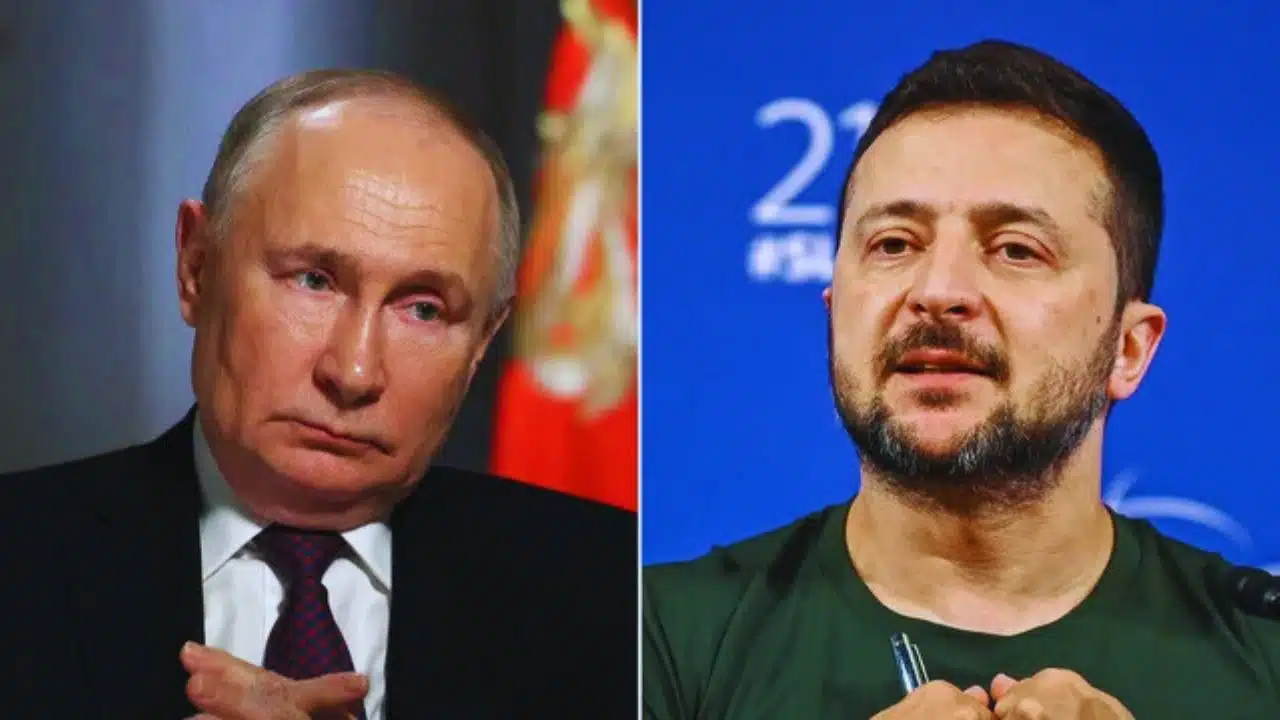
Russia claims a Putin residence drone attack involved 91 long-range drones aimed at one of Vladimir Putin’s state residences in Russia’s Novgorod region overnight into Dec. 29, while Ukraine’s leadership rejects the allegation as false and warns it could be used to justify new strikes.
What Russia alleges
Russia’s Foreign Minister Sergey Lavrov said Ukraine launched 91 long-range unmanned aerial vehicles (drones) at a state residence used by President Vladimir Putin in the Novgorod region, and that Russian air defenses intercepted and destroyed all of them.
Russian statements said there were no reported casualties and no reported damage from the alleged incident.
Russian officials also framed the alleged strike as a turning point for Moscow’s negotiating posture, saying Russia would “review” its stance while still claiming it would not leave the negotiating process entirely.
Lavrov’s claim was widely reported as referring to a residence associated with the Valdai area in Novgorod region, a location tied in public reporting to Putin’s use of state residences outside Moscow.
Public-facing Russian summaries did not present independent, verifiable evidence (such as imagery, debris documentation, or third-party verification) alongside the headline claim of 91 drones.
Ukraine’s response
Ukraine’s President Volodymyr Zelensky publicly rejected Russia’s allegation that Ukraine attacked Putin’s residence, describing the accusation as untrue.
Ukrainian messaging highlighted concern that such claims can be used to shape narratives ahead of additional Russian strikes, while still disputing responsibility for the alleged incident.
In the immediate public record around Lavrov’s remarks, Ukraine did not confirm any operational details supporting Russia’s account of the location, scale, or outcome of the alleged drone wave.
What is known so far
The alleged incident was described by Russian officials as occurring overnight into Dec. 29, with the target in Russia’s Novgorod region.
Russian messaging emphasized interception, saying all 91 drones were destroyed and that there were no casualties or damage reported.
Key elements—such as the exact launch locations, drone models, flight paths, and independent corroboration—were not established in the public materials cited alongside the official claims.
Timeline of key points (public claims)
| Date (local) | What was reported | Key attributed actor |
| Dec. 28–29, 2025 | Russia alleges 91 drones targeted a Putin state residence in Novgorod region; all destroyed; no casualties/damage reported. | Russian Foreign Ministry / Lavrov |
| Dec. 29, 2025 | Ukraine rejects the claim and disputes Russia’s account publicly. | Zelensky / Ukrainian leadership |
| Dec. 29, 2025 | Russia signals its negotiating stance will be “reviewed,” while saying it does not intend to exit talks. | Russian officials |
| Dec. 29, 2025 | Reports say Putin discussed the alleged incident in a call with U.S. President Donald Trump, according to Russian state media accounts cited in international reporting. | Kremlin aide (as reported) |
Diplomatic and military context
The drone-war dimension has been a recurring feature of the broader Russia-Ukraine conflict, including prior high-profile claims by Moscow of attempted strikes linked to senior Russian leadership sites.
In May 2023, Russia accused Ukraine of directing two drones at the Kremlin and described it as an attempted assassination of Putin, while reporting there were no injuries and limited or no damage—an earlier episode often cited as precedent for high-stakes accusation cycles.
In the latest case, Russian officials tied the alleged residence strike to their messaging on negotiations, with public statements indicating a reassessment rather than a formal withdrawal from talks.
International reporting also described a claimed Putin–Trump phone call in which Putin relayed details of the alleged drone incident, with Russian state-media accounts saying Trump reacted strongly to the information.
As presented publicly, these diplomatic readouts remain dependent on official or state-linked accounts, and independent verification of the call’s specific language and emotional characterizations is not established in the same public record.
What happens next
Russian officials said retaliation would follow and that targets and timing had been determined, but they did not publicly specify the nature of any planned response in the same summary materials.
Ukraine’s categorical denial means the core factual dispute—whether Ukraine launched drones at a Putin residence, and whether 91 drones were involved—will likely remain contested unless additional verifiable evidence emerges.
Given the explicit linkage Russian officials made between the alleged incident and negotiation posture, the near-term focus is likely to be on whether Moscow changes diplomatic demands, expands targeting, or uses the claim to justify escalation.