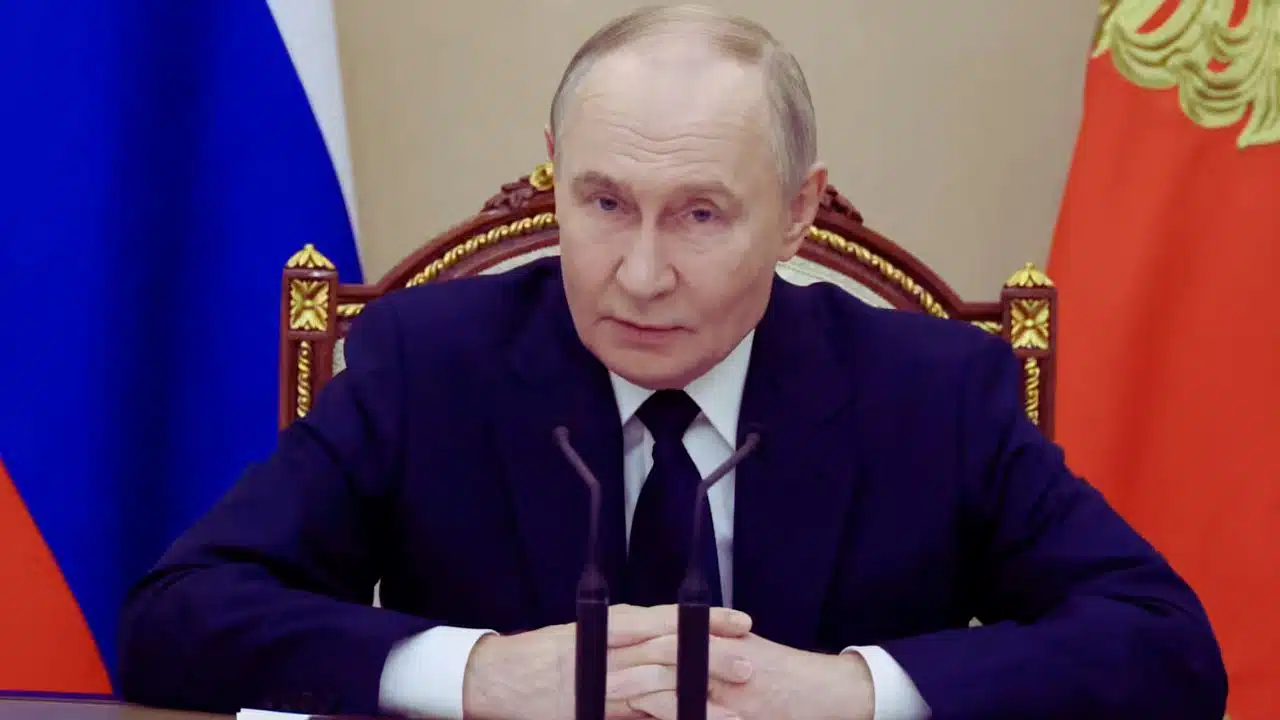
Russia’s President Vladimir Putin told commanders to keep pushing toward the southern Ukrainian city of Zaporizhzhia even as U.S.-led diplomacy with Ukraine’s leadership accelerated, highlighting the widening gap between battlefield objectives and peace-plan timelines.
What Putin ordered
Putin instructed Russia’s military to “continue the offensive” with the “Vostok” grouping to “liberate Zaporizhzhia,” according to accounts of a high-level briefing on the war.
In the same meeting, Russian officials also claimed that Russian troops were roughly 15 km from the southern outskirts of Zaporizhzhia city, a major regional center that remains under Ukrainian control.
Russian military leadership also presented Putin with claims of fresh progress around the Zaporizhzhia front, including references to fighting near Orikhiv and to the alleged capture of a nearby settlement—claims that were disputed by Ukraine-linked open-source mapping cited in the same reporting.
Why Zaporizhzhia matters
Zaporizhzhia city is a strategic hub for southern Ukraine, linking logistics routes that support operations across the broader southern axis of the war.
The wider Zaporizhzhia region also contains the Zaporizhzhia Nuclear Power Plant (ZNPP), a focal point for international nuclear-safety concerns since the site fell under Russian control early in the full-scale invasion.
Taken together, a push toward Zaporizhzhia can be read as both a military move and a negotiating signal, because territory and control lines remain central to ongoing peace discussions.
What the battlefield picture shows
Independent assessments in late December described continued Russian offensive activity on the southern axis, including attacks in western Zaporizhzhia Oblast and near key localities such as Orikhiv, while noting no confirmed major breakthroughs in those specific daily snapshots.
Those assessments also describe Russia’s southern-axis objective as maintaining positions, securing rear areas, and advancing to bring Zaporizhzhia city within effective tube-artillery range.
The resulting picture is one of sustained pressure and incremental tactics rather than a clearly verified rapid advance toward the city itself.
Key developments timeline
| Date (2025) | Development | Why it matters |
| Sep 23 | ZNPP lost off-site power again (10th time since Feb 2022, per the IAEA/UN reporting). | Off-site power is critical for nuclear safety systems and cooling. |
| Late Sep | IAEA said the long power-loss period was “not sustainable” and urged repairs and deconfliction. | Elevated nuclear safety risk during military activity near the plant. |
| Dec 26–27 | Independent reporting tracked continued Russian attacks on the Zaporizhzhia axis without confirmed major advances in those updates. | Suggests a grinding approach even as rhetoric escalates. |
| Dec 28–29 | Putin publicly urged continued offensive efforts toward Zaporizhzhia. | Reinforces maximalist aims amid active diplomacy. |
Peace talks and the U.S. track
In Florida, U.S. President Donald Trump said the parties were “maybe very close” to a peace deal after a call with Putin and an in-person meeting with Ukrainian President Volodymyr Zelenskyy.
Trump also described the talks as covering “95%” of issues, while identifying territory as the toughest unresolved problem—language that underscores how land control remains the core bargaining point.
Zelenskyy publicly emphasized the importance of security guarantees as a milestone for lasting peace, describing substantial agreement on parts of a multi-point plan while indicating sequencing and remaining issues were still being negotiated.
Where diplomacy and offensives collide
Putin’s call to intensify operations toward Zaporizhzhia came as territory was openly described by U.S. leadership as the hardest part of negotiations—making the battlefield push and the diplomatic agenda tightly linked.
The simultaneous timing signals that Moscow may be seeking improved leverage or clearer facts on the ground before any pause in fighting.
At the same time, the public framing from both Washington and Kyiv indicates talks are active, but not yet at a stage where immediate de-escalation is guaranteed.
Nuclear safety risks near Zaporizhzhia
The IAEA and UN reporting has repeatedly warned that external power cuts at the Zaporizhzhia Nuclear Power Plant create unsafe conditions, because emergency diesel generators are not a durable substitute for stable grid connection.
During one extended outage period described by the UN report, the plant relied on emergency diesel generators for essential safety functions and cooling, with eight operating generators, additional units in standby, and fuel reserves described as more than 10 days.
The ZNPP reactors have been shut down for more than three years, which reduces immediate heat and risk compared with an operating plant, but officials warned that a complete blackout without off-site or emergency power could still lead to severe consequences if power is not restored in time.
Zaporizhzhia area at a glance
| Issue | Current relevance | What’s at stake |
| Push toward Zaporizhzhia city | Putin ordered continued offensive efforts toward Zaporizhzhia. | Shifts leverage in talks where territory is pivotal. |
| Southern front activity | Ongoing attacks reported in western Zaporizhzhia areas in late-December assessments. | Sustained pressure without clearly verified rapid breakthroughs. |
| ZNPP external power | IAEA/UN described repeated off-site power losses since 2022 and warned outages are “not sustainable.” | Nuclear safety risk during military activity nearby. |
Final thoughts
Expect continued diplomatic meetings focused on territory, sequencing, and security guarantees, because these were publicly identified as central issues still being worked through.
On the ground, further fighting around the Zaporizhzhia axis is likely to remain tightly connected to negotiating leverage, especially if leaders continue to message territorial objectives in parallel with talks.
Nuclear-safety conditions around the ZNPP will remain a high-stakes factor, as international monitoring has stressed that prolonged reliance on emergency power systems is not a stable long-term situation.