You want more people to visit your website, but the idea of manually writing hundreds of high-quality pages feels overwhelming. Maybe you are worried that trying to scale up will just turn your site into a messy, disorganized ghost town. You are not the only one feeling this way; many business owners try shortcuts that end up hurting their rankings. But there is a better way to grow.
Programmatic SEO is picking up high speed in 2026, allowing websites to build and manage thousands of pages using smart tools and data. In fact, a 2025 report found that 47% of Fortune 1000 companies now use this method to dominate search results.
This guide will walk you through exactly what programmatic SEO is, why it is working so well right now, and how you can use it to build a massive footprint without sacrificing quality. I will share the specific tools I use, from data organization to automated publishing, so you can see exactly how it works.
Ready to outsmart the noise and build something sustainable? Let’s get started.
What Is Programmatic SEO?
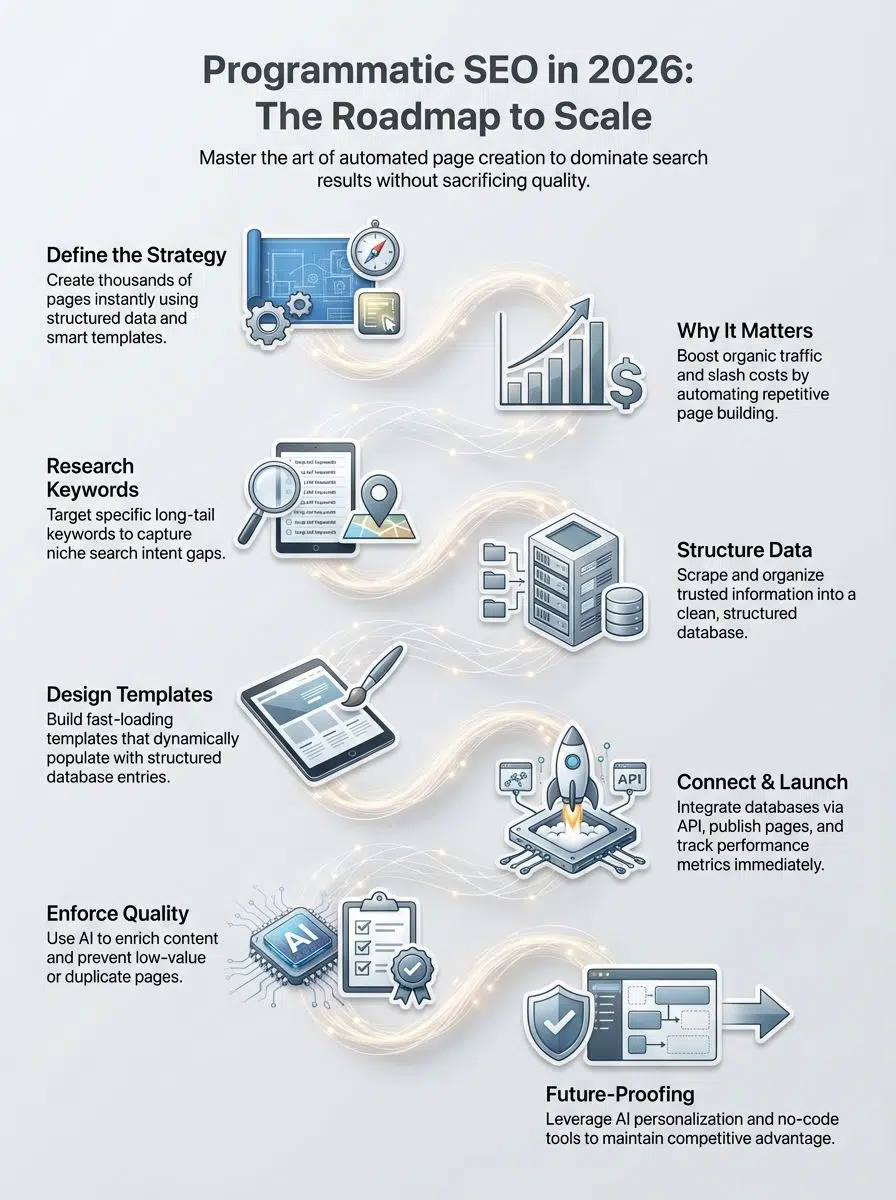
Programmatic SEO is the process of using code and data to create landing pages at scale. Instead of writing each page one by one, you build a single “template” and then use a database to fill that template with unique information for thousands of different search terms.
Definition and Overview
Think of it like a mail merge for websites. You have a standard letter (the template) and a list of names and addresses (the database). Programmatic SEO works the same way but for web pages. You target a “head term” (like “Best hiking trails in”) and combine it with “modifiers” (like “Colorado,” “Utah,” or “Oregon”).
Technically, this relies on structured data. You take organized information, like product specs, location details, or job listings, and feed it into a system that generates a unique URL for every row in your spreadsheet. This allows you to target long-tail keywords that would be too time-consuming to write manually.
A good template is like a Swiss Army knife; it keeps things tidy while doing ten tasks at once.
How It Differs from Traditional SEO
Traditional SEO is like painting a portrait; it takes time, detailed attention, and manual effort for every single piece. You might spend days crafting one “Ultimate Guide to Hiking.”
Programmatic SEO is more like building a printing press. You spend your time designing the system and the template. Once that is done, you can publish 1,000 pages about “Hiking in [City Name]” just as easily as you can publish ten.
While traditional methods focus on high-volume, competitive keywords, automated search optimization goes after the long tail, specific queries with lower volume but much higher intent. A user searching for “cheap 2-bedroom apartment in Austin near downtown” knows exactly what they want, and programmatic pages are perfect for answering that specific need.
Why Programmatic SEO Matters in 2026
The digital landscape is crowded, and speed is becoming a massive competitive advantage. Websites need to grow fast and stay smart, all at once.
Increasing Demand for Scalable Strategies
Companies want fast, repeatable ways to grow organic traffic without hiring an army of writers. According to a 2026 survey by BrightEdge, businesses that implemented programmatic SEO saw an average 24% increase in organic traffic within the first year.
This approach helps you cover the entire “search surface” of your industry. If you run a travel site, you don’t just want to rank for “best hotels.” You want to rank for “best hotels in [City],” “pet-friendly hotels in [City],” and “hotels with pools in [City].”
Doing this manually is impossible. Doing it programmatically is standard practice for industry giants like Tripadvisor and Yelp. If you can’t keep pace with this level of content generation, your site risks fading into the background noise.
Automation and Efficiency Advantages
Programmatic SEO brings automation front and center. Scripts pull data, build structured content, and publish lots of pages in the blink of an eye. Tools like Whalesync or Make can now sync your Airtable database directly to your Webflow or WordPress site, handling thousands of updates automatically.
This shifts your team’s focus. Instead of spending weeks writing similar landing pages by hand, they spend that time on strategy, data collection, and template design. You move from being a writer to being an architect of content.
Efficiency does not sacrifice quality when you do it right. By using clear data and smart templates, you ensure every page answers the user’s question perfectly, whether you have 100 pages or 100,000.
Key Examples of Companies Using Programmatic SEO
Many big brands boost their search numbers using automated SEO. They set the bar high, showing just how far structured data and smart templates can go. Here is a look at the numbers behind their success.
| Company | Estimated Monthly Organic Traffic | Programmatic Strategy |
|---|---|---|
| Zapier | ~5.8 Million | Integration pages (e.g., “Connect Gmail to Slack”) |
| Tripadvisor | ~226 Million | Location/Category pages (e.g., “Best Italian Restaurants in Boston”) |
| Nomad List | ~50,000 | City data pages (e.g., “Cost of living in Lisbon”) |
Zapier’s App Directory
Zapier shines as a strong example of programmatic SEO done right. They manage over 50,000 landing pages dedicated to app integrations. Each page targets specific long-tail keywords like “Slack Gmail integration” or “Google Sheets Mailchimp workflow.”
They don’t write these manually. They use a database of app features and triggers to generate helpful, specific pages that explain exactly how two tools work together. This strategy drives high lead generation at a very low cost per page.
Nomad List’s City Pages
Nomad List uses programmatic SEO to display data for over 24,000 cities. Each page follows a structured template that pulls live stats like cost of living, weather, internet speed, and safety scores.
For a remote worker looking for their next destination, this data is gold. The site uses a “Domain Rating” (DR) of 72 to dominate search results for queries like “best places to live in Europe.” By aggregating data points into a clean, readable format, they provide immense value without writing unique essays for every single town.
TripAdvisor’s Restaurant Directory
TripAdvisor operates on a massive scale, with over 74 million pages indexed by Google. Their restaurant directory covers countless search queries by listing data like restaurant names, addresses, menus, and reviews.
In 2024 and 2025, they continued to refine this by integrating real-time availability and “Things to do” data points. Their system uses structured data to ensure that when you search for “sushi near me,” their programmatic page pops up with exactly the details you need: ratings, hours, and photos.
Steps to Implement Programmatic SEO
Setting up programmatic SEO feels like building a city from blueprints. Each part needs careful planning so your site stands tall on search engines. Here is the process I recommend for 2026.
Perform Keyword Research
Start by identifying your “head terms” and “modifiers.” You can use the “Matching Terms” report in Ahrefs to find patterns. For example, if you see people searching for “best accounting software for small business,” “best accounting software for freelancers,” and “best accounting software for nonprofits,” you have found a programmatic opportunity.
Focus on gaps where big sites miss out. Look for long-tail keywords that have lower volume individually but massive volume when added together. Track these terms using analytics software to see which variations drive the most valuable traffic.
Collect and Structure Relevant Data
Your content is only as good as your data. You need a “source of truth”, a database that holds every piece of information you want to display. Common tools for this include Airtable, Google Sheets, or a PostgreSQL database.
Gather details such as locations, features, pricing, and user ratings. If you are building local pages, you might use the Google Places API to pull in accurate addresses and operating hours. Sort this data into clear columns (e.g., “City Name,” “Population,” “Average Rent”) so your template can read it easily.
Design and Optimize Page Templates
Your page template determines how all that data looks to the user. It should be fast, clean, and mobile-friendly. Tools like Webflow CMS or WordPress with the WP All Import plugin are excellent for building these dynamic templates.
Zapier uses clear, simple layouts that highlight the “Call to Action” immediately. Make sure your template includes ample space for unique data points, like specific ratings or FAQs, so the page doesn’t look empty or generic. Test your design with 5-10 sample pages before you try to publish thousands.
Build and Connect the Database
Once your template is ready, you need to connect it to your data source. If you are using a no-code stack, tools like Whalesync can sync your Airtable data directly to Webflow. For WordPress, plugins or custom scripts can pull data from a CSV file.
Make sure the connection supports updates. If the price of a product changes in your database, it should automatically update on the live page. This keeps your content fresh and accurate without manual editing.
Test and Launch Pages
Don’t just press “publish” on 10,000 pages at once. Start with a small batch, maybe 50 to 100 pages. Check them for errors. Is the data pulling in correctly? Do the images load? Is the “Title Tag” generating properly?
Use Google Search Console to monitor how these initial pages perform. Look for “Crawl” errors or “Discovered – currently not indexed” warnings. Once you confirm that Google likes your structure and the pages are ranking, you can slowly ramp up and release the rest of your database.
Challenges in Programmatic SEO
Scaling search optimization can feel like spinning plates; one wrong move and your content quality drops. Managing so many pages at once adds its own set of headaches, especially as Google raises the bar for content standards.
Avoiding Thin Content
Thin content is the enemy of programmatic SEO. Google’s August 2025 “Helpful Content” update made it clear: pages that just list basic facts without unique value will not rank. If your page only says “We have plumbers in Austin” and lists a phone number, it will likely get de-indexed.
To fix this, you must add “value-add” data. Include specific reviews, pricing trends, or local maps. Use tools like OpenAI’s API to generate unique, helpful descriptions for each page based on the data points you have, ensuring that “Austin” pages sound different from “Dallas” pages.
Addressing Duplicate Content Issues
When you use a template, it is easy for every page to look 90% identical. Google hates this. If two pages are almost twins, only one will show up in the results.
You can solve this by “conditional logic.” Design your template so that it changes based on the data. For example, if a city has a high crime rate, show a “Safety Tips” section. If it has great parks, show an “Outdoor Activities” section. This makes the structure of the page change dynamically, reducing the duplicate feel.
Ensuring Proper Google Indexing
Getting 10,000 pages indexed is harder than getting 10 pages indexed. You might face the “Crawled – currently not indexed” status, which means Google saw your page but decided it wasn’t worth adding to the search results.
Clean sitemaps are essential here. Break your XML sitemaps into smaller chunks (e.g., one sitemap per state or category) so you can track issues more easily. Also, ensure your internal linking is strong. Create “Hub Pages” (like a “California” page that links to all California city pages) so Googlebot can find a clear path to every single URL.
Quality Control Strategies for Programmatic SEO at Scale
Spotting weak links in automated SEO chains keeps your digital ship sailing strong. Here is how the pros keep quality high across thousands of pages.
Leveraging AI for Content Optimization
AI is your best friend for quality control. Tools like Letterdrop or Byword allow you to generate high-quality, long-form content that reads naturally. You can use these tools to review your generated pages for grammar errors or awkward phrasing before they go live.
For example, you can use a script to run every generated title through an AI checker to ensure it sounds like a human wrote it. This helps you catch weird automated phrases like “Best Plumber in North, South Carolina” before a user sees them.
Regularly Auditing Published Pages
You cannot manually check every page, but you can use tools to do it for you. Screaming Frog is the industry standard for this. You can set it to crawl a sample of your programmatic pages every week to check for broken links, missing meta descriptions, or thin word counts.
Think of it as a health check. If you notice that 20% of your pages have fewer than 300 words, you know you have a data problem in your database that needs fixing. Catching these issues early prevents a sitewide penalty.
Monitoring User Feedback and Engagement
Data tells the truth. Watch your engagement metrics in Google Analytics 4 (GA4). If you see that your “Chicago” pages have a high bounce rate compared to your “New York” pages, something is wrong with the Chicago template or data.
Smart marketers also add a simple “Was this page helpful?” thumbs-up/down widget to the bottom of programmatic pages. It provides instant, qualitative feedback. If users keep downvoting a specific section, you know exactly what to improve across the entire template.
Future Trends in Programmatic SEO
The game keeps changing. AI tools will soon get smarter at shaping content for each user, and digital marketers who keep pace will spot surprising wins.
AI-Powered Personalization
We are moving toward dynamic content insertion. By 2026, it is estimated that over 65% of large websites will use AI to adapt content in real-time. Imagine a programmatic page for “Best Credit Cards” that automatically highlights travel cards if the user arrived from a travel blog, or business cards if they came from LinkedIn.
This level of personalization increases “dwell time” and conversion rates because the user feels the page was made just for them. It is the next evolution of the static template.
Integration with No-Code Tools
The barrier to entry is lowering. You no longer need a developer to build a programmatic site. Tools like Softr (for frontend) and Airtable (for backend) allow non-technical marketers to launch powerful directory sites in days.
This “democratization” means more competition, but also more agility. Small teams can now compete with giants like Yelp by moving faster and targeting niche verticals that the big players ignore.
Enhanced Long-Tail Keyword Targeting
As voice search and AI chat answers grow, queries are getting longer. People aren’t just searching for “best running shoes.” They are searching for “best running shoes for flat feet 2026 under $100.”
Programmatic SEO is perfectly suited for this. By adding more columns to your database, like “Price,” “Foot Type,” and “Year”, you can generate highly specific pages that answer these complex questions perfectly. This “hyper-specific” approach is where the biggest traffic gains will be in the coming years.
The Bottom Line
Programmatic SEO for 2026 is about working smarter, not harder. You have seen how structured data, smart templates, and tools like Zapier and Airtable can boost your visibility while keeping quality high. These steps are clear, and you don’t need a massive engineering team to get started. Are you ready to let automation handle the heavy lifting and watch your organic traffic grow?
Start small, focus on clean data, and take action today. Your next big lead might be just one optimized page away!