Being stuck in a room without a window feels like living in a slow cooker, especially when the summer heat kicks in. Whether it is a basement office, a walk-in closet converted into a gaming den, or a tucked-away guest room, the lack of ventilation is a real problem.
Most people think you need a window to run an AC, but that is not entirely true anymore. In 2026, cooling technology has split into two helpful directions. You have high-tech “true” air conditioners that can be vented through walls or doors, and you have smart evaporative coolers that do not need a hose at all. Finding the right portable air conditioner for room without windows depends entirely on your local humidity and how much DIY work you are willing to do. This guide breaks down the top ten options to help you reclaim your space from the heat and breathe easy again.
The Reality of Cooling Without a Window
To cool a room properly, you have to understand one basic rule of physics: you cannot just “create” cold; you have to move the heat somewhere else. Standard air conditioners use a compressor and refrigerant to grab heat from the air inside and push it out through an exhaust hose. If you do not have a window, that hot air has to go into a hallway, through a wall, or up into a ceiling plenum.
If you cannot find any way to vent air out, you are looking at an evaporative cooler, often called a swamp cooler. These do not use a compressor. Instead, they blow air over a wet honeycomb filter. As the water evaporates, it chills the air. It is a brilliant, vent-free solution, but it only works if your indoor humidity is low. If it is already humid, these machines will just turn your room into a tropical rainforest by adding even more moisture.
| Feature | Vented Portable AC | Ventless Evaporative Cooler |
| Cooling Method | Refrigerant & Compressor | Water Evaporation |
| Venting Required | Yes (Hose to door/wall/ceiling) | No Hose Needed |
| Best Climate | Any (Works great in humidity) | Dry/Arid Climates Only |
| Maintenance | Drain water (if not self-evaporating) | Refill water tank regularly |
| Cooling Power | Can lower temp by 20+ degrees | Best for 5-15 degree drops |
| Energy Use | Higher (due to compressor) | Very Low (fan only) |
Why Traditional Units Struggle?
Traditional portable units often rely on a single hose that creates “negative pressure.” This means as they blow hot air out, they suck warm air in from under doors or through cracks in the wall. In a windowless room, this effect is amplified because there is less natural air exchange happening. Choosing a dual-hose or high-efficiency inverter model is usually the best way to combat this specific hurdle. These units intake air from outside (or a separate room) to cool the condenser, rather than using the air you just spent money to cool.
10 Best Portable Air Conditioners for Windowless Rooms
1. Midea Duo Smart Inverter (MAP14HS1TBL)
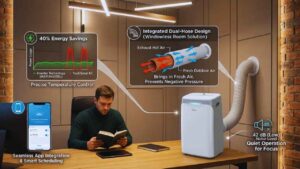
The Midea Duo is the heavy hitter on this list for a reason. Its unique hose-in-hose design solves the negative pressure problem by bringing in fresh air from outside and exhausting heat through the same assembly. This makes it incredibly efficient for a portable air conditioner for room without windows because it does not fight against the room’s vacuum.
It is also an inverter-based model, meaning it can slow down its motor instead of constantly clicking on and off, which saves a massive amount of electricity. The app integration is seamless, allowing you to set schedules so the room is crisp the moment you walk in. It is surprisingly quiet for its size, making it a top pick for office spaces where focus is key.
| Feature | Specification |
| BTU Rating | 14,000 ASHRAE / 12,000 SACC |
| Hose Type | Dual-Hose (Integrated) |
| Noise Level | 42 dB (Low) |
| Key Benefit | Inverter technology for 40% energy savings |
2. Coolzy Pro Personal AC
If you want a “true” air conditioner that does not require a massive 5-inch hose, the Coolzy Pro is your best bet. It is designed to cool the person, not the entire empty space of the room. It uses a tiny amount of refrigerant and blows a focused stream of cold air directly at you. Because it is so low-powered, the heat it vents out the back is minimal—often low enough that you can just point the back of the unit toward an open door without needing a dedicated hose setup.
This is perfect for dorm rooms or small studios where you spend most of your time at a desk or in bed. It is extremely portable and can be moved from room to room as easily as a suitcase.
| Feature | Specification |
| BTU Rating | 3,400 BTU |
| Venting | Optional (Tail kit available) |
| Power Use | 300 Watts |
| Key Benefit | No permanent installation required |
3. Whynter ARC-14S Dual Hose
This unit is widely considered the “workhorse” of the portable AC world. It features a dual-hose system that can move a massive amount of air, which is vital if you are venting through a long run to a different room or a wall hole. It also doubles as a high-capacity dehumidifier, pulling up to 71 pints of moisture out of the air per day.
For a basement with no windows that feels damp and sticky, this is the most reliable way to stay dry and cool. The build quality is exceptional, featuring lead-free, RoHS-compliant components that are built to last for several years of heavy use. It remains a top seller because it simply performs better in high-heat scenarios than almost any other portable unit.
| Feature | Specification |
| BTU Rating | 14,000 ASHRAE |
| Dehumidifier | 71 Pints/Day |
| Thermostat | 61°F – 89°F |
| Key Benefit | Rapid cooling for larger windowless areas |
4. LG Dual Inverter Smart AC
LG has mastered the art of the quiet compressor. This model is perfect for windowless home offices where you need to be on Zoom calls without a jet engine roaring in the background. The “LoDecibel” technology keeps it running at around 44dB, which is quieter than a normal conversation. It also features a very sleek, vertical design that fits into tight corners where space is at a premium.
The ThinQ app allows for voice control via Alexa or Google Assistant, which is handy if you’ve already tucked the unit behind a desk. It also has a very effective air filtration system that captures dust and pet dander, which is a common issue in rooms with poor natural airflow.
| Feature | Specification |
| BTU Rating | 14,000 BTU |
| Noise Level | 44 dB |
| Smart Tech | ThinQ WiFi Enabled |
| Key Benefit | Ultra-quiet performance for bedrooms |
5. Dreo IceWind Max
For those in dry climates looking for a ventless option, the Dreo IceWind Max is top-tier. It uses a high-speed cross-flow impeller that mimics the feel of a natural breeze while dropping the air temperature by up to 15 degrees using ice packs. It does not have a compressor, so it is light, easy to move, and uses about as much power as a standard LED light bulb.
The oscillating louvers ensure the cool air reaches every corner of your windowless nook. It includes a remote control and a very clear LED display that makes it easy to toggle between the various cooling modes. Since there is no exhaust hose, you can place it exactly where you need it without worrying about wall proximity.
| Feature | Specification |
| Type | Evaporative Cooler |
| Water Tank | 2.1 Gallons |
| Speeds | 3 Fan Speeds |
| Key Benefit | No hose needed; incredibly energy efficient |
6. Black+Decker BPP08WTB
This is the “tiny but mighty” option for very small windowless spaces like a 150-square-foot hobby room. It is one of the most compact units on the market, making it easy to store when the weather cools down. While it is a single-hose unit, its low price point and reliability make it a favorite for budget-conscious buyers who only need to cool a small area.
The interface is simple with big buttons, and it comes with a sturdy handle for easy lifting. It also acts as a fan and a dehumidifier, giving you three tools in one compact box. It is specifically designed for ease of maintenance, with a slide-out filter that you can rinse under a tap in seconds.
| Feature | Specification |
| BTU Rating | 8,000 ASHRAE |
| Coverage | Up to 150 sq. ft. |
| Dimensions | 16.5″ x 11.5″ x 26″ |
| Key Benefit | Best value for small, tight spaces |
7. Honeywell CO30XE Ventless Cooler
Honeywell’s CO30XE is built for large, open windowless areas like workshops or garages. It features a massive 7.9-gallon water tank and a weather-resistant housing. If you have a large basement area where you can leave a door ajar to let fresh air in, this unit provides powerful cooling without the need for any permanent installation or hosing.
It features an adjustable humidification dial so you can control exactly how much moisture is being added to the air. The thick cooling pads are designed to last for several seasons, and the unit even has an audible low-water alarm so you never run the pump dry. It’s a rugged solution for spaces that standard ACs just can’t handle.
| Feature | Specification |
| Type | Outdoor/Indoor Evaporative |
| Airflow | 525 CFM |
| Tank Capacity | 7.9 Gallons |
| Key Benefit | Massive water capacity for long run times |
8. SereneLife SLPAC10
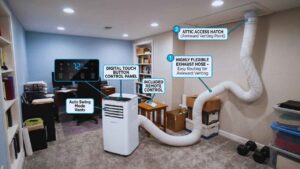
SereneLife offers a great middle-ground for people who need a real AC but do not want to spend a fortune. It comes with a very flexible exhaust hose that is easier to route around corners than the stiff hoses found on many competitors. This flexibility is key when you are trying to reach a distant door or an attic hatch from the middle of a windowless room.
The digital touch button control panel is sleek and modern, and the included remote means you don’t have to get up to change the temperature. It also features an automatic swing mode that moves the air vents up and down, ensuring that the cold air doesn’t just pool on the floor but circulates throughout the room.
| Feature | Specification |
| BTU Rating | 10,000 ASHRAE |
| Weight | 53 lbs |
| Modes | Cool, Dry, Fan |
| Key Benefit | Highly flexible hose for awkward venting |
9. Hessaire MC18M Mobile Evaporative Cooler
The Hessaire is the most “industrial” ventless pick. It is not pretty, but it moves a staggering amount of air (1,300 CFM). If you are working in a windowless garage or a large shed, this unit will outperform almost anything else in its price bracket. It uses high-density cooling pads that hold more water and provide more cooling surface area than the thin filters found in cheaper models.
It is built with high-impact ABS plastic, so it can handle being bumped or moved around a busy workspace. The manual dials are straightforward and unlikely to break, making it a “buy it for life” style of appliance for those who prioritize function over aesthetics.
| Feature | Specification |
| Type | Industrial Evaporative |
| Airflow | 1,300 CFM |
| Coverage | Up to 500 sq. ft. |
| Key Benefit | Powerful airflow for industrial/large spaces |
10. EcoFlow Wave 2
The Wave 2 is a high-tech marvel that can run on a swappable battery or a standard outlet. It is designed for portability, meaning its exhaust hoses are smaller and easier to manage than standard household units. This makes it the perfect portable air conditioner for room without windows if you are renting and cannot make permanent changes to the walls, as you can easily vent the small hoses through a slightly cracked door or a small vent.
It can cool or heat, making it a year-round companion. The build quality is premium, and it can even be charged via solar panels, making it the only “green” AC choice for off-grid windowless cabins or workshops.
| Feature | Specification |
| BTU Rating | 5,100 Cooling / 6,100 Heating |
| Battery Life | Up to 8 hours (Add-on) |
| Weight | 32 lbs |
| Key Benefit | Battery-powered and incredibly portable |
How to Vent an Air Conditioner Without a Window?
If you choose a “real” air conditioner with a compressor, you have to get that hot air out. Since you do not have a window, you have to look at the other openings in your room. It sounds intimidating, but most people can set this up in an afternoon with a few basic tools or a specialized kit. The most common way is venting through a door.
You can buy a “door seal kit” which is a long strip of fabric with a zipper. You stick it to the door frame and the edge of the door, then zip the hose into the gap. This allows the door to stay mostly closed while the hot air is pumped into the hallway or the next room. It is a temporary fix, but it works surprisingly well for renters.
| Venting Method | Setup Time | Complexity | Best For |
| Through a Door | 15 Minutes | Easy | Renters or Temporary setups |
| Through the Wall | 2-3 Hours | High | Homeowners seeking permanent cooling |
| Through the Ceiling | 1 Hour | Moderate | Offices with drop-ceilings |
| Through a Dryer Vent | 45 Minutes | Moderate | Laundry rooms or adjacent spaces |
Permanent vs. Temporary Venting Solutions
For a more permanent setup, venting through the wall is the gold standard. You essentially install a dryer vent—a 5-inch hole with a flap on the outside. This is the most efficient method because it creates a direct, short path for the heat to escape. If you have a drop ceiling, you can also vent into the “plenum” space above the tiles, though you should only do this if that space is large and well-ventilated to prevent heat from radiating back down into the room. Always check local building codes before cutting into walls to ensure you aren’t hitting any electrical lines or plumbing.
Vented vs. Ventless: Which Should You Choose?
The decision between a vented AC and a ventless cooler usually comes down to where you live and the current humidity levels. If you are in a place like Phoenix or Las Vegas, a ventless evaporative cooler is fantastic. It uses much less electricity and provides a comfortable, cool breeze by adding moisture to the dry air. In these regions, a portable air conditioner for room without windows that is ventless is actually the superior choice because it acts as a humidifier too. It keeps your skin from drying out while keeping the temperature manageable.
| Climate Type | Recommended Unit | Humidity Range | Result |
| Arid/Dry | Ventless (Evaporative) | Below 40% | Refreshing, cool, moist air |
| Moderate | Either (Vented Preferred) | 40% – 60% | Controlled temperature |
| Humid/Tropical | Vented (Compressor) | Above 60% | Crisp, dry, chilled air |
However, if you are in a humid place like Houston, Chicago, or New York, a ventless cooler will make your room feel like a swamp. In these climates, you need a vented unit that uses a refrigerant. These units actually remove water from the air, making it feel cooler and crisper. If you buy a ventless cooler in a humid city, you will likely end up with mold issues and a room that feels hotter than when you started because the water won’t evaporate off your skin. It is vital to check your local average humidity before making a purchase.
Buying Guide: What to Look for in 2026?
When shopping for a portable air conditioner for room without windows, do not just look at the price tag. Cooling tech has advanced, and certain features will make a huge difference in your daily comfort. For instance, the BTU (British Thermal Unit) rating can be misleading. Always look for the “SACC” (Seasonally Adjusted Cooling Capacity) rating, which is the modern standard for how much heat a unit actually removes in real-world conditions. This rating accounts for the heat that the machine’s own hose leaks back into the room, giving you a much more honest picture of its power.
| Feature to Check | Why It Matters | Priority |
| SACC Rating | Prevents buying an underpowered unit | High |
| Self-Evaporation | No water buckets to empty manually | High |
| Inverter Motor | Quieter and cheaper to run | Moderate |
| Filter Type | HEPA filters clean the air of dust | Low |
| Hose Insulation | Keeps heat from leaking back inside | Moderate |
You should also prioritize “self-evaporating” models. In the past, portable ACs had a bucket you had to empty every few hours. Modern units take the water they pull from the air and use it to cool the machine’s internal parts, eventually turning it into vapor and blowing it out the exhaust hose. This means you rarely, if ever, have to worry about a messy water spill on your carpet. Additionally, look for models with an “Inverter” compressor. These are more expensive upfront but can pay for themselves in two seasons through lower electric bills.
Noise and Size Considerations
In a windowless room, sound tends to bounce off the walls more than in a room with soft curtains and window glass. If the room is small, a unit that produces 60 decibels will sound like a vacuum cleaner. Look for units with a “Sleep Mode” or those specifically marketed as “Inverter” models, as they are significantly quieter. Also, measure your floor space carefully; remember that a portable AC needs about 12 to 20 inches of clearance around it to breathe properly. Without this space, the unit can overheat and shut down prematurely.
Final Thought
Finding a portable air conditioner for room without windows doesn’t have to be a headache. If you are in a dry area, go for a high-end ventless cooler like the Dreo or Honeywell and enjoy the hose-free life. If you are dealing with humidity, grab a dual-hose unit like the Midea Duo or Whynter and use a door seal or wall vent kit. The most important thing is to match the machine to your specific room size and climate.
Modern 2026 models are quieter and more efficient than ever, so even a room without a view can become the coolest spot in your house. Take your time, measure your space, and get ready to finally turn off that useless desk fan and enjoy some real, crisp air.