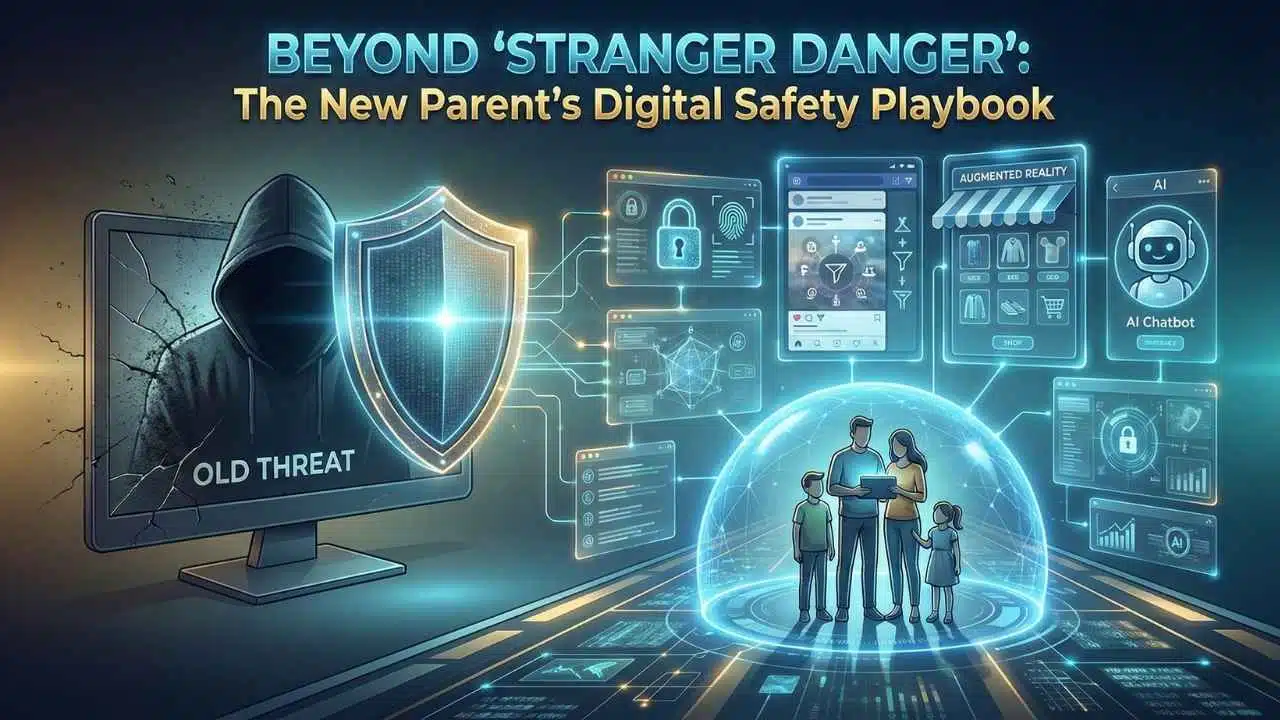
The era of “stranger danger” and simple website blockers is officially over. As we settle into 2026, the digital landscape has shifted from a place where children merely consume content to a world where they are constantly analyzed by it. For the modern family, a comprehensive parents guide to internet safety is no longer about installing a filter and walking away; it is about understanding the invisible mechanics of the AI-driven web. Today, the risks are not just about who your child talks to, but what the algorithms are whispering back to them.
We are living in the age of “AImaginary” relationships, where chatbots are designed to simulate friendship, and video games have evolved into immersive shopping malls. The challenge for parents in 2026 is that the threats are often silent. There are no alarms when a data broker builds a psychometric profile of your child based on their eye movements in a VR game. There is no warning label when a “feed” detects your teenager’s anxiety and begins serving content that exacerbates it to keep them scrolling.
This guide is designed to be your playbook for this new reality. We will move beyond the basic advice of the past decade and dive deep into the three structural pillars of modern digital safety: Privacy (the data exhaust your child leaves behind), Ads (the psychological influence woven into gameplay), and Algorithms (the automated curation that shapes their worldview). By mastering these three areas, you can move from being a gatekeeper—who tries to block the ocean with a spoon—to being a guide, teaching your children how to swim.
Key Takeaways
-
Privacy is Agency: It’s not about hiding secrets; it’s about preventing AI from predicting and manipulating your child’s future behavior.
-
The Feed is a Trap: Algorithms favor high-arousal emotions (anger/fear). Teach kids to “vote” with their attention by scrolling past toxic content instantly.
-
Ads are Worlds: Advertising is now woven into gameplay and “friends” (AI influencers). The distinction between content and commercial has vanished.
-
Silence is Golden: Turn off microphones on all apps that don’t strictly need them to prevent voice profiling.
-
Connection over Control: The best filter is an open line of communication. If your child sees something bad, they must feel safe telling you without fear of losing their phone.
The 3 Pillars of Digital Safety in 2026
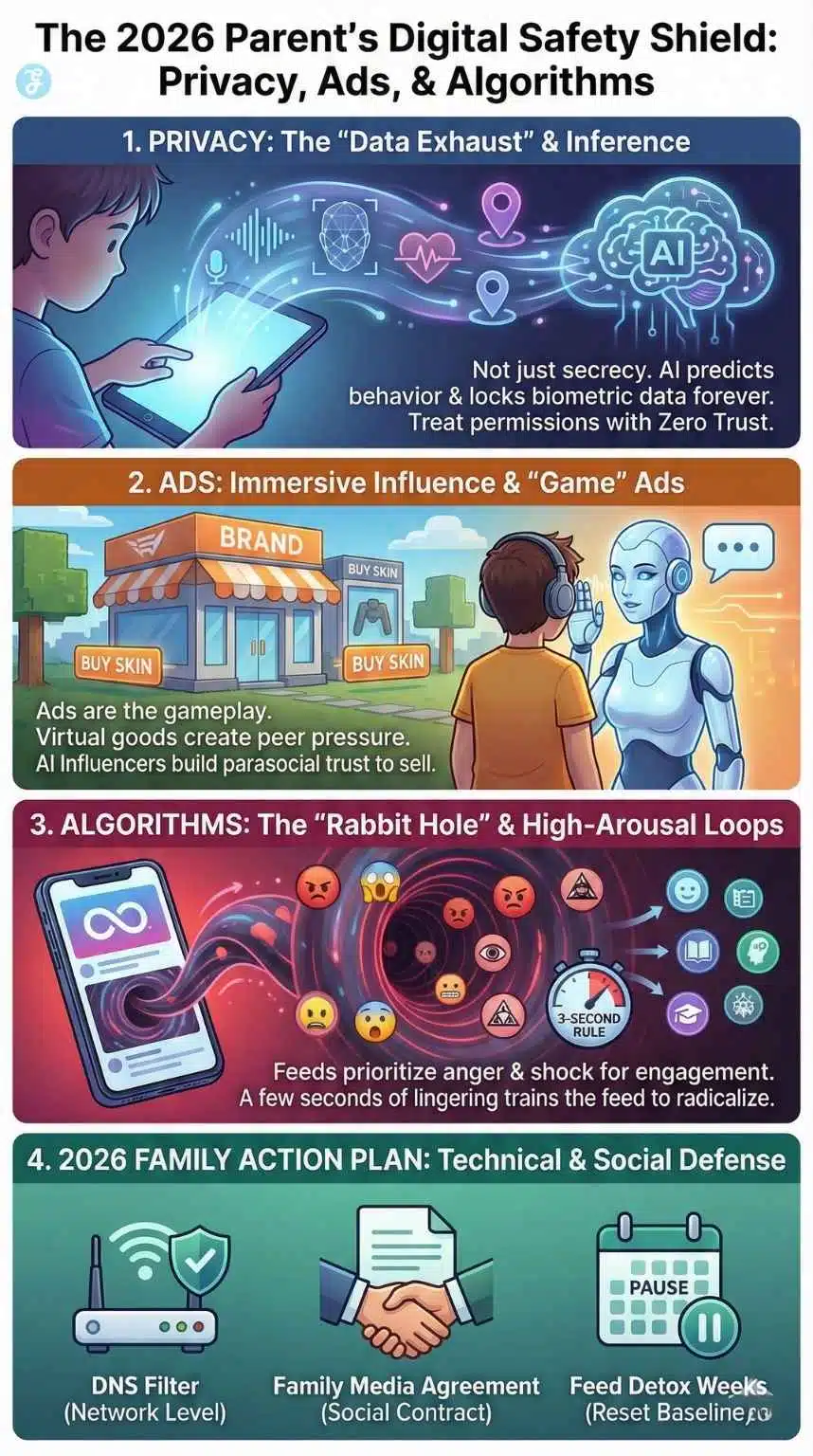
Before we examine the specific threats, we must understand the three forces that now govern the digital playground. The “Safety Trinity” has evolved. It is no longer about antivirus software; it is about understanding the business model of the internet.
To keep your child safe in 2026, you must audit their technology through these three lenses:
-
Privacy (The Data): This is the input. It is everything the device takes from your child—voiceprints, location history, and behavioral patterns. Safety here means limiting what the machine can learn.
-
Ads (The Influence): This is the motive. It is the reason the content exists. In modern gaming and social media, the “ad” is often disguised as a game mechanic or a virtual friend. Safety here means recognizing commercial manipulation.
-
Algorithms (The Curator): This is the output. It is the invisible hand that decides what your child sees next. Safety here means understanding how “engagement loops” can lead children down toxic rabbit holes.
Let’s break down exactly how these three pillars interact to shape your child’s reality, and the specific tools you need to dismantle them.
Privacy in the Age of AI (It’s Not Just Secrecy)
In 2026, “privacy” is a misnomer. We often think of privacy as “hiding,” but in the context of AI, privacy is about agency, the right to not be predicted, nudged, or manipulated. When a child uses a tablet today, they are not just pressing buttons; they are feeding a machine learning model that is hungry for data points.
The “Data Exhaust” & Inference
Every tap, pause, and scroll creates a “digital exhaust.” In the past, companies collected simple data: age, location, and gender. Today, they collect inference data. By analyzing how long a child hesitates before clicking a level in a game, AI can infer their frustration tolerance, their learning speed, and even their emotional state.
This data is often sold or shared with third-party aggregators who build “shadow profiles.” A child who struggles with a math game might be tagged as “insecure about intelligence,” making them a prime target for ads selling “brain-boosting” supplements or academic cheat tools later in the evening. This is not science fiction; it is the standard business model of the programmatic ad web in 2026.
Biometrics: The New Fingerprint
The explosion of educational technology (EdTech) and “smart” toys has brought biometric surveillance into the playroom. Many AI-powered tutors now use facial recognition to “measure engagement,” tracking a student’s eye movement to see if they are paying attention.
-
The Risk: Unlike a password, you cannot reset your face or voice. If a database containing your child’s voiceprint is breached (a growing occurrence), that data can be used to train Deepfake AIs for identity theft or fraud years down the line.
-
The Defense: You must treat biometric permissions with “Zero Trust.” Does that language learning app really need camera access to “see” your child’s pronunciation? Likely not.
For years, privacy advocates warned parents about “sharenting” (sharing too many photos of kids) due to embarrassment or privacy concerns. In 2026, the risk is technical. Publicly available high-resolution photos are the fuel for Generative AI models. Scrapers troll public Instagram and TikTok accounts to build datasets for face-swapping technology.
The Rule: If you post, use the “Glaze” or “Nightshade” method (tools that add invisible noise to images to confuse AI) or, more simply, restrict posts to “Close Friends” only.
| Old Privacy Model (2015-2020) | New Privacy Model (2026) |
| Focus: Hiding real name and address. | Focus: Protecting behavioral and biometric patterns. |
| Threat: Strangers and predators. | Threat: Predictive algorithms and data brokers. |
| Action: “Don’t tell people where you live.” | Action: “Don’t let the app measure your emotions.” |
| Tool: Antivirus software. | Tool: Anti-tracking software & Data deletion requests. |
Ads: The “Game” Is The Commercial
If you are looking for banner ads, you are looking in the wrong place. Advertising to children has become immersive. It is no longer an interruption to the content; it is the content.
Advergames & The Metaverse Mall
Platforms like Roblox and Fortnite have normalized the “Advergame”—branded worlds created by sneaker companies, fast-food chains, or toy manufacturers. In these worlds, the gameplay revolves around collecting branded items.
-
The Psychology: This bypasses a child’s “ad filter.” They don’t see a commercial for a sneaker; they spend 40 hours earning the sneaker to wear on their avatar. The brand loyalty formed here is deep and emotional.
-
Virtual Goods & Status: The currency of the playground in 2026 is not trading cards; it is “skins” and virtual accessories. Children face immense peer pressure to buy these items. This is not just “wanting a toy”; it is about social survival in their digital peer group.
The AI Influencer Phenomenon
One of the most disturbing trends of 2026 is the rise of the AI Influencer. These are hyper-realistic, computer-generated avatars that run YouTube and TikTok channels. They look real, act real, and have “personalities” optimized for maximum engagement.
-
Why it’s dangerous: Human influencers get tired, have scandals, or age. AI influencers are perfect, always happy, and always selling. They can interact with millions of children simultaneously via chatbots, creating a “parasocial” (one-sided) relationship that feels incredibly intimate to the child. When the AI “friend” suggests buying a specific drink, the child trusts them implicitly.
-
The Conversation: You must show your children the difference. Show them the “glitches,” explain that a team of writers controls the avatar, and remind them: “This person does not exist. They are a cartoon designed to sell things.”
Loot Boxes: The Gambling Gateway
Despite regulation attempts in the EU and parts of the US, “Loot Boxes” (blind packs of virtual items) remain prevalent. They utilize the exact same psychological mechanism as slot machines: Variable Ratio Reinforcement. The brain releases dopamine not when you get the prize, but in the anticipation of it.
Strict Policy: Never, ever link a credit card to a child’s game console. Use physical gift cards only. This adds “friction” to the purchase process, forcing the child to stop, ask, and physically enter a code, breaking the dopamine loop.
Algorithms: The “Feed” Is The Product
The “open web” (searching for information) has been replaced by the “feed” (information finding you). This shift is the single biggest safety factor in 2026. The algorithm’s goal is not your child’s well-being; it is Time on Device.
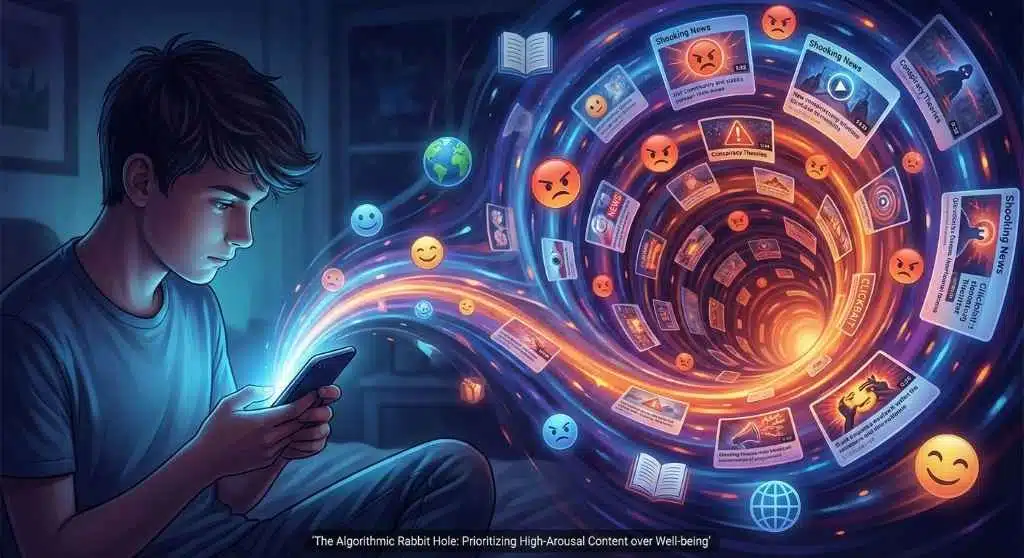
The “Rabbit Hole” Effect
Algorithms prioritize “High Arousal” content. Emotions like anger, fear, and shock keep eyes on the screen longer than calmness or happiness.
-
The Path: A child watches one video about “healthy eating.” The sidebar suggests a video about “bad foods.” Three clicks later, they are in a pro-anorexia community.
-
The Pipeline: A teenager watches a gaming highlight. The algorithm suggests a “feminist fail” compilation (high engagement/anger). Within an hour, they are funnelled into toxic “manosphere” content. This is the Radicalization Pipeline. It happens automatically, without the child ever searching for it.
The “3-Second Rule” & Algorithmic Literacy
We need to teach children how to “train” their feed.
-
The Concept: Explain to your child: “The algorithm is a robot spy. It watches what you stop scrolling for. If you stare at a car crash video for 3 seconds, it thinks: ‘Oh! They love car crashes! Let’s send 50 more!’
-
The Defense: Teach the Scroll-Past. If you see something upsetting or gross, do not comment (even to say “this is bad”), do not share, and do not linger. Scroll past immediately. That is the only “No” vote the algorithm counts.
Beauty Filters & The Dysmorphia Crisis
AI video filters in 2026 are seamless. They don’t just add dog ears; they subtly smooth skin, enlarge eyes, and shrink noses in real-time video chats.
-
The Impact: Children are growing up with a distorted baseline of what a human face looks like. When they look in a mirror, they feel “ugly” because they lack the digital enhancement they see on their friends’ screens.
-
Action: Have “Filter-Free” video calls with family. Normalize normal skin texture. Discuss how filters are “digital makeup,” not reality.
| Algorithmic Red Flags | What It Means |
| “You might also like…” | This is the Rabbit Hole entrance. Be skeptical of these suggestions. |
| Auto-Play is ON | The strongest tool for addiction. Turn this off immediately. |
| Infinite Scroll | A design choice to remove “stopping cues.” Set a timer to create an artificial stop. |
| Notifications | “Someone liked your photo” is a dopamine hook. Disable non-human notifications. |
The 2026 Family Tech Stack [Actionable Tools]
You cannot rely on willpower alone. You need a technical defense layer.
1. Network Level Protection (DNS)
Don’t just rely on device settings; filter the internet at the router level. Services like NextDNS or OpenDNS Family Shield allow you to block categories (Gambling, Pornography, Trackers) for the entire house.
-
Why: It catches devices you might forget, like a friend’s iPad or a smart TV.
-
Set up: Change the DNS settings on your home router. It takes 5 minutes and protects every device connected to your Wi-Fi.
2. The “Dumb” Smart Phone
For children under 14, avoid fully unlocked smartphones. The 2026 trend is the “dumbphone” renaissance or locked-down operating systems (like Pinwheel or Bark phones) that have maps, music, and texting, but no web browser and no app store.
-
The Logic: You wouldn’t give a child the keys to a Ferrari. Why give them the keys to the entire unregulated internet?
3. The Family Media Agreement
This is a physical contract you sign with your child. It moves the rules from “because I said so” to “because we agreed.”
-
Clauses to Include:
-
The Sleep Rule: No devices in the bedroom after 9 PM. (Buy a cheap alarm clock).
-
The Privacy Rule: No naked photos, ever. (Explain that once sent, they are copied forever).
-
The “Ask First” Rule: All app downloads require a parent’s approval, even free ones.
-
4. Feed Detox Weeks
Once a quarter, declare a “Feed Detox.” Delete social media apps (TikTok, Instagram, YouTube) from the phone for 7 days.
-
The Goal: This breaks the algorithmic baseline. When the child returns, they will notice how “loud” and aggressive the content is, giving them a fresh perspective.
Frequently Asked Questions (FAQs)
This is the “Social Cooling” fear. In 2026, the solution is coordinated action. Call the parents of your child’s three best friends. Agree on a collective standard (e.g., “No TikTok until 8th grade”). If the core friend group isn’t on it, the pressure vanishes. Alternatively, allow the app but only on a shared family tablet in the living room, not on a personal pocket device.
How do I spot an AI Influencer?
Look for “uncanny valley” signs: skin that is too smooth, backgrounds that shift slightly or look generic, and a posting schedule that is impossible for a human (e.g., posting content 24/7). Also, check the bio; many are legally required to tag themselves as #VirtualHuman or #AI, though not all do.
Is “Incognito Mode” enough to protect my child?
Absolutely not. Incognito mode only stops the browser from saving history locally on the device. It does not stop the ISP, the Wi-Fi router, or the websites themselves from tracking the user. It offers a false sense of security.
My child saw something disturbing. How do I react?
Do not freak out. If you get angry or immediately confiscate the device, you teach them: “Telling Mom/Dad = Punishment.” Instead, stay calm. Say: “I’m so glad you told me. That looks really scary/gross. That wasn’t your fault; the algorithm made a mistake. Let’s block that channel together.”
What is the best age for a smartphone?
The “Wait Until 8th” (14 years old) movement had gained massive traction by 2026. Before that, use a smartwatch or a text-only phone for safety coordination. The developing brain (specifically the prefrontal cortex) is simply not ready for the dopamine firehose of an unrestricted smartphone before mid-adolescence.
Final Thought: The “Digital Seatbelt”
We don’t teach our children to fear cars; we teach them to wear seatbelts and look both ways. The goal of this guide is not to make you fear the internet; it is the library, the playground, and the town square of the 2026 generation. The goal is to install the mental and technical “seatbelts” necessary to survive the crash.
By understanding the economic incentives of Privacy, Ads, and Algorithms, you strip away the magic trick. You stop seeing a “fun game” and start seeing the engagement loop. You stop seeing a “viral video” and start seeing the rage-bait. And most importantly, you empower your children to see it too.