

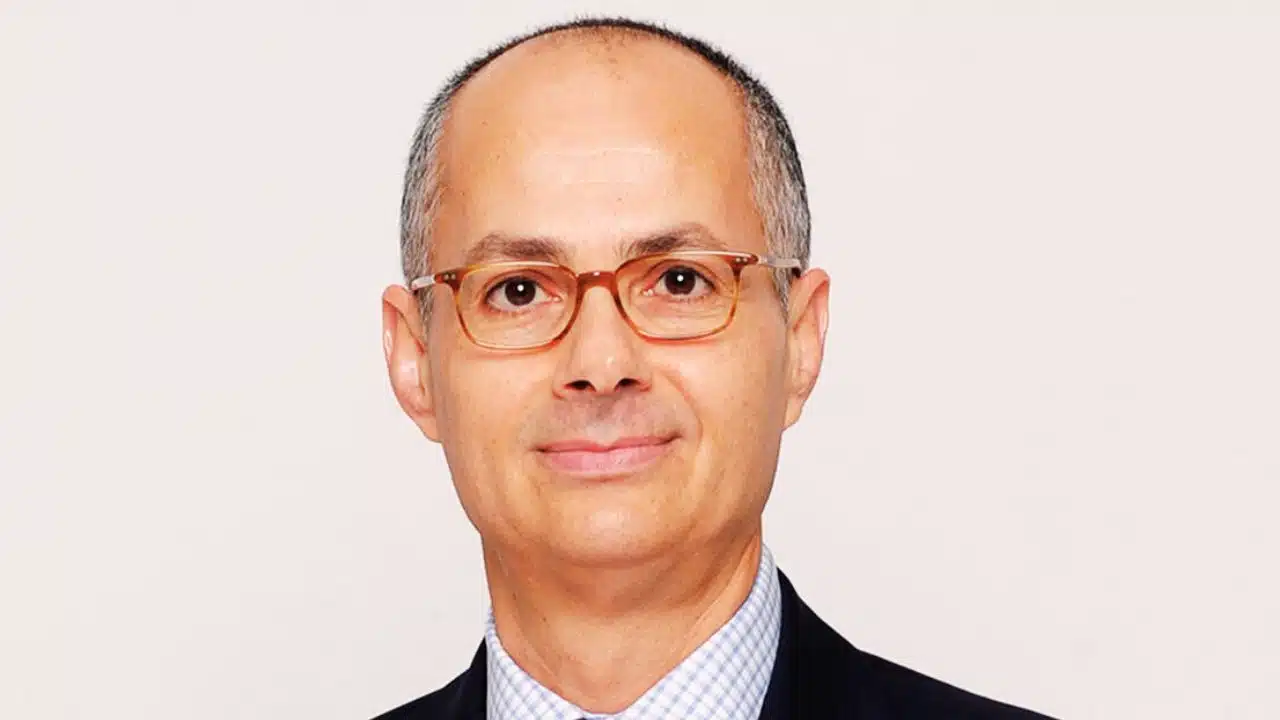
Professor Omar Yaghi, a chemist whose journey began in a crowded refugee home in Jordan, was awarded the 2025 Nobel Prize in Chemistry on Wednesday, a historic first for a Saudi national. He shares the prestigious award with Japan’s Susumu Kitagawa and Australia’s Richard Robson for their revolutionary development of “metal-organic frameworks” (MOFs), a new class of materials poised to tackle some of humanity’s greatest challenges, including climate change and water scarcity.
The Royal Swedish Academy of Sciences recognized the trio for pioneering reticular chemistry, creating molecular “super-sponges” that can selectively capture and store gases like carbon dioxide, hydrogen, or even harvest water from desert air. This groundbreaking work has opened an entirely new field in materials science, marking a watershed moment for chemistry and for the Arab scientific community. Professor Yaghi, who holds dual Saudi and American citizenship, has become a symbol of intellectual perseverance and a celebrated figure across the Middle East.
Key Facts
- Historic Win: Professor Omar Yaghi is the first-ever Saudi national to be awarded a Nobel Prize. He was granted Saudi citizenship in 2021 via a royal decree aimed at attracting global talent.
- Groundbreaking Science: The prize honours the development of metal-organic frameworks (MOFs) and covalent organic frameworks (COFs), porous crystalline materials with record-breaking surface areas.
- Shared Prize: The 11 million Swedish kronor (approx. $1.2 million USD) prize is shared equally between Omar Yaghi (University of California, Berkeley), Susumu Kitagawa (Kyoto University), and Richard Robson (University of Melbourne).
- Global Applications: MOF technology is being applied to carbon capture, clean energy storage (hydrogen), air and water purification, and even targeted drug delivery.
- A Journey of Perseverance: Born in 1965 to a Palestinian refugee family in Amman, Jordan, Yaghi grew up in a single room with his eight siblings. He moved to the United States alone at age 15 to pursue his education.
The Genesis of a Chemical Revolution
The story of metal-organic frameworks is a tale of three scientists, working across decades and continents, who together established a new architectural paradigm in chemistry. It began in the late 1980s when Professor Richard Robson at the University of Melbourne first experimented with combining metal ions with organic linker molecules. His work in 1989 produced an orderly, three-dimensional crystal structure full of empty space, the first proof-of-concept for what would become MOFs.
However, these early frameworks were often unstable. The field took a giant leap forward between 1992 and 2003 through the parallel and complementary work of Professors Kitagawa and Yaghi. Susumu Kitagawa demonstrated the dynamic, flexible nature of these frameworks, showing that gases could flow in and out of their pores.
It was Omar Yaghi who brought exceptional stability and rational design to the field. He pioneered what he termed “reticular chemistry” — the art of stitching molecular building blocks into predetermined, robust, and highly ordered porous structures. His work transformed MOFs from laboratory curiosities into highly functional and durable materials.
The Science: Molecular Cages with Infinite Possibilities
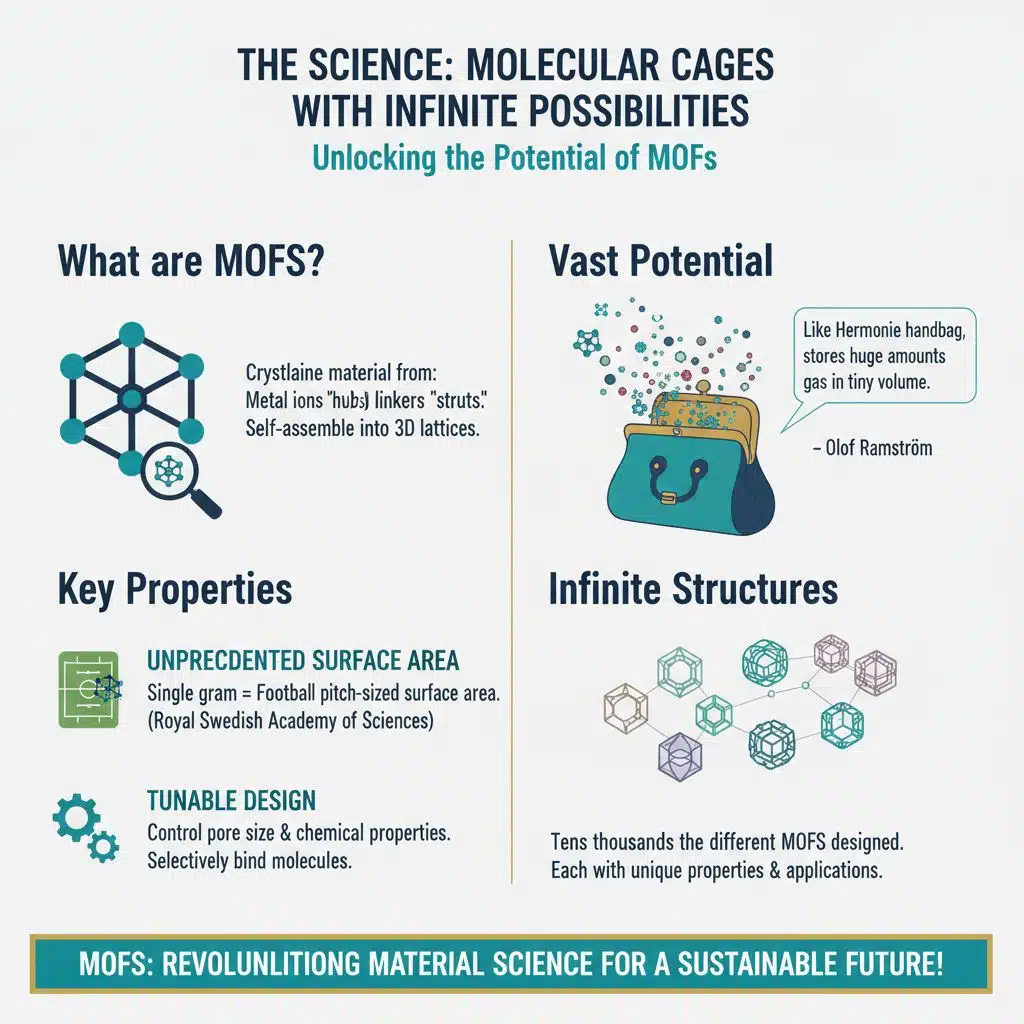
At its core, a metal-organic framework is a crystalline material constructed from two main components: metal ions (which act as “hubs” or “cornerstones”) and organic molecules called linkers (which act as the “struts”). Together, they self-assemble into vast, repeating three-dimensional lattices.
The true genius of MOFs lies in their porosity and immense internal surface area.
- Unprecedented Surface Area: The Royal Swedish Academy of Sciences noted that the surface area contained within MOFs is extraordinary. A single gram of a MOF material can have a surface area equivalent to that of a football pitch.
- Tunable Design: By carefully selecting different metal ions and organic linkers, scientists can precisely control the size of the pores and the chemical properties of the internal surfaces. This allows them to design MOFs that can selectively bind to specific molecules.
- Vast Number of Structures: Since the laureates’ foundational work, chemists globally have designed and synthesized tens of thousands of different MOFs, each with unique properties and potential applications.
Olof Ramstrom, a member of the Nobel Committee for Chemistry, likened the material’s storage capacity to the magical, bottomless handbag from the Harry Potter series. “A small amount of such material can be almost like Hermione’s handbag,” he explained. “It can store huge amounts of gas in a tiny volume.”
Official Responses and Acknowledgment
The announcement on October 8, 2025, from Stockholm was met with immediate celebration, particularly in Saudi Arabia and across the Arab world.
Dr. Munir Eldesouki, President of King Abdulaziz City for Science and Technology (KACST), where Yaghi serves as an advisor, stated: “Dr. Yaghi’s Nobel win reflects the wise leadership’s vision of making the Kingdom a global hub for science, knowledge, and innovation. It confirms that investing in creative minds is the path to building a sustainable future for humanity”.
His Majesty King Abdullah II of Jordan, Yaghi’s birth country, also congratulated the professor, calling the achievement “a new source of pride for Jordanians across various domains worldwide”.
A Personal Journey Fueled by Scarcity
For Professor Yaghi, the practical application of his work is deeply personal. Growing up in Jordan, his family, like many others, faced severe water shortages. In a documentary, he recounted the experience of queuing for water, a memory that fueled his research into harvesting water from the air.
“You store as much water as you can within that four hours and that’s the water you would use for those two weeks. If you ran out of water, you had to find a different source,” Yaghi recalled. “I grew up really appreciating the stress caused by water. It affects all aspects of life”. This motivation led to the development of MOFs capable of passively absorbing moisture from the atmosphere, even in arid conditions, and then releasing it as pure, drinkable water when warmed by sunlight.
What to Watch Next
The Nobel win will undoubtedly accelerate research and investment into MOF technology. Key areas to watch include:
- Commercial Scale-Up: While highly effective in the lab, producing MOFs affordably and at an industrial scale remains a challenge. The prize may spur innovation in manufacturing.
- Carbon Capture Deployment: With growing urgency around climate change, expect to see increased funding for pilot projects using MOFs to capture CO2 directly from industrial flue gas or even the atmosphere.
- Water Harvesting in Arid Regions: Start-ups and research institutes will likely intensify efforts to deploy MOF-based water harvesters in drought-stricken areas.
- Advanced Medical Applications: Research into using MOFs for precision drug delivery and medical imaging will continue to be a fertile ground for discovery.
The 2025 Nobel Prize in Chemistry is a testament to the power of fundamental, curiosity-driven research to yield solutions to real-world problems. The journey of Omar Yaghi, from a refugee’s single-room home to the pinnacle of scientific achievement, serves as a powerful inspiration. His work, alongside that of Kitagawa and Robson, has not just created new materials, but has laid the foundation for a more sustainable and resource-secure future, proving, in his own words, that “science is the greatest equalising force in the world.”






























