
The landscape for elite immigration has shifted significantly as we enter 2026, with the U.S. Citizenship and Immigration Services (USCIS) doubling down on its mission to attract the world’s most innovative minds. The O-1 Visa for Extraordinary Ability remains the “gold standard” for professionals who have reached the pinnacle of their respective fields, whether in science, business, education, athletics, or the arts. Unlike the lottery-based systems that plague other visa categories, the O-1 is an achievement-based pathway that rewards sustained national or international acclaim.
In the current year, the definition of “extraordinary” has been strategically clarified to include founders of high-growth startups and pioneers in emerging technologies like Artificial Intelligence, making it more accessible than ever for those who can prove they are among the small percentage who have risen to the very top.
How We Selected Our 12 Best O-1 Visa for Extraordinary Ability Insights
To curate these essential insights, we reviewed the most recent 2025 and 2026 USCIS Policy Manual updates and analyzed successful “Request for Evidence” (RFE) trends from the first quarter of 2026. Our selection criteria focused on the practical hurdles that global talent faces today, such as the nuances of the STEM-specific criteria and the critical role of peer advisory opinions. We prioritized facts that differentiate the O-1 from other popular categories like the H-1B or the EB-1A green card, ensuring that applicants understand the specific strategic advantages of this non-immigrant route. These 12 points represent the most current, high-leverage data available for anyone looking to secure their professional future in the United States.
12 Crucial Updates for the O-1 Visa for Extraordinary Ability
The following points provide a detailed breakdown of the requirements, benefits, and strategic nuances of the O-1 category in the 2026 immigration environment.
1. The O-1A vs. O-1B Distinction
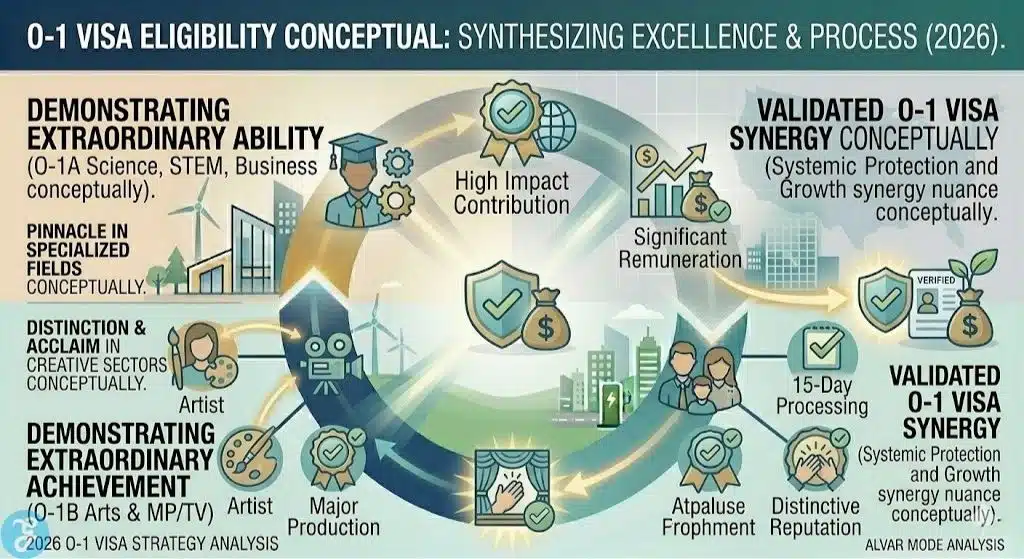
The O-1 category is split into two distinct sub-types. O-1A is reserved for those in science, education, business, or athletics (requiring “extraordinary ability”), while O-1B is for those in the arts or the motion picture and television industry (requiring a “distinction” or “extraordinary achievement”). In 2026, the evidentiary standards for O-1A remain more rigorous than the O-1B, though both require a high volume of documentation.
Best for: professionals across all elite sectors who need to choose the correct legal framework for their evidence.
Why We Chose It:
-
It is the foundational choice that dictates which evidentiary criteria you must meet.
-
It prevents the common mistake of applying under the wrong sub-category, which leads to immediate denial.
Things to consider:
-
Architects and designers often fall into the “Arts” category (O-1B) despite working in technical fields.
2. Expanded STEM and AI Criteria
As of early 2026, USCIS has formalized even broader interpretations of the “Extraordinary Ability” criteria for STEM professionals. New guidance specifically highlights how evidence like high-impact AI research, lead roles in technical standardization, and significant venture capital backing for tech founders can be used to satisfy multiple criteria simultaneously.
Best for: software engineers, researchers, and data scientists in cutting-edge fields.
Why We Chose It:
-
It reflects the current U.S. policy of prioritizing technological sovereignty through talent acquisition.
-
It provides a much clearer roadmap for technical professionals who don’t have traditional “awards.”
Things to consider:
-
Purely “good” work is not enough; you must show your work has impacted the field as a whole.
3. No Annual Cap or Lottery
One of the most surprising facts for many is that the O-1 visa has no annual numerical limit. Unlike the H-1B, which is subject to a chaotic lottery every April, you can apply for an O-1 at any time of the year. This provides a level of certainty and timing control that is rare in U.S. immigration.
Best for: high-level talent who cannot risk their career on a random lottery draw.
Why We Chose It:
-
It is the primary reason why elite professionals choose the O-1 over the H-1B.
-
It allows for strategic hiring at any point during the fiscal year.
Things to consider:
-
Because there is no cap, the standards are much higher than for capped visa categories.
4. The “Three-out-of-Ten” Rule
To qualify for an O-1A, you must provide evidence of either a major, internationally recognized award (like a Nobel Prize) or satisfy at least three of ten specific criteria. These include things like original contributions of major significance, membership in exclusive associations, or judging the work of others.
Best for: applicants who have a diverse portfolio of achievements rather than one single “big win.”
Why We Chose It:
-
It is the most common way to qualify and allows for a “cumulative” proof of excellence.
-
It gives applicants the flexibility to highlight their specific strengths.
Things to consider:
-
Meeting three criteria is the minimum; a strong petition usually targets five or six to be safe.
5. Requirement of a U.S. Petitioner (Employer or Agent)
You cannot “self-petition” for an O-1 visa. You must have a U.S. employer, a U.S. agent, or a foreign employer acting through a U.S. agent to file the petition on your behalf. In 2026, many entrepreneurs are successfully using a U.S. agent to manage “concurrent employment” for multiple projects.
Best for: freelancers, consultants, and startup founders with multiple income streams.
Why We Chose It:
-
It clarifies the logistical necessity of having a U.S. anchor for your application.
-
It highlights the “agent” model which is vital for the gig-economy elite.
Things to consider:
-
The petitioner must be a U.S. entity; a personal friend or family member cannot act as a petitioner.
6. Peer Advisory Opinions
Before the petition can be approved, a written advisory opinion from a peer group (such as a labor union or management organization) is usually required. This document must state whether the applicant is indeed an individual of extraordinary ability. In 2026, these opinions are heavily scrutinized by USCIS officers.
Best for: verifying that your peers and industry leaders recognize your “elite” status.
Why We Chose It:
-
It is a mandatory technical step that often surprises first-time applicants.
-
It adds a layer of third-party validation to the government’s review process.
Things to consider:
-
If no appropriate peer group exists, this requirement can sometimes be waived with proof.
7. Indefinite Renewal Potential
The O-1 is initially granted for up to three years, but it can be extended indefinitely in one-year increments as long as you continue to work in your area of extraordinary ability. This makes it a very stable long-term option compared to the H-1B’s six-year hard cap.
Best for: professionals looking to establish a long-term career in the U.S. without the pressure of a ticking clock.
Why We Chose It:
-
It offers a level of longevity that most other non-immigrant visas lack.
-
It removes the stress of having to leave the country if a green card is delayed.
Things to consider:
-
Each extension requires proof that the “extraordinary” work is still ongoing.
8. O-3 Dependents and Work Restrictions
Spouses and children of O-1 holders can join them in the U.S. on O-3 visas. However, in 2026, O-3 holders are still generally prohibited from working in the U.S. while on this status. They can study, but they cannot legally earn an income.
Best for: families who need to plan their household budget around a single primary income.
Why We Chose It:
-
It is a critical “pain point” that impacts the decision to move to the U.S.
-
It contrasts with the L-2 or E-2 visas where spouses often have work authorization.
Things to consider:
-
Spouses may need to seek their own independent work visas (like an H-1B or their own O-1).
9. 15-Day Premium Processing
USCIS offers a “Premium Processing” service for the O-1 for an additional fee. This guarantees that your case will be processed within 15 calendar days. In the 2026 market, where hiring needs to be agile, this service is almost universally utilized by top-tier firms.
Best for: applicants with urgent start dates or those who want to minimize the period of uncertainty.
Why We Chose It:
-
It is one of the few ways to bypass the months-long backlog of standard processing.
-
It allows for a very rapid “Plan B” if an initial application is rejected.
Things to consider:
-
Premium processing only guarantees a faster decision, not an approval.
10. Dual Intent and the Path to a Green Card
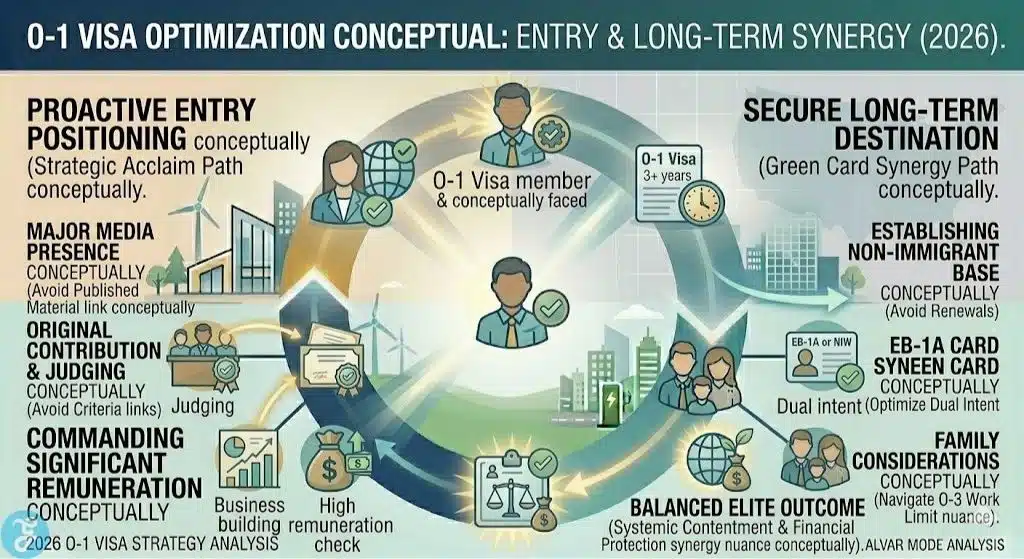
While the O-1 is a non-immigrant visa, it is often referred to as a “quasi-dual intent” visa. This means you can apply for an O-1 while simultaneously pursuing a green card (like the EB-1A or EB-2 NIW) without the risk of your O-1 being denied for “immigrant intent.”
Best for: high-achievers who view the O-1 as a stepping stone to permanent residency.
Why We Chose It:
-
It allows for a seamless transition from temporary work to a Green Card.
-
It provides legal cover during the long wait times for immigrant visa numbers.
Things to consider:
-
You should still consult an attorney about the specific timing of your green card filing.
11. The Role of “Significant Remuneration”
One of the strongest pieces of evidence you can provide is that you have commanded a high salary or other significant remuneration for your services. In 2026, USCIS uses local and national wage data (O*NET) to determine if your pay is truly “significantly” higher than your peers.
Best for: executives and tech leads who have high-value contracts or equity packages.
Why We Chose It:
-
It is a quantifiable, objective metric that is hard for USCIS to ignore.
-
It directly proves that the market values your “extraordinary” skills.
Things to consider:
-
You must prove that the high pay is specifically for your extraordinary ability, not just for a senior role.
12. Flexibility for Startup Founders
Unlike the H-1B, which has complex “employer-employee relationship” rules, the O-1 is very friendly to founders. You can work for a company you own, provided there is a board of directors or another mechanism that can technically “fire” or supervise you.
Best for: international entrepreneurs launching their companies in the U.S.
Why We Chose It:
-
It is the primary visa used by venture-backed founders in 2026.
-
It recognizes that “extraordinary ability” is often best expressed through entrepreneurship.
Things to consider:
-
You will need a strong corporate structure to act as the “petitioner.”
Strategic Summary of the O-1 Visa Framework
The O-1 Visa for Extraordinary Ability is more than just a permit to work; it is a recognition of professional excellence that opens doors across the United States. In 2026, the shift toward rewarding innovators in the tech and startup space has made this category the preferred choice for the global elite. While the evidentiary burden is high, the benefits—including the lack of an annual cap, indefinite renewals, and the clear bridge to a green card—make it a superior strategic choice for anyone who can prove they are at the top of their game. By carefully documenting your impact on your field and leveraging the recent STEM-friendly policy shifts, you can navigate this elite tier with confidence.
Comparing the O-1 to Other Popular U.S. Visas
Understanding how the O-1 stands up against other common visa types is essential for long-term planning. The following comparison highlights the key differences that drive applicant choice in the current year.
Elite Visa Comparison Table
This data illustrates the trade-offs between speed, cost, and the standard of achievement required for the primary work-based categories.
| Feature | O-1 Visa | H-1B Visa | EB-1A Green Card |
| Annual Cap | None | 85,000 (Lottery) | Varies by Country |
| Achievement Standard | Extraordinary | Specialty Occupation | Extraordinary (Permanent) |
| Petitioner Required | Yes (Employer/Agent) | Yes (Employer) | No (Self-Petitioner) |
| Max Duration | Indefinite (Renewable) | 6 Years | Permanent |
| Processing Time | 15 Days (Premium) | Months (Standard) | Months/Years |
| Work for Spouse | Generally No (O-3) | No (except H-4 EAD) | Yes (Green Card) |
Our Top 3 Picks and Why?
-
The 15-Day Premium Processing: This is our top pick because it removes the “limbo” that ruins career plans. In a competitive job market, knowing your status in two weeks is a massive professional advantage.
-
The “Three-out-of-Ten” Criteria: We chose this because it democratizes the visa. You don’t need a Nobel Prize; you just need to be consistently “great” in a few specific, documented ways.
-
No Annual Cap: This is an essential pick for 2026 because it provides a reliable escape route from the H-1B lottery system, which has become mathematically impossible for many.
How to Secure an O-1 Visa by Yourself?
While most O-1 petitions are managed by attorneys, the success of the case depends entirely on the “evidence” you provide. You are the only person who can truly curate the story of your extraordinary career.
The Selection Framework
-
Audit Your “Contribution of Major Significance”: Can you point to one specific thing you did that changed how your field operates? If so, this is your strongest evidence.
-
Assess Your Media Presence: Collect every article written about you or your work. In 2026, high-quality “published material in professional journals or major media” is the backbone of successful petitions.
-
Identify Your “Top Tier” Peers: Start making a list of people who could write “Expert Opinion Letters” for you. These should be people who know of your work but don’t necessarily work with you daily.
-
Determine Your Petitioner: If you are a founder, set up your U.S. corporation early. If you are a freelancer, find a reputable U.S. agent who specializes in O-1 management.
Use the decision matrix below to determine if the O-1 is the right move for your career trajectory this year.
Decision Matrix
| If your priority is… | Choose X if… | Choose Y if… |
| Speed and Certainty | Choose O-1 for no lottery and 15-day processing. | Avoid H-1B if you need to start work immediately. |
| Long-Term PR (Green Card) | Choose EB-1A if you can wait for a decision. | Choose O-1 to get to the U.S. while the PR is pending. |
| Spousal Career | Choose L-1 if you are transferring within a company. | Avoid O-1 if your spouse must work immediately. |
| Entrepreneurship | Choose O-1 if you have VC backing and a board. | Choose E-2 if you are from a treaty country. |
The Final Checklist: 5-Point O-1 Readiness Plan
-
Collect your “Top 5” most impressive press mentions and translate them into English if necessary.
-
Obtain a draft employment contract or deal memo from your U.S. petitioner.
-
Map your achievements against at least five of the ten O-1A (or six O-1B) criteria.
-
Request “Expert Opinion Letters” from at least three internationally recognized figures in your field.
-
Verify the specific “Peer Group” that will provide your Advisory Opinion for your industry.
Defining Your Future as a Global Leader
The O-1 Visa for Extraordinary Ability is not just a visa; it is a career milestone that signals to the world that you have reached the elite level of your profession. In 2026, with the U.S. market more eager than ever for high-impact talent, the “Extraordinary” pathway offers a level of flexibility and speed that no other category can match. By viewing the application process as a strategic “branding” exercise rather than just a legal filing, you can prove your value to USCIS and secure a place in the engine room of global innovation. Whether you are an AI researcher or a creative visionary, the O-1 is your passport to the American dream on your own terms.