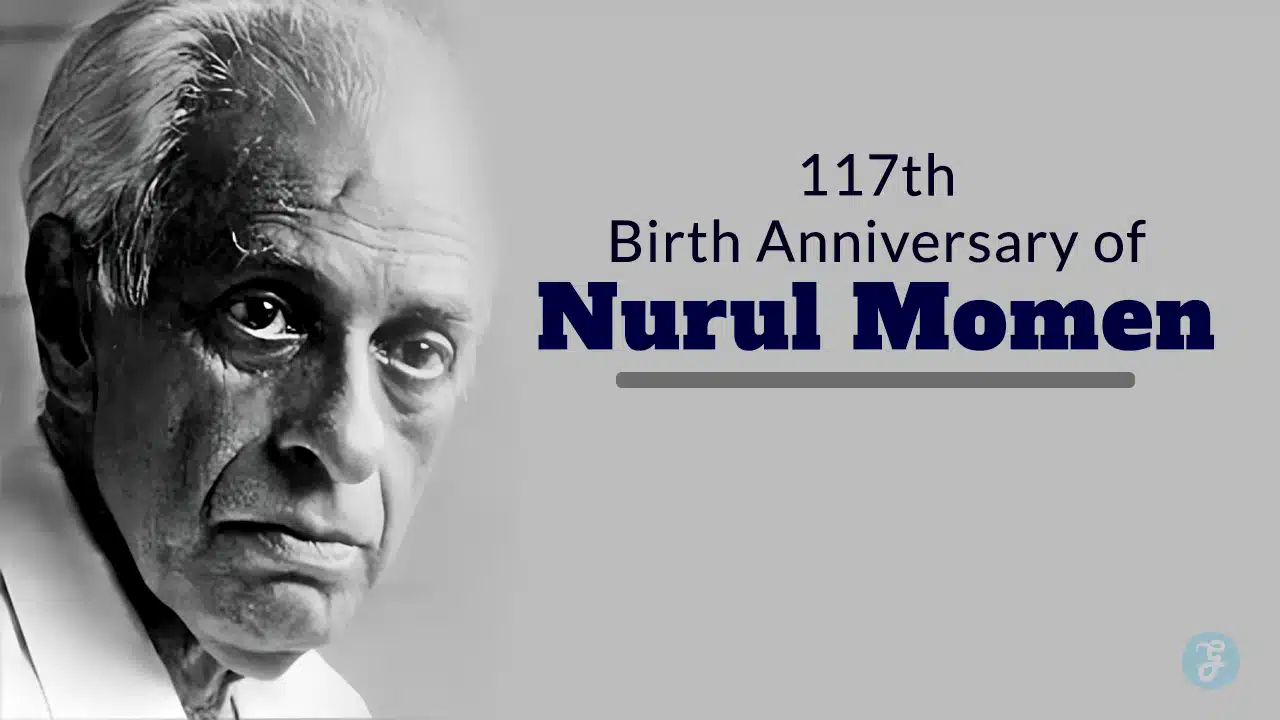
Have you ever heard someone called the “Father of Theater” and wondered what makes them so special?
Nurul Momen earned that title in Bangladesh, and his story is fascinating.
He was known as “Natyaguru,” which translates to Grand Teacher of Theater. When eminent critics from home and abroad, including Malcolm Muggeridge and Mohitlal Mojumdar, praise someone as the father of modern Bangla drama, you know they did something extraordinary.
I’m going to walk you through his journey, from his childhood poem to his groundbreaking plays that changed Bengali theater forever. You’ll see why his work at Dhaka University inspired future leaders and how his awards tell the story of a true pioneer.
Let’s explore together.
Key Takeaways
- Nurul Momen was born on November 25, 1908 in Alphadanga, Jessore District, and became known as the “Natyaguru,” or Grand Teacher of Theater in Bangladesh.
- He wrote “Rupantor” in 1942, Bangladesh’s first modern play featuring a strong female lead, and “Nemesis” in 1944, a groundbreaking one-actor play that ran for one and a half hours.
- According to Banglapedia, Momen received the Bangla Academy Award in 1961, just a year after its inception, and the Ekushey Padak in 1978 for his contributions to drama and literature.
- He joined the Dhaka University faculty in 1945, where he taught law while integrating literature and music into his classes, inspiring students like Sheikh Mujibur Rahman.
- On February 21, 1952, Momen stood with students at the Dhaka University playground during the tragic Language Movement shootings, and in 1954, he inaugurated the second Shaheed Minar monument.
What was Nurul Momen’s Early Life and Educational Background?
Nurul Momen was born on November 25, 1908, in Alphadanga, Jessore District, which was part of British India at the time.
His father, Nurul Arefin, worked as both a physician and zamindar, which means he owned land. You could say young Nurul grew up in a family with both healing and authority.
Here’s something remarkable. At just ten years old, he wrote his first poem called “Shondhya,” which means “Evening.” It got published in the magazine “Dhrubotara” in 1919, using the same verse style as Rabindranath Tagore’s famous “Shonar Tory.”
His School year and Early Academic Path
Momen started his education in Calcutta before moving around quite a bit.
He attended Khulna Zila School in 1916, then transferred to Dhaka High School by 1920, where he stayed at the Dafrin Hostel. After passing his matriculation exam in 1924, he enrolled at Dhaka College.
By 1926, he had joined Dhaka University and completed his Bachelor of Arts degree in 1929.
His Journey to Becoming a Lawyer
Law called to him next. He traveled to the University of Calcutta and earned his B.L. degree in 1936. That same year, he started practicing at the Calcutta High Court.
But his ambitions didn’t stop there. In 1948, he left for the University of London to pursue even higher studies in law, returning with advanced knowledge that would serve him well in his teaching career.
Contributions to Theater and Literature
Md Nurul Momen didn’t just participate in Bengali theater. He transformed it. His plays brought fresh ideas that made audiences question old traditions. At Dhaka University, he became known for mixing legal concepts with dramatic storytelling, creating works that made people laugh, think, and sometimes even cry.
What were Nurul Momen’s key playwriting achievements and theatrical innovations?
Momen’s theatrical innovations changed how people viewed drama in East Bengal and beyond.
Here are his groundbreaking achievements that earned him the title “Natyaguru”:
- In 1942, he penned “Rupantor” for broadcast on All India Radio. This was Bangladesh’s first modern play and featured a strong female lead at a time when most theaters sidelined women or used only male actors.
- In 1944, he created “Nemesis,” published in the acclaimed literary journal “Shonibarer Chithi” in 1945. This one-actor play ran for one and a half hours without a break, a feat that only Eugene O’Neill and Jean Cocteau had attempted before him in world theater history.
- He introduced the concept of “Unity of Person” to classical drama rules. This meant adding a fourth unity to the traditional Greek three unities of time, place, and action, shaking up centuries-old European theater norms.
- While in England after 1948, he teamed up with his friend Nazir Ahmed to create the BBC Bengali program “Anjuman.” Momen handled the literary content for this weekly one-hour show, while Ahmed managed the news.
- National Professor Kabir Chowdhury explained that “Nemesis” shows how a promising personality falls prey to greed, depicting the story through a single character’s dialogue.
According to Banglapedia, Momen also conducted a children’s program called “Kakoli” on BBC’s Bengali service, showcasing his versatility as a broadcaster.
He penned many other works too, including “Yadi Emon Hoto” in July 1961, “Naya Khandan” in September 1961, and “Alochhaya” in June 1962.
His play “Underneath the Law” blended his legal expertise from his Calcutta High Court days with lively stage action. Even Malcolm Muggeridge, the famous editor of the British satire magazine Punch, found it “immensely amusing” after watching it in 1955.
His Role as a Mentor and Teacher
Momen inspired an entire generation of dramatists.
At Dhaka University, he encouraged Munier Chowdhury to read George Bernard Shaw and helped him become a playwright. Chowdhury later translated Shaw’s “You Never Can Tell” into Bengali.
He also pushed students at the Faculty of Law to explore works by writers like Bertrand Russell, planting seeds that would grow into the next wave of theater movements across Bangladesh.
How did Nurul Momen impact Bengali literature?
Momen joined the Dhaka University faculty in 1945 and became a bridge between law, drama, and essays. He taught students who would become national leaders. One of his favorite students was Sheikh Mujibur Rahman, who enrolled in the law department in 1948. Momen encouraged Rahman to read George Bernard Shaw and Bertrand Russell, sparking new ideas in the young mind that would eventually lead a nation.
Standing with Students During the Language Movement
When the Language Movement reached its peak, Momen stood firmly with his students.
On February 21, 1952, he and his student Mohammad Toaha were at the Dhaka University playground when the tragic shootings occurred. Two years later, in 1954, he was the prominent intellectual who inaugurated the second Shaheed Minar monument by cutting the ribbon.
His gesture wasn’t just symbolic. He actively encouraged students to demand rights for the Bangla language.
Celebrating Literary Giants
Momen had a passion for honoring outstanding writers.
In 1961, he and his friend Justice Syed Mahbub Morshed celebrated the birth centenary of Rabindranath Tagore. Three years later, in 1964, he organized the 400th birth anniversary celebration of William Shakespeare, bringing fresh energy to theater circles across the region.
He also wrote sharp pieces under the penname “Magus” for literary magazines. His editorial “Lest We Forget” ran for 5 years in The Bangladesh Times, while he simultaneously wrote the series “Forbidden Pleasure” under his pseudonym.
What is the Legacy and Influence of Nurul Momen?
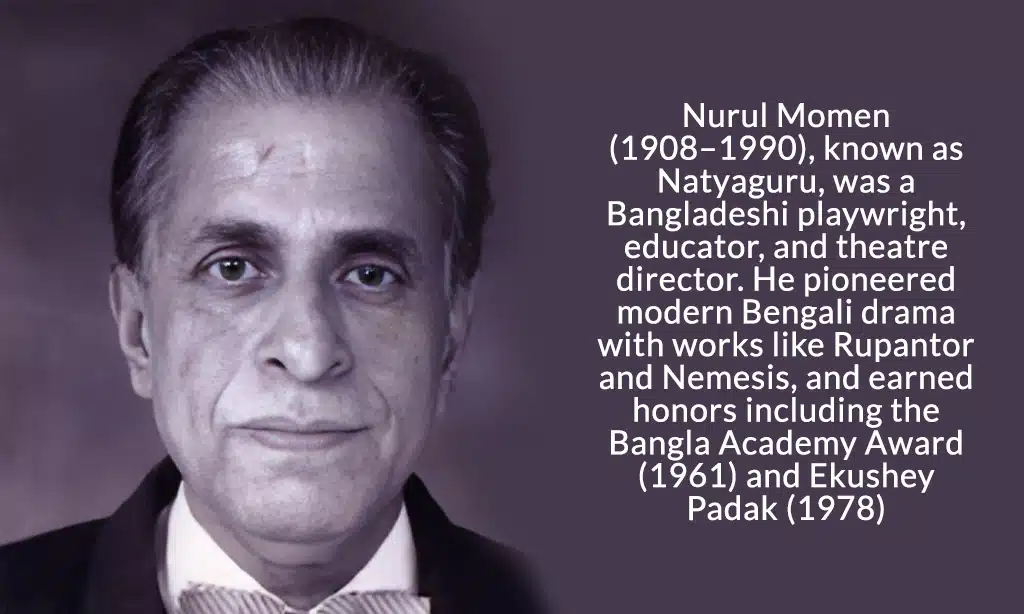
Nurul Momen earned the title “Father of Bangladeshi Theater” for a very good reason.
His 1944 play “Nemesis” changed drama at the University of Dhaka in 1945, marking what teachers and students still recognize as the birth of modern Bengali drama. Literary websites like Banglapedia and The Literary Encyclopedia feature his work, helping new readers understand why he matters so much to theater history.
Recognition Through Prestigious Awards
His awards tell an impressive story.
| Year | Award | Reason |
|---|---|---|
| 1954 | Best New Playwright Award | Honored in Calcutta for his innovative theatrical work |
| 1961 | Bangla Academy Award | Recognized as the best playwright and essayist. |
| 1964 | Chicago University’s International Actors’ Association Honor | International recognition for his dramatic contributions |
| 1978 | Ekushey Padak | Top national honor for drama and literature |
According to records, the Ekushey Padak consists of an 18-carat gold medal weighing 3 tolas, a certificate of honor, and a cash reward that has increased over the years to 400,000 Bangladeshi taka as of 2019.
A Bold Stand Against Injustice
During the difficult days of East Pakistan, Momen made a powerful statement.
In 1967, he received the Sitara-e-Imtiaz medal from Pakistan. But in 1971, he rejected and destroyed it to protest the injustices happening around him. The medal was his way of taking action instead of just speaking words.
Celebrations That Keep His Memory Alive
Every year on November 25, his birthday, fans celebrate him through festivals.
The Bangladesh Shilpakala Academy (BSA) organized his birth centenary in 2008. Two years later, in November 2010, they held a week-long festival for his 102nd birthday, partnering with the Aurony Mohona International Foundation (AMIF).
Even today, plays based on his writing fill theaters at universities like the University of Rajshahi and Dhaka University. His work is still inspiring new voices who dare to write, perform, or simply imagine more.
Takeaways
Momen’s footsteps echo in every corner of Bengali theater and literature.
His play “Nemesis” still sparks fresh ideas today. His lessons at Dhaka University are still inspiring students who walk the same halls where he once taught Sheikh Mujibur Rahman and other future leaders.
He wore many hats. Teacher, playwright, mentor, lawyer, broadcaster. Each role showed a different side of his genius, from the courtroom to the stage, from the classroom to the radio studio.
The legacy lives on in new voices who dare to dream.
FAQs on Nurul Momen
Curious about the life of the “Father of Bangladeshi Theatre”? I have gathered the essential facts about Nurul Momen to help you understand his incredible legacy.
1. When was Nurul Momen born and when did he pass away?
Nurul Momen was born on 25 November 1908 and lived a distinguished life until he passed away on 16 February 1990. His career spanned nearly a century, marking a golden era in Bengali literature.
2. What was Nurul Momen’s connection to Dhaka University?
He first enrolled at Dhaka University in 1926 as a student before he joined the faculty of law there. He returned to teach at Dhaka University in 1945, eventually rising to the prestigious position of Dean (education).
3. Did Nurul Momen receive any major awards for his work?
Yes, he was awarded the Bangla Academy Award in 1961 specifically for his experimental Nemesis (Momen play). While he never competed for film-focused Academy Awards, his unique contributions to drama earned him the revered title of Natyaguru.
4. Where did Nurul Momen study law?
He studied law at Calcutta University, where he completed his B.L. degree in 1936 to launch his legal practice.
5. What organizations was Nurul Momen involved with during his career?
While often confused with modern researchers at PDEU, IACA, or the International Political Science Association, the playwright focused on the BBC and legal education. He did not publish in Taylor & Francis journals or consult for the Department for International Development, as his work was dedicated to the arts and law in the 20th century.