You’ve probably seen the headlines and the futuristic YouTube renders: a stunning, see-through Nokia Transparent 5G phone equipped with a world-beating 550MP camera. It’s a concept that captures the imagination, blending sci-fi aesthetics with specs that sound like they’re from a decade in the future.
However, it’s essential to ground this excitement in reality. The Nokia Transparent 5G is not a real, physical product you can buy. It is a viral digital concept, a “what if” scenario created by tech enthusiasts and concept artists, which has been widely misinterpreted as an upcoming official release by numerous non-authoritative blogs. This article fact-checks the fantasy specs against real-world technology and reveals what HMD Global, the makers of Nokia phones, is actually focusing on right now.
The appeal is undeniable. The rumors describe a device with a fully transparent body, a massive 8,000mAh battery, and a groundbreaking 550-megapixel camera, all for a bafflingly low price. This combination is, by 2025 standards, technologically impossible. Authoritative tech sites like GSMArena and PhoneArena, which catalogue official releases, have no listings or announcements for such a device. Furthermore, the official website for Nokia phones, HMD.com, shows a lineup focused on durability, repairability, and budget-friendly reliability—a strategy far removed from the exotic, high-risk concept of a transparent phone.
Where Did the “Nokia Transparent 5G” Rumor Come From?
This phenomenon isn’t new. The tech world, especially the smartphone sector, thrives on hype and anticipation. The “Nokia Transparent 5G” is the latest in a long line of viral concepts that gain traction for one simple reason: they are exciting.
The World of Concept Renders
The images and videos you’ve seen are “renders.” These are high-quality, 3D models created by independent designers and artists. They are visual explorations of what a future product could look like. These videos are often posted on YouTube, where they are tagged as “concepts” or “introductions”.
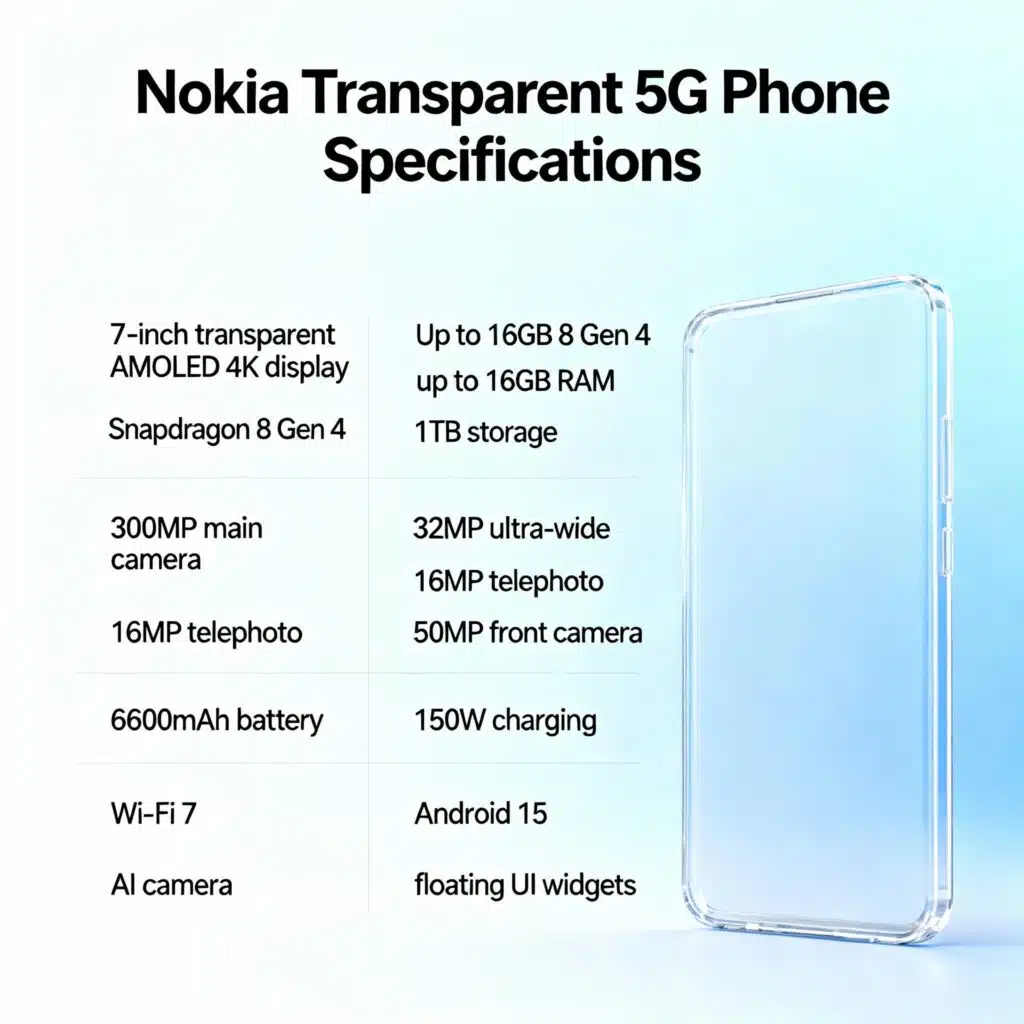
The problem begins when these renders are detached from their original context. Low-authority blogs, often seeking clicks and ad revenue, report these concepts as “leaks” or “upcoming releases.” They invent fantastical specification sheets (like a 550MP camera or a 7,000-8,000mAh battery) to make the story more compelling. You’ll notice that the specs are wildly inconsistent across these rumor sites—some claim a 300MP camera, others 550MP; some claim a low price, others a premium one. This inconsistency is a major red flag and a clear sign that the data is fabricated.
Why It Went Viral
This particular concept hits two key nostalgic and futuristic notes:
- The Nokia Brand: Many people have fond memories of Nokia’s “indestructible” phones from the pre-smartphone era, like the 3310. There’s a persistent hope that Nokia will one day return to the market with something truly innovative to challenge Apple and Samsung.
- Futuristic Technology: A transparent phone is a staple of science fiction, seen in movies like Iron Man and Minority Report. The idea of holding one in our hands is inherently appealing.
When you combine a beloved brand with a sci-fi dream, you get a story that’s too good not to share. Unfortunately, it’s also too good to be true.
Fact Check: The “550MP Camera” vs. Reality
The 550MP camera is perhaps the most outlandish claim of the Nokia Transparent 5G rumor. To understand why this is impossible, we need to look at what’s actually happening in smartphone camera technology.
What’s the Real Highest Megapixel Camera?
As of late 2024 and heading into 2025, the highest-resolution camera sensor available in a mainstream smartphone is 200 megapixels. This sensor, made by Samsung, is featured in flagship devices like the Samsung Galaxy S25 Ultra.
These 200MP sensors don’t typically shoot 200MP photos. They use a process called “pixel binning” to combine 16 smaller pixels into one larger “super-pixel.” This turns a 200MP sensor into a 12.5MP sensor that captures far more light, resulting in dramatically better low-light performance and dynamic range.
Most other flagship phones, like the Apple iPhone 17 Pro and Google Pixel 10 Pro, use 48MP or 50MP main sensors. They focus on computational photography—the software and AI processing—to create stunning images, rather than just increasing the megapixel count. Experts at publications like Amateur Photographer consistently emphasize that sensor size, aperture, and image processing are far more important than a raw megapixel number.
A 550MP sensor, were it to exist for a smartphone, would be physically massive, astronomically expensive to produce, and would create unmanageably large files. It is simply not feasible with today’s technology.
The Megapixel Myth
| Feature | Rumored Nokia Transparent 5G | Realistic 2025 Flagship (e.g., Galaxy S25 Ultra) |
| Main Camera | 550MP (Fictional) | 200MP (Actual, uses pixel binning) |
| Ultra-Wide | (Not specified, often rumored at 64MP+) | 12MP – 50MP (Actual) |
| Telephoto | (Not specified, often rumored at 64MP+) | 10MP – 50MP (Actual, with 3x-10x optical zoom) |
| Basis in Reality | None. Pure speculation. | Verified, commercially available technology. |
Fact Check: The “Transparent Design”
A see-through phone is a fascinating idea, but it defies the basic laws of physics and engineering. A smartphone isn’t just a screen; it’s a densely packed sandwich of opaque components.
Where Does the Tech Go?
Think about what’s inside your current phone:
- Battery: A large, solid, black rectangle. This is the biggest component.
- Motherboard (PCB): A green or blue board holding the (opaque) processor, RAM, and storage chips.
- Cameras: A complex (opaque) module of lenses and sensors.
- Speakers, Vibrate Motor, Antennas: Dozens of other (opaque) physical parts.
A “transparent” phone would need to house all these components, meaning it wouldn’t be truly transparent. At best, it would have to shove all these parts into an opaque “chin” or “forehead,” or have a transparent backplate that simply shows you the (ugly) components, like the Nothing Phone series does to a limited degree.
Is Transparent Display Tech Real?
Yes, but not for phones. Transparent display technology is a real and growing market, but it’s used in very different applications.
- Transparent OLED (T-OLED): This is the most promising tech. Companies like LG and Samsung manufacture large T-OLED panels for use in retail signage, museum exhibits, and smart windows. These displays are very expensive and don’t yet have the brightness, resolution, or durability needed for a phone.
- Transparent LED (T-LED): This involves embedding tiny LEDs into a transparent film. You often see this used for massive media displays on the glass facades of buildings.
The global market for transparent displays is very real, but it’s focused on commercial and architectural applications, not handheld consumer electronics. The challenges of miniaturization, durability, and component-hiding make a truly transparent phone a distant dream.
What Is Nokia Actually Doing in 2025?
While the Nokia Transparent 5G concept is pure fantasy, the real Nokia brand (under HMD Global) has a clear and very different strategy for 2025. This strategy is built on the brand’s original pillars: durability, reliability, and affordability.
HMD Global’s Real-World Strategy
According to official announcements and tech reports from sites like PhoneArena, HMD’s focus is on:
- Rugged Durability: The “XR” series, like the Nokia XR21, is a prime example. These phones are built to military-grade standards (MIL-STD-810H) and have high IP ratings (IP68/IP69K) for water and dust resistance. They’re designed to be dropped, submerged, and used in harsh conditions.
- Sustainability & Repairability: HMD has been a leader in repairability. Phones like the Nokia G42 5G are designed with “QuickFix” builds, allowing users to easily replace the battery, screen, or charging port themselves using kits from iFixit. This extends the phone’s lifespan and reduces e-waste.
- Budget-Friendly Reliability: The core of Nokia’s lineup consists of solid budget and mid-range phones. They offer clean, stock-like Android experiences, guaranteed security updates, and excellent battery life for the price.
- Feature Phone “Classics”: HMD continues to find success by re-releasing classic phones like the 3310 and 8210 4G, catering to users who want a “digital detox” or a simple, reliable backup phone.
The Real 2025 Nokia Lineup (Examples)
| Model | Key Feature(s) | Real Camera | Target Audience |
| Nokia XR21 | Extreme Durability (MIL-STD-810H, IP69K), 120Hz display | 64MP Main + 8MP Ultrawide | Field workers, outdoor enthusiasts, clumsy users |
| Nokia G42 5G | User-Repairable (QuickFix design), 5G connectivity | 50MP Main + 2MP Macro + 2MP Depth | Budget-conscious, eco-conscious users |
| Nokia 3210 (2024) | Classic “dumb phone” re-release, long battery life | 2MP | Digital detox, backup phone, nostalgia |
As this table shows, the real Nokia strategy has absolutely nothing to do with 550MP cameras or transparent bodies. It’s about building dependable, long-lasting phones for the real world.
Conclusion: A Dream We Wish Were Real
The Nokia Transparent 5G is a captivating piece of internet folklore. It represents a collective desire for a “wow” factor that has been missing from the smartphone market, which has become a sea of similar-looking glass slabs. We want to believe that a beloved old brand like Nokia could secretly be working on a device that leaps years ahead of the competition.