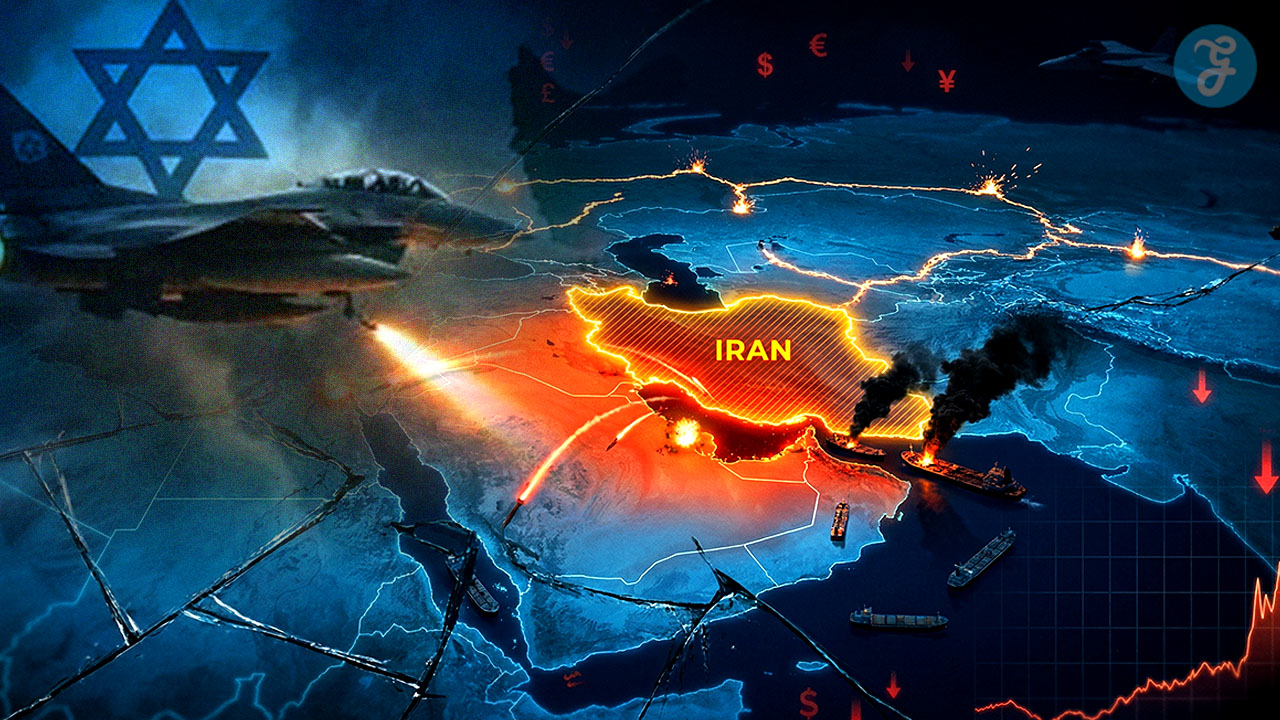
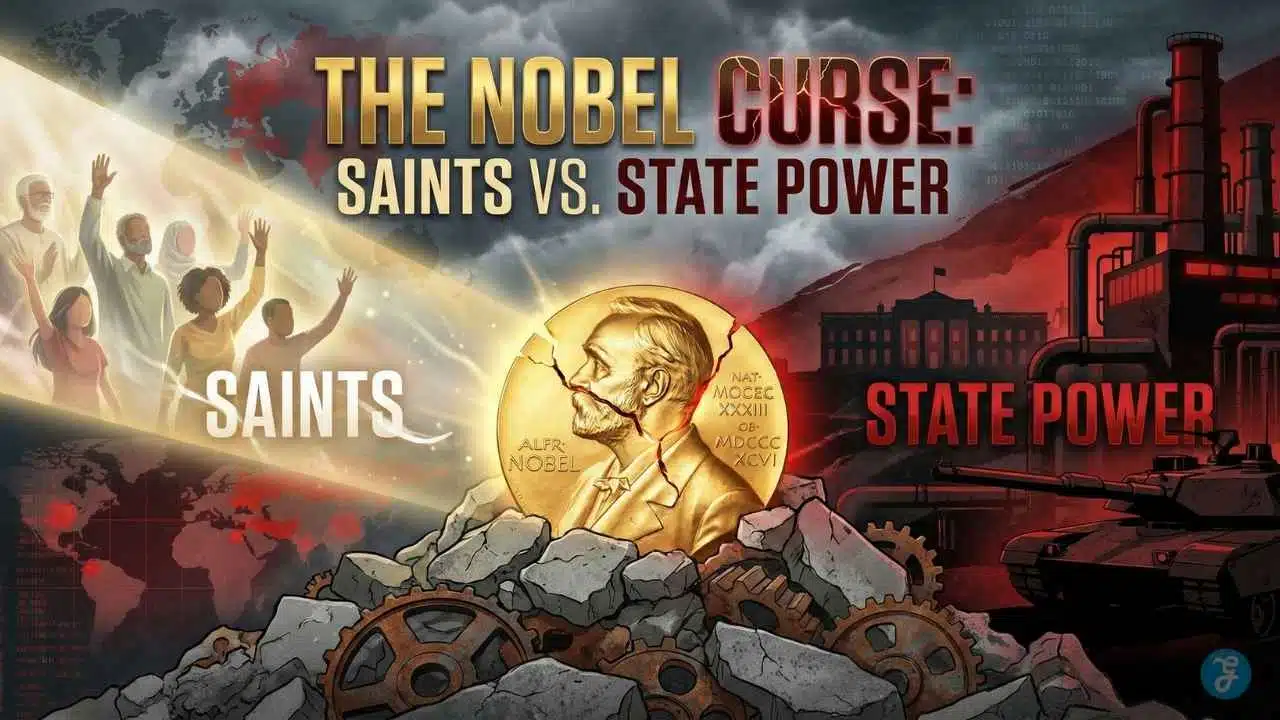
When a nation’s political heart stops beating, when the treasury is empty, the streets are burning, and the army is nervous, the elites often reach for a specific kind of defibrillator: The Nobel Peace Laureate.
We are witnessing a fascinating, almost cinematic trend in 21st-century statecraft. It happened in Bangladesh in August 2024 with Muhammad Yunus. It is the central dynamic of the Venezuelan crisis of 2026 with María Corina Machado. It is not an accident. It is a calculated strategy, a “mind game” played between domestic military powers, international financiers, and the desperate public.
For decades, the playbook was simple: A crisis hits, a Nobel Laureate rises, the West sends aid, and democracy blooms. That playbook was written for a world that no longer exists. With the return of Donald Trump to the White House and his aggressive “America First” doctrine (2025-2029), the geopolitical value of a Nobel Peace Prize has inverted.
In the Biden/European era, a Nobel Prize was a Shield. In the Trump era, a Nobel Peace Prize is a Target. This analysis breaks down why nations turn to “Saints” to do the dirty work of “Sinners,” and why this strategy often ends in betrayal with Nobel Peace Laureates in power.
Key Takeaways
-
The Strategy is Obsolete: Using Nobel Laureates as diplomatic “shields” to secure Western aid worked in the Biden era but fails under Trump’s transactional “America First” doctrine.
-
The “ATM” Trap: Elites cynically install Laureates to unlock frozen IMF loans and pacify the public, often using them as temporary “human shields” before discarding them.
-
Governance vs. Revolution: History proves that the skills needed to topple a regime (unbending idealism) are the opposite of those needed to run a government (pragmatic compromise), leading to frequent administrative failure.
-
The “Saint” Liability: In the age of digital warfare, a leader’s global prestige is easily weaponized by opponents to paint them as out-of-touch “Western Agents” or foreign puppets.
-
The 2026 Warning: Current leaders like Yunus (Bangladesh) and Machado (Venezuela) face existential threats as they are squeezed between local military power and shifting US foreign policy.
The “Mind Game”: Why the Nobel?
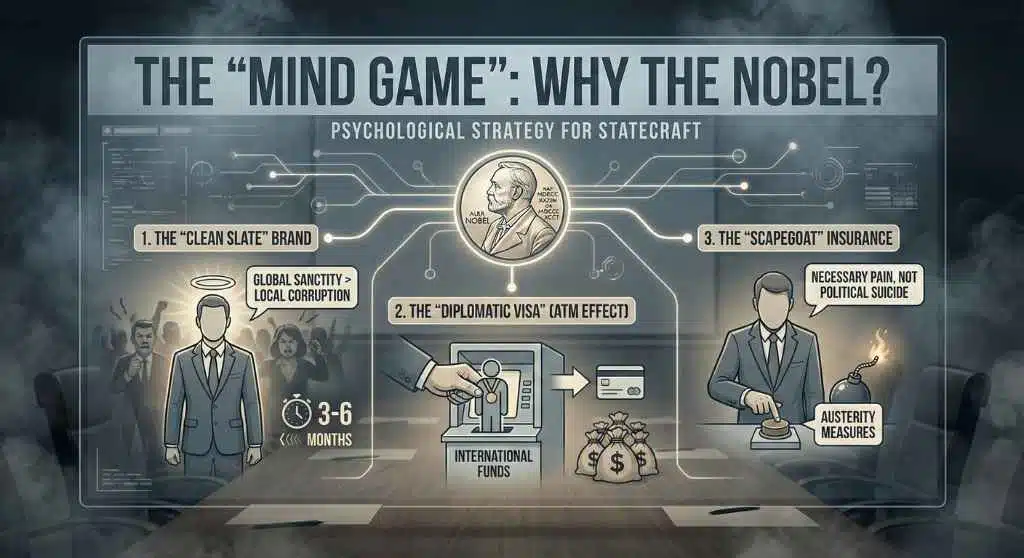
Why hand the keys of a broken state to a professor or a human rights activist? They usually have zero experience in running a bureaucracy. That is exactly the point. The “Mind Game” relies on three psychological pillars:
The “Clean Slate” Brand (Domestic Pacification)
In a revolution, the public’s anger is usually directed at the entire political class. Corruption is the enemy. A Nobel Laureate is the “Anti-Politician.” They bring a brand of “Global Sanctity” that local politicians cannot touch.
-
The Strategy: The military or interim backers use the Laureate as a human shield. The public hesitates to riot against a man or woman whom the world has certified as a “Saint.” It buys the state critical time (3-6 months) to reorganize.
2. The “Diplomatic Visa” (The ATM Effect)
This is the most cynical and practical reason. A collapsed state is a bankrupt state. It needs immediate IMF loans and World Bank grants to pay for fuel and food.
-
The Reality: If a General takes power, sanctions follow. If a Nobel Laureate takes power, the White House invites them for tea.
-
The Mind Game: The local elites know that a Laureate is a “Human Key” that unlocks frozen international funds. Yunus in Bangladesh didn’t just bring stability; he brought immediate access to billions in aid that a partisan leader would have been denied.
3. The “Scapegoat” Insurance
Rebuilding a broken economy requires pain (austerity). Subsidies must be cut; taxes must rise.
-
The Trap: If a politician does this, they are hated. If a Laureate does it, it is framed as “necessary medicine.” But eventually, the Laureate burns through their popularity, acting as a “fuse” that blows so the real power brokers don’t have to.
The Geopolitical Shift: The “Trump Factor”
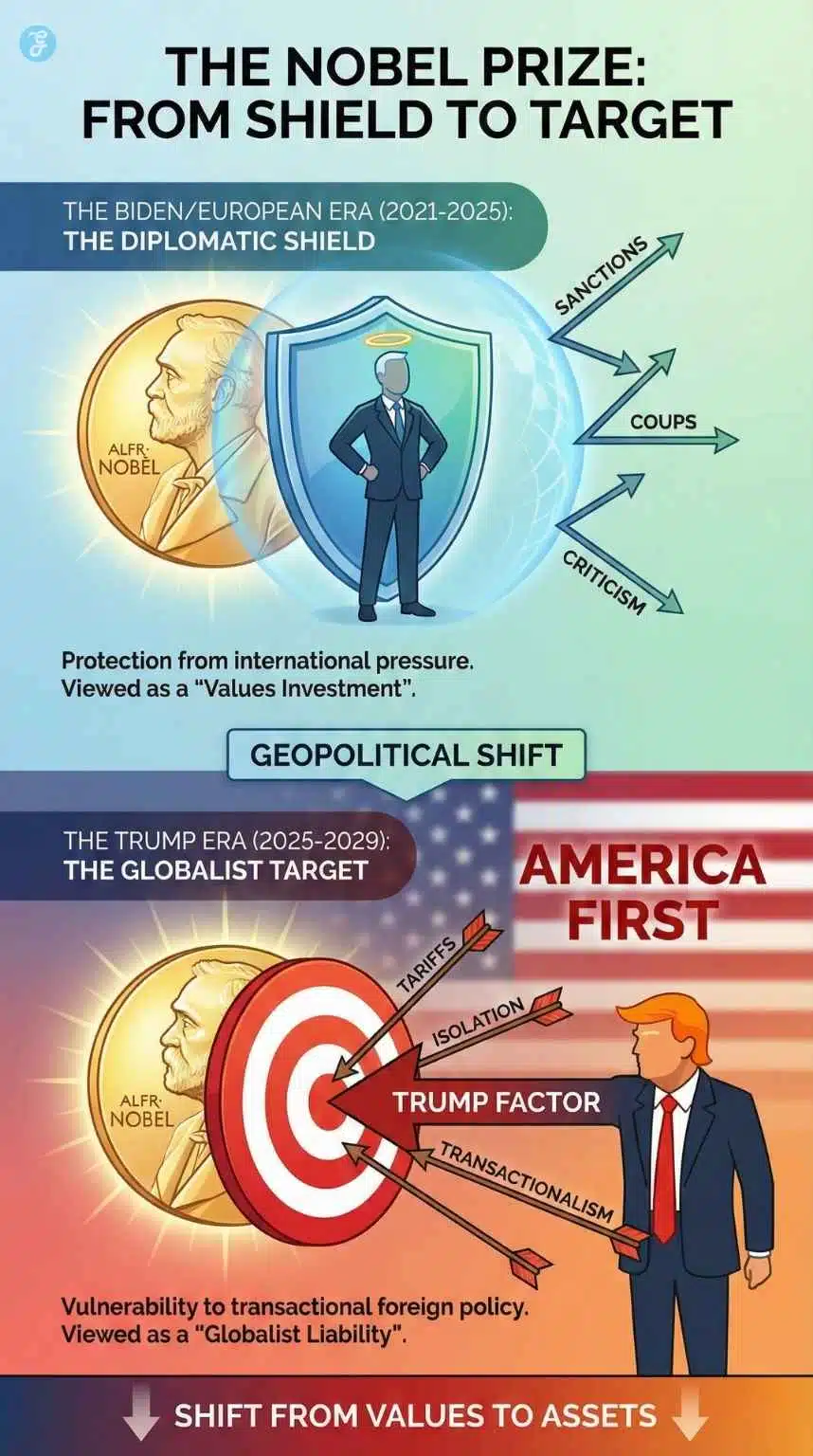
The geopolitical landscape has shifted dramatically. In the 20th century (and under the Biden/Obama era), a Nobel Peace Prize was a Diplomatic Iron Dome. It protected leaders from coups and sanctions because the West viewed them as “investments.”
The 2026 Reality: Under the Trump Administration (2025-2029), the Nobel Prize has become a “Globalist Scarlet Letter.”
The “Transaction” Doctrine: Donald Trump’s foreign policy is purely transactional. He does not trade in “Values”; he trades in “Assets.”
The Asset Test
| Country | Asset Check | Capability Question | Result |
| Venezuela | Does it have oil? Yes. |
Can Machado deliver it? No (she wants purges). Can Delcy Rodríguez deliver it? Yes. |
Support Rodríguez |
| Bangladesh | Does it have money? No. | Do they have a trade surplus with the US? Yes. | Impose Tariffs |
The “Strongman” Preference
Trump instinctively distrusts “weak” coalition builders. He prefers “Killers” (his term for tough leaders) who can deliver a deal. He views Yunus and Machado as “NGO Managers,” not “State Managers.”
Realpolitik Returns: The Extinction of the Nobel Shield
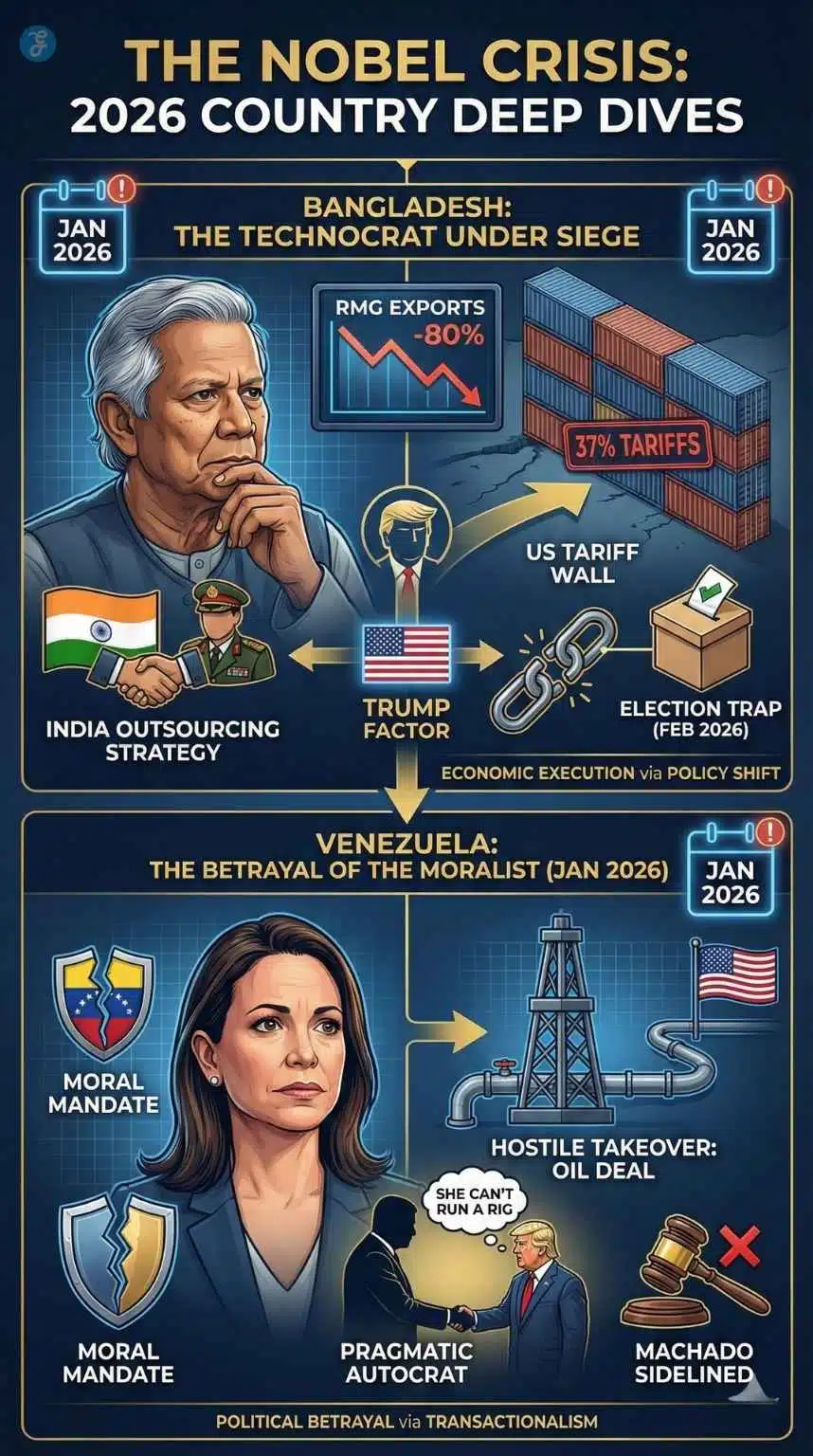
Let’s explore the profiles of the Laureates with the specific “extinction-level” crises they face in January 2026, illustrating the collision between their moral mandate and the new geopolitical reality.
1. Bangladesh: The Technocrat under Siege
The Laureate: Muhammad Yunus (Chief Adviser)
The Context: The collapse of Sheikh Hasina’s 15-year iron rule in 2024 left a vacuum filled by student rage and economic insolvency. Yunus’s ascent was intended to be a “system reboot.”
The Internal Conflict
Technocracy vs. Politics Yunus attempted to “debug” Bangladesh like a faulty piece of code—fixing the judiciary, police, and banks. He appointed fellow technocrats. But he discovered that politics is not a math problem; it is a game of patronage.
-
The “Western Asset” Attack: His enemies, remnants of the old regime, and radical factions weaponized his global fame. They painted his closeness to US Democrats and European elites not as an asset, but as proof he was a “Foreign Agent” sent to secularize the country or serve Western interests against India.
-
The Reality: Yunus found himself squeezed between Street Power (the students who put him there) and Hard Power (the Army that keeps him there). A Nobel Prize commands respect in a seminar room, but it doesn’t command a tank battalion.
The 2026 Breaking Point: The “Tariff Wall”
As of January 2026, Yunus is not facing a military crisis; he is facing an economic execution.
-
The “Hillary” Curse: Yunus has a unique liability: his historical friendship with Hillary Clinton. In the vindictive atmosphere of the new Washington, this makes him a personal target.
-
The Policy: The US Trade Representative (USTR) has slapped a 37% Reciprocal Tariff on Bangladeshi garments (delayed but looming). This destroys the thin margins of the RMG (Ready-Made Garment) sector, which makes up 80% of Bangladesh’s exports.
-
The “India Outsourcing” Strategy: Under Biden, the US engaged directly with Dhaka. Under Trump, the policy is: “Modi handles the neighborhood.” India, viewing Yunus as unstable or too close to China, is emboldened to pressure him to accommodate the ousted Awami League. Yunus is left without his American “Big Brother.”
-
The February Election Trap: The US Chargé d’Affaires has praised the upcoming Feb 12, 2026 election, but this is a trap. If Yunus holds the election, the Nationalists (BNP) will likely purge his reforms. If he delays, the Army will remove him. He is forcing a vote to save the nation, knowing it might end his career.
2. Venezuela: The Betrayal of the Moralist
The Laureate: María Corina Machado (Nobel Peace Prize 2025)
The Context: Awarded for her “tireless defense of democracy,” her prize was a strategic move by the international community to make her “untouchable” by the Maduro regime.
The Internal Conflict: Idealism vs. Brute Force
-
Weaponizing the Prize: The Nobel Committee didn’t just give her a medal; they gave her a shield. It made it diplomatically suicidal for the regime to imprison her immediately.
-
The “Aung San Suu Kyi” Risk: Machado faces a classic dilemma. To govern effectively, she may have to cut deals with elements of the old military guard. If she refuses, they block her. If she agrees, she stains her “Moral Mandate.” Washington and Brussels use her legitimacy to pressure for transition, but simultaneously cultivate “pragmatic” insiders who can actually deliver the army.
The 2026 Breaking Point: The “Hostile Takeover”
As of January 2026, the capture of Nicolás Maduro by US forces was not a “Liberation”; it was a “Corporate Acquisition.
-
The Betrayal: Machado did everything right, united the opposition, and won the moral war. But intelligence briefings suggest Trump views her as “too rigid.” Her “Plan País” involves dismantling the Chavista state, leading to chaos and zero oil exports.
Reports indicate Trump dismissed her: “She’s a nice woman, won a medal from the Europeans. But she can’t run a rig.”
-
The Rise of the “Manager” (Delcy Rodríguez): The US State Department is backing Maduro’s former VP, Delcy Rodríguez. Why?
-
The Asset: Delcy controls the state bureaucracy and mid-level military loyalty.
-
The Deal: A classic Trumpian “Protection Racket.” Delcy stays in power as “Interim President” if she expels Cuban agents and grants Chevron/Exxon unlimited access to the Orinoco Belt.
-
-
The Result: The US is turning Venezuela into a “Client State” run by a compliant autocrat, rather than a “Democracy” run by an independent idealist.
Case Zero: The Karzai Warning [The Prototype]
Before there was Yunus or Machado, there was Hamid Karzai. While he never won the Nobel Peace Prize (though he was heavily tipped for it in 2002), he is the “Patient Zero” of the Western Savior strategy. His rise and fall provide the genetic blueprint for the crises we are witnessing today.
-
The “Gucci Revolutionary” (2001): Karzai was the original “Clean Slate.” Sophisticated, fluent in English, and draped in his trademark green cape, he was the West’s dream candidate to replace the Taliban. The 2001 Bonn Agreement was the prototype for the transition governments we see now. The West believed that a single charismatic man, backed by US Air Power and World Bank cash, could tame a fractured nation.
-
The “Mayor of Kabul” Trap: Karzai fell into the trap that now threatens Yunus. To survive, he had to rely on the very Warlords he was supposed to replace. He controlled the palace, but the “Strongmen” controlled the roads. When he tried to assert authority, the US undermined him; when he tried to compromise, the West called him corrupt.
-
The Expiration Date: Karzai teaches us the most brutal lesson of all: Western Legitimacy has a half-life. By 2009, the same Washington elites who celebrated him turned on him, leaking stories of his incompetence and trying to sideline him. He ended his presidency embittered, paranoid, and openly hostile to the US, famously calling the Taliban “brothers” just to spite his former patrons.
-
The Verdict: Karzai serves as a living warning to the Class of 2026. He proved that being “America’s Man” is a temporary job. If you rely entirely on foreign support, you become a tenant in your own country, and eventually, the landlord evicts you.
Historical Precedents: The Graveyard of Laureates
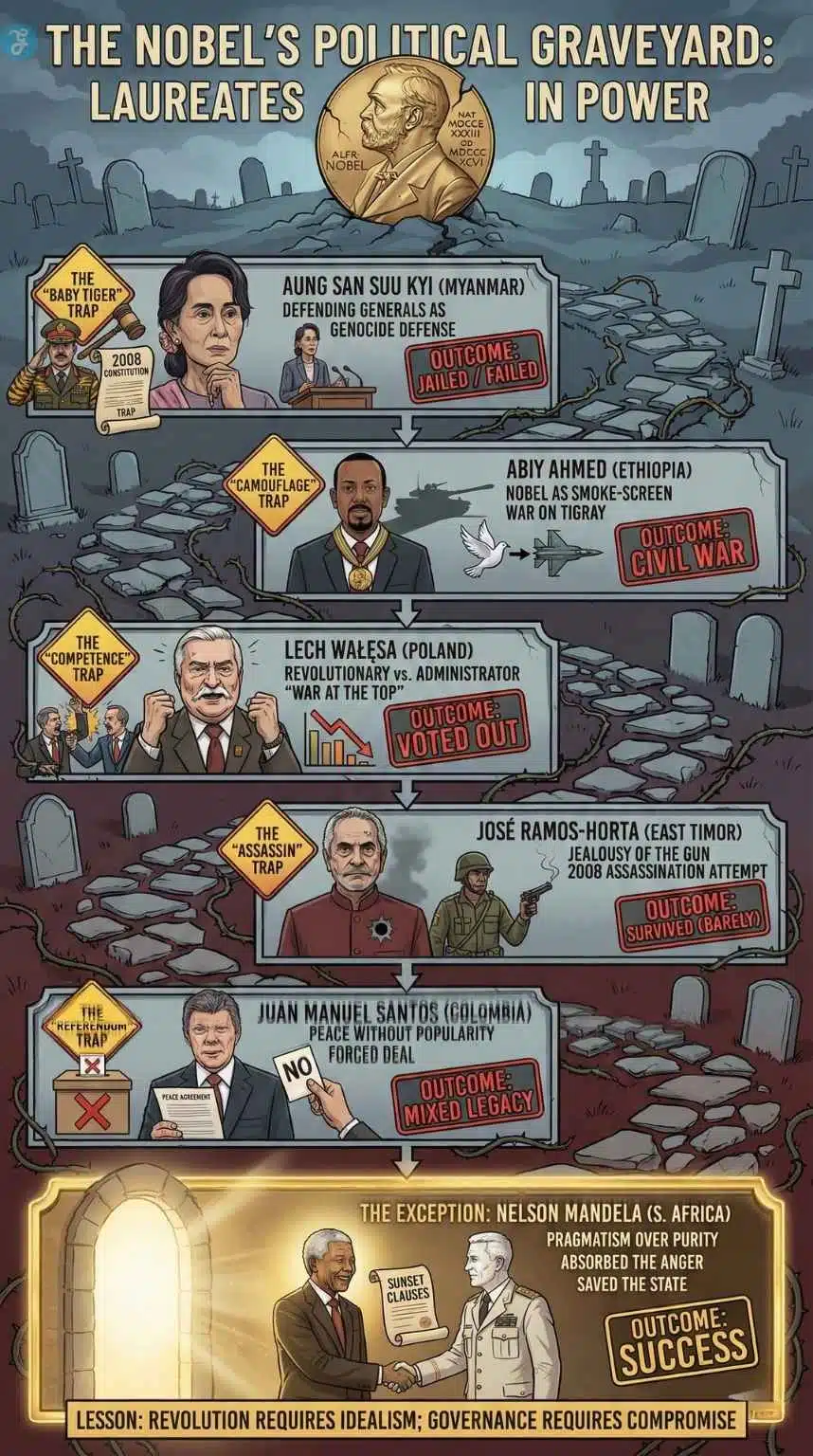
When we analyze every major case of a Peace Laureate taking power, a disturbing pattern of “Governance Failure” emerges. History tells us that Nobel Laureates are excellent at getting power during a crisis, but they often struggle to hold it without losing their soul.
The “Saint” in the Mud: A Comparative Analysis
| Laureate & Country | Crisis Type | The “Trap” They Fell Into | Outcome |
| Aung San Suu Kyi (Myanmar) | Military Transition | The “Baby Tiger” Trap. She thought she could co-opt the military by defending them. Instead, she destroyed her own reputation (Rohingya Genocide defense), and they ate her anyway. | Jailed / Failed |
| Abiy Ahmed (Ethiopia) | Ethnic Fracture | The “Camouflage” Trap. He used the 2019 Nobel as a smoke-screen to prepare for war against Tigray. He proved that a Nobel Laureate can be a Warlord. | Civil War |
| Lech Wałęsa (Poland) | Economic Collapse | The “Competence” Trap. He was a genius revolutionary but an incompetent administrator. He created chaos (“War at the Top”) and was voted out by the very people he freed. | Voted Out |
| Jose Ramos-Horta (East Timor) | Independence War | The “Assassin” Trap. He nearly died in an assassination attempt (2008) because he underestimated the resentment of disgruntled soldiers. | Survived (Barely) |
| Juan Manuel Santos (Colombia) | Civil War (FARC) | The “Referendum” Trap. He won the Nobel for a peace deal that his own people voted against in a referendum. He forced it through, but left office deeply unpopular. | Mixed Legacy |
| Nelson Mandela (S. Africa) | Apartheid Fall | The “Sellout” Trap (Avoided). He is the only success because he accepted that he had to “betray” his radical base to placate the white military/capital. He prioritized Stability over Justice. | Success |
The Price of Power: From Moral Authority to Political Compromise
Let’s explore the brutal transition from “Moral Icon” to “Political Executive.” The central thesis here is that Revolution and Governance require opposite skill sets.
-
Revolution requires unbending idealism, black-and-white morality, and the ability to say “No.”
-
Governance requires cynical compromise, shades of gray, and the ability to say “Yes” to people you hate.
When a Nobel Laureate enters the presidential palace, they are often walking into a trap set by the very “Deep State” (military, bureaucracy, oligarchs) they just defeated.
1. Aung San Suu Kyi (Myanmar): The Tragedy of Compliance
-
The “Mud” She Stepped In: Suu Kyi fell into a constitutional trap—the 2008 Constitution. It was a “poison pill” designed by the military. It guaranteed the Army 25% of parliament seats (a veto on change) and total control of the “Power Ministries” (Defense, Interior, Borders).
-
The Fatal Compromise: To govern, she decided she had to appease the Generals. She believed that if she defended them, they would eventually trust her and let her change the constitution.
-
The Moral Collapse: This culminated in 2019 at the International Court of Justice (ICJ) in The Hague. The world watched in horror as the Nobel Laureate stood up and defended the military against charges of genocide regarding the Rohingya Muslims. She called it an “internal armed conflict,” refusing to even say the word “Rohingya.”
-
The Lesson: You cannot tame a tiger by letting it eat your neighbors.
2. Lech Wałęsa (Poland): The Chaos of Intuition
-
The “Mud” He Stepped In: Wałęsa proved that a great revolutionary can make a terrible President. His style was “The Lion”—loud, confrontational, and impulsive. But a President needs to be “The Fox”, strategic and patient.
-
The “War at the Top”: Instead of uniting the post-communist government, he declared a “war at the top,” firing allies and causing constant instability because he felt sidelined by the intellectuals in his own movement. He viewed compromise as weakness.
-
The Economic Shock: He presided over the Balcerowicz Plan (Shock Therapy). It was necessary to fix the economy, but it caused massive pain (unemployment, loss of savings). Because he was the face of the state, the “Hero of the People” suddenly became the “Traitor of the Workers.”
-
The Lesson: A revolutionary feeds on conflict; a governor starves on it.
3. Abiy Ahmed (Ethiopia): The Wolf in Sheep’s Clothing
-
The “Mud” He Stepped In: This is the darkest case study. Abiy Ahmed didn’t just fail; he weaponized the prize.
-
The “Camouflage” Strategy: Many analysts now believe Abiy used the 2019 Nobel Peace Prize as a “diplomatic shield.” He knew he was planning to centralize power and crush the Tigray People’s Liberation Front (TPLF). The Prize gave him a temporary “God Status” in the West.
-
The Pivot: Less than a year after receiving the prize, he launched a full-scale military offensive in Tigray. He used the very peace deal with Eritrea (for which he won the prize) to ally with Eritrean troops to attack his own citizens.
-
The Lesson: Ideally, the prize is a reward. Cynically, it is a disguise.
4. Nelson Mandela (South Africa): The Art of the Deal
-
The “Mud” He Stepped In: Mandela is the only one who truly survived the mud. Why? Because he understood that betraying his base was necessary to save the country.
-
The Sunset Clauses: This was the critical “dirty deal.” Mandela accepted a proposal by Joe Slovo (Communist Party leader) to guarantee the jobs, pensions, and property of the white minority (the apartheid enforcers) for five years.
-
The Masterclass: Mandela absorbed the anger. He used his personal “Saint” capital to force his own people to accept a deal they hated. He realized that if he tried to be a “Pure Revolutionary,” the white army would burn the country down.
-
The Lesson: To lead is to disappoint your own followers at a rate they can absorb.
5. José Ramos-Horta (East Timor): The “Assassin” Trap
-
The Trap: He underestimated the “Jealousy of the Gun.” While he was winning awards in New York, the guerrilla fighters who stayed in the jungle felt forgotten and underpaid.
-
The Failure: In 2008, a group of disgruntled rebel soldiers led by Major Alfredo Reinado attacked his home. Ramos-Horta was shot in the stomach and barely survived.
-
The Result: It was a brutal wake-up call. Moral authority means nothing to a hungry soldier with a rifle.
6. Juan Manuel Santos (Colombia): The “Referendum” Trap
-
The Trap: He won the Peace Prize strategically. The committee awarded it to him on October 7, 2016—just five days after the Colombian people had voted NO to his peace deal in a referendum.
-
The Failure: The prize was a lifeline thrown to a drowning man. The Colombian public hated the deal because it gave amnesty to FARC commanders (no prison time). Santos was celebrated in Oslo but despised in rural Colombia where the FARC had kidnapped and killed for decades.
-
The Result: He forced the deal through Congress anyway, bypassing the voters. He is a “Prophet without Honor” in his own land.
7. The Dalai Lama: The “Exile” Trap
While most laureates lose power after winning the prize, the 14th Dalai Lama offers a unique lesson: The King Without a Kingdom. He represents the “Option Z” that María Corina Machado may be forced into, a permanent, symbolic presidency operated from a hotel room abroad.
-
The “Symbolic State” Trap (1959-Present): The Dalai Lama lost his hard power (territory/army) in 1959 when he fled to India. He established the Central Tibetan Administration (CTA) in Dharamshala—effectively a “Government-in-Exile.” It has a parliament, a prime minister, and a constitution, but it controls zero land and collects zero taxes. It is a state of mind, not a state of matter.
-
The “Nobel” Paradox (1989): He won the Nobel Peace Prize 30 years after leaving his country.
-
The Strategy: The West used the prize as a diplomatic weapon against Beijing, awarding it just months after the Tiananmen Square massacre. It was a signal, not a solution.
-
The Trap: The prize made him a global pop-culture celebrity, but it froze his political progress. Beijing viewed the award as an act of war and hardened its stance. The more famous he became in Hollywood, the less influence he had in Lhasa.
-
-
The Realpolitik Fade (The Warning for 2026): The Dalai Lama’s trajectory is a warning for the “Trump Era.”
-
In the 1990s: US Presidents and European leaders lined up to meet him. He was a geopolitical asset against a weaker China.
-
In the 2020s: As China became an economic superpower, Western leaders quietly stopped the meetings. He has been “geopolitically ghosted.” The Moral Saint became an economic liability.
-
-
The Lesson: The Dalai Lama proves that Moral Authority has a shelf life. You can be the most loved man on earth, but if you do not have an economy or an army to trade with, the world will eventually treat you as a museum piece rather than a head of state.
8. Mikhail Gorbachev (USSR): The “Foreigner’s Hero” Trap
Leader of the Soviet Union. He tried to reform a totalitarian state (Glasnost/Perestroika) and ended the Cold War peacefully.
The Mind Game: The West (Reagan/Thatcher/Bush) showered him with praise, magazine covers, and finally the Nobel Peace Prize in 1990. They loved him because he was dismantling their enemy (the USSR) from the inside without firing a shot.
-
The Betrayal (Realpolitik):
-
Domestic: While Oslo celebrated him as a Saint, Russians cursed him. His reforms caused economic chaos, empty shelves, and the loss of superpower status. He was seen as a weakling who sold out the empire for Western applause.
-
International: When the end came in 1991, the West did not save him. The Bush Sr. administration quietly pivoted to Boris Yeltsin (a drunk, erratic populist) because Yeltsin had the real power on the streets. Gorbachev was allowed to fade into irrelevance, eventually doing Pizza Hut commercials to pay the bills.
-
-
The Lesson: You can be the darling of the West, but if your own people cannot buy bread (or eggs), the West will step over your political corpse to shake hands with your successor.
9. Mohamed ElBaradei (Egypt): The “Paper Tiger” Trap
The Egyptian Revolution (2011-2013). Like Yunus in Bangladesh, ElBaradei returned to Egypt during the Arab Spring as the “Clean Slate” candidate. He was the liberal icon, educated, international, a Nobel Laureate. He was supposed to be the bridge between the Army and the Revolution.
-
The Climax (2013): After the coup against Morsi, the Military (under Sisi) appointed ElBaradei as Vice President to give the new regime “International Legitimacy.” He was the Human Shield for the coup.
-
The Fall: Weeks later, the Military massacred protesters (Rabaa massacre). ElBaradei realized he was being used to whitewash blood. He resigned in horror.
-
The Outcome: The Military didn’t care. They had already consolidated power. They smeared him as a traitor, and he fled into exile again. The “Saint” was used to open the door, then discarded when the “Soldier” walked through.
Systemic Failures: Why They Cannot Govern
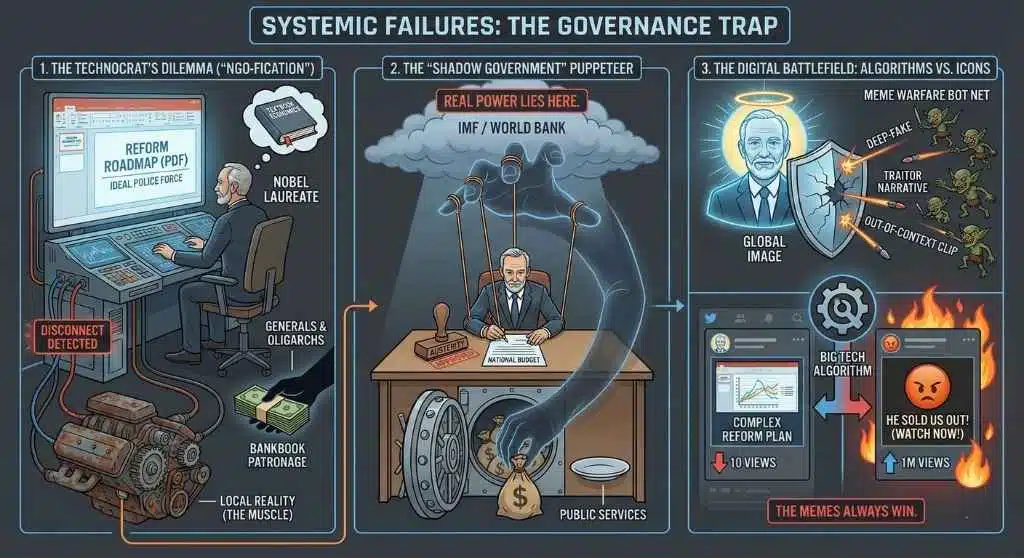
When a Nobel Laureate takes power, they rarely come alone. They bring what can be called the “Consultant Class.” This is a specific phenomenon in which the machinery of the state is outsourced to international experts, creating a fatal disconnect with local reality.
-
The “PowerPoint” Trap: In Bangladesh (2024-2026), Muhammad Yunus’s administration was heavily supported by the UNDP and international legal scholars. They drafted brilliant “reform roadmaps” for the police and judiciary.
-
The Failure: These plans worked perfectly in PDF format, but failed in the streets. For example, while consultants were designing a “human rights-compliant police force,” the actual police stations were empty because officers were afraid of retribution. The “Technocratic Brain” could not communicate with the “Muscle” of the state.
-
The “Harvard” Disconnect (Venezuela): In the Venezuelan transition, Machado’s team is relying on “Plan País”—an economic recovery plan drafted by brilliant Venezuelan economists in exile (often from Harvard or IESA).
-
The Conflict: This plan requires rational economic behavior (removing price controls, privatizing oil). But the survival of the state requires irrational patronage (paying off generals with secret funds). The Laureate wants to follow the “Textbook”; the Generals want to follow the “Bankbook.”
1. The “Shadow Government”: Who actually rules?
In these scenarios, the IMF and World Bank often set the budget, effectively making them the shadow government. The Laureate becomes merely a spokesperson for austerity. This allows the opposition to paint the Laureate not as a leader, but as a “Clerk for Foreign Banks.”
2. The “Third Party” Factor: Are They Assets?
We cannot ignore the geopolitical elephant in the room. Why does the West (specifically the US and EU) so heavily support the “Nobel Strategy”?
-
The “Soft Coup” Mechanism: Awarding the prize to an opposition figure (like Machado or Wałęsa) is a way to delegitimize a hostile regime without firing a shot. It creates a “Government-in-Waiting” that the world already recognizes.
-
The Funding Trail: Many of these figures spend their “exile” years in Western think tanks or universities (e.g., Yunus’s strong ties to global microfinance networks). This isn’t necessarily a conspiracy, but it creates a Cultural Alignment. When they take power, they implement free-market reforms, open up to foreign investment, and align with Western diplomatic norms.
-
The Backlash: This alignment is exactly what nationalist opponents use against them. In Bangladesh, the “Western Asset” narrative is the primary weapon used to erode Yunus’s domestic support.
3. The Digital Battlefield: When Algorithms Defeat Icons
In the 20th century (Mandela’s time), you killed a leader’s reputation with state propaganda newspapers. In 2026, you do it with “Memetic Warfare.” Nobel Laureates are uniquely vulnerable to this because their power relies entirely on their image.
-
The “De-Saintification” Strategy: Opponents do not attack the Laureate’s policies; they attack the sanctity of their image. In Bangladesh, cyber-cells (suspected to be funded by the ousted Awami League or external actors) flooded TikTok and Facebook with deep-fakes and out-of-context clips portraying Yunus not as a wise professor, but as a confused, senile puppet of the CIA. They successfully coined the narrative: “He can win a medal, but he can’t fix the price of eggs.”
-
The Patriotism Hack: A specific digital narrative is used: “Global Citizen = National Traitor.” Every time the Laureate receives an award abroad, bot farms amplify the message: “Look, they are being rewarded by the West for selling out our country.”
-
The “Silence” Algorithm: Big Tech platforms (X, Meta) often suppress “instability” content. Ironically, this hurts the revolutionary government. When Yunus or Machado tries to communicate complex reforms, the algorithm downranks them in favor of sensationalist, angry content from the opposition. The “Saint” speaks in paragraphs; the “Sinner” speaks in memes. The memes always win.
Frequently Asked Questions (FAQs)
1. Why do Nobel Laureates notoriously fail when they become heads of state?
The failure is usually due to a “skill set mismatch.” Laureates are often awarded for idealism, moral rigidity, and opposition. However, running a state requires cynicism, compromise, and the management of corrupt networks. As seen with Lech Wałęsa in Poland, being a “Lion” in the streets does not translate to being a “Fox” in the palace.
2. What is the “ATM Effect” mentioned in the article?
The “ATM Effect” refers to the cynical use of a Nobel Laureate by local military or political elites to unlock international finance. A military junta is sanctioned; a Nobel Laureate is welcomed. By installing a Laureate as the face of the government, a bankrupt nation gains immediate access to IMF loans, World Bank grants, and Western aid that would otherwise be frozen.
3. Why does the “Trump Factor” make a Nobel Prize a liability?
Donald Trump’s foreign policy is transactional (“America First”). He prefers “strongmen” who can deliver immediate deals (like oil or trade surpluses) over “moral leaders” who focus on human rights. In this worldview, a Nobel Prize marks a leader as part of the “Globalist NGO” class—someone who will likely lecture the US on values rather than sign a favorable trade deal.
4. How did Nelson Mandela avoid the “Laureate Trap”?
Mandela is the exception because he embraced “ruthless pragmatism.” He avoided the trap by disappointing his own radical base to save the state structure. He agreed to “Sunset Clauses” that protected white minority wealth and jobs, prioritizing stability over immediate retributive justice. He understood that to govern, he had to make deals with his former oppressors.
Social media has enabled “De-Saintification.” In the past, a Laureate’s image was protected by state media. Today, opposition groups use “Memetic Warfare” (TikTok, deep-fakes) to portray the Laureate’s global connections as treason. A Nobel Prize, once a symbol of honor, is reframed digitally as proof that the leader is a “Western Puppet” disconnected from the struggles of the common people.
What’s Next: The Era of Transactionalism
We are witnessing the end of the “Liberal Savior” era. As Muhammad Yunus and María Corina Machado face existential threats in 2026, the verdict is in: the old playbook is dead. In a world now defined by “America First” transactionalism, a gold medal offers no protection against economic siege or geopolitical betrayal.
The future belongs not to the Saints who hold the moral high ground, but to the Operators who can hold the ground itself.
Final Words: The Death of the “Savior” Model
The “Mind Game” is a dangerous seduction. Using a Nobel Laureate to fix a broken state is like using a crystal glass to hammer in a nail; it works for a moment, but eventually, it shatters. History proves that moral purity rarely survives the dirty machinery of statecraft.
From Suu Kyi’s tragic compromise in Myanmar to Wałęsa’s chaotic administration in Poland, the lesson is brutal but clear: a Peace Prize is a reward for idealism, not a qualification for governance.