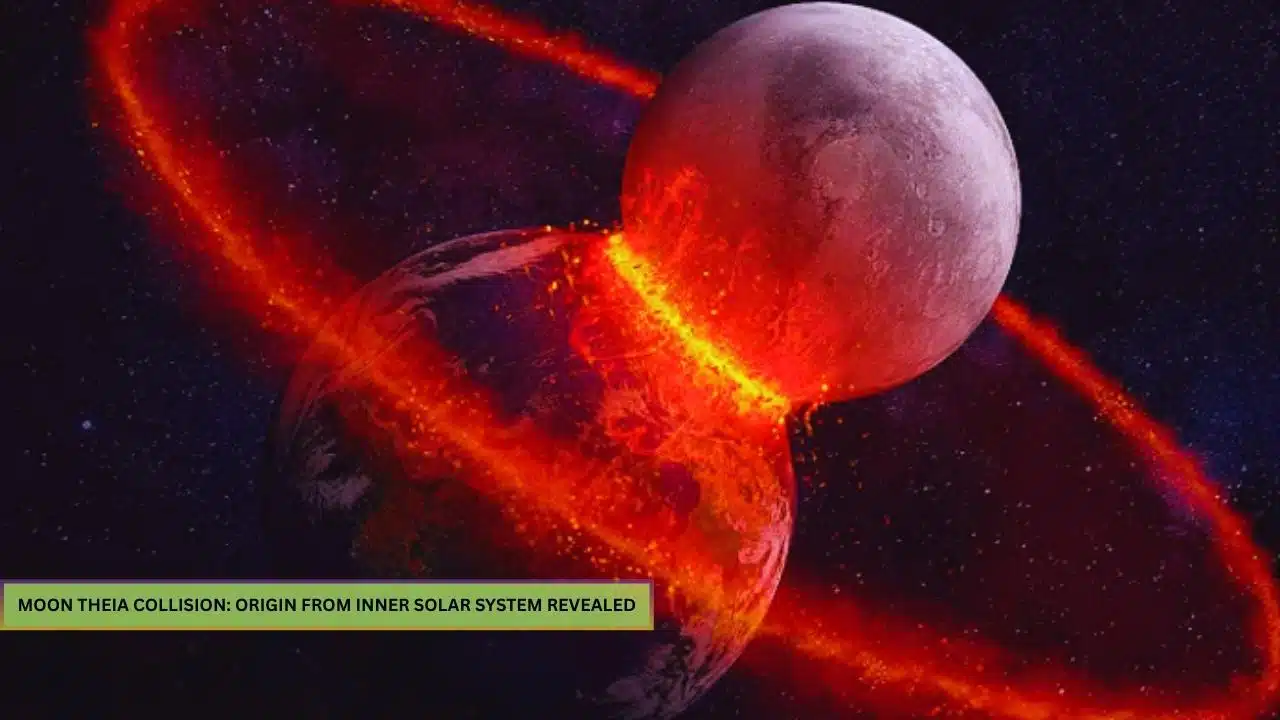
About 4.5 billion years ago, during the chaotic early days of the Solar System, a massive Mars-sized protoplanet called Theia collided with the young proto-Earth. This enormous impact vaporized much of both bodies, ejecting vast amounts of molten debris into orbit around Earth. Over time, that debris disk cooled, clumped together, and coalesced into the Moon we see today. This giant-impact hypothesis has stood as the leading explanation for the Moon’s formation since the 1970s, but until recently, scientists lacked clear evidence about Theia’s size, composition, or exact origins.
The collision reshaped Earth dramatically. It boosted Earth’s mass, altered its spin, and tilted its axis, setting the stage for stable seasons and climates that later supported life. Without the Moon’s gravitational pull stabilizing Earth’s wobble, our planet’s tilt could swing wildly, causing extreme climate chaos. Theia’s core likely merged with Earth’s, while its mantle material mixed with Earth’s to form the lunar building blocks. Recent research now pins down Theia as a local neighbor, not a far-flung visitor.
A groundbreaking study published November 20, 2025, in Science provides the strongest evidence yet. Led by Timo Hopp, a scientist at the Max Planck Institute for Solar System Research, the team included experts from the University of Chicago and the University of Hong Kong. The most convincing scenario is that most of the building blocks of Earth and Theia originated in the inner Solar System,” Hopp explained. “Earth and Theia are likely to have been neighbors.”
Decoding Celestial Origins Through Isotopes
Every rocky body in the Solar System carries a unique isotopic fingerprint, etched during its formation from stardust and gas around the young Sun. Isotopes are variants of elements differing only in neutron count, like titanium-46 versus titanium-50. Stars forge these through nuclear fusion, but when ejected into space, the material never fully homogenized across the Solar System. Inner regions near the Sun developed distinct ratios from outer zones, acting like cosmic barcodes.
Earth and Moon rocks show strikingly similar isotope ratios for oxygen, titanium, and others, puzzling scientists. Early models predicted the Moon should mostly be Theia material, implying differences from Earth. Yet samples match closely, suggesting thorough mixing or shared origins. The new study examined iron isotopes alongside prior data on chromium, calcium, titanium, molybdenum, and zirconium, revealing Theia’s contributions. These heavy elements help trace planetary recipes back to their stellar nurseries.
Prof. Nicolas Dauphas, now at the University of Hong Kong and formerly at the University of Chicago, specializes in isotope precision. His lab crafted techniques to measure tiny variations in minuscule samples. Different regions inherited distinct isotopic proportions, which now serve as a fingerprint to trace the origins of meteorites and other celestial bodies,” Dauphas noted. This approach resolved long-standing debates on Moon composition.
Precision Lab Work on Precious Moon Rocks
The researchers analyzed 15 terrestrial rocks, six lunar samples from Apollo missions, and meteorites from potential Theia birthplaces like carbonaceous chondrites. Lunar rocks, tiny and irreplaceable, required ultra-sensitive mass spectrometry to detect neutron-driven weight shifts. Iron isotopes proved key: Earth’s early core hoarded most iron and molybdenum, leaving the mantle depleted. Post-collision iron in the mantle thus likely came from Theia.
They integrated metal partitioning behaviors—how elements separate during planetary differentiation. Simulations modeled impact angles, speeds, and Theia sizes to match observed ratios. Non-carbonaceous chondrites, from inner Solar System asteroids, best fit Theia’s profile. These meteorites formed closer to the Sun, richer in heavy elements like molybdenum. Theia held 5-10% of Earth’s mass, with a metallic core and rocky mantle.
Dauphas likened the early Solar System to “cosmic billiards,” where gravitational nudges from Jupiter or Venus dislodged Theia from stable Lagrange points near Earth’s orbit. Theia may have trailed Earth at L4 or L5 points before colliding at a steep angle, ensuring vigorous mixing. Head-on crashes would destroy both; glancing blows fit the evidence.
Theia: A Protoplanet from the Sun’s Inner Neighborhood
Calculations rule out Theia as an outer Solar System interloper. Its isotopes align with inner disk materials, nearer the Sun than Earth’s orbit. Earth gained extra molybdenum and zirconium from Theia, explaining enrichments beyond its original mix. Carbonaceous chondrites from farther out don’t match; inner non-carbonaceous ones do.
This inner origin resolves Moon-Earth similarities. Both bodies brewed from the same dust-gas cloud, making their mantles chemically akin post-impact. Theia delivered solar-enriched materials via stellar nucleosynthesis products. Without this neighborly smash, Earth’s composition and Moon might differ sharply. Simulations confirm a debris ring formed, with 20% of Theia accreting as the Moon.
The study’s funding from NASA, National Science Foundation, U.S. Department of Energy, Deutsche Forschungsgemeinschaft, and European Research Council underscores its rigor. Co-authors like Marion Boyet, Sarah Jacobson, and Thorsten Kleine bolstered interdisciplinary expertise. Future missions could hunt Theia remnants in Earth’s mantle plumes.
Why This Collision Changed Everything for Life?
The Moon’s formation tilted Earth at 23.5 degrees, moderated by lunar gravity. This axial stability fosters predictable seasons, ocean tides, and habitable climates. Chaotic tilts seen on Mars highlight the Moon’s role. The impact also homogenized Earth’s layers, kickstarting plate tectonics and magnetic fields.
Theia hypothesis evolves with data. Early 1970s models assumed glancing blows; 2012 simulations allowed direct hits with high speeds. Oxygen isotopes demand steep angles for mixing. Water ice in Theia remains possible, up to 50%. Isotope tech advances promise deeper insights into Solar System dynamics.