You chase your own tail on the keyboard, you type slowly, and you spot typos everywhere. You try tests, but the extra bells and whistles slow you down. You want a clean layout, a smooth caret, and zero clutter.
You just want to track your typing speed and improve.
Monkeytype lives on GitHub; it is a minimalistic typing test you can tweak to fit your style. It uses AI to spin up new passages, and then it tracks your words per minute and accuracy and precision.
You will see how to pick test modes, save your speed with an account system, and join the Discord server for tips. Ready to see your speed soar?
Key Takeaways
- Monkeytype is a minimalistic typing test on GitHub that uses AI-generated passages and tracks words per minute, accuracy, and error variance.
- The platform offers focus mode, customizable layouts, language and theme swaps, and an account system that saves speed history and shows a live WPM graph.
- It gives real-time feedback on each mistyped key, backspace count, and overall accuracy, and it lets you export keystroke data via a Python module or CLI script.
- Test modes include timed races, quote mode, sentence scramble, ball dodge, and a daily scoreboard, with a Discord server for tips and GitHub issues for feedback.
- To see gains, set a clear goal (for example, add 5 WPM in one week), practice at least 10 minutes daily, and adjust your keyboard layout and posture.
Features of Monkeytype

Monkeytype shows a stark menu (computing) and a live graph of your words per minute and error variance. You can swap keyboard layouts, code in Python snippets, and even spy on your backspace count.
Minimalistic design and customizable interface
A clean layout shows what you need. You can hide ads and distractions with focus mode. You pick punctuation, numbers, or time intervals for each test. You switch languages and themes in the menu (computing).
Page layout stays simple, with only your words and a blank space. Customizable typing makes every session yours.
An account system to save your typing speed history lets you track your progress and improve. That system stores speed and accuracy in a graph. You watch your WPM climb over tests.
Settings stay light so you can keep your eyes on the screen.
How Monkeytype Helps Improve Typing Skills
Monkeytype logs your keystrokes and shows statistics like average speed and coefficient of variation. You can export your data to run a Python script or load it into an app for deep analysis.
Tracks typing speed, accuracy, and progress
This typing website logs time spent on the test, words per minute, accuracy percent, raw characters, and consistency. It plots stats on a chart so you spot trends and increase your typing speed.
Signed-in users save results, review input history, and watch test replays. A daily scoreboard tracks top scores. You can create an issue on GitHub to file a feature request or report a software bug.
Provides real-time feedback and error analysis
After you track your speed and accuracy, Monkeytype marks each error in real time. It highlights every typographical error as soon as you mistype a key. The dashboard shows your error count, WPM, and accuracy percentage instantly.
A live graph of your WPM and speed of the last 10 results sits below the text. You can run it in a bash shell or pip install its Python module to work with any QWERTY layout.
New typists type at a slow pace and keep their wrists flat. They train to keep their eyes on the display, not on the keys. Monkeytype’s error analysis flags each mishit instantly. Live feedback forces a quick fix, so you build cleaner habits with each test.
Tips for Maximizing Your Experience on Monkeytype
Tweak your keyboard layout, swap the typeface on the CLI, and see your speed climb like a sprinter chasing a bus. Mix in different test modes from the leaderboard, watch the live WPM counter, and let error analysis nudge you past your last best.
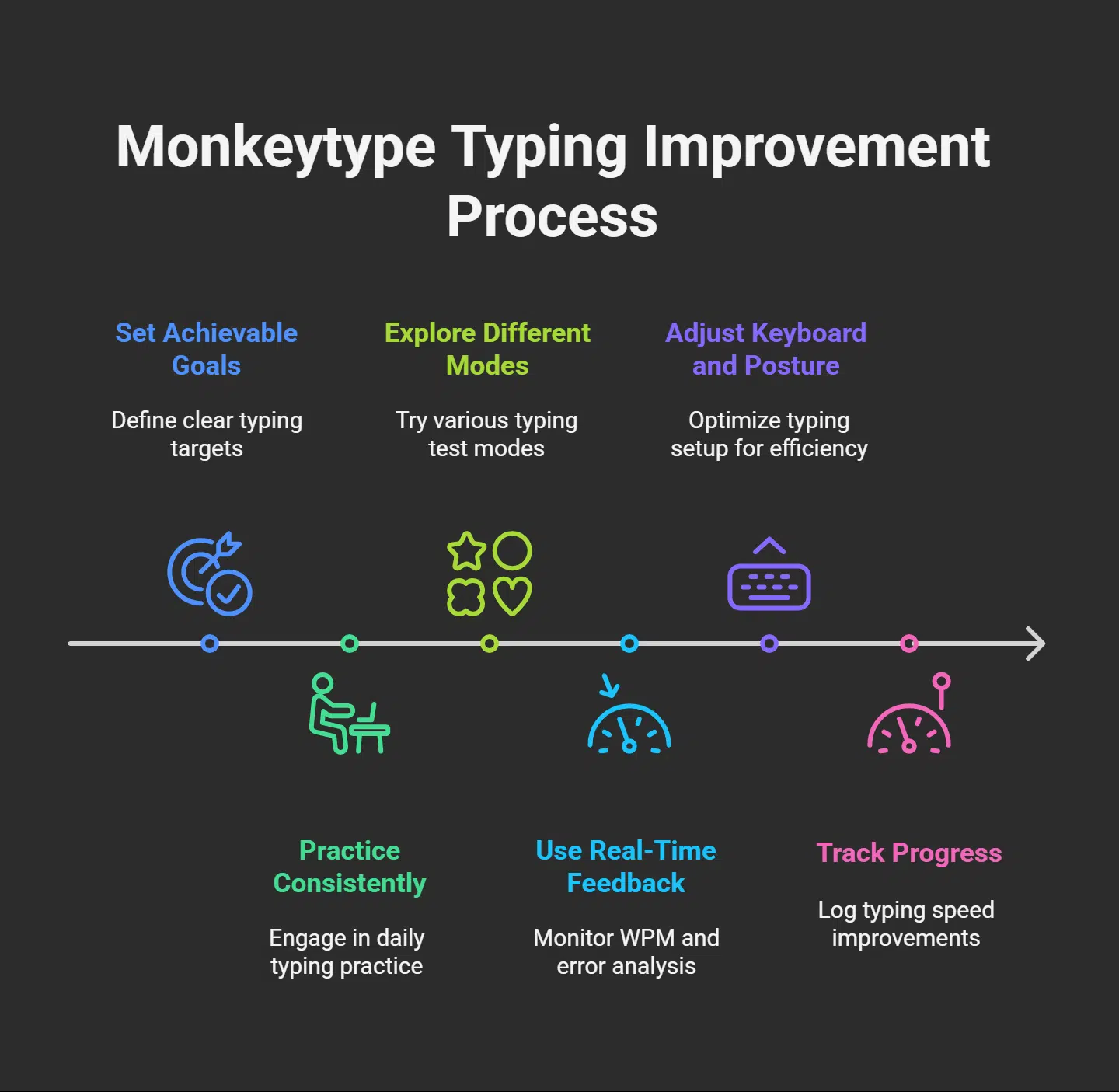
Set achievable goals and practice consistently
Pick a clear target, like raising your words per minute by five in one week. Monkeytype is a minimalistic, customizable typing website that uses your computer keyboard to deliver many test modes.
It lets you set test length and raw speed focus. The five-step process highlights proper technique and real-time error analysis.
Practice for ten minutes each day, and add more time as you improve. Run a small command-line interface script or Python module to log the speed of your previous test. Donations, Patreon, or merch help fund fresh features and keep the site running.
Consistent effort drives growth.
Explore different modes to challenge your skills
After you set goals and practice daily, shift to modes that test your raw speed and focus. Monkeytype attempts to emulate a real typing exam with timed races, quote mode, and custom drills.
You can try a speed race that lights a fire under your fingers.
Time attack mode helps improve your typing speed under pressure. Ball dodge will push you to keep up with moving text. Sentence scramble uses words in the English language to test your accuracy.
You might switch to a mechanical keyboard and proper posture to see gains faster.
Takeaways
Monkeytype uses a machine learning module written in a scripting language. It pairs that code with a clean design to boost your typing. You can tweak parameters and use code modules in a simple type system.
Tests report speed and accuracy in real time. You gain clear feedback and track progress on leaderboards. Try a timed challenge and watch your skills grow.
FAQs on Monkeytype
1. What is Monkeytype, and why is it so popular?
Monkeytype started as a prototype of this website on a forum. It now has a ton of features, like random themes, leaderboard info, and new test modes.
2. How do I quickly jump to the test page and start typing?
You click the link to jump to the test page. You pick a test duration or choose quote mode. Then you start typing in English or change the language entirely.
3. What happens when I press an incorrect letter?
In raw speed mode, the test ends as soon as you press any wrong letter. It will automatically fail a test, so watch your fingers. In relaxed mode it counts as an error but lets you keep going.
4. Can I adjust settings like dead key behavior or spelling style?
Yes. You can tweak the setting for dead key input. You can restart while typing. You can switch between American and British English spelling differences.
5. Will I find code passages or only plain text?
It feels like a text buffet, with plain English text, toolset code snippets in Python, and even practice in significant figures or folder paths. These are special modes that change the website’s look.
6. How can I give feedback if I encounter a bug?
You can visit the original forum post or send a private message on social media with a bug report. Everyone who gave valuable feedback on the original design helped shape the current test experience.