Mobile communication trends are redefining how people interact, work, shop, and respond to emergencies. Smartphones have become central to daily life, acting as communication hubs, identity verifiers, and gateways to digital services. This shift is driven by rising user expectations, smarter networks, and rapid advances in artificial intelligence and connectivity.
Traditional voice calls and SMS are no longer enough. Users now expect richer messaging, instant connectivity, better privacy, and seamless performance across locations and devices. Businesses, meanwhile, are adapting to conversational engagement rather than one-way communication.
This article explores twelve mobile communication trends shaping the future. Each trend explains what is changing, why it matters, and how it affects users and businesses. The focus is on clarity, real-world impact, and long-term relevance.
1. RCS Goes Mainstream for Cross-Platform Messaging
RCS is emerging as the modern replacement for SMS. It brings chat-style features directly into default messaging apps, removing the need for third-party platforms for basic rich communication.
RCS supports high-quality images, videos, typing indicators, read receipts, and better group chat functionality. These features create a smoother experience, especially for mixed-device conversations. A major turning point is wider platform support, which reduces fragmentation between Android and iPhone users. This makes everyday texting more consistent and predictable. RCS also benefits businesses by enabling branded, interactive messages instead of plain-text alerts. Customers can respond, tap buttons, or complete actions within the message itself. Despite progress, adoption depends on carrier support, user settings, and regional rollout speed.
Key Points
| Aspect | Explanation |
| Main Benefit | Richer default messaging |
| User Impact | Better media, smoother chats |
| Business Impact | Interactive customer messaging |
| Challenges | Carrier support and feature gaps |
2. End-to-End Encryption Expands Beyond App Silos

Privacy expectations are reshaping mobile communication. Users increasingly assume their conversations are private, regardless of which device or platform they use. Historically, strong encryption was limited to specific apps. Default messaging systems often lacked consistent protection, especially across platforms. The industry is now working toward stronger encryption standards for broader messaging ecosystems. This means better protection for group chats, media, and cross-device communication. For users, this shift builds trust and reduces fear of surveillance or interception. For businesses, it raises expectations for responsible data handling. The challenge lies in balancing privacy, lawful access requirements, and interoperability across different networks and devices.
Key Points
| Aspect | Explanation |
| Main Benefit | Stronger privacy by default |
| User Impact | Safer everyday messaging |
| Business Impact | Higher trust expectations |
| Challenges | Standards alignment and transparency |
3. Satellite-to-Phone Messaging Moves Beyond Emergencies
Satellite connectivity is no longer limited to specialized devices. Smartphones are beginning to support direct satellite communication for basic messaging. This trend is especially important for people in rural areas, travelers, outdoor workers, and emergency situations. When cellular networks fail, satellite messaging can provide a critical fallback. Early implementations focus on text-based communication due to bandwidth limitations. Over time, supported features are expected to expand. Satellite messaging improves resilience and safety but comes with trade-offs, including latency, limited throughput, and potential cost considerations. As coverage improves, satellite connectivity may become a standard part of mobile communication expectations.
Key Points
| Aspect | Explanation |
| Main Benefit | Connectivity without cell signal |
| User Impact | Improved safety and reliability |
| Business Impact | Field operations continuity |
| Challenges | Bandwidth and pricing limits |
4. Mobile Communication Becomes Multi-Network by Default
Modern smartphones are evolving into multi-network devices. They dynamically switch between cellular, Wi-Fi, and satellite connections based on availability and performance. This approach reduces dropped calls, improves messaging reliability, and ensures continuity during network disruptions. Users no longer need to think about which network they are using. Wi-Fi calling has become more reliable, while secure Wi-Fi authentication reduces friction in public spaces. Satellite links add an extra layer of resilience. For businesses, this trend means customers may interact under varying bandwidth conditions. Communication flows must adapt accordingly. Battery efficiency, privacy, and seamless handoff performance remain key challenges.
Key Points
| Aspect | Explanation |
| Main Benefit | Seamless connectivity |
| User Impact | Fewer interruptions |
| Business Impact | Broader reach |
| Challenges | Power use and privacy |
5. AI Makes Calls Clearer, Smarter, and More Useful
Artificial intelligence is transforming voice communication. AI-powered features now clean background noise, enhance speech clarity, and adapt audio in real time. Live transcription and call summaries help users capture important details without manual note-taking. These features are especially helpful for meetings, interviews, and accessibility needs. AI also supports spam call detection and call screening, reducing unwanted interruptions. However, these improvements raise questions about consent, data storage, and accuracy. Users must trust how their conversations are processed. As AI models improve, calling becomes more informative, inclusive, and efficient.
Key Points
| Aspect | Explanation |
| Main Benefit | Clearer and smarter calls |
| User Impact | Better understanding |
| Business Impact | Improved support calls |
| Challenges | Privacy and consent |
6. Business Messaging Shifts From Broadcasts to Conversations
Business communication is moving away from mass SMS blasts toward interactive messaging experiences. Customers now expect two-way engagement. Rich messaging enables appointment scheduling, order tracking, support chats, and payments within conversations. This reduces friction and speeds up resolutions. Verified business profiles help users trust who they are communicating with. This also reduces impersonation and fraud risks. For brands, conversational messaging increases engagement and satisfaction. For users, it reduces confusion and wasted time. Strong opt-in practices and compliance are essential to prevent abuse.
Key Points
| Aspect | Explanation |
| Main Benefit | Interactive engagement |
| User Impact | Faster support |
| Business Impact | Higher conversions |
| Challenges | Spam control |
7. eSIM Becomes the Default Connectivity Standard
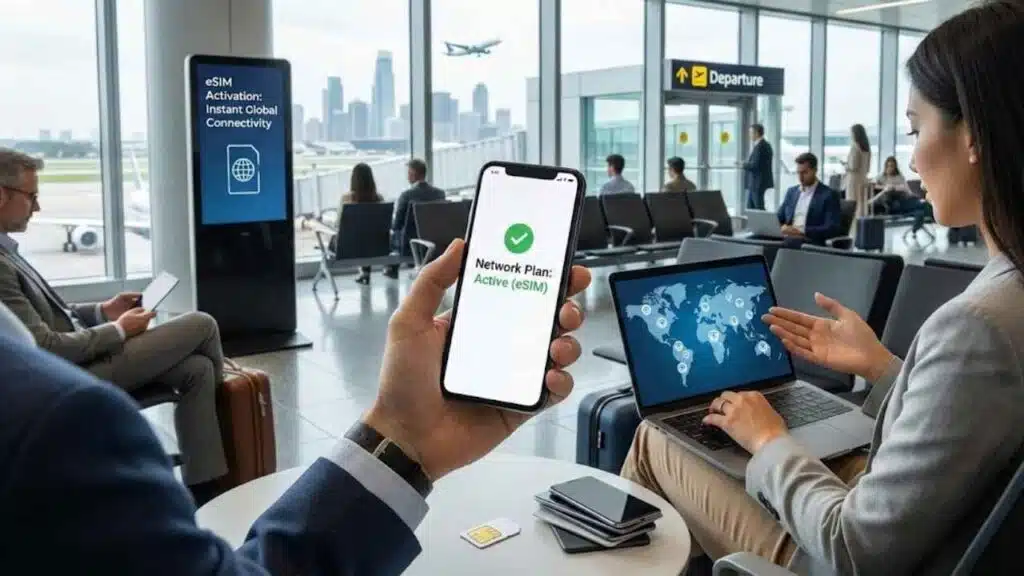
eSIM technology simplifies how devices connect to networks. Users can activate plans digitally without physical SIM cards. This flexibility benefits travelers, remote workers, and people managing multiple lines. Switching providers becomes faster and more convenient. For businesses, eSIM enables easier device provisioning and centralized management. Security measures are improving, but SIM swap risks still require strong safeguards. As physical SIM slots disappear, eSIM is becoming the standard entry point for mobile communication.
Key Points
| Aspect | Explanation |
| Main Benefit | Instant connectivity |
| User Impact | Easy switching |
| Business Impact | Scalable deployment |
| Challenges | Security controls |
8. 5G-Advanced Improves Real-World Communication Quality
5G evolution focuses on real-world performance rather than headline speeds. Improved uplink, lower latency, and better stability enhance communication experiences. Video calls become smoother, especially in crowded environments. Live streaming and content sharing benefit from stronger uplink capacity. Network efficiency improvements allow more devices to connect reliably at once. Users may not notice the term “5G-Advanced,” but they will notice fewer drops and clearer calls. Coverage consistency and device compatibility influence the pace of benefits.
Key Points
| Aspect | Explanation |
| Main Benefit | More stable connections |
| User Impact | Better video calls |
| Business Impact | Reliable collaboration |
| Challenges | Coverage rollout |
9. 6G Planning Starts Influencing Today
Although 6G is years away, early planning is already shaping investment and research priorities. Future networks are expected to integrate sensing, AI-native design, and new spectrum approaches. For users, this groundwork influences device capabilities and long-term connectivity costs. Businesses benefit from early visibility into future opportunities and constraints. Policy, governance, and ethical considerations are becoming part of early design discussions.
Key Points
| Aspect | Explanation |
| Main Benefit | Long-term innovation |
| User Impact | Future-ready devices |
| Business Impact | Strategic planning |
| Challenges | Uncertainty |
10. Identity, Verification, and Anti-Fraud Become Core Features
Scams and impersonation attacks are rising across messaging and calling channels. Strong identity verification is now essential. Verified sender systems help users recognize legitimate businesses. Advanced filtering reduces spam and fraudulent messages. Authentication methods are evolving beyond SMS codes toward more secure approaches. Users benefit from fewer scams and clearer trust signals. Businesses benefit from reduced fraud-related losses. Education remains important to help users recognize suspicious behavior.
Key Points
| Aspect | Explanation |
| Main Benefit | Reduced fraud |
| User Impact | Higher confidence |
| Business Impact | Lower risk |
| Challenges | Adoption speed |
11. On-Device AI Enables Faster and More Private Communication
On-device AI processes data directly on the phone instead of the cloud. This reduces latency and improves privacy. Features include offline transcription, real-time translation, and smart reply suggestions. Local processing minimizes data exposure and improves responsiveness. Hardware efficiency and battery management play a critical role. This trend supports privacy-focused communication experiences.
Key Points
| Aspect | Explanation |
| Main Benefit | Privacy and speed |
| User Impact | Instant features |
| Business Impact | Secure workflows |
| Challenges | Hardware limits |
12. Regulation Shapes the Future of Mobile Communication
Technology does not operate in isolation. Laws and regulations influence security, privacy, and service availability. Governments are focusing on consumer protection, emergency access, and fraud prevention. Companies must balance innovation with compliance across regions. For users, regulation can improve safety but may also affect feature availability. Understanding this context helps explain why some features roll out unevenly.
Key Points
| Aspect | Explanation |
| Main Benefit | User protection |
| User Impact | Safer services |
| Business Impact | Compliance costs |
| Challenges | Regional differences |
Takeaways
Mobile communication trends show a clear direction. Communication is becoming richer, smarter, more secure, and more resilient. Phones now operate across multiple networks, use AI to enhance clarity, and rely on stronger identity systems to build trust.
For users, these changes mean fewer interruptions and better experiences. For businesses, they demand more thoughtful engagement strategies. Understanding mobile communication trends helps everyone prepare for a future where connection is constant, intelligent, and reliable.
FAQs
What Are the Biggest Mobile Communication Trends Right Now?
The biggest mobile communication trends include RCS growth, satellite-to-phone texting, eSIM expansion, AI-enhanced calling, and stronger anti-fraud identity systems.
Will RCS Replace SMS Completely?
Over time, RCS can reduce SMS usage for many users, but SMS will likely remain as a fallback for compatibility and basic delivery in some contexts. Apple’s iOS 18 RCS support increases momentum, but rollout consistency still varies.
Is Cross-Platform Messaging Finally Getting More Secure?
Security expectations are pushing default messaging toward stronger protections, but encryption and feature parity can vary by implementation. Watch for clearer transparency from platforms and carriers.
How Does Satellite Texting Work on a Normal Phone?
In direct-to-cell models, satellites connect using compatible cellular spectrum and enable basic messaging when you have no normal signal. Early services focus on text first, then expand features later.
Why Is eSIM Such a Big Deal for Communication?
eSIM makes it easier to add or switch plans quickly, which can reduce downtime and improve travel connectivity. GSMA reporting tracks broad momentum across the ecosystem.
What Should Businesses Use: SMS, WhatsApp, or RCS?
It depends on audience and region. SMS still has reach, WhatsApp has strong app-based penetration in many markets, and RCS can deliver richer interactions through default messaging when supported. A practical strategy is often a blended channel mix.