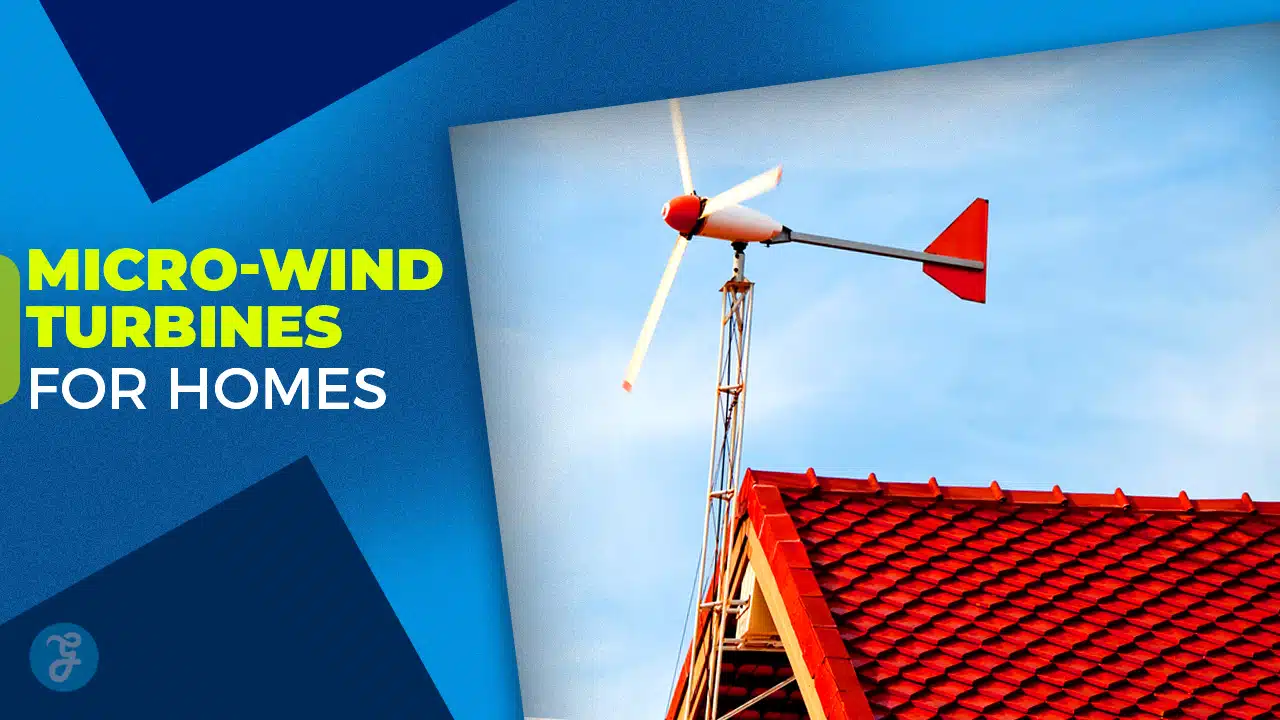
For 95% of urban homeowners, micro-wind turbines are not worth the investment compared to solar PV. The physics of wind energy heavily penalize the low, turbulent wind speeds found in cities. However, for a specific “edge case” of users, they can be a viable renewable energy source.
Micro-wind is potentially worth it if:
- You live in a “fetch-rich” environment: You are on a coast, a high ridgeline, or a rural-urban edge with zero obstacles (trees/buildings) for at least 500 feet in the prevailing wind direction.
- You can install a tall tower: You have the zoning permission and space to mount the turbine at least 30 feet above any nearby obstruction, not just on a roof.
- Your average wind speed exceeds 5 m/s (11 mph): You have verified this with an anemometer logging data for at least 3–6 months, not just looked at a regional weather map.
Micro-wind is likely NOT worth it if:
- You plan to mount it directly on a roof: Rooftops create a “bubble” of turbulent air that drastically cuts output and causes mechanical wear.
- You live in a dense suburb or city block: Nearby houses and trees create “surface roughness” that slows wind to unusable speeds (below 3–4 m/s).
- You want a quick payback: The Return on Investment (ROI) for urban wind is typically 15–20+ years, whereas solar is often 5–7 years.
- You have strict HOA or noise regulations: Turbines are moving parts that generate sound and vibration; strict zoning often bans them outright.
What Counts As a “Micro-Wind” Turbine (And How It Differs From Small Wind)
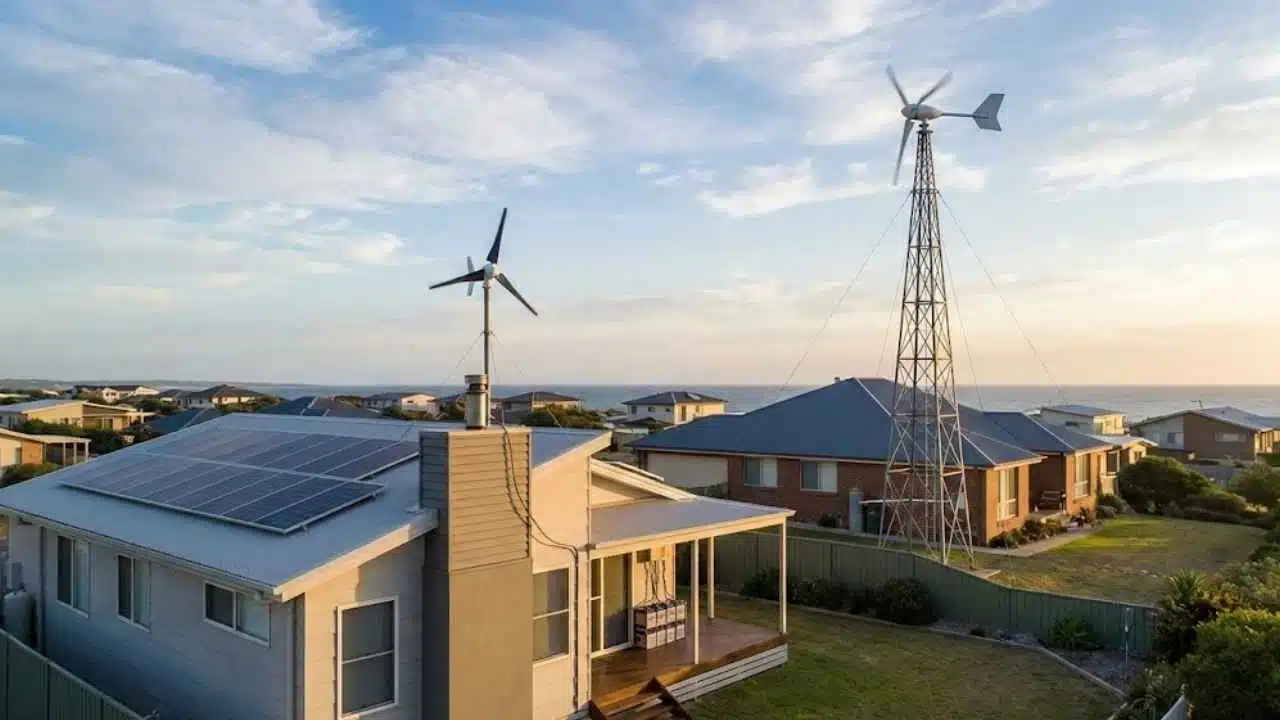
When shopping for home wind power, you will encounter a confusing mix of terms. Marketing materials often blur the lines, but in engineering terms, “micro” and “small” wind refer to distinct categories with vastly different capabilities.
Micro vs Small Wind Definitions (Practical Ranges)
The distinction largely comes down to swept area (the circle the blades spin in) and rated power output.
- Micro-Wind Turbines: These typically have a rated capacity of 50 watts up to 1 kilowatt (kW). The rotor diameter is usually under 2 meters (6.5 feet). These units are lightweight, often available in “kits” online, and are designed for battery charging (12V/24V/48V banks) rather than powering a whole home. They are common on sailboats, RVs, and remote sheds, but they rarely produce enough amperage to run standard household appliances directly.
- Small Wind Turbines: These range from 1 kW to 100 kW, though residential units usually top out at 10–20 kW. A 5 kW turbine—a common size for a home—might have a rotor diameter of 5–6 meters (16–20 feet). These are serious infrastructure projects requiring concrete foundations, professional installation, and grid-tie inverters. They are capable of offsetting a significant portion (50–90%) of a typical home’s energy bill in the right conditions.
Key Components (Rotor, Generator, Controller, Inverter, Tower/Mount)
Regardless of size, every system relies on five critical components working in harmony:
- The Rotor: The blades and the hub. This is the “engine” that captures kinetic energy. In micro-wind, blades are often carbon fiber or molded plastic.
- The Generator: Usually a permanent magnet alternator located in the nacelle (body). It converts rotational energy into “wild” AC electricity (varying voltage and frequency).
- The Controller: A vital safety device that regulates the voltage sent to the batteries and prevents the turbine from over-spinning in storms by activating “dump loads” or brakes.
- The Inverter: For grid-tied homes, you need a wind-specific inverter (different from solar inverters) to rectify the wild AC to DC, and then invert it to clean 120V/240V AC synchronized with the utility grid.
- The Tower/Mount: Often the most expensive part. It must be rigid enough to withstand vibration but tall enough to reach “laminar” (smooth) air.
The Urban Reality: Wind In Cities Isn’t Like Wind In Open Fields
The biggest mistake homeowners make is assuming that because it feels windy on their front porch, a turbine will generate power. Urban environments murder wind energy potential through two physical phenomena: shear and turbulence.
Why Buildings Create Turbulence (And Why Turbulence Hurts Output)
Wind flows like water. When it hits an obstacle—like your neighbor’s house, a tree, or an office block—it doesn’t just stop; it tumbles. This tumbling air is called turbulence.
For a wind turbine, turbulence is poison.
- Reduced Energy: Turbulent air creates chaotic vectors. Instead of hitting the blade at the perfect aerodynamic angle to generate lift, the wind hits from random sides. This dramatically lowers the efficiency of the rotor.
- Mechanical Stress: Turbulence causes “hunting.” A horizontal turbine will constantly yaw left and right, trying to find the wind direction. This constant movement wears out the main bearings and the yaw bearings prematurely, leading to failures in 2–5 years rather than the rated 20.
In an open field, wind flows in smooth “laminar” layers. In a city, the air within 30–50 feet of the ground is a chopped-up mix of eddies and swirls, holding very little harvestable energy.
Rooftop Installations: Common Pitfalls
Mounting a turbine on your roof seems logical—it’s the highest point you own, and it saves buying a tower. However, this is almost always a bad idea for three reasons:
- The Roof Bubble Effect: When wind hits the side of your house, it is forced upward, compressing over the roofline. While this speeds up the wind slightly (the Venturi effect), it creates a zone of intense turbulence immediately above the shingles. Unless the turbine is on a pole 15–20 feet above the roofline, it sits right in this “dirty” air.
- Structural Vibration: A spinning turbine creates vibrations and low-frequency resonance. If bolted to your roof joists, your entire house acts as a speaker cabinet. The hum can be audible inside bedrooms and living areas, becoming a major nuisance.
- Leak Risks: The constant torque and vibration can loosen roof penetrations over time, compromising your waterproofing and voiding roof warranties.
The “Height Problem”: Why Towers Often Beat Roof Mounts
Wind speed increases drastically with height due to “wind shear.” The ground creates friction that slows the air.
- At 10 feet: Wind might be 3 m/s.
- At 30 feet: Wind might be 4.5 m/s.
- At 60 feet: Wind might be 6 m/s.
Because power output is cubic (explained below), that jump from 3 m/s to 6 m/s doesn’t just double your power—it increases it by nearly eight times. A freestanding tower, while expensive and ugly to some, is the only way to get the turbine up into the smooth, fast air it needs to justify its cost. In the city, zoning rarely allows towers tall enough to escape the “urban boundary layer.”
How Much Power Can You Actually Expect In An Urban Home?
This is where marketing brochures often clash with reality. Understanding the math of wind power will save you from expensive disappointment.
Rated Power vs Real Output (Why Marketing Misleads)
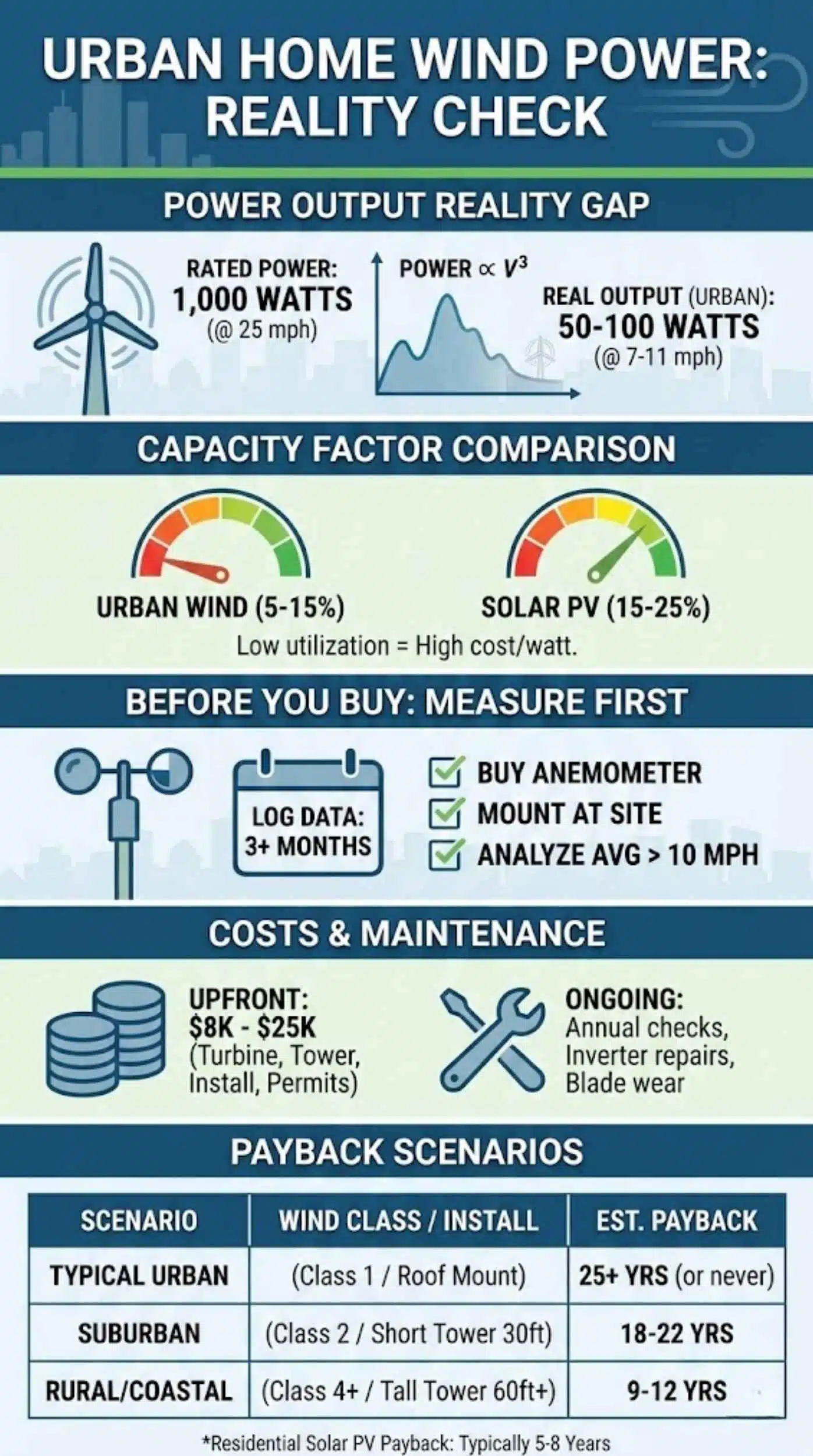
- Manufacturers label turbines by their Rated Power, for example, “1,000 Watts.” However, you must check at what wind speed it achieves that power.
- Most turbines are rated at 11 m/s (25 mph) or 12 m/s (27 mph).
- Ask yourself: How often does the wind blow at 25 mph at your house?
- In most urban areas, the average wind speed is 3–5 m/s (7–11 mph).
- Due to the physics of wind, at 5 m/s, a “1,000 Watt” turbine might only produce 50 to 100 Watts.
- The Physics: Power is proportional to the cube of wind speed ($V^3$).
- If you cut wind speed in half, you get only 1/8th of the power.
Capacity Factor Explained (Simple, Non-Technical)
Capacity Factor (CF) is a percentage that tells you how much energy you get compared to what the machine could do if it ran at full power 24/7.
- Ideally sited wind farm: 30–45% CF.
- Typical Solar Panel: 15–25% CF.
- Urban Micro-Wind: Often 5–15% CF.
If you buy a 1 kW turbine, don’t expect 24 kWh a day. In a city, you might be lucky to average 1–2 kWh a day. This low “utilization rate” is why the cost-per-watt of urban wind is so high compared to solar.
What You Need To Measure Before Buying (Wind Speed + Exposure)
Never buy a turbine based on a “feeling” that it is windy.
- Buy an Anemometer: A simple logging anemometer costs $50–$150.
- Mount it: Place it exactly where you plan to put the turbine (not on the ground).
- Log Data: Record for at least 3 months (ideally a year).
- Analyze: If your average wind speed isn’t consistently above 4.5 m/s (10 mph), a turbine will likely never pay for itself.
Cost, Maintenance, And Payback: The “Worth It” Math
Wind energy economies of scale work in reverse for residential setups: the smaller the system, the more expensive the electricity it produces per kilowatt-hour.
Upfront Costs: Turbine + Mounting + Electrical + Permits
The sticker price of the turbine is just the beginning. A “cheap” $800 micro-turbine from Amazon is often just the generator and blades. A complete, code-compliant installation includes:
- Turbine Unit (Qualitative): $1,500 – $4,000 (for a reputable 1–2 kW machine).
- Tower/Mounting: $2,000 – $10,000 (depending on height and guy wires vs. monopole).
- Inverter/Controller: $1,000 – $3,000.
- Installation Labor: $3,000 – $8,000 (requires specialized electrical and rigging work).
- Permitting/Engineering: $500 – $2,500.
Total Project Cost for a 1–2 kW system: Typically $8,000 – $25,000.
Ongoing Costs: Maintenance, Repairs, Lifespan Expectations
Unlike solar panels, which sit still, wind turbines are dynamic machines under constant stress.
- Annual Maintenance: Visual inspection of blades, tightening bolts, checking guy wire tension.
- Repairs: Inverters often fail after 10 years ($2k replacement). Blades can pit or crack from debris/hail. Bearings eventually wear out.
- Lifespan: A high-quality turbine might last 20 years, but cheap imports often fail catastrophically in high winds within 3–5 years.
Incentives & Credits (What To Check Locally)
In the US, the Federal Investment Tax Credit (ITC) applies to small wind turbines (currently 30% until 2032). This significantly changes the math.
- Example: A $20,000 system becomes $14,000 after the tax credit.
- Check for local “feed-in tariffs” or state rebates, though many utilities have dropped wind incentives in favor of solar.
Payback Scenarios: Best Case vs Typical Urban Case
| Scenario | Wind Class | Install Type | Capacity Factor | Est. Payback Period |
| Typical Urban | Class 1 (Low) | Roof Mount | 5–8% | 25+ Years (or never) |
| Suburban | Class 2 (Med) | Short Tower (30ft) | 10–12% | 18–22 Years |
| Rural/Coastal | Class 4+ (High) | Tall Tower (60ft+) | 25–30% | 9–12 Years |
Note: For comparison, residential Solar PV payback is typically 5–8 years.
Permits, Zoning, Noise, And HOA: The Make-Or-Break Factors
Before you spend a dime, you must tackle the “red tape.” In cities, this is often the hardest part of the project.
Common Restrictions (Height, Setbacks, Safety, Aesthetics)
- Height Restrictions: Most residential zones cap structure height at 35 or 40 feet. Since a functional wind turbine usually needs a 60-foot tower to work well, you will likely need a Variance—a special exception from the zoning board. These are hard to get.
- Setbacks: Zoning often requires a “fall zone.” If your tower is 60 feet tall, the city may require it to be set back 60 feet (or 1.1x height) from all property lines. On a standard urban lot (e.g., 50×100), this is mathematically impossible.
- Aesthetics: Many neighbors view turbines as “industrial eyesores.” Expect opposition at public hearings.
Noise & Vibration: What Homeowners Worry About
Modern micro-turbines are quieter than older models, but they are not silent.
- Aerodynamic Swish: The sound of blades cutting air. It increases with wind speed.
- Mechanical Hum: Gearbox or generator whine.
- The Decibel Rule: Most cities limit noise at the property line to 45–55 dB. A turbine might be 50 dB at the hub. If your neighbor’s window is 20 feet away, you might violate the noise ordinance on windy nights.
Paperwork Checklist: What To Ask Your City/Installer
- HOA Rules: If you have a Homeowners Association, check the bylaws first. They often ban “external structures” or “rotating devices” explicitly.
- Building Permit: Required for the foundation and electrical tie-in.
- Interconnection Agreement: If grid-tied, your utility must approve the equipment (UL 1741 certification usually required).
Choosing The Right Type: Vertical Axis vs Horizontal Axis For Cities
You will see two main shapes of turbines. Which one is better is a subject of intense debate, but the data is fairly clear.
VAWT: Where It Helps (Directional Wind, Tight Spaces) — And Limits
Vertical Axis Wind Turbines (VAWTs) look like eggbeaters or helical screws.
- Pros: They are “omnidirectional”—they don’t need to yaw into the wind, so they handle turbulence slightly better. They are generally quieter and more aesthetically pleasing (often called “sculptural”).
- Cons: They are inherently less efficient (lower Cp) than horizontal types because half the rotor is always moving against the wind (drag). Many cheap VAWTs have trouble “self-starting” and need a motor to get spinning.
- The Verdict: VAWTs are the only option that makes sense for rooftop mounting due to lower vibration, but their power output is usually disappointing per dollar spent.
HAWT: Efficiency Upside — And Why It Often Needs Better Siting
Horizontal Axis Wind Turbines (HAWTs) look like miniature airplane propellers.
- Pros: High efficiency. The physics of lift allow them to extract more energy from the wind for the same swept area.
- Cons: They need smooth, laminar wind. In turbulence, they suffer from fatigue and reduced output. They are louder and require a tall tail vane to track the wind.
- The Verdict: HAWTs are the superior technology for energy production, but only if you can put them on a tall tower in clean air.
Certification & Safety: What To Look For Before You Buy
Beware of cheap imports on eBay/AliExpress claiming “2000W” for $400. These often have no over-speed protection and can disintegrate in a storm.
Look for Small Wind Certification Council (SWCC) or ICC-SRCC certification. This ensures the turbine’s power curve and sound levels have been independently verified.
Installation Options For Urban Homes (And Which Ones Usually Work Best)
Roof Mount vs Pole/Tower Mount
- Roof Mount: Generally discouraged. If you must, mount on a reinforced gable end, not the mid-span of a roof truss. Use rubber isolation pads to dampen vibration.
- Tilt-Up Tower: The gold standard for residential wind. These towers are hinged at the base, allowing you to lower the turbine to the ground for maintenance (or before a hurricane) using a winch. This is safer and cheaper than hiring a crane or climbing a tower.
Grid-Tied vs Off-Grid / Battery Hybrid
- Grid-Tied: The turbine pushes power into your home’s breaker panel. If you generate more than you use, it flows to the grid (Net Metering). This is the most efficient use of power but requires expensive utility-approved inverters.
- Off-Grid/Battery: The turbine charges a battery bank (e.g., for a garage, shed, or emergency backup). This is easier to permit because it doesn’t touch the utility grid. It’s a great way to dip your toe into wind power without a $20k commitment.
Pairing Wind + Solar: The “Hybrid” Case
This is the strongest argument for urban wind. Solar is dead in winter and at night. Wind is often strongest in winter and at night.
- A “Hybrid Controller” can accept input from both PV panels and a wind turbine to charge a shared battery bank.
- The wind turbine acts as a “trickle charger” during the dark, cloudy months, keeping batteries healthy when solar struggles.
A Practical “Should You Buy?” Checklist (Decision Framework)
Use this “Gate” system. If you fail a gate, stop—micro-wind is likely not for you.
Gate 1: The Resource Gate
- Do you have an average annual wind speed > 4.5 m/s (10 mph)?
- Have you verified this with on-site logging (not just a weather app)?
Gate 2: The Zoning Gate
- Does your zoning allow a tower height of at least 40+ feet?
- Can you meet the “fall zone” setback requirements (distance from property lines)?
- Is your property free of strict HOA restrictions on external structures?
Gate 3: The Obstruction Gate
- Is the proposed site free of trees/buildings within a 300-foot radius?
- Or, can you mount the turbine 30 feet higher than the tallest nearby obstacle?
Gate 4: The Budget Gate
- Are you comfortable with a payback period of 15+ years?
- Is your goal “energy independence/hobby” rather than “maximum financial return”?
Gate 5: The Installer Gate
- Can you find a local installer with experience (or are you a highly skilled DIYer with electrical/rigging knowledge)?
- Is the turbine SWCC certified?
Result:
- Passed all 5? You are a prime candidate for micro-wind.
- Failed one? Proceed with extreme caution.
- Failed two or more? Invest in Solar PV or insulation instead.
Realistic Use Cases (Where Micro-Wind Makes Sense In/Near Cities)
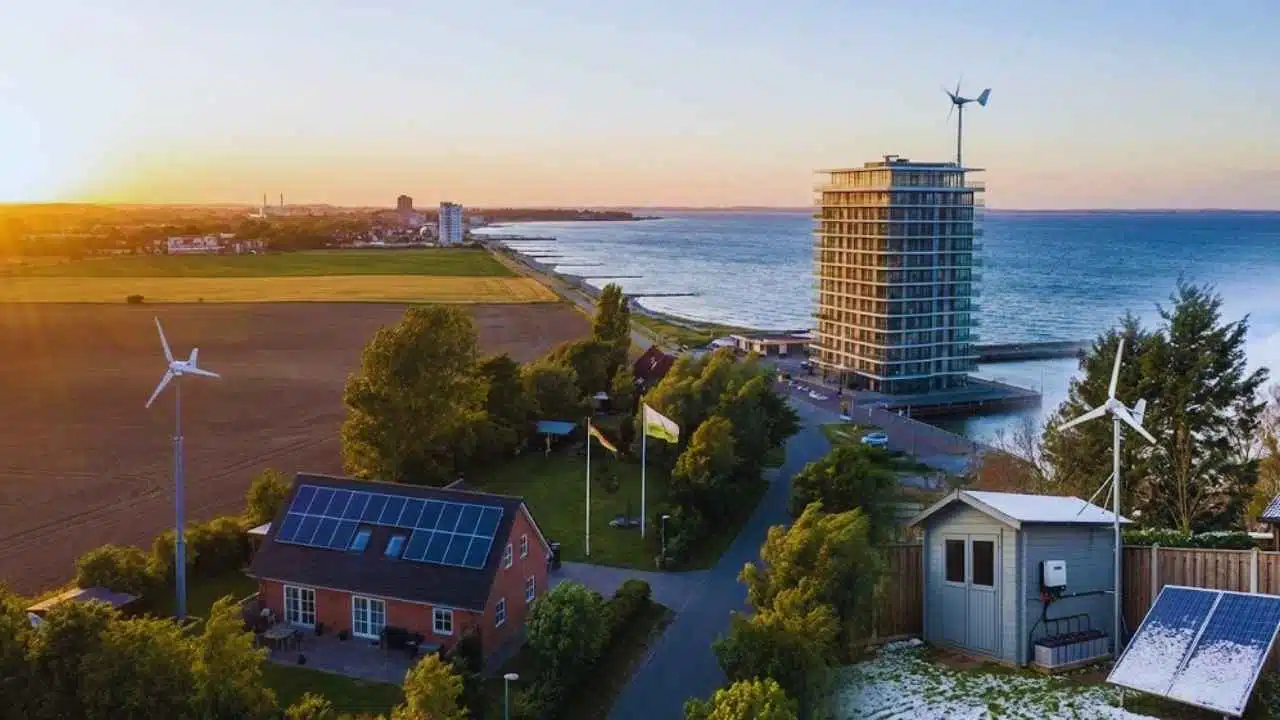
While the “average” suburban home is a poor fit, several specific scenarios allow micro-wind to shine.
Coastal/High-Rise Edge Zones (Better Exposure)
Homes located directly on a waterfront (ocean or large lake) often have smooth, laminar wind coming off the water. A turbine mounted on the water-facing side can perform exceptionally well. Similarly, the roof of a very tall high-rise (20+ stories) may sit above the urban turbulence layer, though structural engineering for the mount becomes critical.
Peri-Urban Homes With Clear Fetch
If you live on the edge of town (“peri-urban”) with open farmland or desert on the side of the prevailing wind, you have “fetch”—distance for the wind to smooth out. Even if you are technically in a city zip code, your wind resource acts rural.
Non-Primary Goals: Backup charging, sheds, low loads
If your goal isn’t “lower my electric bill” but rather “keep my backup batteries charged during a winter blackout,” micro-wind is excellent. A small 400W turbine can keep a fridge and lights running during a storm when solar panels are covered in snow or clouds. This is an investment in resilience, not ROI.
Final Verdict
For the vast majority of urban homeowners, micro-wind turbines are an expensive hobby rather than a sound financial investment. The physics of turbulence and the low cost of solar panels make PV the superior choice for city dwellers.
However, if you have the land, the wind, and the zoning permission, a wind turbine adds a powerful layer of diversity to your energy system, generating power exactly when solar sleeps.