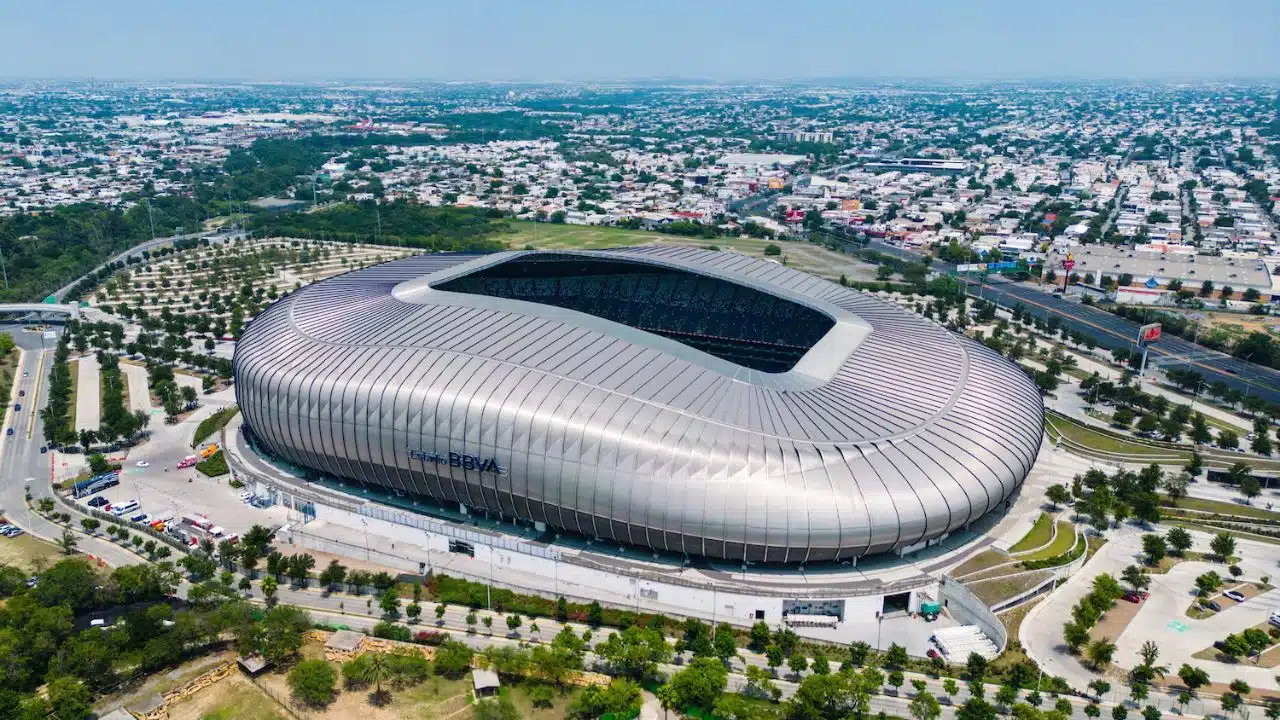
Mexican President Claudia Sheinbaum officially confirmed Monday that all federal infrastructure projects for the 2026 FIFA World Cup are on schedule. The announcement, targeting key transport and airport upgrades, aims to reassure FIFA and fans. However, the declaration comes as the separate, privately-funded, and historically vital renovation of the Estadio Azteca enters its final, high-pressure months amid reports of potential delays and lingering labor disputes.
Key Facts & Quick Take
- Official Confirmation: President Claudia Sheinbaum stated on November 10, 2025, that federal infrastructure projects for the World Cup “will be completed in time.”
- Federal Investment: The government is investing 9 billion pesos (approx. $489 million USD) into renovating Mexico City’s International Airport (AICM) and finishing a new train line to the Felipe Ángeles Airport (AIFA).
- Economic Impact: The Mexican Football Federation projects the 13 World Cup matches hosted in the country will generate over $3 billion USD in economic gains and create ~24,000 jobs.
- Tourism Surge: The federal government anticipates an influx of 5.5 million additional visitors across the three host cities (Mexico City, Guadalajara, Monterrey) during the tournament.
- Azteca Timeline: The iconic Estadio Azteca, a private project, is undergoing an intense, large-scale renovation. While authorities insist it will be ready, reports in early November cited “potential delays” for stands and VIP areas, with a hard deadline in Q1 2026.
- Labor Concerns: Earlier this year, the Building and Wood Workers’ International (BWI) union accused FIFA of blocking a labor inspection at the Azteca, raising concerns about worker scrutiny that remain unresolved.
The Presidential Assurance: A Focus on Transport
With just seven months until the opening kick-off, Mexico confirms World Cup infrastructure readiness, at least at the federal level. In her daily press conference on Monday, President Claudia Sheinbaum projected unwavering confidence, shifting the focus to the critical transport infrastructure required to manage the massive influx of fans.
“This is not only a time to see the best soccer but also a time to share with the world who we are, Mexico is not only a country of immense cultural richness but also a country experiencing a historic moment.”
The President’s core message was backed by hard numbers, specifically aimed at solving the logistical bottlenecks of the nation’s capital:
- Mexico City International Airport (AICM): A 9 billion peso ($489 million) investment is underway to renovate both terminals at the aging, but centrally located, primary airport.
- Felipe Ángeles Airport (AIFA) Link: Sheinbaum confirmed the completion of the new train line connecting Mexico City’s hotel zones to the newer, but more distant, AIFA, which will be crucial for dispersing international arrivals.
Details on parallel federal projects in the other host cities, Monterrey and Guadalajara, were promised “in the coming weeks,” though city-level projects are already well underway. The Mexico City government, for instance, separately secured a MX$4 billion (approx. $217 million) loan from BBVA Mexico specifically for “urban infrastructure to promote tourism” ahead of the event
A Tale of Three Stadiums: The Private-Led Race
While the President’s update secured the public-facing transport narrative, she notably sidestepped details on the stadiums, stating the Estadio Azteca’s renovation is being handled by its private owners. This is where the true drama of Mexico’s preparation lies.
Mexico will host 13 of the tournament’s 104 matches, spread across three venues. The modern stadiums in Guadalajara and Monterrey require only technological upgrades, but the historic Azteca in Mexico City—set to be the first stadium ever to host three World Cup opening matches—is being rebuilt from the inside out.
Estadio Azteca (Mexico City): The $100M Crown Jewel
The “Coloso de Santa Úrsula” is in the “most intense phase” of a renovation reportedly budgeted at over $100 million USD
- New Roof: A new, sleek metal-and-glass roof ring is being installed.
- Hybrid Pitch: The old pitch has been replaced with a state-of-the-art hybrid grass system with superior drainage and ventilation.
- Tech Overhaul: The stadium is being fitted with over 23,000 square feet of LED screens, Wi-Fi 6, and new smart energy systems.
- Fan Experience: All old seating is being replaced with modern, ergonomic seats, bringing the capacity to approximately 90,000.
The deadline is non-negotiable. City officials have stated surrounding urban renewal projects must be done in Q1 2026. To showcase its readiness, the stadium’s operators have reportedly scheduled a grand reopening in March 2026 with a high-profile friendly between Mexico and Portugal, theoretically featuring Cristiano Ronaldo
Estadio Akron (Guadalajara) & Estadio BBVA (Monterrey)
Preparations at the other two venues are far less dramatic. Both are modern marvels, home to Chivas and Rayados, respectively. Their upgrades are primarily technological.
- Estadio Akron (4 matches): Upgrades include a new playing surface, enhanced viewing screens, and improved lighting and sound systems
- Estadio BBVA (4 matches): The “Steel Giant” is receiving a new, state-of-the-art LED lighting system from Musco Lighting. This system not only meets FIFA’s strict broadcast standards but will reduce energy consumption by over 40%
The Investigative Angle: Timelines, Labor, and Armored Cars
Despite the government’s confident assertions, significant challenges remain, particularly around the Azteca.
First is the timeline. While the March 2026 friendly provides a public deadline, reports from StadiumDB.com in early November noted “potential delays” in the complex renovation of the stands and VIP areas, suggesting “some works may extend beyond initial deadlines.” Local authorities insist the stadium and surrounding “Play Fair, Walk Fair” urban projects—which include repaving and widening sidewalks from transit hubs to the stadium—will be completed on time.
Second, a serious labor dispute from earlier this year hangs over the project. In March 2025, the Building and Wood Workers’ International (BWI), a global union, delivered a scathing accusation that FIFA had actively “blocked a labour inspection” at the Azteca. The BWI argued at the time that there was “virtually no scrutiny of labour rights at Mexico’s World Cup sites” . While construction has proceeded, these concerns over worker welfare and oversight have not been publicly resolved.
Finally, there is the issue of security. While officials are coordinating a massive security operation, the market tells its own story. A WION news report from October 2025 highlighted a “sharp increase in demand for armoured vehicles” in Mexico, noting that “Mexican armouring factories are working overtime” to service wealthy international visitors and VIPs preparing for the World Cup.
What to Watch Next
For observers, the next few months are critical. The first major test will be the “Play Fair, Walk Fair” urban infrastructure projects in Mexico City, all slated for a Q1 2026 completion. The second, and more visible, test will be the planned March 2026 reopening of the Estadio Azteca. If that friendly match kicks off as scheduled, President Sheinbaum’s confidence will have been vindicated. If it is delayed, the final sprint to the World Cup will become a frantic race against time.