A figure circulating online has captured the imagination of aspiring tech professionals: up to $290,000 a year for Meta entry-level jobs with little prior experience. An investigation by this publication confirms the number is plausible, but the reality is far more nuanced than a golden ticket for every new graduate, revealing a fierce, strategic battle for a very specific type of elite talent.
Quick Take: Key Facts
- Total Compensation, Not Salary: The widely cited ‘$290,000’ figure is not a base salary. It represents a Total Compensation (TC) package, which includes a base salary, stock grants (RSUs), and potential performance bonuses.
- The “Experience” Myth: “Little experience” does not mean no skills. These roles are targeted at top-tier university graduates, typically with Computer Science degrees, multiple internships, and a portfolio of complex projects.
- Location is Everything: The highest packages are concentrated in high-cost-of-living areas like the San Francisco Bay Area and New York. Compensation for similar roles in other locations is significantly lower.
- Targeted Roles: The most lucrative offers are for highly sought-after technical positions, such as Software Engineer (SWE) and, specifically, those in the Rotational Engineering Program.
- Market Context: Despite recent tech industry layoffs, the competition for the top 1% of engineering talent remains incredibly fierce, pushing compensation for this elite group to record highs.
A Gilded Cage in a Volatile Market
The global tech industry has been on a rollercoaster since 2022, with widespread layoffs casting a shadow over the once-unshakeable promise of stable, high-paying careers. Companies like Meta, Google, and Amazon have trimmed their workforces significantly in a push for what CEO Mark Zuckerberg has termed a “year of efficiency.
Yet, paradoxically, at the entry-level for elite talent, the salary war has not abated. Companies recognize that their long-term innovation pipeline depends on acquiring the brightest new minds from universities like Stanford, MIT, and Carnegie Mellon. This has created a bifurcated market: leaner mid-career ranks but hyper-competitive, top-dollar offers for the next generation of potential “10x engineers”—engineers who are considered as productive as 10 others.
The viral claims of near-$300,000 packages for new graduates fit squarely into this strategy. It’s a powerful marketing tool for Meta’s recruitment arm, designed to attract the best and brightest away from rivals like Google, Apple, and burgeoning AI startups.
What Happened: Deconstructing the $290,000 Offer
The eye-watering compensation figures are not pulled from thin air. They are derived from data aggregated on salary transparency platforms and corroborated by industry reports. However, understanding the components is crucial.
The Anatomy of a Top-Tier Tech Offer
An offer package approaching $290,000 for an entry-level Software Engineer (Level E3 at Meta) in the Bay Area typically breaks down as follows for the first year:
- Base Salary: This is the guaranteed, take-home pay before taxes. For an E3 engineer, this generally falls between $135,000 and $155,000.
- Stock Grants (RSUs): This forms the largest variable component. A new hire might receive a grant of $150,000 to $200,000 in Restricted Stock Units. Crucially, these do not vest all at once. They typically vest over four years, meaning the engineer receives 25% of the total grant value each year. So, a $160,000 grant adds $40,000 to the annual compensation.
- Sign-On Bonus: A one-time cash bonus to entice the candidate, which can range from $25,000 to $75,000. While this inflates the first-year earnings significantly, it is not recurring.
- Annual Performance Bonus: A target bonus based on individual and company performance, typically 10% to 15% of the base salary. This could add another $15,000 to $22,000.
Calculation Example (High-End First Year):
- Base Salary: $150,000
- Annualized Stocks (25% of a $180,000 grant): $45,000
- Performance Bonus (15% target): $22,500
- Sign-On Bonus (one-time): $70,000
- First-Year Total Compensation: $287,500
This calculation shows how the $290,000 figure is achieved, but highlights that the recurring annual compensation after the first year (without the sign-on bonus) would be closer to $217,500, which is still a substantial sum.
Latest Data and Statistics
To verify these figures, we analyzed publicly available, crowdsourced data alongside official reports.
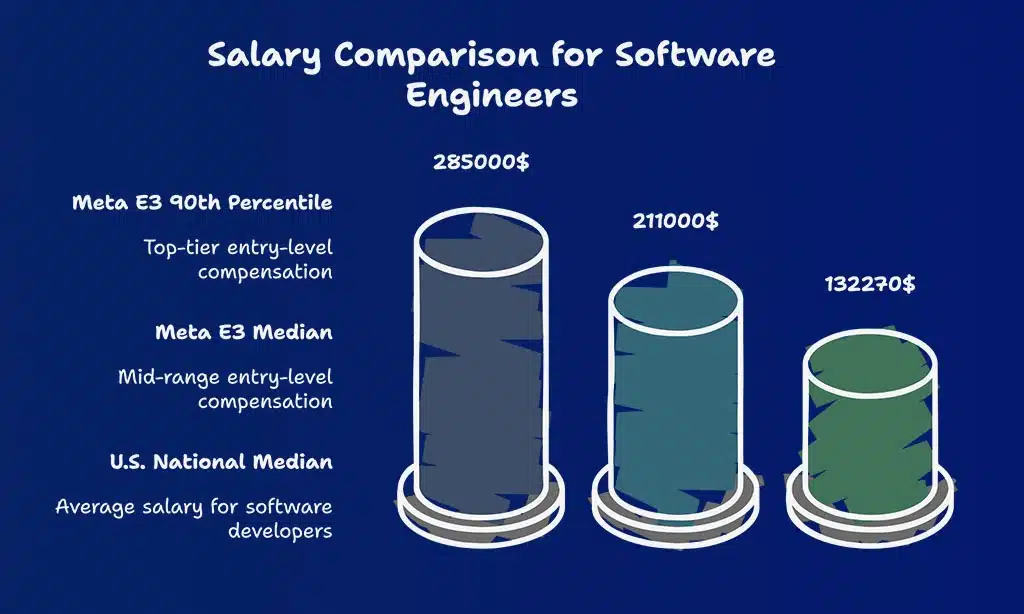
- Levels.fyi Data (as of October 2025): The salary transparency site, which aggregates verified offer letters, shows that the 90th percentile for Total Compensation for a Meta E3 Software Engineer in the San Francisco Bay Area is $285,000 for the first year. The median is a more modest $211,000. This demonstrates that the highest figures are outliers, reserved for the most in-demand candidates.
- U.S. National Average Context: The U.S. Bureau of Labor Statistics (BLS) reported the median annual wage for software developers was $132,270 in May 2024. Meta’s top-tier entry-level packages are more than double the national median for the profession as a whole.
Official Responses and Expert Analysis
Meta does not publicly comment on specific compensation bands. However, in a company-wide Q&A in June 2025, CEO Mark Zuckerberg addressed talent strategy, stating (paraphrased from internal meeting notes leaked to The Verge):
“We are focused on attracting and retaining the most talented people in the world to build the future of connection and the metaverse. This requires us to be competitive at every level, especially with the engineers who will create our next generation of products.”
This sentiment is echoed by industry experts. Dr. Anirban Dutta, a Computer Science professor at a leading engineering university in Bangladesh, commented via email: “The FAANG companies are in an arms race for AI and machine learning talent. A top graduate with proven skills in these areas from a top global university is seen as an asset worth millions in future value. The starting salary, while high, is a calculated investment for them. It’s not about years of experience; it’s about the scarcity of their specific, cutting-edge skill set.”
The Impact on People: The Grueling Path to an Offer
For students, the lure of these salaries has intensified the pressure to excel. One recent graduate who accepted an offer at a major tech firm shared their experience on the condition of anonymity on the professional network Blind:
“It wasn’t just about grades. I had three internships, contributed to two open-source projects, and practiced LeetCode [a coding practice website] for 300+ hours. The interview loop was five back-to-back technical rounds. The money is life-changing, but the burnout to get there is real.”
This anecdote underscores the reality: these are not jobs one simply applies for. They are the culmination of years of dedicated, highly-focused academic and practical work.
What to Watch Next
- AI Talent War: As competition in generative AI intensifies, expect to see even higher, more specialized packages for graduates with AI/ML research backgrounds. These roles may command an additional premium over standard software engineering roles.
- Geographic Dispersion: Watch if compensation in other tech hubs (like Austin, Seattle, or international offices) begins to catch up to Bay Area levels, or if the gap widens further.
- Stock Market Volatility: A significant portion of the total compensation is tied to Meta’s stock ($META). A downturn in the market could substantially reduce the actual take-home pay for these employees, making high base salaries more attractive.
The promise of a $290,000 entry-level job at Meta is not a myth, but it’s a reality reserved for a select few. It is a total compensation package for elite engineering graduates with highly specialized skills, interviewing for roles in one of the world’s most expensive regions. For the vast majority of graduates, the figures will be lower, though still substantial. The headline-grabbing number serves its purpose: it keeps Meta at the top of every brilliant young engineer’s dream company list, ensuring its talent pipeline remains filled with the best the world has to offer, no matter the cost.
The Information is Collected from MSN and Yahoo.