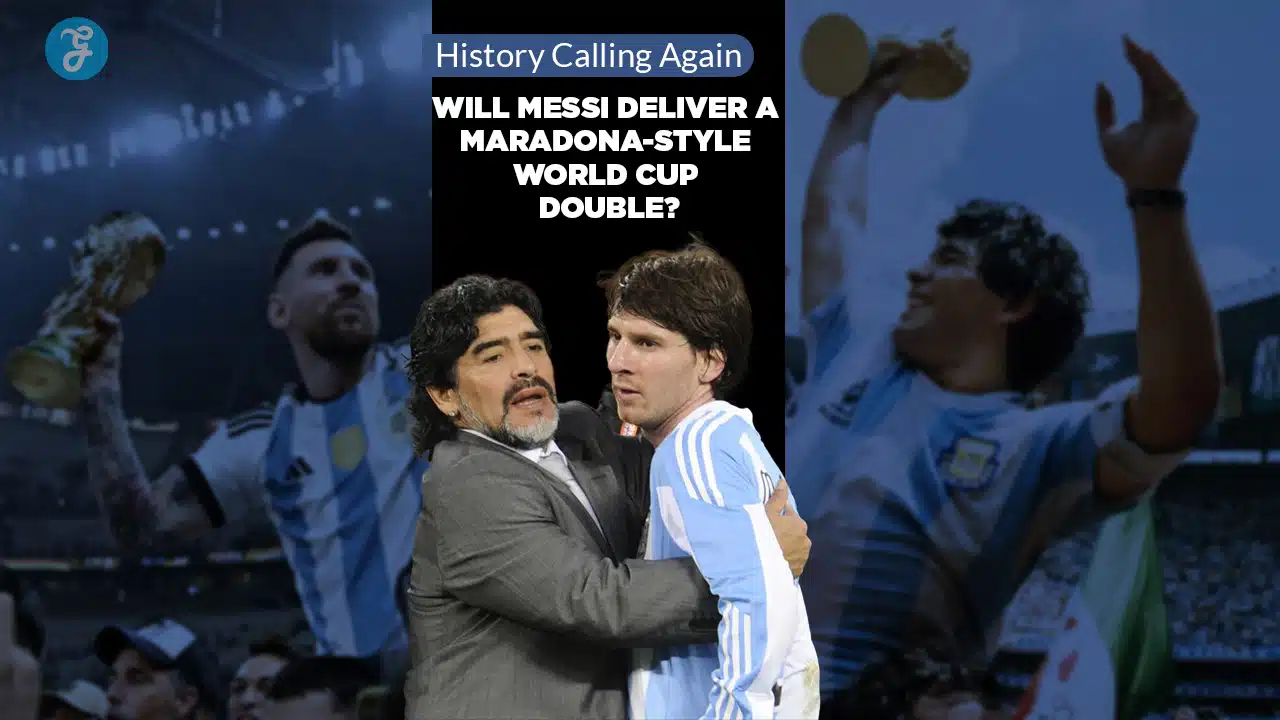
Lionel Messi lifting the World Cup in Qatar in 2022 felt like the closing scene of a football fairy tale. For many fans, it was the moment when Messi finally stepped into the same World Cup light as Diego Maradona in 1986. Now another question hangs over the game:
Can Messi deliver a Maradona-style World Cup double and lead Argentina deep into the 2026 World Cup?
A “double” can mean different things: back-to-back titles, two finals, or two legendary tournaments from the same superstar. Whatever definition you choose, it would be historic.
In this long, reader-friendly guide, we will:
- Look back at Maradona’s 1986 genius and Messi’s 2022 masterpiece
- Explain the new 2026 World Cup format
- Use real stats, records and widely reported data
- Evaluate Argentina’s squad and rivals
- Weigh the realistic chances of another Messi World Cup run
All information is based on reputable football sources such as FIFA, major sports outlets, and historical records.
From Mexico ’86 to Qatar 2022 – The Weight of Argentina’s Number 10
The number 10 shirt in Argentina is more than a jersey — it’s a symbol of hope, genius, and national identity. Two legends have carried that weight more than anyone else: Diego Maradona and Lionel Messi. Their World Cup stories span decades, yet they feel connected like chapters of the same book. To understand Messi’s chances of achieving a “double,” we must first explore the history behind the number 10.
Maradona’s World Cup Myth: More Than Just a Trophy
Diego Maradona didn’t just win the 1986 World Cup — he owned it. His performances were filled with drama, emotion, and unmatched brilliance. The tournament turned him into a global icon and transformed Argentina’s football identity forever. Understanding Maradona’s 1986 heroics reveals why fans still compare everyone, even Messi, to that unforgettable run.
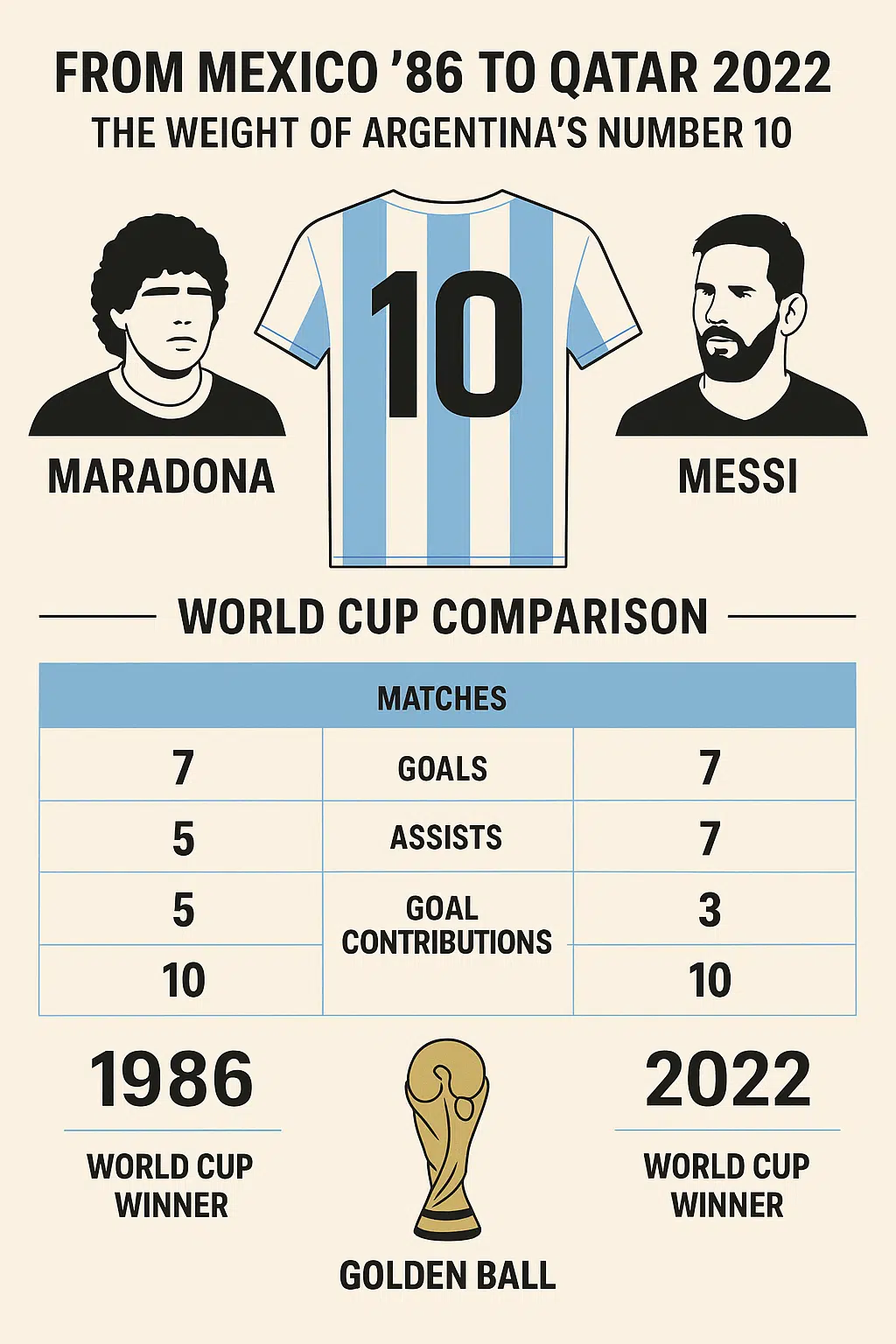
In Mexico 1986, Maradona produced one of the greatest individual World Cup campaigns in history. He scored 5 goals and provided 5 assists, directly contributing to 10 of Argentina’s 14 goals. He played every minute, carried the team creatively, and imposed his personality on every match.
At-a-Glance: Maradona at World Cup 1986
| Aspect | Details |
| Tournament | FIFA World Cup 1986 (Mexico) |
| Matches played | 7 |
| Minutes played | 630 (every minute) |
| Goals | 5 |
| Assists | 5 |
| Goal contributions | 10 (around 71% of Argentina’s total goals) |
| Famous moments | “Hand of God”, “Goal of the Century” vs England |
| Final | Argentina 3–2 West Germany |
| Main award | Golden Ball (Best Player of the Tournament) |
| Legacy impact | Elevated him to near-mythical status in Argentina and beyond |
Maradona became more than a footballer. He became a symbol of rebellion, pride, and street football genius. That emotional and cultural weight is still felt whenever another player, especially Messi, pulls on the Argentine number 10 shirt.
Messi’s Road to Glory in Qatar 2022
Lionel Messi’s journey in Qatar was a story of resilience, leadership, and pure football magic. After years of heartbreak in past tournaments, he finally found the ending fans dreamed of. Every match carried emotion, pressure, and expectation — and Messi delivered every time. His 2022 triumph is the foundation for today’s “double” conversation.
At the 2022 World Cup in Qatar, Messi scored 7 goals and provided 3 assists, matching Maradona’s 10 direct goal contributions in 1986. He guided Argentina from an early shock defeat to Saudi Arabia all the way to a dramatic final against France, decided on penalties after a 3–3 thriller.
He also set multiple records:
- Most World Cup appearances by a male player (26 matches)
- Most World Cup matches for Argentina
- Most World Cup goals for Argentina (13 goals across his career)
Messi at World Cup 2022: Match Impact
| Stage | Opponent | Messi’s Key Impact |
| Group vs Saudi | Saudi Arabia | 1 goal (penalty) |
| Group vs Mexico | Mexico | 1 crucial long-range goal |
| Group vs Poland | Poland | Missed penalty, but key in build-up play |
| Round of 16 | Australia | 1 goal |
| Quarter-final | Netherlands | 1 assist + 1 goal (penalty) |
| Semi-final | Croatia | 1 goal (penalty) + 1 assist |
| Final | France | 2 goals + scored in penalty shootout |
| Total | – | 7 goals, 3 assists, Golden Ball (Best Player) |
By the end of Qatar 2022, Messi had 13 World Cup goals and 8 World Cup assists across five tournaments (2006–2022). That places him among the most productive World Cup players ever and cemented his place at the top of the game.
Comparison: Maradona 1986 vs Messi 2022
| Category | Maradona (1986) | Messi (2022) |
| Matches | 7 | 7 |
| Goals | 5 | 7 |
| Assists | 5 | 3 |
| Goal contributions | 10 | 10 |
| Trophy | World Cup winner | World Cup winner |
| Main award | Golden Ball | Golden Ball |
| Era | 1980s, more physical football | Modern, tactical, data-driven era |
Both campaigns stand as legendary benchmarks. That is why the idea of Messi adding another iconic World Cup run — a “double” — is so fascinating.
What Does a “Maradona-Style World Cup Double” Really Mean?
When fans discuss Messi repeating Maradona, they imagine something rare and historic. The idea of a “double” can mean different things, from lifting back-to-back trophies to producing two legendary tournaments. But in football, language matters — and so do expectations. Before we predict the future, we need to define what this double actually is.
Defining the Double: Titles, Finals, or Pure Dominance?
A “double” is not always about trophies. Sometimes, it’s about influence, leadership, and performance on the biggest stage. Football legends are often defined by moments that go beyond medals. So the real question becomes: What kind of repeat performance would be enough for Messi to match or even surpass Maradona?
For Maradona, the “double” idea comes from his 1986 win and Argentina’s run to the 1990 World Cup final, where they lost to West Germany. He didn’t win twice, but he led his team to two straight finals and remained the central figure both times.
For Messi, a double could mean:
- Winning another World Cup (2022 and 2026)
- Reaching another final as the main leader
- Delivering another tournament where he clearly defines the story, even if Argentina fall short
Possible Meanings of a “World Cup Double” for Messi
| Type of Double | Description | Difficulty Level |
| Trophy double | Back-to-back World Cup wins (2022 & 2026) | Extremely high |
| Final double | Reaching two consecutive World Cup finals | Very high |
| Legendary performance double | Producing another iconic individual tournament | High but realistic |
Back-to-back World Cup titles are incredibly rare. Only Italy (1934–1938) and Brazil (1958–1962) have managed it, and that was in very different eras of football. That’s why even just reaching another final with Messi at the center would already feel historic.
Comparing Context: 1980s vs Modern Football
Football in the 1980s looked nothing like today’s high-intensity, analytics-driven game. The structure, style, pace, and preparation have all changed dramatically. Understanding these differences shows how unique Maradona’s 1986 success was — and how challenging a double would be for Messi in the modern era.
Back then, tactics were simpler, sports science was limited, and video analysis was basic. Today, teams use data on every movement, maintain strict fitness plans, and prepare in detail for specific opponents. The physical and mental demands on players at major tournaments are higher than ever.
World Cup Environment: 1986 vs Modern Era
| Aspect | 1986 World Cup Era | Modern World Cup Era |
| Tactical complexity | Simpler systems (e.g., 3–5–2, 4–4–2) | Hybrid, flexible, data-driven systems |
| Sports science | Limited | Advanced: GPS, nutrition, recovery protocols |
| Video analysis | Minimal, basic match replays | Detailed opposition analysis and analytics |
| Global parity | Strong top nations, clearer gap to others | More balance; more “smaller” nations competitive |
| Media pressure | TV and newspapers | 24/7 coverage, social media, online debate |
| Tournament size | 24 teams | 32 teams (1998–2022), 48 teams from 2026 |
Because of this, achieving a Maradona-style double now would mean surviving a longer, more demanding, and more heavily analyzed tournament environment.
Messi in 2026 – Age, Fitness, and Motivation
As Messi approaches the later years of his career, questions about his physical readiness naturally appear. Yet his talent has always been about more than speed or stamina. His leadership, intelligence, and creative vision remain unmatched. Analyzing his condition for 2026 helps us understand both the hope and the uncertainty ahead.
How Old Will Messi Be at the Next World Cup?
Age is one of the biggest unknowns in Messi’s 2026 journey. He will be among the oldest players at the tournament if he chooses to participate. But in football, age affects players differently based on style, training, and roles. Messi’s evolution makes this an interesting discussion rather than a simple barrier.
Messi was born on 24 June 1987. The 2026 World Cup is scheduled to take place in June and July 2026, meaning he will be 39 during the tournament. At that age, he would likely not be able to run at the same intensity, but his experience and game-reading could still be priceless.
Other players have performed well in major tournaments in their late 30s. Luka Modrić, Cristiano Ronaldo, and Miroslav Klose all played important roles for their national teams at advanced ages.
Age and Performance: Older Stars at Big Tournaments
| Player | Tournament & Year | Age | Role / Outcome |
| Luka Modrić | World Cup 2022 | 37 | Led Croatia to semi-finals |
| Cristiano Ronaldo | World Cup 2022 | 37 | Scored, played key minutes for Portugal |
| Miroslav Klose | World Cup 2014 | 36 | Impact sub, became all-time top scorer, champs |
| Andrés Iniesta | Euro 2016 | 32 | Creative leader, still influential |
| Lionel Messi | World Cup 2022 | 35 | Best Player, World Cup champion |
| Lionel Messi | Potential WC 2026 | 39 | Likely deep-lying playmaker if he plays |
So age is a challenge, but not an automatic stop sign. The key will be how Messi manages his fitness and how the coaching staff manages his minutes.
The Evolution of Messi’s Game: From Dribbler to Playmaking Brain
Messi’s playing style has transformed dramatically over the years. What began as explosive dribbling has matured into deep playmaking and strategic control. This evolution may allow him to stay effective longer than most forwards. Understanding this transition reveals why many experts still believe he can shine at 39.
In his early years at Barcelona, Messi beat defenders with speed and close control. Later, under Pep Guardiola, he became a false nine, combining goals and playmaking. In recent years, both for club and Argentina, he has operated more as a pure creator, dropping deeper to dictate tempo and find killer passes.
This shift means he no longer depends on raw pace. Instead, he relies on vision, timing, and technique — attributes that age far more gracefully.
How Messi’s Role Has Changed Over Time
| Career Phase | Typical Position | Main Strengths |
| Early Barcelona | Right winger | Pace, dribbling, one-on-one ability |
| Guardiola era | False nine | Goal-scoring, link-up play, central influence |
| Late Barcelona / PSG | Free attacking playmaker | Through balls, long shots, set-pieces |
| Argentina 2021–2022 | Deep number 10 | Vision, control of tempo, leadership |
| Potential 2026 role | Central playmaking hub | Experience, intelligence, creative passing |
For a 2026 World Cup, the key question is less “Can Messi still dribble past everyone?” and more “Can Argentina build a system where Messi’s brain is the main weapon?”
Can Argentina’s Squad Support Another World Cup Run?
No player wins a World Cup alone, not even Messi or Maradona. The strength of Argentina’s supporting cast plays a huge role in their chances in 2026. From the goalkeeper to emerging talents, the team around Messi is full of potential. Evaluating this squad helps us picture what Argentina could look like in the next tournament.
The Core That Won in 2022
Argentina’s 2022 champions formed one of the most unified teams in recent history. Their mix of grit, talent, and chemistry helped them win tight matches under pressure. The big question now is how many of these players will stay strong through 2026. This core will determine whether Argentina can replicate their success.
Many key players will still be in or near their primes in 2026. Their goalkeeper, central defenders, and midfield engine room are particularly well-placed to continue at a high level.
Argentina 2022 Core and Their 2026 Outlook
| Player | Position | Age in 2026 | 2022 Role | 2026 Potential Role |
| Emiliano Martínez | GK | 33 | Star goalkeeper, penalty shootout hero | First-choice goalkeeper |
| Cristian Romero | CB | 28 | Aggressive centre-back, defensive leader | Mainstay in central defense |
| Lisandro Martínez | CB/LB | 28 | Left-footed, ball-playing defender | Key starter |
| Rodrigo De Paul | CM | 32 | Tireless midfielder, Messi’s trusted link | Experienced box-to-box |
| Enzo Fernández | CM | 25 | Young star in midfield, excellent passer | Midfield engine |
| Alexis Mac Allister | CM/AM | 27 | Versatile midfielder, helped balance team | Tactical glue |
| Julián Álvarez | FW | 26 | High-pressing forward, 4 goals in 2022 | Main striker option |
| Lautaro Martínez | FW | 28 | Important striker, impact off the bench | Key goal source |
With this core, Argentina have the foundation to remain competitive. They will not rely on Messi alone, which is essential if he plays fewer minutes in 2026.
Emerging Talents and the Next Generation Around Messi
Every great team needs fresh energy, and Argentina’s youth pipeline is full of exciting prospects. These players bring pace, creativity, and hunger — perfect complements to an older Messi. Their development could be the difference between a competitive team and a title contender. The future of Argentina depends heavily on this new generation.
Young Argentine players across Europe and South America are already breaking into senior squads. Their role will be to run, press, and stretch defenses, giving Messi more freedom to create.
Selected Emerging or Younger Argentine Talents
| Player | Position | Key Strengths | Why They Matter for 2026 |
| Alejandro Garnacho | Winger | Pace, direct dribbling, cutting inside | Adds width and counter-attacking threat |
| Thiago Almada | AM | Creativity, set-pieces, dribbling | Can share creative load with Messi |
| Facundo Buonanotte | AM/CM | Close control, vision | Future midfield option, depth |
| Valentín Barco | LB/LM | Energy, overlaps, crossing | Offers attacking full-back option |
| Other youth options | Various | Energy, work rate, flexibility | Allow rotation and rest for key stars |
If these younger players mature as expected, Argentina can protect Messi from heavy physical work while still getting the best out of his mind and left foot.
Tactical Stability vs Reinvention
Argentina’s tactical identity has become clearer under coach Lionel Scaloni. But a long tournament like 2026 demands flexibility and depth. The team must balance continuity with innovation. Whether they adapt successfully could decide how far they go — and how much Messi contributes.
At Qatar 2022, Argentina used compact shapes, intense pressing in key moments, and fluid roles around Messi. They did not dominate every match, but they controlled the key moments. For a 39-year-old Messi in 2026, that balance becomes even more important.
Tactical Questions for Argentina 2026
| Tactical Area | 2022 Approach | 2026 Key Question |
| Defensive line | Romero + Otamendi as main partnership | Who partners Romero as Otamendi ages out? |
| Midfield | De Paul, Enzo, Mac Allister | Can they dominate elite midfields consistently? |
| Forward line | Álvarez + rotating striker or winger | Best attacking trio for a long tournament? |
| Messi’s position | Free roaming number 10 / support striker | Does he start every game or select matches? |
| Pressing & energy | Press in bursts, team compactness | Can they maintain intensity with an older core? |
Argentina do not need a revolution. They need intelligent evolution, especially in defense and attack, while preserving the chemistry that carried them to victory in 2022.
The Roadblocks: Rivals, Format, and Pure Luck
Even the best teams face obstacles in the World Cup. Argentina will have to deal with strong opponents, a new and more exhausting tournament format, and the unpredictable nature of knockout football. These challenges remind us that a double is never guaranteed — no matter how good the star player is.
Major Contenders: Europe and Beyond
The global landscape of football is more competitive than ever. Several nations now have world-class squads and elite coaching. France, England, Brazil, Spain, Germany, Portugal and emerging teams like Japan and others are building powerful sides for 2026. Understanding these rivals shows how tough Messi’s potential path will be.
France, for example, reached the 2018 and 2022 finals and still have Kylian Mbappé and a deep talent pool. England have a young core. Brazil remain dangerous despite recent struggles. Spain and Germany are rebuilding with technically gifted youth.
Likely 2026 Contenders vs Argentina
| Team | Region | Key Strengths | Why They’re Dangerous |
| France | Europe | Mbappé, deep squad, big-tournament experience | Strong in almost every position |
| Brazil | S. Amer | Flair, individual talent, strong history | Always among favorites |
| England | Europe | Young core, attacking depth | Improving tournament mentality |
| Spain | Europe | Technical midfielders, possession style | Can control games through the ball |
| Germany | Europe | Tactical discipline, historical pedigree | Dangerous once they rebuild fully |
| Portugal | Europe | Mix of youth and experience | Creative and clinical in attack |
| Japan / others | Asia / elsewhere | Energy, pressing, growing confidence | Capable of upsets, pushing big teams |
| Argentina | S. Amer | World champions, strong core, Messi factor | Come in with champion mentality |
For Messi to complete any form of double, Argentina will likely need to beat several of these teams in knockout matches, where a single mistake can be fatal.
Expanded World Cup, More Games, More Risk
The 2026 World Cup brings a bigger tournament with more teams and more travel. This means more physical strain, more matches, and less recovery time. For an older player like Messi, this could be a major factor. The expanded format adds complexity to every team’s strategy.
From 2026, the World Cup will have 48 teams instead of 32. It will be hosted across the United States, Canada and Mexico, increasing travel distances. The format is expected to include 12 groups of 4 teams, followed by a 32-team knockout stage.
World Cup Format – 2022 vs 2026
| Feature | World Cup 2022 (Qatar) | World Cup 2026 (USA/Canada/Mexico) |
| Host countries | 1 | 3 |
| Teams | 32 | 48 |
| Total matches | 64 | 104 |
| Group stage | 8 groups of 4 | 12 groups of 4 |
| Knockout stage starts at | Round of 16 | Round of 32 |
More matches mean more chances for injuries, fatigue and surprise results. For Argentina and Messi, the challenge will be to manage energy levels across a longer campaign.
The Role of Luck in World Cup History
Football may be a game of skill, but luck often plays a silent role in determining champions. One bounce, one injury, or one referee decision can shape history. Maradona and Messi both experienced moments of good and bad fortune. For a double to happen, luck would need to be on Argentina’s side again.
Over the years, World Cups have turned on tight offside calls, penalty shootouts, or individual mistakes. Even the greatest players cannot control everything.
Selected “Luck Moments” in Argentina World Cup History
| Year | Moment | Impact |
| 1986 | “Hand of God” goal vs England | Controversial goal helped shift quarter-final |
| 1986 | “Goal of the Century” vs England | Boosted Argentina’s momentum and confidence |
| 1990 | Penalties vs Yugoslavia and Italy | Helped Argentina reach another final |
| 2014 | Missed chances vs Germany in final | Narrow defeat cost Messi a World Cup earlier |
| 2022 | Remaining alive after shock vs Saudi Arabia | Group recovery allowed eventual title run |
In 2026, a similar mixture of quality and luck will be necessary for any dream of a Messi double to become reality.
GOAT Debate Reloaded – What If Messi Wins Again?
Few debates in sports have lasted as long as Messi vs Maradona. A second iconic World Cup run from Messi would push the conversation into new territory. It would give analysts more reasons to elevate him above Maradona — or deepen the debate even further. Exploring this possibility reveals how much is at stake.
Would Another World Cup End the Messi vs Maradona Debate?
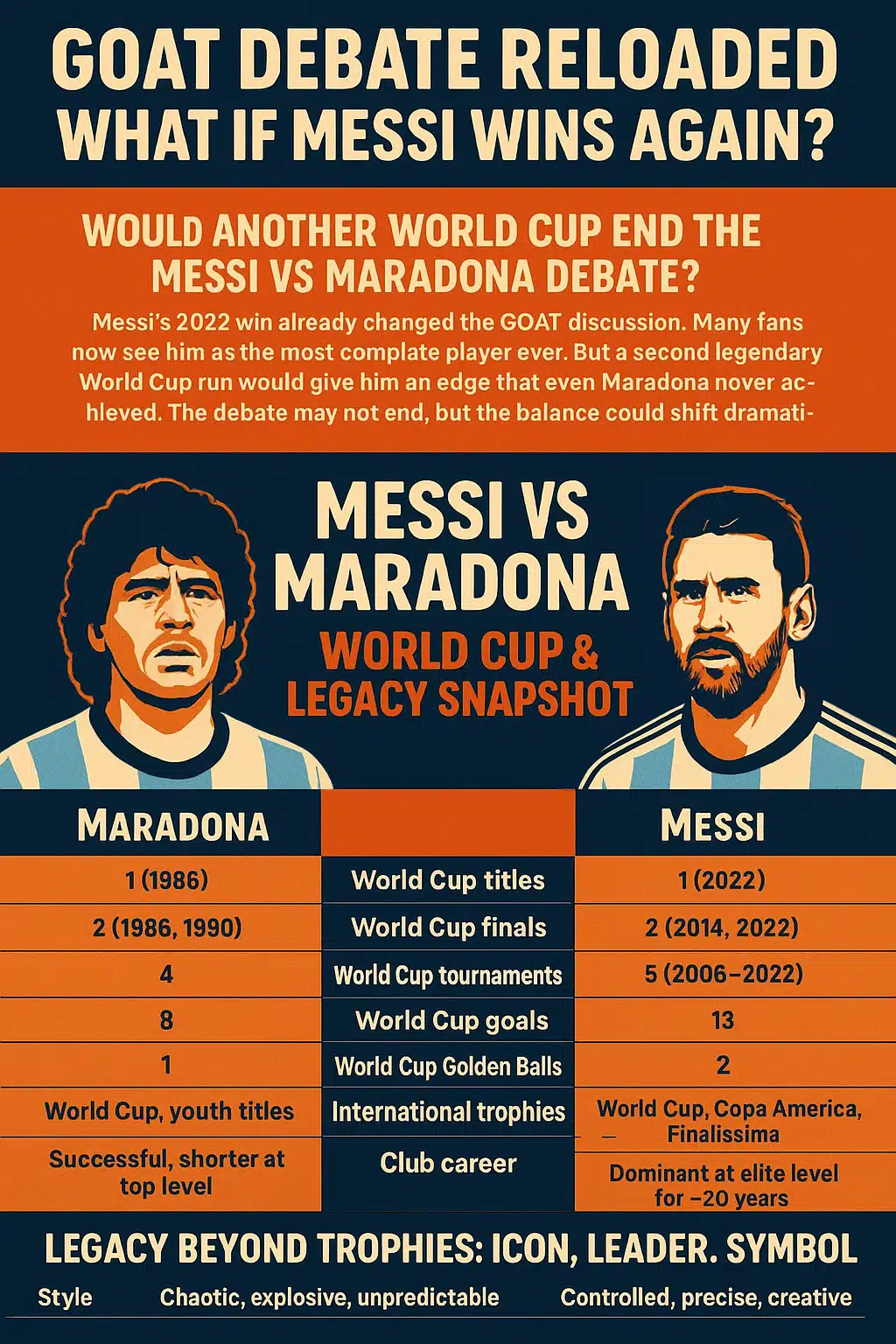
Messi’s 2022 win already changed the GOAT discussion. Many fans now see him as the most complete player ever. But a second legendary World Cup run would give him an edge that even Maradona never achieved. The debate may not end, but the balance could shift dramatically.
Messi already has:
- 1 World Cup title
- 2 World Cup final appearances (2014, 2022)
- 13 World Cup goals (most for Argentina)
- Multiple international trophies, including Copa América and Finalissima
- A record number of Ballon d’Or awards
Maradona, meanwhile, has one World Cup win and one runner-up finish, combined with his unforgettable style and impact on Argentina and Napoli.
Messi vs Maradona – World Cup & Legacy Snapshot
| Category | Maradona | Messi |
| World Cup titles | 1 (1986) | 1 (2022) |
| World Cup finals | 2 (1986, 1990) | 2 (2014, 2022) |
| World Cup tournaments | 4 | 5 (2006–2022) |
| World Cup goals | 8 | 13 |
| World Cup Golden Balls | 1 | 2 |
| International trophies | World Cup, youth titles | World Cup, Copa América, Finalissima |
| Club career | Successful, shorter at top level | Dominant at elite level for ~20 years |
If Messi were to win another World Cup or even just lead Argentina to another final with a strong personal performance, many would consider the GOAT debate settled in his favor.
Legacy Beyond Trophies: Icon, Leader, Symbol
Legacy goes far beyond medals and awards. It includes influence, personality, leadership, and global impact. Both Maradona and Messi have shaped football in different ways. Understanding these dimensions helps us appreciate what another World Cup run would mean for Messi’s story.
Maradona is remembered as rebellious, wild, and deeply emotional — a symbol of the streets and the struggles of ordinary people. Messi, in contrast, is seen as quiet, professional, and relentlessly excellent. He represents dedication, humility, and long-term brilliance.
Different Types of Legacy
| Dimension | Maradona | Messi |
| Style | Chaotic, explosive, unpredictable | Controlled, precise, creative |
| Personality image | Rebellious, controversial | Humble, reserved, family-oriented |
| Symbol of | Street football, defiance, passion | Professionalism, consistency, brilliance |
| Cultural impact | Huge in Argentina & Naples | Global, multi-club, multi-generation |
| Likely 2026 framing | Past legend | Veteran GOAT defending or extending crown |
A second iconic World Cup from Messi wouldn’t erase Maradona’s magic, but it would redefine what a complete football legacy looks like.
So, Will Messi Deliver a Maradona-Style World Cup Double?
Predicting football is never easy, especially when the expectations are historic. Messi’s chances depend on fitness, team support, and tournament conditions. But the emotional weight of the question makes it fascinating. This final evaluation brings every factor together.
The Case For: Why It Could Happen
Despite the challenges, there are strong reasons to believe Argentina can compete for another title. The squad is talented, disciplined, and hungry for more success. Messi’s intelligence and experience still make him one of the most influential players in the world. These factors create a realistic path toward another deep run.
Argentina have:
- A solid core of players in their prime
- A coach who has already built a winning structure
- Emerging talents to add speed, pressing, and depth
- Messi’s game intelligence, set-piece threat, and leadership
Arguments “For” a Messi Double
| Factor | Why It Helps |
| Strong squad core | Reduces over-reliance on Messi |
| Tactical stability | Team already knows a system that works |
| Champion experience | Players have handled pressure before |
| Messi’s evolving role | His vision can compensate for lost pace |
| Emotional motivation | Chance to make unique football history |
If injuries are kind and the team arrives in good form, a deep run with Messi at the heart of it is entirely possible.
The Case Against: Harsh Realities of Back-to-Back World Cups
Back-to-back World Cups are extremely rare for a reason. Age, fatigue, pressure, and powerful opponents make the journey difficult. The expanded 2026 format adds even more obstacles. These realities remind us that a double is possible — but far from guaranteed.
Messi’s age, the number of games, and the strength of rivals like France, Brazil, and England all work against the dream. There is also the chance that Messi may decide not to play if he feels he cannot perform at his usual level.
Arguments “Against” a Messi Double
| Factor | Why It Hurts Chances |
| Messi’s age and fitness | Harder to sustain high-intensity football |
| Expanded tournament | More matches, more chances for slip-ups |
| Strong global rivals | Several elite teams with younger cores |
| Historical rarity | Very few examples of back-to-back winners |
| Participation uncertainty | Messi may choose not to play at all |
These are real barriers, and they cannot be ignored in any honest prediction.
Final Verdict – Dream, Myth, or Real Possibility?
With everything considered, the picture is both hopeful and challenging. Messi’s brilliance keeps the dream alive, but football’s unpredictability creates uncertainty. Whether he plays in 2026 or not, the possibility of a double adds excitement to his legacy. This is what makes the debate so compelling.
A true back-to-back World Cup win with Messi as the central figure would be one of the greatest achievements in football history. It is possible, but extremely difficult. A more realistic version of the “double” might be another deep tournament run where Messi again shapes the story — even without lifting the trophy.
Whatever happens, Messi has already secured his place among the very greatest to ever play the game. A Maradona-style World Cup double would not build his legend from scratch. It would simply take it to a level that may never be touched again.