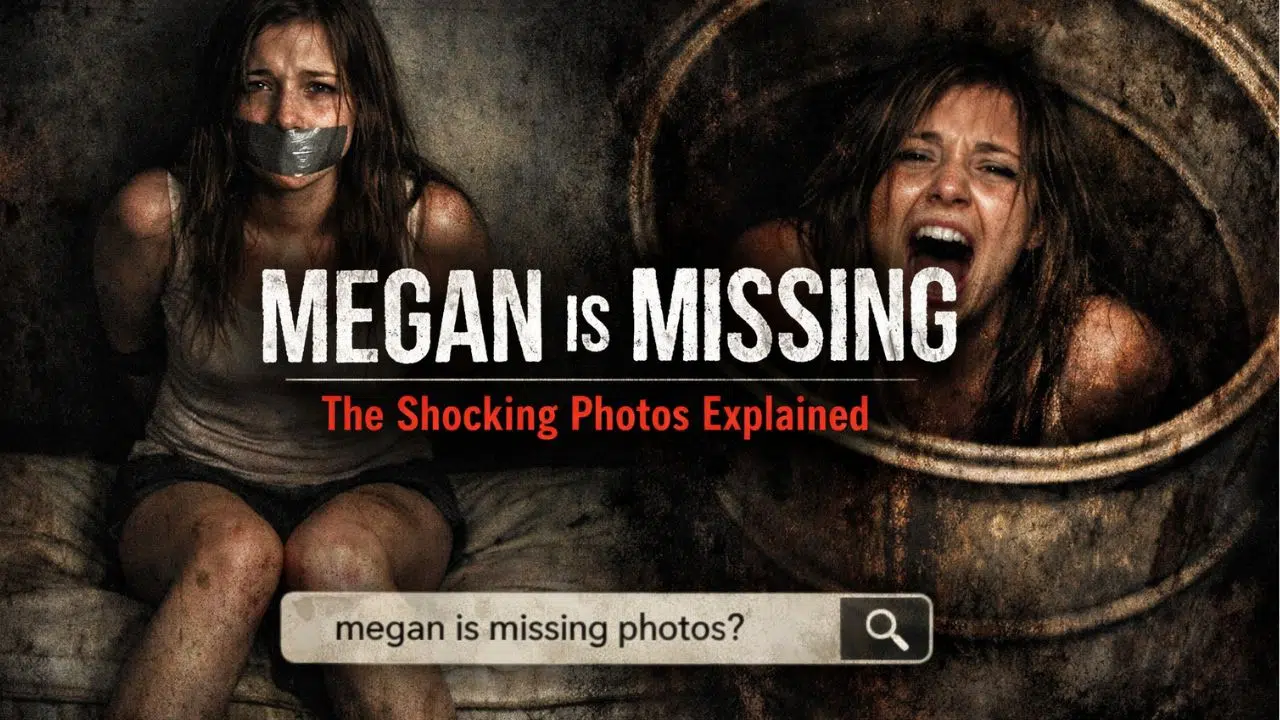
The 2011 found-footage horror film Megan Is Missing has resurfaced in recent years to become one of the most controversial and talked-about movies of its genre. Central to its chilling narrative are two specific photographs that circulate within the storyimages that have sparked countless online discussions, warnings, and searches for “megan is missing photos.” For the uninitiated, these photos represent the film’s harrowing turning point; for those who have seen the movie, they are unforgettable symbols of its grim cautionary tale.
Understanding the context of these images requires separating the film’s fictional narrative from its very real intentions. This article provides a professional, comprehensive look at the Megan Is Missing photos, their role in the story, the facts behind the fiction, and why this film continues to resonate with audiences and safety advocates alike.
What Are the “Megan Is Missing” Photos?
In the context of the film, the two photos of Megan are discovered after her disappearance, surfacing on disturbing websites and found by her best friend, Amy. They serve as the primary evidence that Megan is in grave danger. These are not real crime scene photographs but rather meticulously crafted props within a fictional movie .
Here is a breakdown of the two pivotal images:
Photo 1: The Proof of Life
The first photograph shows Megan sitting on a mattress in a dark, confined space. Her hands are bound behind her back, and her mouth is covered with duct tape . This image is discovered relatively early in Amy’s search. Its purpose within the narrative is to confirm the audience’s worst fears: Megan was not a runaway; she was abducted. The photo is grainy, poorly lit, and undeniably sinister, designed to evoke the feeling of authentic crime scene documentation.
Photo 2: The Desperate Plea
The second photograph is arguably the most disturbing. It depicts Megan inside a large, filthy barrel, screaming in terror . The implication is that she is being held captive in a container, buried or hidden away. This image escalates the horror from abduction to imminent death. It removes any hope of a rescue and sets the stage for the film’s notoriously graphic final act.
It is crucial to reiterate that these are acted scenes featuring actress Rachel Quinn. They are special effects and makeup designed to look as realistic as possible to serve the film’s narrative .
The Film’s Purpose: More Than Just Horror
While Megan Is Missing is categorized as horror, writer-director Michael Goi has consistently framed the project as a cautionary tale. The film is not based on a single true story but is instead inspired by the very real dangers of online predation .
Goi shot the film on a meager budget of $30,000–$35,000, using the found-footage technique to create a sense of raw, unpolished reality . The inclusion of the photos serves a specific narrative function: they represent the digital footprint of a crime. In an era where predators used early internet platforms to target victims, the idea that images of a missing child could be circulated in dark corners of the web was a terrifyingly plausible concept in 2011, and remains relevant today.
The film opens with a title card stating it is a fictional work but is intended to spark conversation. In fact, the DVD releases include features and statements from child safety advocates, highlighting the film’s educational intent .
Why the Photos Spark So Much Confusion
A significant amount of online search traffic regarding “megan is missing photos” stems from a misunderstanding about the film’s veracity. Because the movie utilizes a documentary stylecomplete with faux news reports and “found” VHS-quality footagemany viewers, particularly those who discover the film through viral social media clips, are left wondering if what they are seeing is real .
Are the Photos Real?
No. The photos of Megan (the character) are 100% fictional. They are stills taken from a scripted film .
Are the Events Real?
The events depicted in the film did not happen to a girl named Megan Stewart. However, the film is a composite inspired by numerous real-life cases of child abduction, including the 2002 murders of Miranda Gaddis and Ashley Pond . The director used these real-world horrors as a foundation to build a fictional story that felt authentic enough to serve as a warning.
The “Last 22 Minutes” Myth
The film’s resurgence on TikTok often focused on the infamous “last 22 minutes.” This segment includes the discovery of the photos and the capture of Amy. While the footage is graphic and unsettling, it is not real . It is a testament to the filmmaking and acting that the scenes blur the line between fiction and reality so effectively.
The Symbolism of the Images
From a cinematic perspective, the two photos of Megan are more than just plot devices; they are symbolic of the loss of innocence.
- The Loss of Identity: Prior to her disappearance, Megan’s identity is defined by her social media presence, her video diaries, and her popularity. After her disappearance, the photos strip her of that identity. She is no longer “Megan the popular girl” but “Megan the victim.” The photos are dehumanizing, showing her as an object trapped in a cage.
- The Failure of Digital Safety: The photos are uploaded and shared online. This represents the ultimate irony of the digital age that the film critiques. The same internet that Megan used to meet “Josh” becomes the medium through which her suffering is displayed.
The Ethical Debate: Exploitation or Education?

The graphic nature of Megan Is Missing, including the photos, has led to a polarizing debate among critics and viewers.
- The Argument for Education: Proponents, including the director, argue that the film is meant to be uncomfortable. The theory is that by making the horror feel real, it leaves a lasting impression that a sanitized PSA never could. The goal is to make teenagers think twice before meeting an online stranger alone.
Regardless of where one stands on the debate, the power of the images is undeniable. They are the catalyst for the film’s notoriety.
Frequently Asked Questions
Q: What do the photos in Megan Is Missing show?
A: The first photo shows the main character, Megan, tied up with duct tape over her mouth. The second, more disturbing photo shows her inside a barrel, screaming. These are fictional images from the 2011 horror film .
Q: Are the Megan Is Missing photos real or fake?
A: They are completely fake. They are scenes from a scripted movie featuring actors and special effects. The film is not a real documentary .
Q: Is Megan Is Missing based on a true story?
A: The specific story of Megan and Amy is fictional. However, director Michael Goi has stated the film was inspired by several real-life cases of children being abducted by people they met online .
Q: Why did Megan Is Missing go viral on TikTok?
A: The film went viral during the pandemic as users shared their reactions to the disturbing “last 22 minutes” of the movie. Many viewers were unaware it was a fictional film, leading to widespread curiosity and concern .
Q: What is “Megan’s Law”?
A: It is important not to confuse this film with the real-world legislation. Megan’s Law is a federal law in the United States passed in 1996 that requires law enforcement authorities to make information about registered sex offenders available to the public. It was named after Megan Kanka, a real-life victim, and is unrelated to this film .
Final Thoughts
The “megan is missing photos” are a powerful example of cinematic craft designed to provoke a visceral reaction. While they are often the subject of morbid curiosity and confusion, understanding their context within the fictional film Megan Is Missing is essential. They are not historical documents but rather a deliberate artistic choice meant to underscore the dangers of online predation.
Whether viewed as a necessary evil or an exploitative shock tactic, the film succeeds in its primary mission: it starts a conversation. For parents and teenagers, the filmand its infamous imagesserves as a stark reminder that digital safety is not a topic to be taken lightly. If you or someone you know is navigating online relationships, maintaining open communication and adhering to strict safety protocols is the most effective way to ensure the story remains fiction.