You know that feeling when you’re craving tacos, you grab your phone, type “best tacos,” and instantly see a list of spots just minutes away? You pick the one with the mouth-watering photos and the 4.8-star rating. That right there is the power of local search. But if you own a business and you’re not showing up in that “local pack,” you’re effectively invisible to the people who are ready to buy right now.
Here is the reality: nearly half of all Google searches today have local intent. This guide isn’t just about “being online.” It is about dominating the map in your specific neighborhood.
We are going to walk through the exact steps to get your business found, trusted, and chosen in 2026. Local SEO Strategies have changed, and I want to show you exactly what works today. Ready to turn those searchers into walk-in customers? Let’s get to work.
What Is Local SEO?
Local SEO (Search Engine Optimization) is the process of improving your online visibility for location-based searches. It is not just about your website; it is about securing your spot in the “Local Pack”, that block of three business listings that appears at the very top of Google results with a map.
Think of it as the digital version of the Yellow Pages, but dynamic and much more powerful.
When someone searches for “plumber near me” or “coffee shop in [City Name],” Google’s algorithm looks for three specific things: relevance, distance, and prominence. It wants to give the user the best possible option that is also the most convenient.
The “Local Intent” Reality: According to recent data from BrightLocal and Google, 46% of all searches on Google now have “local intent.” This means nearly half of the time someone types in a query, they are looking for a service or product in their immediate physical area.
By using tools like Google Business Profile and focusing on specific geographic terms, you signal to Google that you are the best answer for those nearby queries. It is the difference between hoping someone finds you and planting a neon sign right where they are looking.
The Importance of Local SEO in 2026
The days of just listing your address on a website are gone. In 2026, local search is driven by AI-enhanced results and hyper-specific user behavior. Your business needs to meet customers exactly where they are, on their phones, in their cars, and on their smart speakers.
The rise of “Near Me” searches
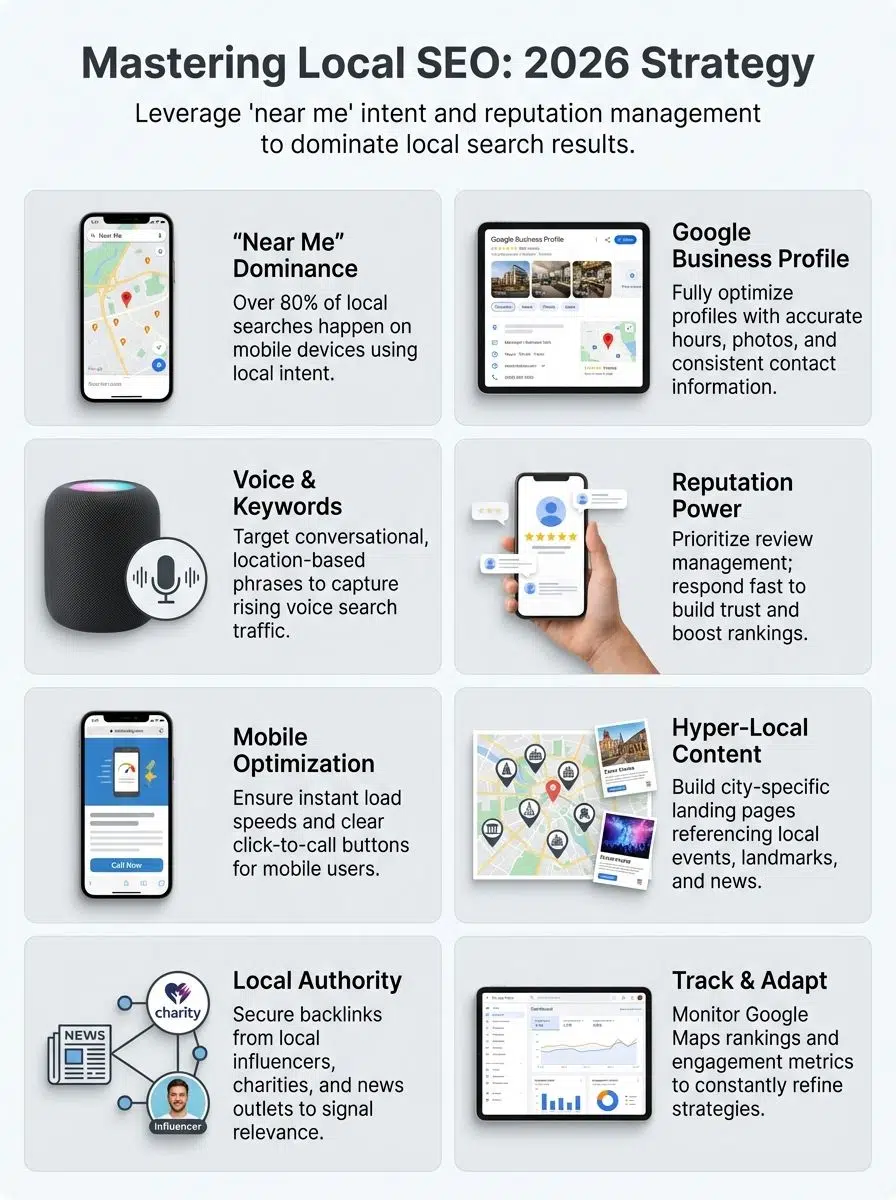
The phrase “near me” has transformed from a simple keyword into a primary consumer behavior. Search data shows that queries for “open now near me” have grown by over 400% in recent years. People don’t just want a service; they want it immediately.
This trend is powered largely by mobile usage. Over 80% of “near me” searches happen on mobile devices. When a parent asks Alexa for an “urgent care nearby,” or a driver asks their dashboard for “gas stations,” they are relying on structured local data. If your business hours aren’t accurate or your location isn’t verified, you simply won’t exist in these results.
For example, Google’s “Openness” update in late 2024 made it harder for businesses to rank if they are currently closed. This means keeping your operating hours updated down to the minute is now a direct ranking factor, not just a customer service detail.
The role of online reputation in local rankings
Your reputation is no longer just about public perception; it is a mathematical ranking factor. Google’s algorithm explicitly rewards businesses with high ratings and frequent reviews.
Data from 2025 indicates that businesses need a steady stream of reviews, not just a one-time batch, to maintain visibility. A study by Moz suggests that review signals (quantity, velocity, and diversity) make up about 15% of the local pack ranking factors.
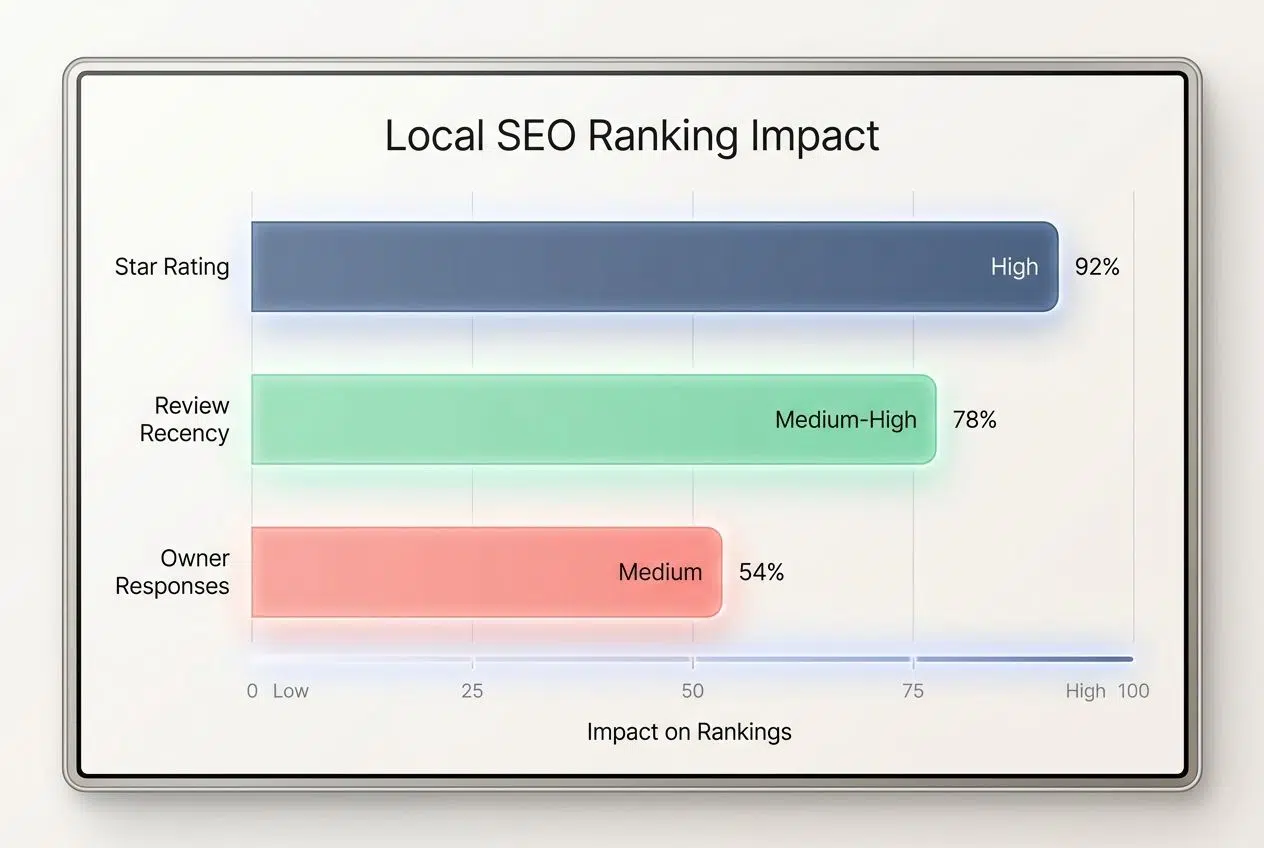
| Feature | Impact on Rankings | Actionable Tip |
|---|---|---|
| Star Rating | High | Aim for a 4.2 to 4.5 average. A 2025 report showed conversion rates dropped significantly below 4.0. |
| Review Recency | Medium-High | Google prefers reviews from the last 30 days. Consistent feedback beats a dormant 5-star profile. |
| Owner Responses | Medium | Responding effectively builds “Prominence.” 53% of customers expect a reply to negative reviews within a week. |
Speedy replies to both good and bad comments help boost trust. Five-star ratings make your brand stand out on maps or listings, while low ratings can drag down rankings faster than an anchor dropped in a pond.
Key Components of a Local SEO Strategy
You need a solid plan to boost your local search presence. These next steps set the stage for real growth in your community by focusing on the signals that actually move the needle in 2026.
Google Business Profile (GBP) optimization
Your Google Business Profile is the single most important asset for local SEO. It is often the only thing a customer sees before deciding to visit. In 2026, Google added features that allow for richer interaction, like video previews and emoji reactions.
- Nail the Verification: Use the new “Video Preview” feature to check your verification video before submitting it. This reduces rejection rates significantly.
- Complete Every Field: Don’t leave the “Attributes” section blank. Identifying as “Veteran-Led” or “Wheelchair Accessible” can be the deciding factor for many customers.
- Use Real Photos: Avoid stock images. Upload photos of your storefront, team, and products. Profiles with 100+ images get 520% more calls than those with fewer.
- Leverage the “What’s Happening” Section: Use this new feature to highlight local events or limited-time offers directly on your profile.
- Keep Hours Accurate: Update them for every holiday. Inconsistent hours are a major trust killer.
- Enable Chat: Turn on the messaging feature, but only if you can respond quickly. Responsiveness is displayed publicly.
Local keyword research and targeting
Getting your Google Business Profile in top shape is just the start. You must identify the specific terms locals use to find you. It’s rarely just “plumber”; it’s “emergency drain cleaning [Neighborhood Name].”
- Use Specific Tools: Use the Semrush Keyword Magic Tool or AnswerThePublic to find question-based queries like “Who is the best landscaper in Dallas?”
- Target “Service + Location” Terms: Optimize for phrases like “roof repair in North Austin” rather than just “roofing.”
- Analyze Competitors: Look at the categories your top competitors use on their GBP. If they are ranking for “Italian Restaurant” and you are just “Restaurant,” you are missing out.
- Focus on Mobile Intent: Over 60% of local searches are mobile. Use shorter, punchier keywords that match how people type on small screens.
- Update seasonally: People search for “ac repair” in summer and “furnace check” in winter. Adjust your website headings to match the season.
Building and managing local citations
Citations are mentions of your business name, address, and phone number (NAP) across the web. They act as “votes of confidence” for your business’s location. If your address varies across different sites, Google loses trust in your data.
Pro Tip: Use a tool like Whitespark or BrightLocal to audit your citations. They can identify inconsistent listings on major aggregators like Data Axle and Foursquare, which feed data to hundreds of smaller directories.
- Start with the Big Players: Ensure your NAP is identical on Google, Yelp, Facebook, and Apple Maps.
- Don’t Ignore Niche Directories: If you are a lawyer, get listed on Avvo. If you are a contractor, look at Houzz. These industry-specific citations carry more weight than generic ones.
- Clean Up Old Data: Did you move three years ago? An old address on a forgotten directory can still hurt your rankings today. Fix it immediately.
Enhancing Visibility with “Near Me” Searches
Boosting your spot in “near me” results requires technical precision. You need to make sure your digital footprint screams “local relevance” to the search algorithms.
Optimizing for mobile and voice search
In 2026, voice search is a dominant force. People don’t speak as they type. They ask full questions. Your content needs to answer them directly.
- Optimize for Speed: Use Google PageSpeed Insights to check your mobile load time. If your site takes more than 3 seconds to load, mobile users (and Google) will bounce.
- Add “Click-to-Call” Buttons: Make your phone number a clickable button in your website header. This is a primary conversion action for mobile users.
- Use FAQ Schema: Add a “Frequently Asked Questions” section to your site and mark it up with Schema code. This helps you rank for voice queries like “Is there a 24-hour vet near me?”
- Natural Language: Write your content conversationally. Instead of “Plumbing Services Available,” try “Need a plumber in Seattle right now? We are open.”
Using location-specific landing pages
If you serve multiple cities, do not just list them on one page. You need a dedicated landing page for each major location. However, a common pitfall is creating “Doorway Pages”, pages that are identical except for the city name. Google hates this.
| Bad Location Page (Avoid) | Good Location Page (Do This) |
|---|---|
| Identical text, just swapped “Dallas” for “Houston.” | Unique details about the specific team, projects, or clients in that city. |
| Generic stock photos of a city skyline. | Photos of your actual branded truck or office in that specific location. |
| No map or local info. | Embed a Google Map pointing to your specific office or service area center. |
Always connect your landing pages with your main business listings. Ensure that the URL for your “Dallas” GBP points to your “Dallas” landing page, not just your generic homepage. This creates a tight relevance loop for the algorithm.
Reputation Management in Local SEO
Your business reputation can lift your local search ranking or sink it faster than a stone. In the current landscape, reviews are the currency of trust.
The impact of customer reviews
Customer reviews hold immense power. According to a 2025 survey, 71% of consumers will not even consider using a business with an average rating below three stars. Even a small increase in star rating, from 3.5 to 3.7, can increase conversion rates by nearly 120%.
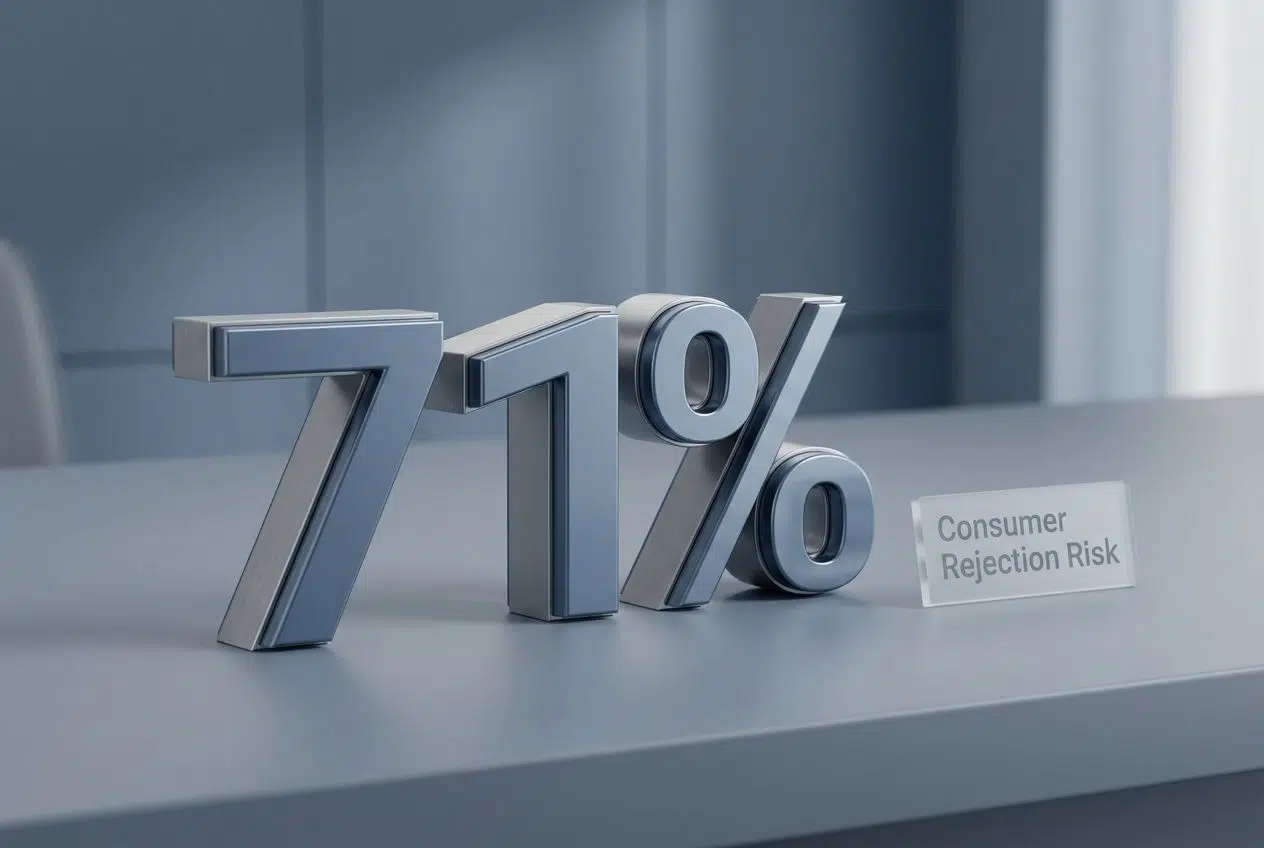
Google trusts fresh feedback from real users. A profile with 50 reviews from three years ago is less valuable than a profile with 10 reviews from the last month. Freshness signals to Google that you are still active and relevant.
Strategies for generating and responding to reviews
You cannot just wait for reviews to happen. You have to build a system to capture them.
- Ask at the Right Moment: The best time to ask is right when the service is completed. Send a text request while the customer is still happy.
- Use Tools to Automate: Platforms like GatherUp or BirdEye can send automated review requests via SMS and email, making the process effortless.
- Respond to Everything: Reply to every single review. For positive ones, say “Thanks, [Name]!” For negative ones, address the issue professionally.
- Use QR Codes: Print a QR code linked directly to your Google Review form and place it on your front counter or business cards.
- Personalize Your Replies: Don’t use canned responses. Mention the specific product or service they bought to show you are paying attention.
- Admit Mistakes: If a review is negative but fair, own it. “I’m sorry we missed the mark on your latte today, Sarah,” goes a long way.
- Share the Wins: Take your best 5-star reviews and turn them into social media posts (with the customer’s permission). It’s great social proof.
Advanced Local SEO Tactics for 2026
Ready for some next-level local SEO tips to help your business shine above the crowd? These are the strategies the pros use to edge out the competition.
Creating localized content
Standard blog posts won’t cut it. You need “hyper-local” content. Write about things that only a local would know. For example, a real estate agent could write “The Best Coffee Shops in [Neighborhood] for Remote Work.”
Mention local landmarks, annual festivals, or specific street names. This builds “topical authority” for your area. When Google sees you writing about the “Main Street Parade,” it understands you are deeply connected to that community.
Collaborating with local influencers
You don’t need a Kardashian. You need the person who runs the popular “Foodie in [City]” Instagram account. These micro-influencers often have incredibly engaged local followings.
Invite a local TikTok creator to tour your shop or try your service. Their video provides a powerful backlink and social signal that tells Google you are a “prominent” local entity. User-generated content from trusted locals is gold for search visibility.
Securing backlinks from local sources
Forget generic directory links. In 2026, a link from a local church, Little League team, or Chamber of Commerce is far more valuable. These are known as “hyper-local” backlinks.
Pro Tip: Sponsor a local charity run or a youth soccer team. These organizations often have high-authority .org websites and will link to their sponsors. A single link from a trusted local school or non-profit is worth ten links from a random blog.
Reach out to local news sites for coverage of your grand opening or a charity event you are hosting. Local newspapers often spotlight businesses, and their digital editions provide high-quality, relevant links.
Measuring Success in Local SEO
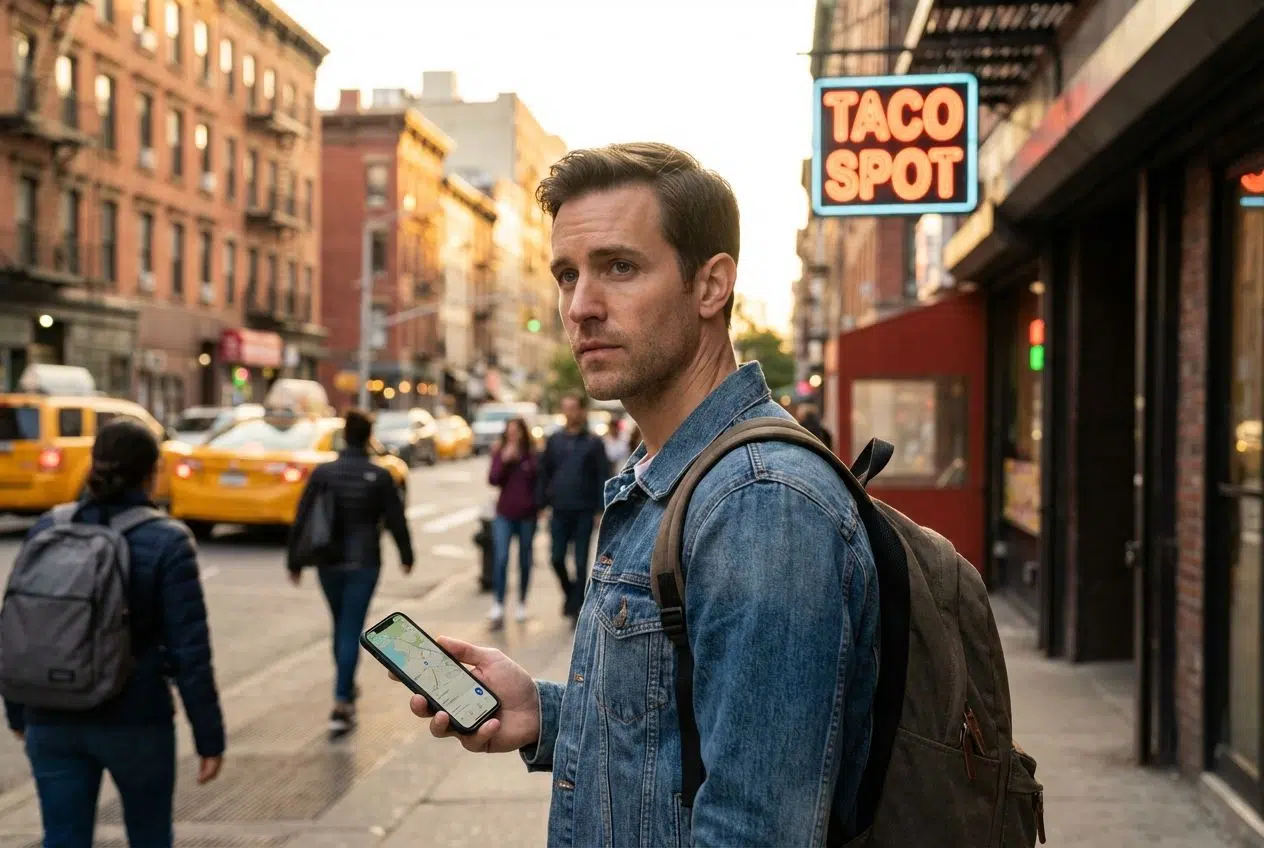
You need to keep an eye on how your business shows up for local searches, or you might be left out in the cold. You need to look beyond vanity metrics and track what pays the bills.
Tracking local rankings in Google Maps
Standard rank trackers often fail at local SEO because rankings change every mile. You might be #1 for “pizza” at your front door, but #10 three miles away.
Use a grid-tracking tool like Local Falcon or BrightLocal’s Local Search Grid. These tools show your ranking across a map grid, giving you a heat map of your visibility. This tells you exactly where you are winning and where you need to improve your proximity signals.
Using analytics to monitor engagement and conversions
Rankings are great, but phone calls are better. Use Google Analytics 4 (GA4) and the “Performance” tab in your Google Business Profile to track real actions.
- Direction Requests: A high number of direction requests is a strong signal of high purchase intent.
- Click-to-Call: Track how many people are calling you directly from the search results.
- Website Visits from GBP: Use UTM parameters on your profile link (e.g., `?utm_source=google&utm_medium=organic&utm_campaign=gbp`) to separate map traffic from regular organic traffic in your analytics.
- Photo Views: A spike in photo views often correlates with increased discovery searches. Keep uploading!
Final Thoughts
Mastering Local SEO in 2026 is about more than just checking boxes. It is about building a digital presence that mirrors your real-world reputation. By optimizing your Google Business Profile with video and attributes, gathering fresh reviews, and tracking your success with grid tools, you can own your local market.
Don’t get overwhelmed by the data. Start with your profile, fix your hours, and ask your next happy customer for a review.
Small wins add up fast. A better spot in local search is often just one great review or one smart keyword update away. So, what is the first change you are going to make today?