In the crowded world of collagen supplements, marine collagen has emerged as the gold standard for skin health and anti-aging benefits. While bovine collagen dominates the market due to lower production costs, a growing body of scientific research reveals that ocean-sourced collagen peptides offer superior bioavailability and more targeted benefits for skin elasticity, hydration, and wrinkle reduction. Understanding the molecular differences between these two collagen sources can help you make informed decisions about which supplement delivers the results you’re seeking.
The Molecular Advantage of Marine Collagen
Marine collagen, derived primarily from fish skin and scales, consists almost exclusively of Type I collagen, the most abundant collagen type in human skin, accounting for approximately 80% of the dermal structure. This precise match between supplement source and target tissue creates a fundamental advantage for skin health applications.
The particle size of marine collagen peptides averages significantly smaller than bovine alternatives, typically ranging between 2,000-5,000 Daltons compared to bovine collagen’s 10,000+ Daltons. This size differential has profound implications for absorption rates. Smaller peptide chains require less digestive breakdown, allowing them to enter the bloodstream more rapidly and efficiently through the intestinal wall.
Research published in the Journal of Agricultural and Food Chemistry demonstrated that marine collagen peptides achieved up to 1.5 times greater absorption rates compared to bovine sources when measured through blood plasma analysis. This enhanced bioavailability means more of the collagen you consume actually reaches the tissues where it’s needed, rather than being broken down and excreted.
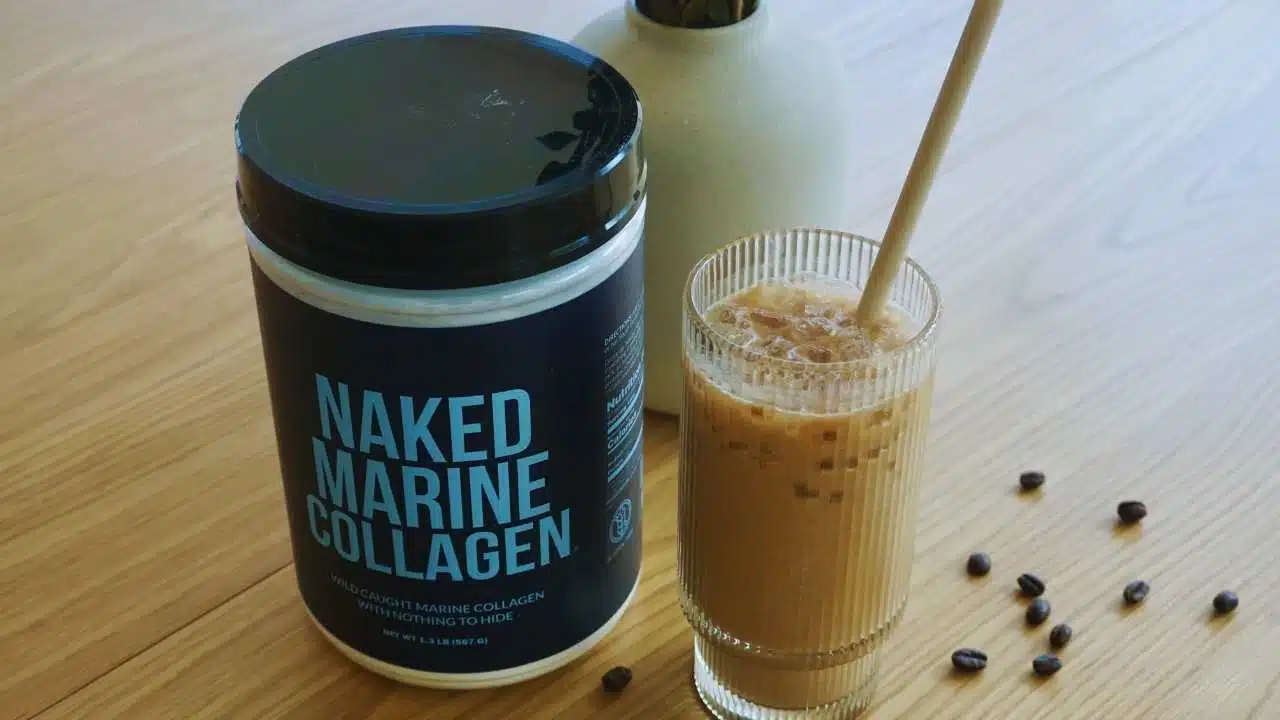
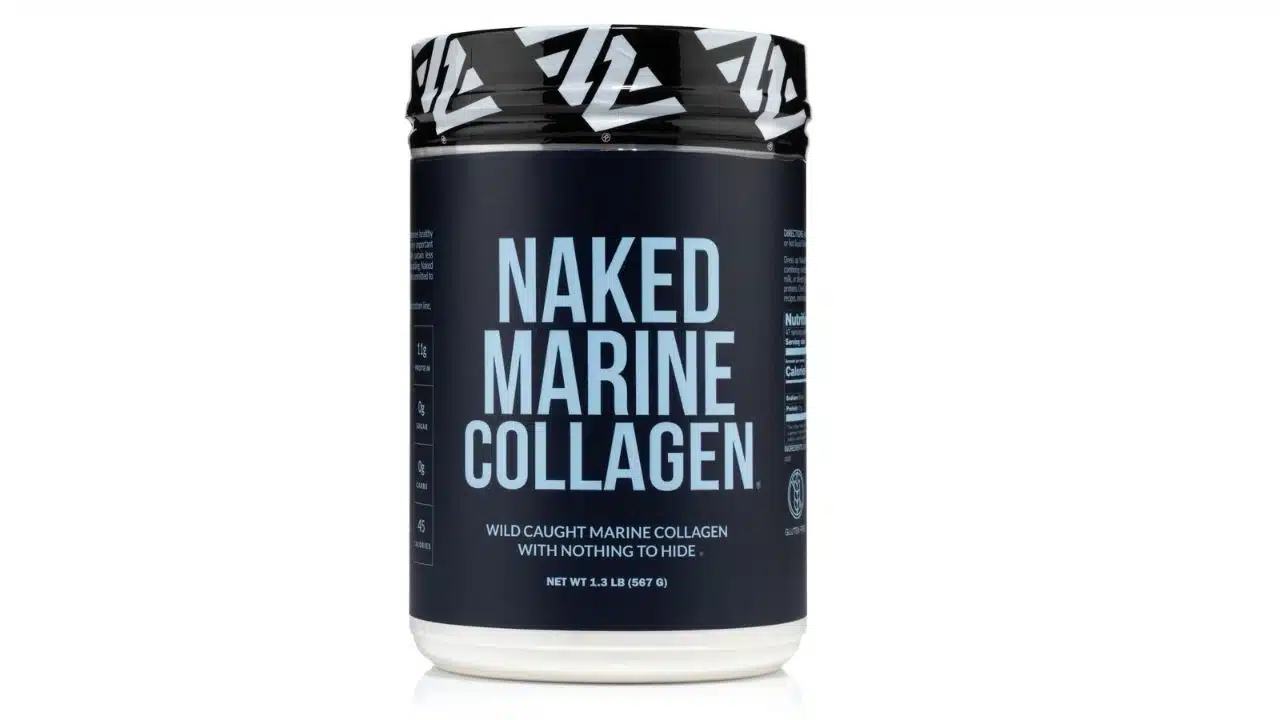
When selecting a marine collagen supplement, look for products with high-quality sourcing from wild-caught fish rather than farmed alternatives, as wild fish typically have lower contaminant levels. Naked Nutrition’s Marine Collagen exemplifies these quality standards, providing Type I collagen peptides from wild-caught fish in the optimal 2,000-5,000 Dalton range for maximum absorption. The unflavored formula contains no fillers or artificial ingredients and dissolves easily in both hot and cold liquids, making daily consumption seamless.
Type I Collagen: The Skin Elasticity Powerhouse
While bovine collagen contains a mixture of Type I and Type III collagen, marine collagen’s concentrated Type I composition directly addresses the primary structural protein lost during skin aging. After age 25, humans lose approximately 1-1.5% of their collagen stores annually, with Type I collagen degradation being the primary driver of wrinkle formation, sagging, and loss of elasticity.
Type I collagen fibers form the structural scaffold of the dermis, creating the framework that gives skin its firmness and resilience. These fibers are organized in a dense network that provides tensile strength and elasticity. When this network degrades, skin becomes thinner, less elastic, and more prone to wrinkle formation.
A 2015 double-blind, placebo-controlled study published in Skin Pharmacology and Physiology examined 69 women aged 35-55 who consumed 2.5-5 grams of marine collagen peptides daily for eight weeks. Researchers measured skin elasticity using cutometry and found statistically significant improvements in the collagen group, with a 7.4% increase in skin elasticity compared to placebo. Equally impressive, eye wrinkle volume decreased by an average of 6.3% in the marine collagen group.
Amino Acid Profile and Skin Benefits
The amino acid composition of marine collagen provides another layer of advantage for skin health. Marine collagen is particularly rich in glycine, proline, and hydroxyproline, the three amino acids that comprise roughly 50% of collagen’s structure and are essential for collagen synthesis in the body.
Hydroxyproline, which is found almost exclusively in collagen, serves as a biomarker for collagen metabolism and plays a critical role in stabilizing the collagen triple helix structure. Marine collagen contains higher concentrations of hydroxyproline than bovine sources, potentially explaining its superior effect on skin parameters in clinical trials.
Beyond the primary collagen-building amino acids, marine collagen provides substantial amounts of glycine, an amino acid that supports not only collagen production but also detoxification pathways in the liver and antioxidant synthesis. This broader metabolic support contributes to overall skin health beyond just structural support.
Absorption and Utilization: Why Smaller Is Better
The concept of bioavailability extends beyond simple absorption rates. Once marine collagen peptides enter the bloodstream, their smaller size allows them to more easily reach the dermal layer of skin through the capillary system. Studies using radiolabeled collagen peptides have tracked their distribution throughout the body, confirming accumulation in skin tissue within hours of consumption.
The digestibility of marine collagen also surpasses bovine alternatives. Fish collagen denatures at lower temperatures than mammalian collagen, meaning it breaks down more easily during both processing and digestion. This characteristic allows manufacturers to create highly hydrolyzed marine collagen without harsh chemical processing, preserving the natural amino acid profile.
Research from Japan’s Kyoto University tracked the distribution of dipeptides and tripeptides from marine collagen consumption, finding that these small peptide chains remained intact in the bloodstream for extended periods rather than being immediately broken down into individual amino acids. These intact peptides can signal fibroblast cells to increase collagen production, essentially telling your skin cells to manufacture more of their own collagen.
Clinical Evidence for Skin Improvement
Multiple clinical trials have demonstrated marine collagen’s effects on various skin parameters. A 2014 study in the Journal of Cosmetic Dermatology followed 114 women aged 45-65 who consumed 2.5 grams of specific bioactive marine collagen peptides daily for eight weeks. Skin elasticity improved by 7.5% on average, while skin moisture increased and the depth of facial wrinkles decreased.
Particularly noteworthy was the study’s finding that benefits appeared within four weeks and continued to improve through the eight-week study period, suggesting cumulative benefits with consistent use. Follow-up measurements four weeks after discontinuation showed that improvements persisted, though they began to decline, indicating the need for ongoing supplementation.
Another compelling study published in Open Nutraceuticals Journal examined the effects of marine collagen on cellulite reduction, a condition related to weakened collagen structures in subcutaneous tissue. Women who consumed marine collagen peptides showed statistically significant improvements in skin waviness and dermal density compared to placebo groups.
Practical Application: Dosage and Timing
For maximum skin benefits, research suggests consuming 2.5-10 grams daily, preferably on an empty stomach or with vitamin C, which supports collagen synthesis. Many users find that splitting the dose between morning and evening optimizes absorption and provides sustained amino acid availability throughout the day.
Consistency proves more important than dosage. Studies show that daily consumption over 8-12 weeks produces the most significant measurable improvements. Some users report visible changes in skin texture and hydration within 3-4 weeks, though deeper structural improvements in elasticity and wrinkle depth typically require 2-3 months of consistent use.
Maximizing Results Through Comprehensive Recovery Protocols
While marine collagen provides the internal nutritional building blocks for skin health, combining supplementation with external recovery practices amplifies and accelerates results. Forward-thinking wellness practitioners increasingly recognize that skin elasticity and overall tissue health benefit from comprehensive approaches that address inflammation, circulation, and cellular regeneration from multiple angles.
Cold exposure therapy has emerged as a powerful complement to collagen supplementation, working through entirely different but synergistic mechanisms. Regular cold plunge sessions trigger vasoconstriction followed by vasodilation, dramatically increasing blood flow to skin and peripheral tissues. This enhanced circulation delivers more of your marine collagen peptides to the dermal layer while simultaneously removing metabolic waste products that contribute to skin aging.
The anti-inflammatory effects of cold immersion directly address one of the primary drivers of collagen degradation. Chronic inflammation activates matrix metalloproteinases (MMPs), enzymes that break down collagen fibers in the skin. By reducing systemic inflammation, cold therapy helps preserve existing collagen structures while your supplementation builds new ones.
For those seeking a complete skin health protocol, alternating between sauna sessions and cold exposure creates powerful contrast therapy effects. Heat exposure increases circulation, opens pores for deep cleansing, and promotes detoxification through sweat, eliminating toxins that can impair collagen synthesis. A barrel sauna session 3-4 times weekly, followed by a brief cold plunge, creates an optimal environment for tissue regeneration and skin renewal.
Many athletes and biohackers report that this combination (daily marine collagen supplementation paired with 3-4 weekly contrast therapy sessions) produces visible skin improvements that exceed either intervention alone. The collagen provides raw materials, the heat therapy optimizes circulation and detoxification, and the cold exposure reduces inflammation and enhances nutrient delivery.
Final Thoughts
The science clearly demonstrates marine collagen’s superiority for skin health applications. Its high bioavailability, concentrated Type I collagen content, optimal amino acid profile, and clinically proven benefits make it the intelligent choice for anyone serious about maintaining skin elasticity and combating visible signs of aging. When combined with strategic recovery protocols that enhance circulation and reduce inflammation, marine collagen supplementation becomes part of a comprehensive approach to long-term skin health and vitality.