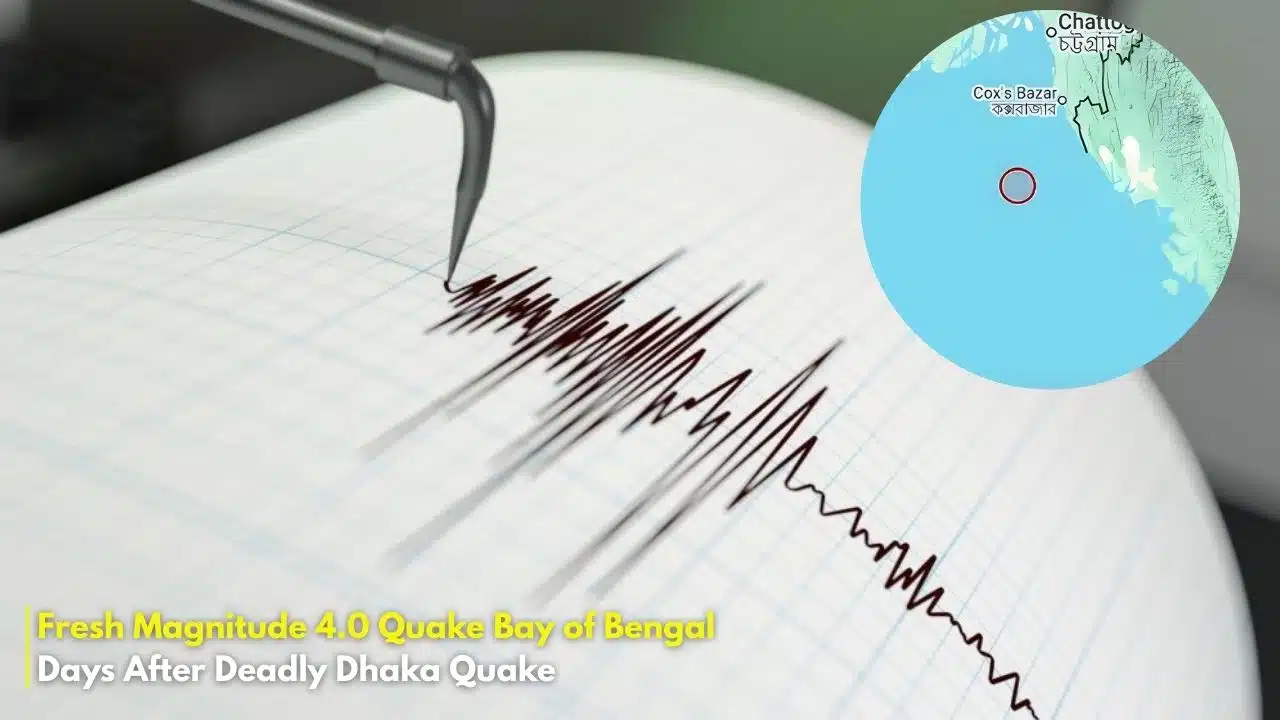
The deep waters of the Bay of Bengal churned in the early hours of Thursday, releasing a Magnitude 4.0 Quake that sent tremors rippling through the coastal sub-district of Teknaf. Striking at 3:29 AM BST, the event has amplified a growing sense of unease across Bangladesh’s southeastern frontier.
Coming less than a week after a deadly magnitude 5.7 earthquake devastated parts of central Bangladesh, this offshore tremor has shifted the spotlight from the country’s interior faults to the volatile subduction zone lurking beneath the ocean—a geological giant that experts warn has been “sleeping” for too long.
Quick Take: The Event & The Context
-
Event: Magnitude 4.0 (Mb) Earthquake
-
Time: 3:29 AM (BST), Thursday, Nov 27, 2025
-
Epicenter: Bay of Bengal, 118 km Southwest of Teknaf (Coordinates: 20.12°N, 91.85°E)
-
Depth: 10 km (Shallow Focus)
-
Felt Intensity: II to III (Weak to Light) on the Modified Mercalli Scale in coastal areas.
-
Immediate Impact: Panic in St. Martin’s Island and Teknaf; no structural failures reported.
-
Critical Context: This is the second significant seismic event in 7 days, following the Nov 21 disaster (10 dead, 600+ injured).
The Midnight Jolt: A Sleepless Coast
For the residents of Teknaf and the isolated coral island of St. Martin’s, the tremor was not violent, but it was unmistakable. In the silence of 3:30 AM, the ground motion felt like a sudden, nauseating sway—distinct from the jarring vibration of a truck passing by.
“The dogs started barking about ten seconds before I felt the bed move,” recounted Faruk Ahmed, a hotel manager on St. Martin’s Island, currently hosting the first wave of winter tourists. “We have guests who came here to escape the anxiety in Dhaka after last week’s tragedy. When the tremor hit, people panicked. Many guests ran out to the beach with their children, fearing a tsunami.”
While the Bangladesh Meteorological Department (BMD) confirmed within minutes that there was no tsunami threat—as a magnitude 4.0 is insufficient to displace enough water column—the fear was palpable. The memory of the 2004 Indian Ocean Tsunami remains etched in the collective psyche of this coastline.
Beneath the Waves: The Science of the “Silent” Threat
To understand why a moderate 4.0 quake is generating headlines, one must look at the geology beneath the Bay of Bengal. Bangladesh sits atop the world’s largest river delta, but beneath kilometers of sediment lies a collision zone where the Indian Plate is actively thrusting underneath the Burma Plate.
This specific quake occurred along the Arakan Subduction Zone.
Dr. Mehedi Ahmed Ansary, a renowned seismologist and professor at BUET (Bangladesh University of Engineering and Technology), explains the significance:
“Most people focus on the Dauki Fault in the north. But the plate boundary running along our coast and into the Bay of Bengal is a ‘Megathrust’ fault. It is similar to the fault that caused the 2011 Japan earthquake. A 4.0 magnitude release here tells us the plates are interacting. It is a release of stress, yes, but it also confirms the fault is active and locked.”
According to research published by Columbia University’s Lamont-Doherty Earth Observatory, this zone has been building strain for over 250 years. The last massive rupture here was the 1762 Arakan Earthquake, which raised the coast of St. Martin’s Island by several meters.
The “Swarm” Concern: Geologists are currently analyzing whether today’s 4.0 quake and last week’s 5.7 inland quake are connected. While they occurred on different fault systems, stress transfer can sometimes trigger a “domino effect” in neighboring tectonic regions.
The Refugee Crisis: A Disaster Waiting to Happen?
The epicenter’s proximity (118 km) to the Rohingya Refugee Camps in Ukhia and Teknaf highlights a humanitarian nightmare scenario. Over one million people live in these camps, residing in temporary shelters built on hills that have been deforested and terraced.
While a 4.0 magnitude quake is manageable, a hypothetical shift to magnitude 6.0 or higher in this same location would be catastrophic for the camps.
-
Landslide Risk: The camp shelters are constructed on loose, sandy soil. Even moderate shaking can trigger “dry landslides,” causing shanties to collapse domino-style down the slopes.
-
Access Routes: The singular Marine Drive road and the narrow highway connecting Cox’s Bazar to Teknaf are vulnerable to liquefaction. In a major event, aid routes would be severed instantly.
“We felt the earth shudder,” said Mohammed Zunaid, a Majhi (community leader) in Camp 11. “Our houses are made of bamboo and plastic. We don’t fear the roof falling as much as we fear the ground sliding away from under us. There is no ‘safe space’ here.”
Economic Aftershocks: Tourism Takes a Hit
The timing of this seismic activity is economically brutal. November marks the beginning of Bangladesh’s peak tourism season. Cox’s Bazar and St. Martin’s Island rely heavily on the winter influx of visitors to sustain their economy for the rest of the year.
Following the devastating November 21 earthquake near Dhaka, cancellations had already begun. Thursday’s fresh tremor in the Bay has accelerated the trend.
-
Hotel Occupancy: Major hotels in Cox’s Bazar report a 15-20% drop in bookings for the upcoming December victory day holidays compared to last year.
-
St. Martin’s Ferry Service: While ferries are operational, operators report fewer passengers willing to make the sea crossing, fearing isolation on the island during a potential larger quake.
Jamal Hossain, Vice President of the Hotel-Motel Owners Association, stated: “We are trying to reassure tourists that our buildings follow code. But fear is irrational. When people read ‘Earthquake in Bay of Bengal,’ they cancel their trips.”
Infrastructure: Are We Ready for the “Big One”?
The recurring tremors have forced a hard look at the “National Building Code” compliance in coastal cities. While Dhaka’s risks are well-documented, the rapid, unplanned urbanization of Cox’s Bazar creates a new trap.
A 2024 survey by the Chittagong Development Authority (CDA) revealed alarmingly high vulnerability in the region’s budget hotels:
-
Soft Story Failure Risk: Many hotels have open ground floors for parking, making them prone to collapse during strong lateral shaking.
-
Salt Corrosion: The saline air accelerates the corrosion of steel reinforcement bars (rebar) in concrete, weakening buildings faster than in inland cities.
What to Watch Next: The 72-Hour Window
Seismologists advise high alert for the next 72 hours.
-
Aftershock Probability: 80% chance of smaller tremors (Magnitude 2.0–3.0) in the Bay.
-
Monitoring Data: The Bangladesh Meteorological Department is sharing real-time data with the USGS and Indian National Centre for Seismology to track any migration of the epicenter.
Official Guidance: The Ministry of Disaster Management and Relief issued a bulletin at 8:00 AM:
-
Do not spread rumors on social media regarding tsunamis.
-
Keep emergency kits ready: Water, torch, first aid, and dry food.
-
Identify safe spots: In coastal areas, if shaking is strong enough that you cannot stand, move to high ground immediately after the shaking stops, just as a precaution.
Conclusion: A Tectonic Wake-Up Call
The Magnitude 4.0 Quake in the Bay of Bengal may not have toppled buildings, but it has shaken the complacency of a nation. Sandwiched between the “megathrust” risks of the ocean and the active faults of the interior, Bangladesh faces a geological reality that cannot be engineered away. As Teknaf residents go about their day, casting wary glances at the sea, the message from the earth is clear: the ground is moving, and preparedness is the only shield.