

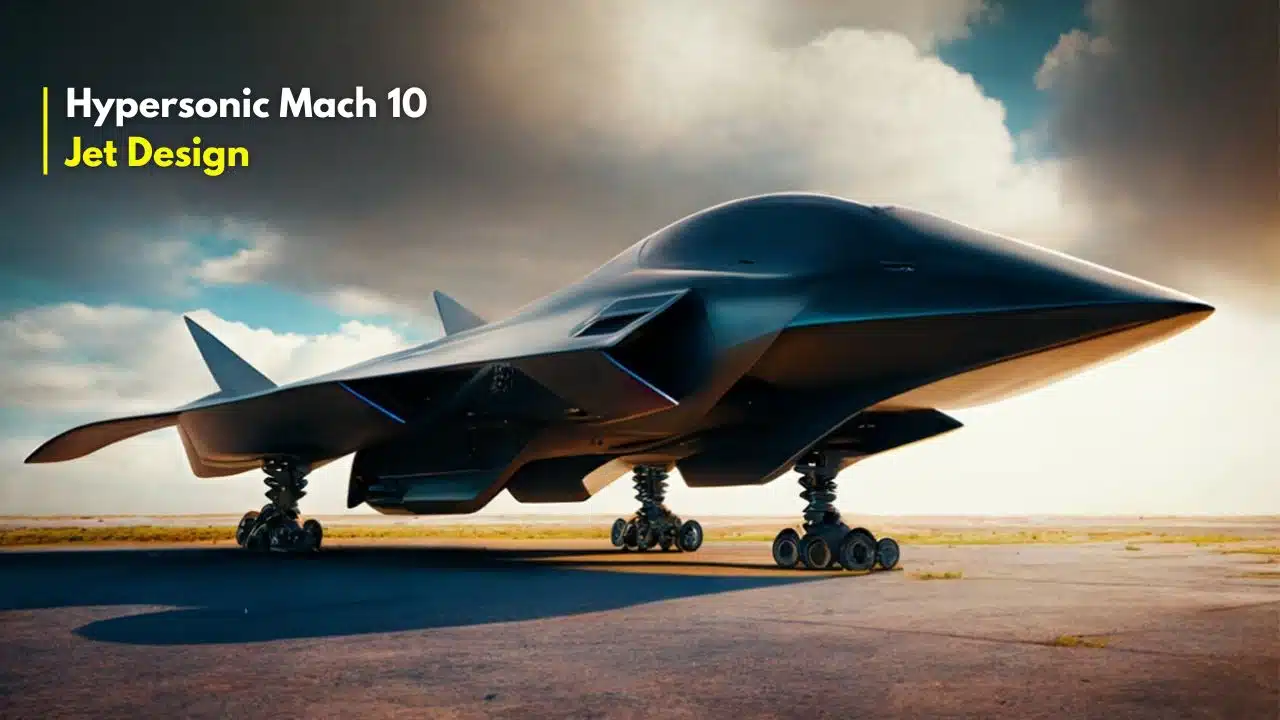
Researchers have experimentally validated a revolutionary engine theory that dramatically simplifies hypersonic flight, unlocking a viable path toward aircraft capable of sustained speeds from Mach 6 to Mach 17. This breakthrough in Mach 10 Jet Design pivots on harnessing the power of a “frozen explosion,” a concept that could make next-generation engines significantly shorter, lighter, and more efficient than current complex scramjet designs.
The landmark study, led by engineers at the University of Central Florida (UCF) and published in the Proceedings of the National Academy of Sciences (PNAS), provides the first concrete experimental proof of a stabilized oblique detonation wave. This validation solves a fundamental physics problem, shifting the global hypersonic race from a question of if such an engine is possible to how fast it can be engineered for flight.
As of late 2025, this validated theory is underpinning a new generation of research focused on engineering and reliability, all while Western defence agencies, including DARPA, are launching ambitious new programs to fund the very propulsion systems this discovery enables.
The Hypersonic Hurdle: A Problem of Complexity
For decades, the primary candidate for air-breathing hypersonic flight—traveling at more than five times the speed of sound, or Mach 5—has been the scramjet (supersonic combustion ramjet).
A scramjet is an engineering marvel, but also a complex beast. It has no moving parts like a traditional jet engine, but to function, it must slow the incoming hypersonic air to supersonic (not subsonic) speeds, inject fuel, mix it, and complete combustion, all in a few milliseconds before the air exits the engine.
This mixing process, known as deflagration (a rapid burn), requires time and distance. The result is that scramjet engines must be very long and are exquisitely sensitive to the shock waves inside. This adds significant weight, structural complexity, and numerous potential points of failure to the aircraft. The challenge of a Mach 10 Jet Design using this technology has been formidable.
A ‘Frozen Explosion’: The Oblique Detonation Breakthrough
The UCF study validated a far simpler, and more powerful, alternative: the Oblique Detonation Wave Engine (ODWE).
Instead of the relatively slow burn of a scramjet, an ODWE is designed to use a detonation—an explosion that moves at supersonic speed. The core theory, now proven, is that this immensely powerful detonation can be “frozen in space” and held stationary inside the engine.
Here’s how it works:
- Hypersonic air (e.g., Mach 10) mixed with fuel is channeled toward a simple ramp or wedge inside the engine.
- This ramp creates an “oblique shock wave” that stands rigidly in the flow.
- The intense pressure and temperature increase from this shock wave is precisely calibrated to instantly detonate the fuel-air mixture.
- This controlled, continuous explosion, fixed in place by the ramp, generates immense, stable thrust.
The UCF Validation: From Theory to Reality
For years, this was only a theory. No one had been able to prove that a detonation, inherently an unstable phenomenon, could be controlled and stabilized long enough to power a vehicle. Most experiments failed or produced a detonation that lasted only milliseconds.
The team at UCF, led by Associate Professor Kareem Ahmed, built a unique test facility called the Hypersonic High-Enthalpy Reaction (HyperREACT) facility. In this chamber, they not only created a stable oblique detonation wave but, crucially, kept it stable and stationary for 3 seconds.
While 3 seconds may sound brief, in the world of hypersonic physics, it is an eternity. It proved the system is stable and that the physics holds true, paving the way for designs that can run indefinitely.
Data & Impact: Why This Simplifies Mach 10 Jet Design
The implications of this validated theory are transformative for aircraft design.
Shorter, Lighter, More Efficient Engines
The primary advantage is simplification. Because the detonation is nearly instantaneous and coupled with the shock wave, an ODWE does not require the long mixing chamber of a scramjet.
- Statistic 1: Simplified Geometry. The entire combustion process occurs in a very short distance. This means the engine, and by extension the entire vehicle, can be “significantly shorter” and lighter than a scramjet designed for the same mission.
- Statistic 2: Immense Speed Envelope. The UCF team’s analysis showed this technology is viable for flight speeds between Mach 6 and Mach 17 (approx. 4,600 to 13,000 mph). This comfortably covers the Mach 10 Jet Design goal and opens possibilities for vehicles that could fly from New York to London in under 30 minutes.
- Statistic 3: Higher Efficiency. Detonation-based engines operate on the Humphrey cycle, which is theoretically more efficient than the Brayton cycle that governs traditional jet engines and scramjets. This translates to more thrust for the same amount of fuel, increasing range and reducing payload costs.
Official & Expert Voices on the Revolution
The validation was met with excitement from the aerospace and defence community.
Gabriel Goodwin, an aerospace engineer at the Naval Research Laboratory and co-author of the study, noted at the time that the work was “crucial to advancing our understanding of these complex phenomena” and was helping to answer “fundamental questions” that would enable the design of engineering-scale systems.
The Path Forward: From Lab Validation to Flight (2025 Context)
The 2021 study was the validation of the core physics. The work in 2025 is now focused on the engineering. The core theory is being used to design functional, reliable engine prototypes.
Recent publications in 2025 show that research has intensified, focusing on new design geometries and reliability. A review paper published on ResearchGate in August 2025 analyzes the progress in “standing oblique detonation,” focusing on “conical” engine designs (using a cone instead of a flat ramp) and the critical challenge of “reliable initiation” under varying flight conditions.
This academic push is mirrored by a massive strategic investment from the U.S. government. In October 2025, the Defense Advanced Research Projects Agency (DARPA) launched a new program to design a “High Mach Gas Turbine (HMGT)” engine, signaling a major push for reusable hypersonic aircraft. While the HMGT program is focused on turbine-based systems, it highlights the immense priority and funding now being channeled into the exact reusable hypersonic sector that the ODWE is poised to revolutionize.
The primary hurdle, as noted by a October 2025 Purdue University report, is now a “worker shortage” across the hypersonics industry, demonstrating how quickly the field is expanding.




























