
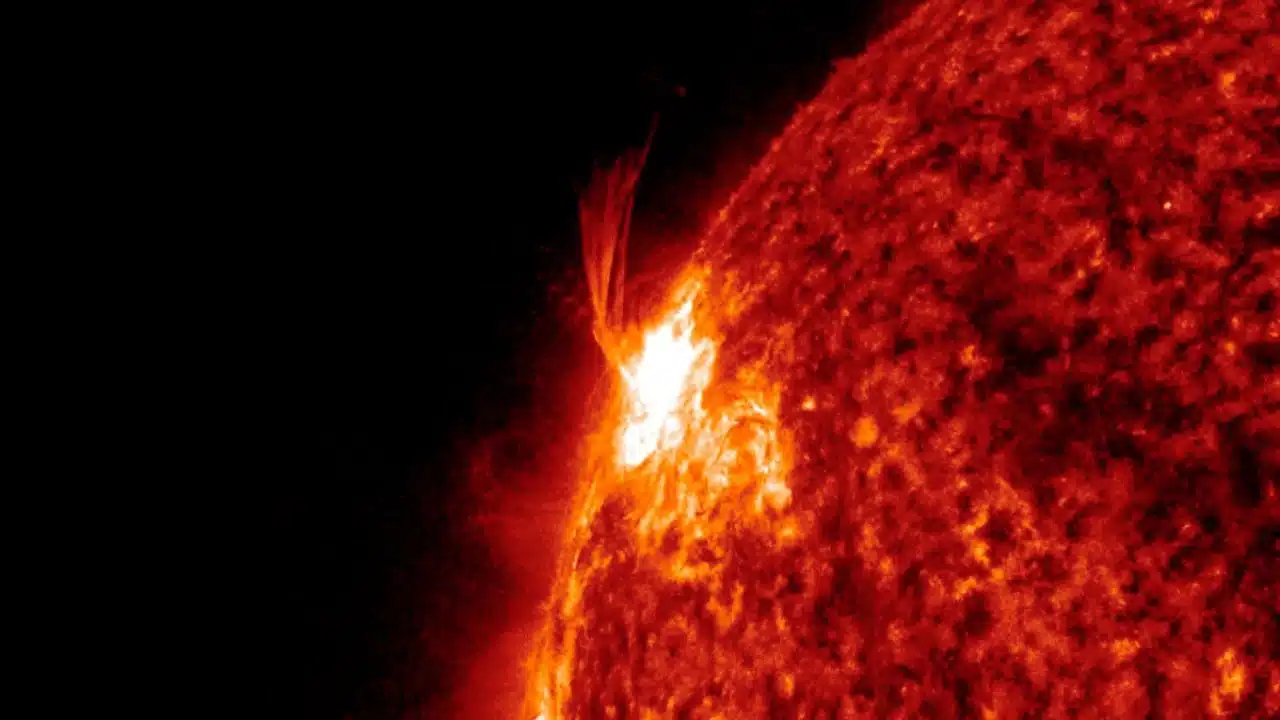
NOAA reported an M5.1 solar flare from a newly emerging active region, underscoring that Solar Cycle 25 remains in a highly active phase that can disrupt radio and navigation signals on Earth.
What happened on the Sun
NOAA’s Space Weather Prediction Center (SWPC) said an M5.1 flare occurred at 27/0150 UTC and appeared to originate from a new active region just northwest of Active Region (AR) 4323.
SWPC issues flare alerts at the M5 threshold, because flares at or above this level can produce notable impacts in Earth’s ionosphere.
SWPC’s GOES X-ray measurements are a primary way forecasters track flare strength in real time and determine when thresholds for alerts are met.
Why an “M5” flare matters
Solar flares are categorized by peak soft X-ray output into letter classes (A, B, C, M, X), with each step representing a tenfold increase in X-ray intensity.
SWPC notes that large X-ray flares can change Earth’s ionosphere and block or degrade high-frequency (HF) radio transmissions on the sunlit side of the planet.
Not every flare launches a coronal mass ejection (CME), but flares are commonly associated with CMEs that can later drive geomagnetic storms if Earth-directed.
What it can do on Earth
SWPC explains that under normal conditions, HF radio signals (about 3–30 MHz) can travel long distances by refracting off upper ionospheric layers.
During a strong flare, added ionization in the lower D-layer increases collisions that absorb HF energy, which can degrade signals or cause a short-lived blackout.
These flare-driven disruptions are classified on NOAA’s R-scale (radio blackouts), where higher levels indicate more severe and widespread HF impacts.
Typical impacts from flare-driven radio blackouts
SWPC states that radio blackout categories are directly related to the flare’s maximum peak in soft X-rays reached or expected.
In practical terms, the most immediate risks tend to be on the dayside of Earth, affecting aviation, maritime, amateur radio, and some navigation users depending on frequency and region.
SWPC also highlights that its D-Region Absorption Prediction (D-RAP) product correlates flare intensity with expected D-layer absorption strength and geographic spread.
| NOAA radio blackout level | X-ray level example | What it can disrupt (typical) |
| R1 (Minor) | M1 | Minor HF degradation on the sunlit side; occasional loss of contact. |
| R2 (Moderate) | M5 | Wider HF degradation/blackout potential on the sunlit side than R1, especially at lower HF frequencies. |
| R3–R5 (Strong–Extreme) | X-class | Increasing risk of broader and longer HF blackouts and navigation impacts as intensity rises. |
Why Solar Cycle 25 is the backdrop
NASA and NOAA announced in October 2024 that the Sun had reached the solar maximum period of its 11-year cycle, and said this maximum phase could continue for the next year.
At solar maximum, the Sun transitions into a more magnetically active and stormy state, and the Sun’s magnetic poles flip around the height of the cycle.
That context helps explain why an M5-class flare in late 2025 fits a broader pattern of heightened flare and sunspot activity during Cycle 25.
What forecasters expected for the peak
SWPC’s Solar Cycle 25 prediction information states the panel forecast a Cycle 25 maximum of 115 (smoothed sunspot number) occurring around July 2025, with uncertainty that places the peak timing between November 2024 and March 2026.
NASA also reiterated that scientists expected activity to ramp up toward a predicted maximum around July 2025 as Solar Cycle 25 progressed.
Because “solar maximum” is a period rather than a single day, elevated flare rates can persist even as different indicators peak at different times.
| Solar Cycle 25 metric (official forecast framing) | What it indicates |
| Predicted peak timing | July 2025 (± 8 months). |
| Peak timing window (with uncertainty) | Between Nov 2024 and Mar 2026. |
| Predicted peak strength (smoothed sunspot number) | 115 (with expected range roughly 105–125). |
| What “solar maximum” means operationally | A higher-activity period that can last many months and features more sunspots and eruptive events. |
What to watch next
SWPC emphasizes that X-ray flares can be associated with CMEs, and CMEs are a key driver of geomagnetic storms that can affect satellites, communications, and power systems.
For near-term planning, SWPC’s operational products (alerts, watches, warnings, and forecasts) are designed to help operators monitor flare impacts and broader space-weather risk.
If additional flares emerge from the same developing region, the main practical question becomes whether any associated CME is Earth-directed, since that largely determines whether aurora and geomagnetic storm conditions follow.
What readers can do (practical, non-alarmist)
- If using HF radio, expect the highest short-term risk during daylight hours in affected regions because flare impacts concentrate on Earth’s sunlit side.
- If relying on precise GNSS navigation for work, monitor SWPC updates during active periods, since ionospheric disturbance can degrade radio propagation and related services.
- For general audiences, treat SWPC as the official U.S. source for alerts and forecast context during elevated solar activity.
Final thoughts
An M5-class flare is not rare during a busy solar cycle, but it is strong enough that forecasters routinely flag it due to its potential to disrupt HF communications on the dayside of Earth.
With NASA and NOAA describing the Sun as being in its solar maximum period, additional bursts of flare activity remain plausible as Cycle 25’s active phase continues.
The most important “what comes next” signal is whether future eruptions pair with Earth-directed CMEs, which would raise the odds of geomagnetic storm impacts beyond short-lived radio blackouts.