Building a low risk high return portfolio in 2026 is no longer about playing it safe—it’s about choosing the right mix of assets that protect your money while helping it grow steadily. Investors everywhere are asking the same question: Is it still possible to get decent returns without taking huge risks in 2026?
Interest rates are higher than the ultra-low levels of the 2010s. Stock markets are more volatile and concentrated in a handful of big technology and AI names. Inflation has cooled from recent peaks, but it still eats away at idle cash.
In this environment, the appeal of low-risk, high-return investments in 2026 is obvious. People want growth. But they also want stability, capital protection, and peace of mind.
It is an educational overview, not personal financial advice. Every investor should consider local regulations, taxes, and currency risks before implementing any strategy.
What “Low Risk, High Return” Really Means in 2026
A “low risk, high return” strategy in 2026 does not mean eliminating risk—it means taking only the risks that truly reward you. Markets today are shaped by higher interest rates, selective equity growth, and steady but persistent inflation. That creates an opportunity for investors who want stability without sacrificing long-term performance.

The Real Risk–Return Trade-Off
There is no such thing as a completely safe investment with guaranteed high returns. Risk and return are always linked.
However, you can build a portfolio that offers:
- Lower volatility than a pure stock portfolio
- Better return potential than cash or term deposits
- Smaller drawdowns during market shocks
In 2026, low-risk risk high-return investments usually mean a mix of:
- Quality bonds
- Defensive, income-focused equities
- Diversifying assets such as real estate investment trusts (REITs) or infrastructure
- A modest cash buffer
The goal is not to avoid risk. The goal is to take the right kinds of risk, in the right amounts, and be paid fairly for it.
The Risks You Must Manage
For a conservative investment portfolio strategy, it helps to understand the main risks:
- Market risk: Stock prices can fall sharply, especially in hot sectors.
- Interest rate risk: Bond prices can move when rates rise or fall.
- Credit risk: Corporate bonds carry default and downgrade risk.
- Inflation risk: Cash and low-yield deposits may lose real value over time.
- Currency risk: Cross-border investing adds exchange-rate volatility.
A low volatility investment portfolio aims to reduce these risks through diversification and asset selection, not eliminate them.
Setting Realistic Return Expectations
A low-risk portfolio is unlikely to return 20–30% per year. That is a speculation profile, not a conservative one.
For the best low-risk investments for 2026, realistic annual returns may sit in:
- Very conservative portfolios: 3–5% per year, depending on bond yields and inflation
- Conservative portfolios: 4–7% per year
- Moderate portfolios: 5–9% per year
Actual outcomes will vary. The important point is to think in ranges, not single numbers.
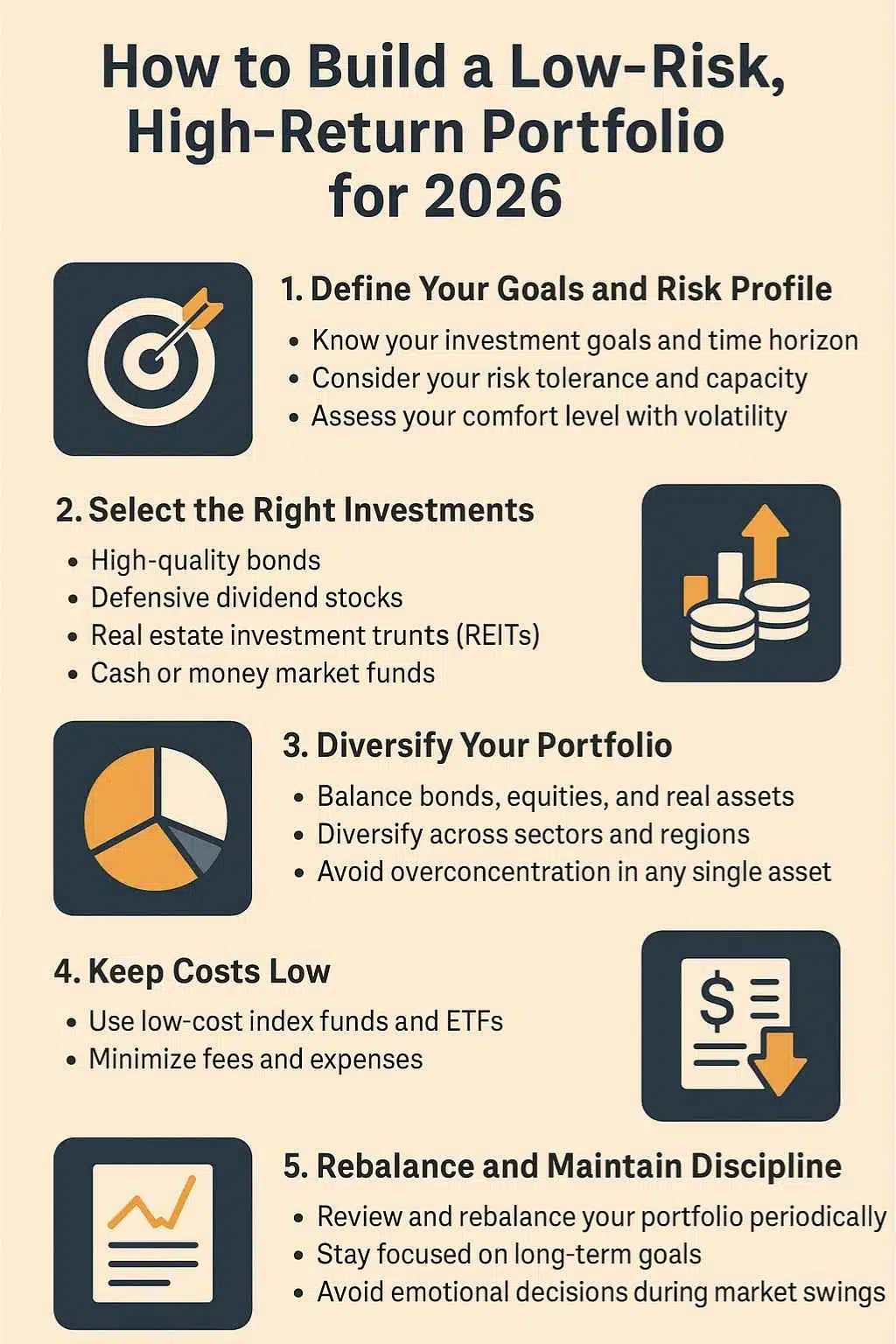
Step 1: Define Your Goals, Time Horizon, and Risk Profile
Before picking any investment, you need clarity on three things:
Start With Your “Why”
Ask yourself:
- What am I investing in?
- When will I need this money?
- How much loss could I tolerate along the way?
Common goals include:
- 1–3 years: building an emergency buffer or saving for a near-term purchase
- 3–7 years: education, business expansion, home upgrades
- 7+ years: retirement, long-term wealth building
Short-term goals call for more capital protection. Long-term goals allow more growth assets.
Risk Capacity vs Risk Tolerance
These two ideas sound similar but differ:
- Risk capacity is your ability to take risks. It depends on income, job stability, existing savings, debt level, and family responsibilities.
- Risk tolerance is your emotional comfort with volatility. It answers the question: how will I react if my portfolio drops 10–20%?
A good low risk high return portfolio in 2026 respects both. Even if you can afford risk, taking more than you can emotionally handle will likely lead to mistakes.
Quick Self-Assessment
You may be:
- Very Conservative: any loss feels painful, need money soon.
- Conservative: can tolerate small fluctuations but not large swings.
- Moderate: willing to accept volatility for better long-term growth.
Keep this in mind as you read the sample portfolio frameworks below.
Step 2: Choose the Right Building Blocks for 2026
Now we look at the main components of safe investments with high returns, or at least attractive risk-adjusted returns, in 2026.
Fixed Income: The Core of a Low-Risk Portfolio
Bonds are the backbone of many conservative investment portfolio strategies. With yields more attractive than in previous ultra-low-rate years, they deserve renewed attention.
Key options include:
- Government bonds / Treasuries: Generally low credit risk. Good for capital protection and moderate income.
- Investment-grade corporate bonds: Higher yield than government bonds, with slightly higher risk. Bond funds and ETFs provide diversification.
- Inflation-linked bonds: These protect purchasing power by adjusting to inflation.
- Short-duration bond funds: Less sensitive to interest rate changes, often used to reduce volatility.
For most retail investors, low-cost bond ETFs or diversified bond funds are simpler than picking individual bonds.
Equities: Growth With a Defensive Tilt
Equities are still essential for long-term growth and inflation protection. But in a low risk high return portfolio in 2026, the focus shifts to quality and resilience.
Consider:
- Dividend-paying blue-chip stocks: Large, stable businesses that share profits via regular dividends.
- Low-volatility or quality-factor ETFs: These target companies with strong balance sheets, stable earnings, and lower price swings.
- Global diversification: Avoid concentrating only in one country or one sector. Spread exposure across regions and industries.
This approach seeks upside participation but reduces exposure to speculative, high-beta names.
Real Assets and Alternatives
Real assets can add income and diversification:
- REITs (real estate investment trusts): Provide exposure to property markets without direct ownership. Often offer higher yields.
- Listed infrastructure: Utilities, toll roads, energy pipelines, and similar assets with stable cash flows.
- Gold and commodities: Potential hedges during inflation or market stress, best used as small satellite allocations.
For a low-risk brief, complex alternatives, leveraged products, or highly illiquid instruments are usually not necessary.
Cash and Cash-Like Instruments
Cash still plays a role in low-risk, high-return investments, 2026:
- High-yield savings accounts and money market funds can provide modest returns with daily liquidity.
- Short-term treasury bills are often seen as very safe for capital preservation.
However, holding too much cash for too long can reduce your real returns if inflation stays above deposit rates. The balance between liquidity and growth is critical.
Step 3: Model Portfolios for 2026 (From Very Conservative to Moderate)
Below are three sample frameworks. They are not prescriptions, but starting points you can customise.
Portfolio A: Capital Preservation Plus (Very Conservative)
Ideal for near-retirees or anyone who wants minimal volatility and is focused on capital protection.
Example allocation:
- 60–70% high-quality bonds (government and investment-grade, with a tilt to short or intermediate duration)
- 10–15% cash or money market funds
- 15–25% defensive equities (dividend blue chips, low-volatility ETFs)
- Optional 5% gold or infrastructure equities
This portfolio prioritises stability. Returns may be modest, but drawdowns during market stress should be less severe than in equity-heavy allocations.
Portfolio B: Balanced Income and Growth (Conservative)
A strong candidate for many investors searching for the best low-risk investments for 2026. It blends income with moderate capital growth.
Example allocation:
- 40–50% high-quality bonds
- 10% cash buffer
- 35–45% global equities (focus on quality, dividends, and diversification)
- 5–10% REITs and infrastructure
This structure aims for a smoother ride than a 60/40 equity–bond mix but still targets reasonable long-term returns.
Portfolio C: Growth With Downside Protection (Moderate)
Suitable for investors with longer horizons and slightly higher risk tolerance, who still want some defence.
Example allocation:
- 25–35% bonds
- 5–10% cash
- 50–60% global equities (mix of broad market index funds and quality-factor or dividend ETFs)
- 5–10% real assets (REITs, infrastructure, selective commodities, or gold)
This can form a low volatility investment portfolio compared with an all-equity approach, while preserving strong growth potential.
Customising the Model Portfolios
Adjust any of these templates by:
- Increase bonds and cash if you feel too exposed to volatility
- Reducing equities or real assets if a recent market rally makes you uncomfortable
- Considering domestic vs international exposure based on your currency and future spending plans
Step 4: Implement the Portfolio at Low Cost
Even the best-designed portfolio can fail if costs are too high. Fees eat directly into returns.
Why Costs Matter
A seemingly small 1–2% annual fee difference can compound into a major gap in long-term outcomes. For low-risk, high-return investments in 2026, controlling costs is one of the easiest “wins” available.
Using ETFs and Index Funds
ETFs and index funds are often the most efficient tools to build a diversified portfolio strategy. When comparing products, review:
- Total expense ratio (TER)
- Tracking error vs benchmark
- Liquidity and typical bid–ask spread
- Fund size and provider reputation
A small group of broad, low-cost funds can usually replace a complicated collection of expensive products.
Robo-Advisors and Digital Platforms
Robo-advisors use algorithms and model portfolios to construct and manage investments automatically.
For cautious investors, they can:
- Offer conservative, balanced, or moderate portfolios
- Handle automatic rebalancing
- Sometimes, optimise tax efficiency in eligible accounts
If your goal is a low risk high return portfolio for 2026 and you prefer a hands-off approach, a reputable robo-advisor can be a practical solution.
Direct Stocks vs Funds
Picking individual stocks offers more control but requires more research and discipline. Funds offer simplicity and diversification.
For most investors, building the core of their conservative investment portfolio strategy with funds, and optionally adding a small sleeve of carefully chosen blue-chip stocks, is a balanced approach.
Step 5: Risk Management and Rebalancing
Effective risk management and regular rebalancing keep your portfolio aligned with your long-term goals in 2026. By adjusting allocations and maintaining discipline, you reduce volatility and prevent your investments from drifting into higher-risk territory.
Rebalancing: Your Built-In Discipline
Over time, market movements will push your allocations away from target. Tech stocks may surge. Bonds may lag or rally. Cash may pile up.
Rebalancing means:
- Selling assets that have grown beyond their target share
- Adding to assets that have fallen below target
This enforces a “buy low, sell high” discipline. Many investors rebalance once or twice a year, or when allocations move more than 5 percentage points away from targets.
For a low risk high return portfolio in 2026, rebalancing helps:
- Prevent overexposure to boiling-hot sectors
- Keep risk aligned with your original plan
- Capture gains and redeploy them into lagging but still attractive areas
Simple Hedging Without Complexity
You do not need sophisticated derivatives to manage risk.
Simple tools include:
- A modest allocation to gold or defensive sectors
- Using low-volatility equity funds
- Maintaining a cash buffer for emergencies and opportunities
Complex hedging strategies may add costs and confusion without clear benefits for most individual investors.
Scenario Thinking for 2026–2028
Consider how your portfolio would behave if:
- Interest rates fall faster than expected (bonds may rally, some high-yield assets may run)
- Inflation stays sticky (real assets and inflation-linked bonds may help)
- Geopolitical tensions hit specific regions (global diversification reduces concentration risk)
Thinking ahead does not mean guessing the future. It means checking that your portfolio is adaptable rather than fragile.
Step 6: Taxes, Currency, and Behaviour
Taxes, currency movements, and emotional decision-making can quietly reduce your long-term returns. Managing tax efficiency, choosing the right currency exposure, and avoiding behavioural mistakes help keep your portfolio stable and focused on real growth.
Taxes: Focus on Net Return
An investment that looks attractive before tax may be less appealing after tax.
To improve net outcomes:
- Use tax-advantaged accounts where available
- Place income-heavy assets (high-yield bonds, REITs) in more tax-efficient wrappers if possible
- Avoid unnecessary trading that triggers frequent capital gains
The specifics vary by country, but the principle is universal: net return matters more than headline yield.
Currency Considerations
If you invest globally, currency movements can help or hurt returns in your home currency. Key ideas:
- Hedged funds reduce currency volatility, usually at a cost
- Unhedged funds give you both asset and currency exposure
- Match your currency exposure with your future spending plans when possible
For example, if you plan to retire abroad or pay for overseas education, having part of your portfolio in that currency can make sense.
Behavioural Traps to Avoid
Even the best low risk high return portfolio in 2026 can fail if behaviour is poor.
Common mistakes include:
- Chasing recent winners and hot themes
- Panic selling after short-term losses
- Overconfidence after a good year, leading to higher risk and leverage
- Constantly changing strategy based on headlines or social media
A written plan, clear rules, and scheduled reviews reduce the impact of emotions on decisions.
Common Mistakes to Avoid in 2026
To protect both capital and returns, be careful of:
- Equating “low risk” with “all cash”: This ignores inflation and opportunity cost.
- Over-concentration in one sector or region: Especially in hot trends such as AI or speculative technology.
- Ignoring bond opportunities: Bonds and cash-like instruments can now offer better yields than in recent years.
- Using leverage without full understanding: Margin trading and complex structured products can turn a low-risk plan into a high-risk gamble.
- Neglecting rebalancing: Letting allocations drift can gradually turn a conservative profile into a much riskier one.
Action Plan: Build Your 2026 Portfolio in 7 Practical Steps
- Write down your goals and timeframe for each goal.
- Assess your risk profile honestly: very conservative, conservative, or moderate.
- Select a model portfolio (A, B, or C) that feels closest to your profile.
- Map each allocation bucket to specific low-cost funds or instruments available in your market.
- Automate monthly contributions if possible, so the portfolio grows steadily without constant decisions.
- Schedule portfolio reviews once or twice a year, and rebalance according to simple rules.
- Stick to the plan, refine slowly, and avoid reacting to short-term noise.
FAQs: Low Risk High Return Investments in 2026
Can you really get high returns with low risk in 2026?
You can aim for better risk-adjusted returns, not high returns with zero risk. Diversification, quality assets, and cost control can improve outcomes compared with cash-only strategies or concentrated bets.
What is a realistic annual return for a conservative investor now?
For many conservative portfolios, a realistic range might be 4–7% per year over time. Actual results depend on bonds, inflation, and equity performance.
How often should I rebalance my portfolio?
Once or twice a year is enough for most people. You can also rebalance when an asset class moves more than about 5 percentage points away from its target allocation.
Should I use a robo-advisor or manage investments myself?
If you prefer convenience and lack the time or interest to manage your own allocations, a robo-advisor can be a good tool. If you enjoy research and can stay disciplined, a do-it-yourself approach using low-cost funds also works.
Is it safe to invest in bonds if interest rates might move again?
No investment is fully “safe”, but high-quality bonds are still among the most stable assets available. You can reduce interest rate risk by mixing shorter and intermediate durations.
How much of my portfolio should be in cash in 2026?
Enough to cover emergencies and near-term goals, plus a small buffer for flexibility. Too much cash, however, may hold back long-term growth and make it hard to meet your objectives.
By following these principles, you can design a low risk high return portfolio in 2026 that fits your situation, respects your risk tolerance, and gives you a disciplined path toward your financial goals—without trying to predict every move of the market.
Bottom Line
A low risk high return portfolio for 2026 isn’t about chasing quick gains—it’s about balance, discipline, and choosing the right mix of bonds, defensive equities, real assets, and cash. With smart diversification, regular rebalancing, and a focus on long-term goals, you can grow wealth steadily while keeping risk under control.