Have you ever felt like your business is leaking money? You probably have a feeling that somewhere between getting an order and delivering a product, time just vanishes. Your team works incredibly hard, but those profits stubbornly stay the same. Most businesses lose thousands of dollars every single year to hidden inefficiencies. We are talking about redundant steps, outdated systems, and employees spending half their day on tasks that do not create real value.
The frustration is completely valid, and the stakes for your business are very high. Companies that implement Lean waste management cut their operational costs significantly.
In fact, a 2025 survey from SixSigma.us showed that organizations using lean management cut their operational costs by 20% to 30% within their first year. You do not need a massive budget or a complete overhaul to start seeing these kinds of results.
I will walk you through exactly how to spot hidden waste and apply proven lean principles to fix it. We will cover the specific tools that actually work and how to get your team on board.
What is lean operations?

Lean operations is a practical management style that focuses on maximizing value while cutting out waste. Your company produces real value when it performs activities that your customers actually want and will gladly pay for.
Everything else represents waste that drains your resources and slows down your team. This includes excessive inventory sitting on shelves and redundant approval steps in your software.
A recent 2025 study by the Boston Consulting Group found that improving cost efficiency is now the top critical priority for a third of global executives. Lean management gives you the exact framework to achieve that efficiency. It teaches you to spot wasteful activities, cut them out, and streamline your entire workflow.
This philosophy started in manufacturing, but today it applies to every single industry. Retailers, healthcare clinics, and software companies all use lean principles to make their operations faster and much cheaper.
Continuous improvement sits right at the center of this approach. You do not just fix a process once and forget about it. Instead, you build a workplace culture where every employee actively looks for better ways to work.
- Process improvement is everyone’s job. It is not just a task for your management team.
- You rely on visual tools. Techniques like value stream mapping show you exactly where the waste hides.
- You measure real numbers. You track key performance indicators to prove your results.
The main goal is incredibly straightforward. You want to deliver more value to your customers with fewer resources, less time, and much less effort.
“Lean is not about working harder; it is about working smarter by eliminating everything that doesn’t add value.” – Taiichi Ohno, Toyota Production System Pioneer
Why is Lean waste management critical for business success?
Waste drains your profit margins faster than a leaky pipe drains a water tank. Every dollar you spend on unnecessary steps or excess inventory is a dollar that vanishes from your bottom line.
Your competitors who actively cut waste will simply move faster than you. They respond quicker to their customers, and they keep more cash in their bank accounts. Operational excellence demands that you attack waste at every single opportunity.
Process improvement efforts help you deliver better value while spending far less money. Just look at the math from recent industry data.
According to 2025 data from SixSigma.us, a single targeted “Kaizen” improvement event saves an average of $27,000 with almost zero capital investment.
Your team members probably spend their days fighting against broken systems. Continuous improvement frees your people from those frustrating roadblocks so they can focus on work that actually matters.
When your organization masters this kind of efficiency, you build a culture of proactive problem solvers. This shift transforms your business from the ground up, making you a tough competitor in any market. Now, we will explore exactly how you can recognize this waste hiding in your own daily workflows.
Recognizing Waste in Your Business
You are likely throwing away money right now without even realizing it. Let us find out exactly where that waste is hiding.
Defining waste in the context of lean.
Waste means anything that does not add direct value for your customer. It is the friction that slows you down, costs you money, and annoys your staff.
In a physical product business, waste often looks like extra inventory taking up expensive warehouse space. In a service business, it usually looks like duplicate data entry or waiting three days for a manager’s approval.
Lean management treats all of these problems exactly same way. You have to find them, measure them, and get rid of them. Your business burns precious resources on activities that your customers never asked for. That is a waste, plain and simple.
“Waste is any activity that consumes resources without creating value for the customer.” – Lean Operations Philosophy
Continuous improvement means you permanently stop accepting lazy excuses for bad workflows. Value stream mapping helps you see the complete truth about your operations.
Some problems are loud and obvious, like a printer that jams every ten minutes. Other types of waste sneak around quietly, like an employee spending an hour searching for a digital file.
Operational excellence requires you to spot both the loud and the quiet problems. Your team already knows where these issues live, so you just need to give them permission to speak up.
The seven types of waste
Lean operations specifically target seven categories of waste that drain your resources. Knowing these types helps you spot problems instantly.
- Transportation waste: This happens when you move materials, products, or information more than you need to. Poor facility layouts create extra trips between departments. Reorganizing your workspace easily slashes these specific transportation costs.
- Inventory waste: Stocking too much raw material ties up your cash. A December 2025 Logistics Managers Index report showed US warehouse utilization hit an all-time low of 42.9, proving that smart companies are aggressively clearing out their excess stock. Just-in-time systems ensure you only keep what you need for today.
- Motion waste: This involves unnecessary movements by your employees. Reaching for poorly placed tools or walking across the building to find a file counts as motion waste. Simple ergonomic improvements can eliminate these tiny, expensive delays.
- Waiting waste: Processes stall when bottlenecks occur. Your team might wait around for an approval email or a piece of equipment. Streamlining your handoffs between departments will eliminate these very frustrating gaps in productivity.
- Overproduction waste: Making more products than your customers want is a massive mistake. You create excess items that might never sell. Accurate demand forecasting prevents this issue entirely.
- Over-processing waste: This happens when you add unnecessary features or redundant inspections to a product. To fix this, teams often use software like Lucidchart or eVSM to map their exact steps and cut out the redundant touches that customers do not care about.
- Defects and rework waste: Mistakes force you to scrap materials and start over. Every single defect multiplies your costs. Implementing quality enhancement steps catches errors early before they ruin a whole batch.
Core Principles of Lean Waste Management
Three major philosophies shape this approach. You need to respect your people, focus on the flow of work, and chase perfection relentlessly.
Key philosophies
Lean operations rest on a few very practical ideas that should guide your daily decisions. First, you must focus on value strictly from your customer’s perspective. You have to strip away everything else.
Second, you map out your entire value stream. This lets you clearly see where work flows nicely and where it suddenly stalls.
Third, you eliminate waste relentlessly. As we covered, those seven types of waste drain your profits quickly.
- Respect your people: Involve them in your continuous improvement efforts. Your frontline workers see tiny problems that leaders usually miss.
- Aim for flow: Work should move smoothly through your business without bottlenecks.
- Pull work based on demand: Only produce what is actually ordered. This just-in-time approach keeps your cash flowing nicely.
You must challenge the status quo constantly. Ask why things happen the way they do, and refuse to accept lazy answers.
Your team members should drive optimization by spotting inefficiencies in their own daily tasks. You can measure their progress through key performance indicators, like tracking a lower defect rate.
Operational excellence naturally emerges when you combine these philosophies into a living, breathing system. Streamlining becomes a permanent part of your company culture.
Identifying Wasteful Processes
Finding hidden money drains requires you to look at your daily operations with a fresh set of eyes.
Visualizing Your Workflow
You cannot fix what you cannot see. These visualization tools help you build a clear picture of your current reality.
- Value stream mapping: This shows every single step a product takes from start to finish. Teams often use modern software like Businessmap or Microsoft Visio to build these maps digitally.
- Process analysis: This breaks down each task into tiny parts. It reveals which actions add value and which ones just burn your time.
- Flowcharts: These create a simple visual picture of how work moves. They make it incredibly easy to see exactly where your processes get tangled up.
- Walk-throughs: This involves managers physically walking through the work areas. You will catch physical inefficiencies that spreadsheets will never show you.
Measuring Your Data
Once you can see the process, you need hard numbers to understand exactly how bad the waste really is.
- Data collection: This gathers the real numbers about how long steps take and how many errors happen.
- Time studies: These measure precisely how long tasks take an average worker to complete. You will easily see if people are spending too much time on low-value chores.
- Lean metrics: These track specific numbers like cycle time and inventory levels. They give you concrete proof that your optimization efforts are working.
- Six Sigma tools: These measure the variation in your processes. They help your team permanently eliminate the root causes of quality issues.
Engaging Your People and Industry
Your best data often comes directly from conversations and external research.
- Employee interviews: Staff members know about hidden delays that managers miss. Tapping into their knowledge is completely essential.
- Root cause analysis: This digs deep into why a problem happened in the first place. It prevents you from relying on temporary band-aids.
- Benchmarking: This compares your specific processes against industry standards. It shows you exactly what true excellence looks like in your market.
- Just-in-time analysis: This examines your storage systems to find old stock that is just tying up your cash.
Spotting inefficiency takes a sharp eye, but your team members usually know the real story. They easily notice when a machine sits idle or when paperwork starts piling up.
You need to talk to them, watch their workflows, and listen to their honest complaints. These simple conversations often uncover massive waste that raw data cannot show you.
“The best principal engineers I know walk the lines every single morning.” – Expert advice shared on the r/manufacturing community regarding effective Gemba walks.
Common signs of inefficiency pop up everywhere. If employees repeat the same data entry twice, you have a serious process improvement issue. Long wait times between department handoffs will drain your productivity very fast.
World-class manufacturing operations target an OEE score of 85 percent, according to standards set by TPM pioneer Seiichi Nakajima. If your equipment is breaking down constantly and your OEE is closer to 60 percent, you are losing a massive amount of potential revenue.
Hidden sources of waste include outdated legacy software, unclear management communication, and painfully slow approval chains. Lean management tools help you spot these problems quickly.
Effective Strategies to Eliminate Waste
You will cut waste incredibly fast by using proven tools that actually work in the real world.
Top lean waste management tools
These practical instruments help your teams spot problems quickly and fix them before they drain your bank account.
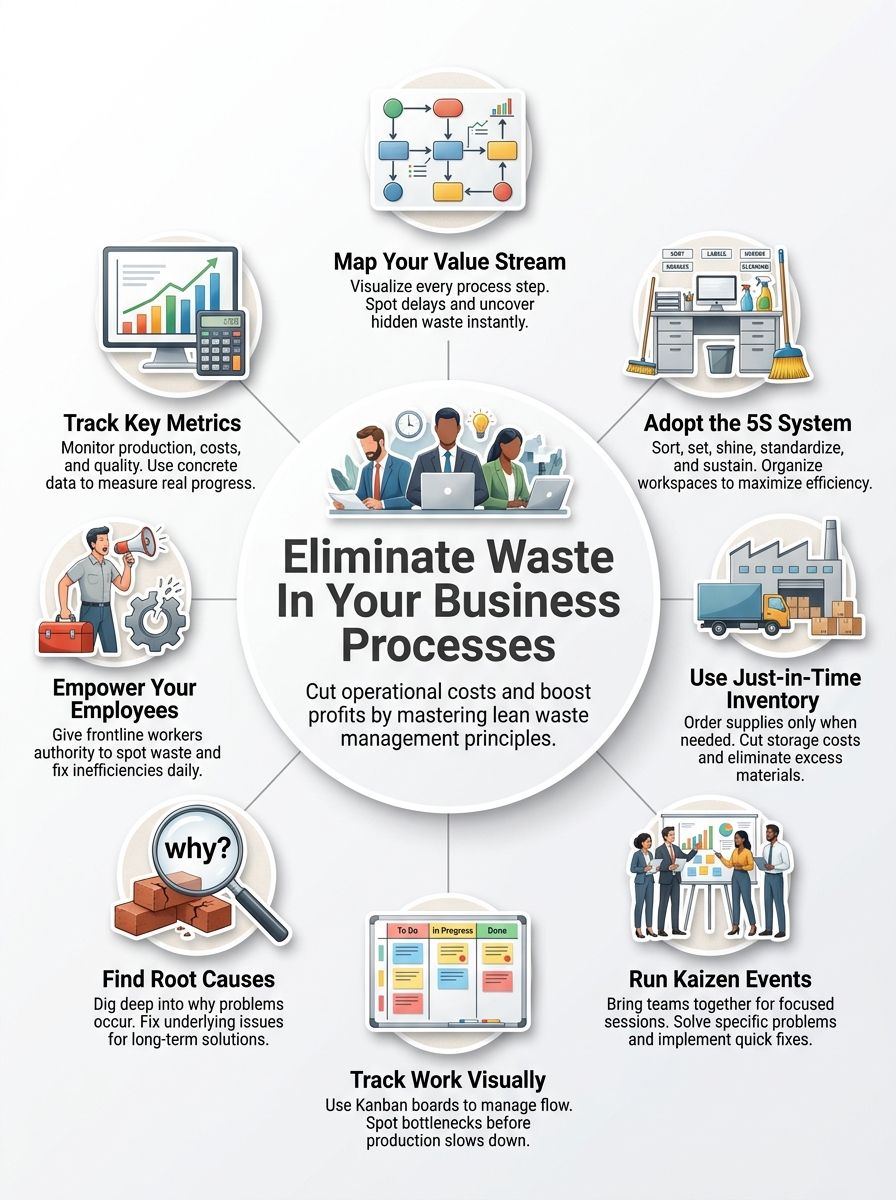
- Value stream mapping: Using software like eVSM shows exactly where your waste hides and where real value gets created.
- The 5S system: This organizes your workspace into five logical stages. You sort, set in order, shine, standardize, and sustain. It makes finding tools incredibly easy.
- Kaizen events: These are focused improvement sessions. Your employees tackle a specific problem head-on and implement a fast solution.
- Just-in-time inventory: This slashes your storage costs. You order supplies exactly when you need them, cutting down on dusty inventory.
- Kanban boards: Teams use visual tracking tools like Trello or Jira to manage their flow and spot bottlenecks instantly.
- Root cause analysis: Tools like the fishbone diagram help you treat the actual disease, rather than just treating the symptoms.
Empowering employees to drive continuous improvement.
Your frontline workers see problems that you will naturally miss. They understand their own workflows better than anyone else in the building.
You must give your employees the actual authority to suggest and test fixes. They will catch small inefficiencies in real-time. Empowering your staff turns them into active problem solvers who genuinely care about operational excellence.
You should create a daily culture where people feel safe sharing their ideas. Hold regular team huddles to discuss what is working and what is completely broken. Listen closely to their feedback regarding inventory control and quality issues.
Train your staff thoroughly on lean principles so they understand why this all matters. When a team implements a great idea that boosts productivity, celebrate that win publicly.
Implementing Lean Across Your Organization
Lean transformation has to start at the top. Leaders must set the tone and commit real money and time to the change.
Phase 1: Planning and Assessment
Transforming your business takes serious planning. You must set a strong foundation first.
- Secure leadership support: Transformation always fails without the backing of executives who control the budget.
- Assess your current state: Map out all of your processes to understand exactly how work flows right now.
- Train your workforce: Teach your employees about waste reduction techniques so they understand the exact philosophy behind the changes.
- Form cross-functional teams: Bring people together from different departments to spot unique inefficiencies.
Phase 2: Execution and Tracking
Once the plan is set, you need to execute it carefully.
- Start with a pilot project: Do not overhaul everything at once. Test your ideas in one specific area to build confidence.
- Use value stream mapping: Visualize every single step to highlight exactly where your resources get wasted.
- Implement just-in-time practices: Reduce your inventory control costs by ordering materials only when you actually need them.
- Measure your progress: Track your cycle time and defect rates to prove that your efforts are working.
Fostering a lean culture and involving your team.
You can map processes all day long, but nothing improves without your people. They work in the trenches every single day.
Involve them from day one. Ask your team members exactly what slows them down and listen to their brilliant ideas. Employees who feel genuinely heard become your absolute best partners in continuous improvement.
Build a strong lean culture by making improvement a normal part of the daily routine. Celebrate the small wins, like when someone figures out a way to cut three steps from a boring paperwork process.
Share these success stories across your entire company. Make it perfectly safe for people to fail while trying a new idea. Your business will achieve flow optimization much faster when people aren’t terrified of making a mistake.
Measuring and Sustaining Lean Success
You track your success through very specific numbers. These measurements keep your efforts strictly on course.
Tracking progress with key performance indicators (KPIs)
Measuring your initiatives requires hard data, not just hopeful guesses. KPIs point you to real progress.

| KPI Category | What It Measures | Why It Matters | Action Steps |
|---|---|---|---|
| Production Efficiency | Output per labor hour, defect rates, and cycle time reduction | Shows if processes run cleaner; directly ties to cash savings | Track daily numbers; compare to your baseline; flag delays |
| Cost Reduction | Material waste; overtime hours; inventory carrying costs | Demonstrates financial impact; proves your investments pay off | Monitor weekly spending; document your direct savings |
| Quality Metrics | Error rates, customer complaints, and rework instances | Lower quality issues build much stronger customer trust | Record all defects; analyze the root causes; celebrate fixes |
| Employee Engagement | Suggestions submitted, participation rates, and safety incidents | Engaged workers spot the tiny waste that managers often miss | Create a suggestion system; reward your best contributors |
| Resource Utilization | Machine downtime, OEE scores, and equipment availability | Prevents idle resources from draining your tight budgets | Target an 85% OEE score; redistribute workloads strategically |
Most smart companies track between five and eight KPIs at the exact same time. Too many metrics will completely overwhelm your team, but too few will leave you with dangerous blind spots.
Review your KPIs monthly or quarterly to spot genuine trends. Share the results openly with your workforce, and explain any setbacks with total honesty. Data-driven decisions will beat personal opinions every single time.
Continuous evaluation and adapting to change
Your lean program needs constant, daily attention. Teams should track their progress weekly to catch minor problems before they explode.
Data shows that companies checking their progress regularly catch problems much faster. You must update your value stream maps as your business shifts, because what worked wonderfully last year might fail today.
Adapting to change means keeping your strategy flexible. Market demands will shift, and new technology will open up completely fresh opportunities.
The very best companies treat lean operations as a living system. Your operational excellence grows significantly stronger when you willingly question your old habits.
Real-World Examples and Lessons Learned
Companies across retail, healthcare, and software have slashed their costs using these exact methods.
Case studies of businesses that achieved results
Learning from the success of others gives you a massive shortcut. Here are two examples of lean principles transforming a business.
- Toyota’s Manufacturing Revolution: Toyota completely revolutionized the manufacturing world by applying lean principles to its assembly lines. They used value stream mapping to spot useless steps, and then they mercilessly eliminated them. They gave their floor workers the actual power to stop the line when they saw a defect, which fixed problems immediately instead of letting them pile up.
- The Software Agency Turnaround: A modern software development company recently faced mounting delays and angry clients. Their developers spent hours waiting for management approvals. The team applied lean management to streamline their process, and they cut their project timelines by thirty percent in just six months.
Best practices for ongoing success
Keep waste from creeping back into your business by following these proven rules.
- Track your KPIs with discipline: Measure your defects and cycle times regularly to catch issues early.
- Empower every employee: Frontline workers see the inefficiencies that managers completely miss.
- Update your maps quarterly: Visualize your current processes to find brand new bottlenecks.
- Invest in staff training: Teach your workforce exactly why waste reduction matters to their own job security.
- Conduct daily Gemba walks: Go directly to the work floor and observe operations directly.
- Celebrate your wins publicly: Reinforce that continuous improvement is highly valued in your company.
The Bottom Line
Eliminating waste completely transforms how your business runs on a daily basis. Organizations that embrace Lean waste management actively cut costs, boost their productivity, and drastically improve their quality.
Your team gains the real power to spot inefficiencies and fix problems fast. Process improvement becomes a natural part of your company culture. Value stream mapping reveals exactly where your cash is leaking, and continuous improvement keeps you highly competitive.
Starting your lean journey today gives you a massive advantage in any market. Methods like Six Sigma and just-in-time practices work perfectly together to streamline your workflows. Employees feel significantly more engaged when they get to help solve complex problems.
FAQs on Lean Waste Management
1. What does lean operations mean for a business?
Lean operations means trimming the fat from your daily workflows to boost efficiency and save your company serious money. A 2025 Lean Enterprise Institute study shows that US organizations using these methods cut operational costs by up to 30%. By cutting out wasted time and energy, it feels just like cleaning out your garage so you only keep the tools you actually use every day.
2. How can I spot waste in my company’s daily work?
The best tool for this is Value Stream Mapping (VSM). By visually mapping every step of a process from start to finish, you can distinguish between “Value-Added” steps (what the customer pays for) and “Non-Value-Added” steps (waste).
3. Can Lean be applied to service industries or just manufacturing?
Absolutely. In services (like software, healthcare, or finance), waste often manifests as “invisible” bottlenecks—such as excessive email chains (Transport), waiting for manager approvals (Waiting), or entering the same data into two different systems (Over-processing).
4. What is “Kaizen” and how does it work?
Kaizen translates to “change for the better” or continuous improvement. It is the philosophy that small, daily changes made by employees at all levels lead to massive long-term gains. It shifts the responsibility of improvement from “management only” to everyone on the team.
5. What are some simple ways to eliminate waste right now?
You can start small by organizing your workspace using the 5S system, which stands for Sort, Set in order, Shine, Standardize, and Sustain. This straightforward method stops people from hunting for misplaced tools and sets clear rules so no one repeats work. You can also track your daily tasks on a digital Kanban board like Trello, helping your team fix bottlenecks as soon as they pop up instead of waiting until they become bigger headaches.
6. Why is eliminating waste important for long-term success?
Cutting out extra steps helps teams move faster, keeps costs low, and directly boosts your bottom line. Data from the 2025 National Association of Manufacturers shows that US manufacturing workers earned an average of $106,691, so maximizing their productive time with smooth workflows ensures you get the most out of your payroll investment. Happy workers stick around longer when they face less daily frustration, helping your business grow strong roots over time.