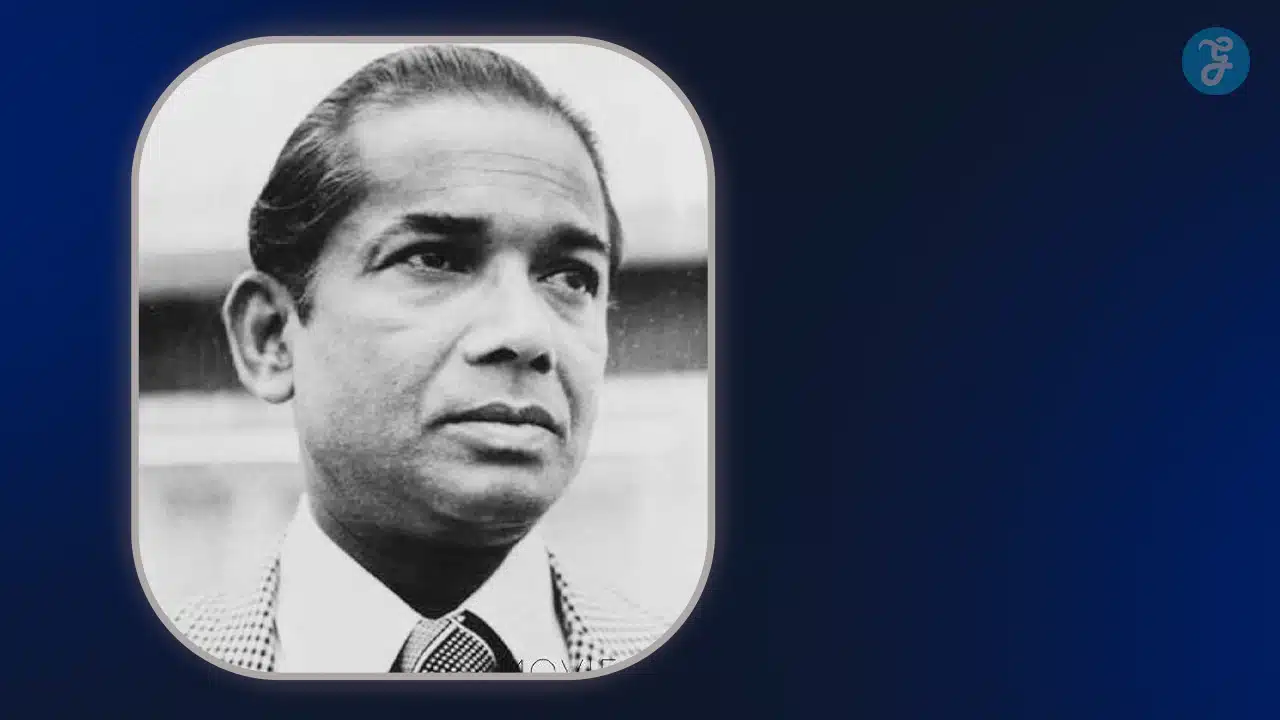
Today marks the death anniversary of Khan Ataur Rahman — one of the most multifaceted and influential figures in the history of Bangladeshi film and music. On this very day in 1997, the lights dimmed on a life defined by unmatched creativity and fearless artistic exploration. Yet even decades later, his work continues to shape Bangladesh’s cultural identity.
Born on December 11, 1928, in the quiet village of Ramkantpur in Singair, Manikganj, Khan Ata grew up far from the world of cinema that he would one day transform. His journey from a rural upbringing to becoming a national cultural treasure shows how passion, resilience, and a refusal to settle for the ordinary can define an entire generation of artistry.
Although his life ended at age 69, his work — spanning music, film, storytelling, and acting — continues to live vibrantly in the hearts of millions.
Early Life and the Courage to Choose the Unknown
Khan Ataur Rahman possessed the kind of talent that could have led him toward any respectable profession. He studied at prestigious institutions including Dhaka Collegiate School, Dhaka College, and later both Dhaka Medical College and the University of Dhaka. He had a promising academic future, but he felt a pull that was much stronger — the magnetic world of film.
Walking away from a conventional life was not easy. In 1949, driven by an overwhelming love for cinema, he left home and travelled to India. Without financial stability or support, he walked the unfamiliar streets of Mumbai, a city full of possibilities but also hardships. He spent nights on footpaths, survived through odd jobs, and absorbed everything he could from the film environment around him.
Eventually he found work as a cameraman’s assistant, which became the first real connection to the industry he dreamed of joining. His time in Mumbai and later in several cities across Pakistan, the United Kingdom, and the Netherlands exposed him to global artistic practices, theatre, and filmmaking techniques. These experiences broadened his vision and matured his understanding of storytelling and visual expression.
During his stay in London, he also worked alongside the legendary artist SM Sultan — an experience that nurtured his artistic depth and enriched his understanding of creative disciplines outside film.
Return to Dhaka and the Beginning of a Remarkable Career
Khan Ata returned to Dhaka in 1957 with a world of experience and a heart full of artistic ambition. He initially worked for the Pakistan Observer, but cinema continued to call to him — and soon he answered.
He became involved with the film Jago Hua Savera, directed by Jung Kardar. This project marked his formal entry into the world of filmmaking. The following year, he appeared in Desh Tomar Amar, where he not only acted but also debuted as a lyricist, music director, and composer. This rare combination of roles revealed the depth of his talent and hinted at the extraordinary career ahead.
From then on, he established himself as a creative force who refused to fit into a single label. Actor, director, writer, composer, lyricist — he embraced every role with equal dedication and mastery.
A Versatile Genius: Actor, Music Director, Lyricist, and Storyteller
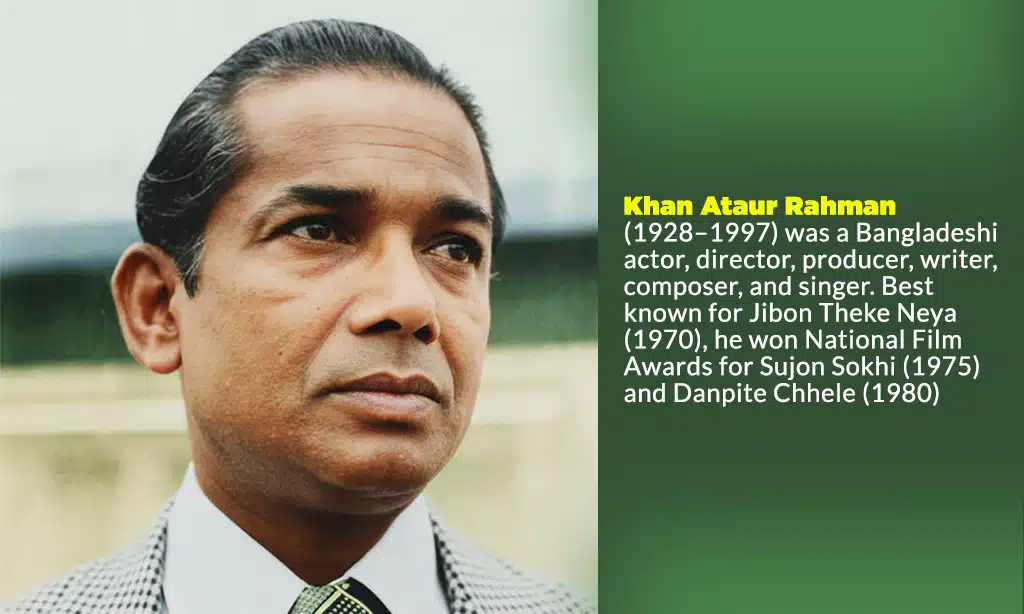
Throughout his decades-long career, Khan Ata earned a reputation as one of Bangladesh’s finest creative minds. His contributions spanned nearly every corner of the film world.
As an actor, he appeared in numerous films that are now considered classics. Some of the most notable among them include:
- Kabhi Asni
- Glass Wall
- Gold Flower
- Surjo Snan
- Nawab Sirajuddaula
- Jowar Bhata
- Apan Por
- Triratna
- Sujan Sakhi
- Mati Maya
His screen presence was natural and powerful, and he captured emotions with a grace that few could match.
As a lyricist and composer, he left behind more than five hundred songs, many of which are now cultural treasures. Songs like “A Ki Sonar Aloy,” “A Kage Bhangbo Kemon Kore,” and the emotionally stirring pieces from Ek Nadi Rokto Periye continue to be sung, remembered, and cherished.
As a film director, he debuted with Anek Diner Chena in 1963. This began a new era in his career — one that demonstrated his ability to manage complex narratives, visual storytelling, and emotional depth with remarkable skill. His directed works include:
- Raja Sannyasi
- Abar Tora Manush Ho
- Din Jai Kotha Thake
- Arshinagar
His final film as a producer was Ekhono Onek Raat, completed shortly before his death in 1997. He had fixed its release date for December 12 of that year — a dream he could not witness himself.
A Lasting Legacy That Defines Bangladesh’s Creative Identity
Calling Khan Ataur Rahman a filmmaker or composer understates the magnitude of his contribution. He is remembered as:
- A cultural architect
- A pioneer of the modern Bangladeshi film identity
- A master of multi-genre storytelling
- A mentor and inspiration to countless artists
His work shaped the Golden Age of Bangladeshi cinema, influenced music trends for decades, and continues to guide film and theatre practitioners even today. His children — Rumana Islam and Agun — followed his footsteps into music, carrying his legacy forward into a new generation.
Even though he died before seeing the final release of his last film, his entire cinematic journey stands as a timeless testament to determination and creative excellence.
Why Khan Ataur Rahman Will Live for Ages
Khan Ata’s life is a powerful reminder that true artistry cannot be contained by a single role or a single era. His films continue to be watched, his songs are still sung, and his name remains an essential chapter in Bangladesh’s cultural history.
He lived only 69 years on this earth, but his creative spirit, his courage to chase his dreams, and his unforgettable contributions ensure that he will live forever in the country’s film and music industry. Generations to come will continue to discover his talent, learn from his work, and draw inspiration from the man whose life was defined by relentless creativity.
Khan Ataur Rahman may have left this world in 1997, but his legacy will continue to shine — unchanged, undimmed, and eternal.